
Random Thoughts
It was a while ago that I first spoke with the folks at Cult Pens. At the time I was desperate for some special ink colours, and I was delighted to learn that I could buy them from a company based not far from my house. Tiverton has always had a special importance for me, because my wife and I were married there rather more years ago than I care to remember now.
Later, I had the great good fortune to discover the Perfect Pencil from Faber Castell, and again, I was able to turn to Cult Pens to buy it. Since then I have purchased fibre-tipped pens, inks, paper, pencils, highlighters, and everything else in terms of stationery.

A few of my notepads. I think I need to rationalise!
But a while ago it occurred to me that it would be interesting to write blogs with a company like Cult. I thought that explaining how writers work could be useful and interesting. After all, most people know what authors are like, don’t they?
An author is a bone-idle character who finds it impossible to hold down a real job. Instead, the novelist scratches himself awake at some unGodly hour of the day, probably about ten o’clock, and performs the necessary calisthenics of his exercise regime by reaching for the packet of cigarettes and bump-starting his lungs. Then he performs the obvious necessary routines in the toilet, peering blearily at the reddened eyes that tell of an exciting evening during which certain activities may, thankfully, remain exceedingly hazy. Having gargled and splashed a little water about the place, he wanders downstairs, and for two hours, on a strict diet of cigarettes and coffee, he writes. Two hours of intense concentration and effort, you understand. He may cover almost two pages before being forced to answer the phone. Naturally it will be his agent or his editor, asking him to attend a thrilling lunch party for a new author. Or something. And so off he goes. It’s essential networking, after all.
And of course this fictional author is a multi-millionaire.
You will, I hope, note that word “fictional”.
There are authors who have large fortunes. Some best-sellers will earn a half a million a year without breaking a sweat. But the vast majority of all authors are lucky to hit the national average wage. They struggle to juggle basic essential bills against an income that remains a mystery until that wonderful day when royalty advices come through the post.
But royalties are odd. They are paid regularly – every six months. For the rest of the year the author has to carefully hoard and scrimp and save wherever he can. He may see books appear in the shops, but it will be up to nine months before he will see any money. The publishing industry is set up to pay their main creative talents every six months, but only after a further three months have passed. So authors will earn their money for all the sales from January to June in March or April the following year. July to December sales are paid to the author in September or October the following year.
That may not sound too bad – but of course it’s all rather late for the work put in.
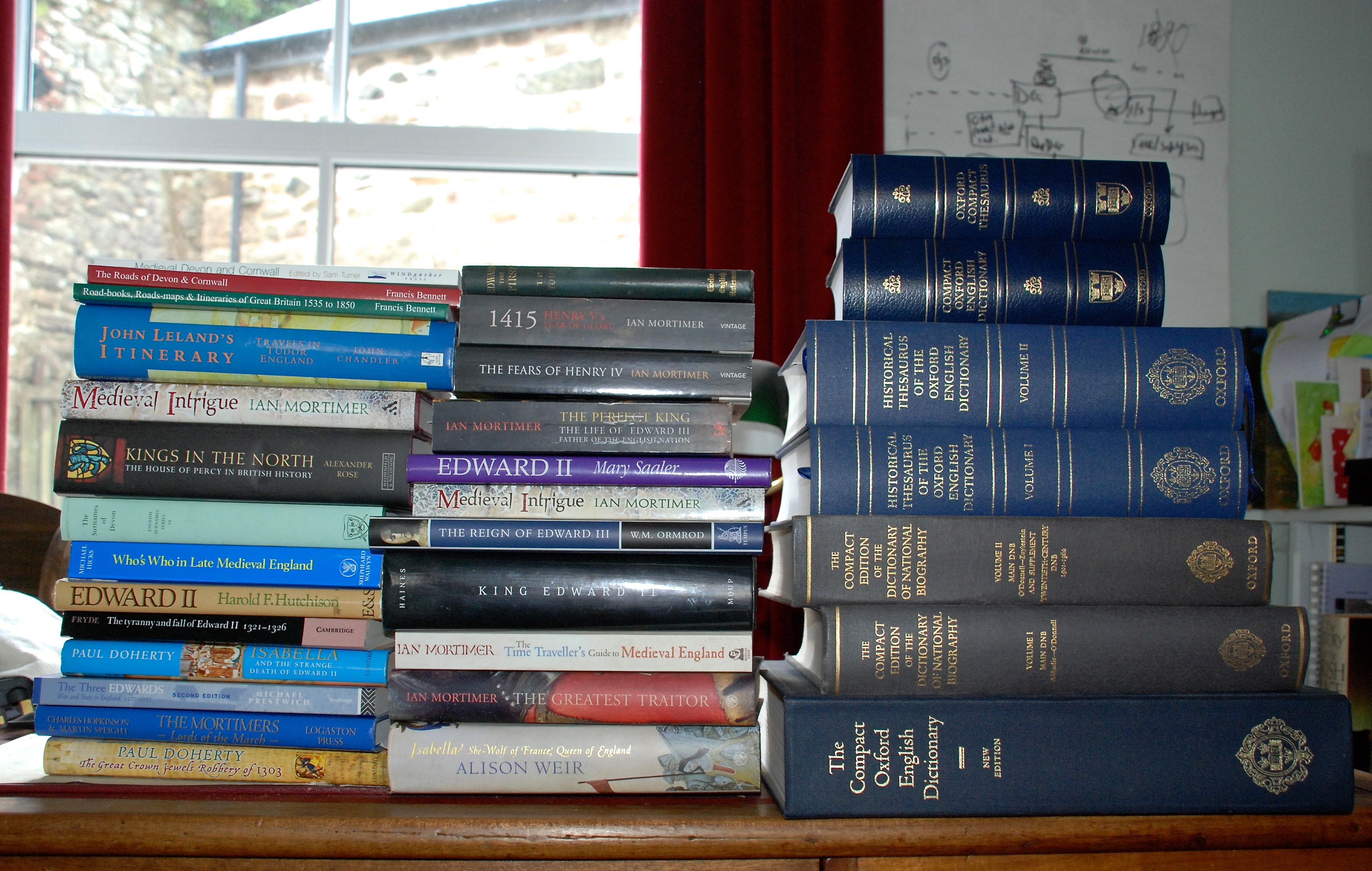
A little holiday reading. My basic research.
For example, take my first book. I wrote that in early 1984, and it was published in 1985. I was paid an advance (which wasn’t bad for a new author at the time) of £3,000 in the middle of the year. Not all that money came through, though. An author is paid rather like a builder, with stage-payments. So I was paid one third for signing the contract, and I was to receive a second third on hardback publication, and the final sum when the paperback was on sale.
Let’s look at that. It means I earned £1,000 in 1984. In 1985 I earned £1,000 in March when my book came out in hardback, and another £1,000 in November. But this wasn’t real money. It was “advances”, which are an interest free loan against expected royalties. That means that when the books start to sell, the income from them has to first pay back the advances loaned by the publisher. So although I earned the advances, I knew I wouldn’t earn more from that book until there had been enough sales to pay off the £3,000. And when I had, say six months after the publication of the paperback, it would be a while before I would receive my money. Six months after launch would mean May in 1986, so I would receive my first money in November of that year. Except I knew full well that it would be more likely to be the following six months before I started earning money, so it would be March 1987. And so it came to pass.
Life then was tough. It’s a great deal harder today for authors trying to set out on a career writing. The money is much worse, for a start. In the 1980s and 90s, authors were paid based on the cover price of the book (which meant about 47 pence per paperback). Now, with discounting rampant, authors are allowed a percentage of receipts to the publisher, which means income can be as low as 6 pence – or even 7.
Authors tend to work long hours. They work from home, and drive partners and families potty by remaining in a bemused state for weeks at a time, living other lives and imagining experiences that would usually lead to demands for the men in white coats to come and measure them up for coats that button at the back but, in truth, while it’s a ridiculous way to try to earn a living, and it certainly is not profitable except for a tiny minority of writers, it’s still a marvellous existence for a group of people who are irrepressible, enthusiastic, keen, and pathologically incapable of being employed.
People like me, really.
And so I write. However, because I write a lot of fiction all the time, I do find it hard to keep up with blogs like this. I’m trying, ye Gods, am I ever, to keep up to date with this, but it’s not easy. And so, with the sponsorship of Cult Pens (You see? I did mention them for a reason), I am writing a diary blog over at http://www.cultpens.com/blog/ – look up on the bar and you’ll see my blog piece.
The idea is, that I’ll be explaining what I’ve been getting up to. After all, I’m now the author of the longest running series by a living author (so I’m told), and the 32nd title, TEMPLAR’S ACRE, will be a massive event, winning prizes and praise all over the place from 6th June. Seriously, it’s been wonderfully reviewed by my peers, and I have very high hopes for it. Simon and Schuster are sending me on signing tours all over the place, and to celebrate the new book, they will be relaunching the first three Templar books on the same day as ACRE, and the next three in the series in July, and a further three in August – and so on. You get the drift.
So, with major launches, signing tours, talks, literary festivals and the rest of it, there will be lots to write about.
And those very nice folks at Cult Pens have given me a pen, ink and paper in order to get it all down.

Here are The Leper’s Return, Squire Throwleigh’s Heir and The Abbot’s Gibbet. All proofed and ready to republish.
Meanwhile, I have to get cracking with my social media campaign. By which I mean, try to figure out what the hell I am doing!
Tagged: author, blogs, books, crime writing, marketing, novelist, publishing, Templar series, writing


 newest »
 This really made me laugh....I'm a new author and I imagine my first royalty cheque for considerably less than £1 might be with me by the time I'm 85. But seriously I have bought practically all your books so maybe some of this money might have overcome all obstacles and allowed you a decent bottle for christmas..!!!! Good luck with the blog....see if your new pen can be cloned and given to me so that some of your skill might rub off on me??


