
Mind Mapping: Kicking Creativity Block in the Backside
 We’ve all been there; it’s one o’clock in the morning and we’ve been staring at the computer screen now for three hours and the view hasn’t changed. Just that big white rectangle with your name and address in the top left corner and the words Untitled centered about a third of the way down the page. You want to start writing, but you have no idea where to go.
Or maybe it’s even worse. Maybe you’re halfway through your novel and things were going great up until a week or so ago; you were making incredible progress. And then, everything just ground to a halt as you crept up onto that midway point that a lot of authors like to call the “muddle in the middle” (if you are having problems with the “muddle in the middle” see my previous posts on the Hero’s Journey where I describe a solution to this… my take on the journey has no muddle in the middle. Instead, there is a midpoint Climax, giving you a goal to write to and away from).
Or maybe you have just plumb run out of original ideas and you need something more. Everything you’re coming up with right now feels old and staid and stereotyped, as though you’ve seen it a thousand times.
Well, the solution might just lie in mind mapping. What is mind mapping? It’s a relatively recent technique in radical thought development that allows you to free associate things very quickly. It does this by structurally laying out the information in a linear fashion where connections are formed between similar ideas. Because of the way the information in a mind map is stored, it is also a good method to store your notes from your research you do for your next novel.
A Google search on the web will uncover many mind mapping software products available, most for around a price of $200, but there are two that worth mentioning that are free. One is freemind (http://freemind.sourceforge.net/wiki/index.php) and the other is freeplane (http://freeplane.sourceforge.net/wiki/index/php). Freeplane seems to be an offshoot from freemind and has a few more bells and whistles, making it the better choice, I believe, although both programs seem pretty solid and are compatible with each other, so feel free to try them both out.
You don’t need a computer program to mind map, though. You can do it the old fashioned way, with just a paper and a pen. Actually, different colored pens will come in handy if you have access to them. Mind maps are unique in that, when they are finished, they can almost resemble works of art.
The way you go about creating one is like this. First you come up with your initial idea. It doesn’t have to be an incredibly great idea, just an idea you want to run with. For instance, this morning, while testing out the software programs I just described, I tried this procedure using the idea “Train.” So you write down the word “Train” in the center of your paper and circle it. This is your root idea.
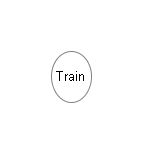
Now, as quickly as you can, you free associate any words that come to you based on the word “train.” It doesn’t matter if they don’t really seem to have any connection to a train at all. Just write them down. In my case, the next word I thought of was “robbery”. So I wrote down “robbery” beside “train,” circled it, and drew a line between them. Now you free associate words with “robbery”. I came up with “bank,” then “cowboys,” then “hoodlum.”
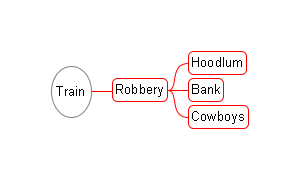
Notice how some of the words connect better with different root words in my map? Just connect the ones you feel have the strongest connection. Keep brainstorming. Keep “train ” in mind. For some reason, “train” brought up “rain” for me, so I started a new set of child nodes that connected to “train” that included mountains, which brought Switzerland to mind.
Soon this was what my mind map looked like:
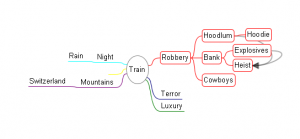
Now this isn’t necessarily finished. A mind map isn’t necessarily ever finished. It’s finished when you feel you’ve exhausted all usable free associated words that are going to help you kick start your imagination into gear. Usually, you’ll feel when you reach the point where the map starts working. At first, putting down words will be a struggle. Then, about fifteen minutes into the process, the floodgates open, and the words pour out faster than you can get them down. This is actually a very small mind map I made for demonstration purposes only. I could’ve kept going for another 30 words in about five more minutes at the point where I stopped.
While you are putting down words, you can reorganize the ones you have on the page, grouping like words together and connecting them interdependently of their child nodes or their parent nodes. For instance, in my graph, “explosives” and “heist” are connected to “bank” but they’re also connected to “hoodlum.” This is where your different colored pens come in handy. With the software programs, you can automatically make every node a different color if you like or create “clouds” of nodes—bunches of nodes tied together by a surrounding cloud rendered any of a few different ways.
So what do you do once you’re satisfied you have exhausted your mind of everything you can think of to do with your initial idea and all avenues leading off of it? You sit back, and start looking at the overall connections and how they lump together. Your mind has probably already started to see the problem in a different way. This is the power of mind maps; they make you think from different angles.
For instance, a story idea that immediately sprung to mind from my mind map was that a luxury train full of high ranking royalty travelling through the Swiss Alps falls victim to a good ol’ fashioned train robbery. Perhaps one of the royals onboard the train has in her possession a piece of priceless jewelry. Since the perpetrators are dressed as cowboys, the victims onboard believe, at first, that it’s part of some sort of theatrical period piece. Meanwhile, in another part of the city, a major bank falls victim to a terrorist attack designed to look like a heist but is really just an act to distract everyone from the train robbery and keep the police busy. The attack on the train happens on a rainy night up in the mountains.
Okay, it’s not the greatest idea, but it’s an idea I didn’t have before I started and I literally spent ten minutes generating it. And I didn’t spend any time conceiving my original idea, “train.” I just picked the first word that popped into my head. You, of course, would pick your very special idea that was near and dear to your heart.
One last thing. You want to keep the ideas on the mind map simple. Don’t write down sentences. Try to keep it to single words, if at all possible. If you can’t, make the phrases as short and concise as possible. Do use symbols and pictures if those help you. Don’t forget to use colors. These all appeal to different parts of the imagination and will be of aid in generating ideas.
The main thing, though, is don’t take the process too seriously. Have fun with it. Whether you do it on paper or with one of the computer programs I described above, mind mapping is entertaining and enjoyable.
It definitely beats staring at that white screen of death on your computer monitor until one in the morning. Let me tell you that.
Michael out.


Michael Hiebert's Blog

- Michael Hiebert's profile
- 99 followers

