
How Do You Write?
Everyone seems to have a different approach when it comes to that first blank page. I wanted to take a survey and find out who does what to overcome that initial barrier to getting your story idea kick-started.
Me? I’m a three-act structure guy, which means I can’t write a story until I know a few things about it first (which can be really annoying at times). Take a look at the following picture I butchered up in photoshop:
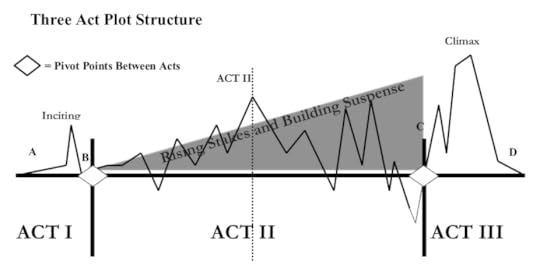
The diamonds indicate anchor points for Act I/Act II and Act II/Act III. I’m almost sure I stole this title for them from Syd Field, the author of Screenplay.
Other than the diamonds, the rest of it should look fairly familiar. Act I has a setup (which I’ve labelled A), followed by an inciting event (which is the big spike on the graph). Then there’s that time between the inciting event and crossing the the threshold into Act II, which is generally the “bargaining phase”. This is where reluctant heroes try to back out, or threshold guardians do their thing and try to keep the protagonist from getting anywhere.
But sooner or later, the main character makes it to Act II where he hits the first anchor point. This is an important point, because it’s the first real place in the story where there’s a definite change in the character. It might not be obvious to the other characters in the story (or even the protagonist himself), but something clicked inside him that set him off on adventure. And once he crosses the gateway into Act II, there’s no turning back.
The same thing happens at the next anchor point, only it’s way more extreme. By the time the character has made it through Act II (which is the longest act in the book and completely full of challenges and struggles), he’s basically had the $%#t knocked out of him. In fact, there’s a point, right before entering Act III where the protagonist experiences a death of sorts; not necessarily a physical death (although it can be), but more a metaphorical one. He’s done. He can’t go on.
This leads him to the second pivot point where he’s no longer even recognizable as the same person who started the story way back on page one. No, three hundred odd pages have had their toll on him. It’s not until he passes the boundary into Act III (marked C in my picture) and the subplots combine that he discovers a potential way out of this whole mess. That discovery leads to a single ray of hope that builds to a mustering of strength that takes him into the climax where he either saves the day or loses everything.
Of course, the climax is the resolution of the story. It can either be positive (yaay, he won), negative (boo, sniff, he lost), or ironic (he lost, but in losing he actually gained something he hadn’t considered until finding it).
Then there’s the denouement (which I’ve labelled D), but that’s really just a wrapping up of any loose threads, so, for this discussion it’s not important.
There are definite advantages and disadvantages in my using this structure to write my books. The disadvantage is that I really can’t start the story until I know, at the very least, the inciting event and the resolution of the story. Preferably, I’d like to know the entire climax.
In a perfect world, I would like to know all that and where the character will be at both pivot points. If I know all four of those things, writing with a structure like this is a dream, because you can literally just forget about story construction and write.
I like to outline as I go, so I will (once I know the above items) begin writing my book and just outline ahead of wherever I happen to be. Sometimes I even jump around. The beauty of following a structure like this is that you aren’t tied down to writing linearly at all.
That, in a nutshell, is how I do it. I actually have a much more complicated version of this that I use for a seminar that I give on writing, but I figured nobody on here needed to sit through anything longer than this 
So, tell me, how do YOU do it? I’m really interested in learning other author’s techniques.
Until then,
Michael Out.


Michael Hiebert's Blog

- Michael Hiebert's profile
- 99 followers

