Indie Publishers Partner with Amazon, Changing Face of Publishing
by G G Collins
Indie Publishers Fire First Shot
Public Domain Image
There is a revolution going on and it’s changing the world of book publishing. Indie publishers are uniting and uploading their books to the Amazon machine. The days of a half-dozen huge New York book publishers making all the decisions on what the public will read is coming to an end. What has led us to this threshold? Of course technology is part of it, but traditional publishers are partly to blame. Is it a good change or not? Probably both, but like other revolutions, it is a sea change, a wave that cannot be turned back.
Putting Aside Perceptions
The first day I walked into a book publisher as a new employee, I thought that writers (authors after you write a book) would be revered. I would soon know differently as one after another, my beliefs would topple. There was no reverence for the hard work, sweat, tears and talents of writers.
Your book may be your “baby,” but to a publisher, books are merely widgets, products; they either move out of the warehouse and rack up sales, or accumulate dust until the publisher sends them to remainder land.
It became apparent in an office stacked with manuscripts, that writers were a necessary evil and mostly ignored. When a publisher deigns to accept your work and transforms it into a paper book, the promotions department will most likely send out a handful of galleys (now, more often digital) to review media such as Publishers Weekly, The New York Times, Kirkus, Library Journal and Booklist. After publication another few copies would be sent to the author’s local newspaper (if still in operation) and a few appropriate specialty review markets.
Our book house was listed in trade publications as accepting queries and manuscripts. Despite this, there came a time when the reams of paper threatened to push us out of the office, the word would come from on high: “Send them all back. If they haven’t included an SASE, trash it.” We didn’t read or evaluate a single query or manuscript. We did include a much copied “rejection” letter explaining it just wasn’t right for our list. This after the writer paid postage both ways and copy costs.
Fed Up
Today, many publishers accept email queries, but instead of a rejection email, writers are virtually ignored. Once after giving an editor an exclusive submission and waiting three months without a word, I sent a follow-up email asking politely if she had received it (email can be lost forever in cyberspace), I received a blast from her that said in effect: Don’t call me, if I’m interested, I’ll call you! Ouch. While I admit there is a wasteland of discourtesy everywhere (including some writers), can’t we stretch the boundaries of decorum enough to be, if not kind, at least not venomous?
After I entered into a business relationship with a literary agent–her telling me this would be my “breakout” book–I thought I was on the road to publication. But again, a few months passed and I received my manuscript via mail. In it, a note was scratched: “This hasn’t gotten the attention from my office it deserved.” That’s it. At least she was honest.
These are the “good ol’ days” of book publishing. Where writers earned about $2 on their book, priced at $20 retail. In these days of tree-dependent books, many publishers outsourced the printing of the books to other countries to save greenbacks.
New Kid in Town
So along comes a little start-up called Amazon that dared to discount books while the bricks-and-mortar bookstores continued to sell at suggested retail. The company was established in 1994 and went online as amazon.com a year later. While founder Jeff Bezos didn’t expect an immediate profit, investors were antsy at the lack of return. But in late 2001, Amazon had its first profitable quarter. And the rest is history.
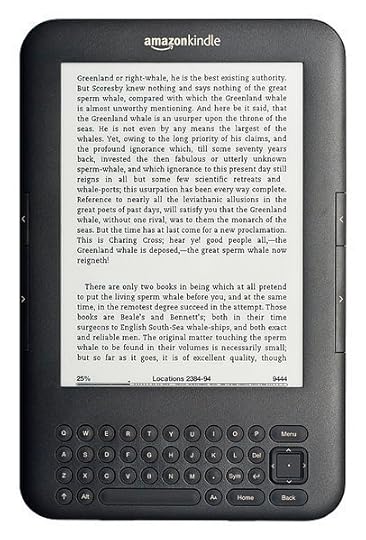
Amazon’s Kindle
GNU FDL
NotFromUtrecht
During my tenure with publishers of books, newspapers and magazines there began a faint rumble in the distance skies. People were beginning to talk about a book you would read on a computer. I imagined sitting on a beach, holding a laptop while trying to read through the glare of the sun. But then, Amazon Kindle made its debut. It is now in its fourth incarnation, the Fire. What followed was a surge in tree-free eBooks. Amazon Kindle books out-sell paper and cloth combined.