Getting my ya-yas out
I don’t understand young-adult (YA) fiction.
I mean, I used to think I did. YA fiction was fiction written for young adults – or teenagers, as we used to call them back in my day. Stories about teenagers, for teenagers, at a teenage reading level. That makes sense, right?
But the eager degree to which less-young adults swoop up and devour YA fiction shows that it’s not as simple as all that. Books like The Hunger Games and Twilight have many, many adult readers, from those in their 20s to those in their 50s. These are stories that resonate with adults, even if adults perhaps do not read them for the same purposes as teenagers – or maybe they do, I don’t know. Look at the way Twilight got snapped up by adult readers, its sexual elements strengthened and made more overt via fanfic, to finally transmogrify into Fifty Shades of Grey and have its pages filled with boners rather than sparkle-vampires while still retaining much of the characterisation and language level of the original. (Or so I assume, anyway, which probably means I’m making an ass of myself, so feel free to correct me.) That suggests that there’s something in those stories (or perhaps the writing approach of those stories) that speaks to adults, and they’ll take those stories and make them theirs by whatever means necessary, often by adding a whole bunch of fucking.
So anyway, many adults read YA fiction and enjoy it. But not me. I read YA books when I was a teenager, but these days I’m in my 40s and pretty much only read adult-adult books. The few times I’ve accidentally started a YA book in the last decade or so, I’ve quickly stopped when I realised that this wasn’t a story that resonated with me. That’s not a judgement on my part… okay, let’s be honest, it probably is a judgement and me looking down on YA books. Because I can be a lit-snob sometimes, even though I try to fight that urge.
But I’m trying to change that, because right now I’m trying to write a YA book, Raven’s Blood. Or, more accurately, what I think might be a YA book. Because, as noted, I don’t read YA and don’t get it. But I think this story might fit nicely into that category, and I’d like to see what working within those genre boundaries is like – which is why I’d like to work out what those boundaries are.
And I think I need some help with that.
So this is not a post where I sit you all down and educate you on what YA really means. This is a post where I hold things up, say ‘Is this it? What about this?’ and hope that you (the collective you) tells me what you think and whether I’m right – or, more importantly, where I’m wrong. Because I mostly learn by getting things wrong.
(I could probably also learn by reading some YA fiction, and I will do that at some point, but I like to get a grounding in theory before moving into practice. Which probably explains why it took so long for me to get a girlfriend in my teens. But I digress.)
This is what I think about when I hear ‘young adult’:
Characters
A protagonist that is a teenager, first and foremost, probably around the 17-18 mark. Obviously that varies down a bit (early Harry Potter) and up a little (late Twilight), but nonetheless YA books are almost always about young adults. (Although books about young adults aren’t necessarily YA, of course.) And this makes sense, because the assumed audience want to read about characters that they can personally identify with, characters their own age and with similar problems – making sense of the world, finding love, coping with the fact that their parents are STUPID.
 Similarly, the antagonists should be similar to the enemies of teenagers – parents, authority figures, the forces of the adult world that try to dictate and reshape their lives before they’re fully-formed. They don’t have to specifically be those people, but they should fill a similar role. Alternatively, the other great enemy of teenagers is always other teenagers, who chip away at their identity and self-image from the other side and occasionally pants you in front of the class. Adults tell you what you should be; teenagers tell you what you shouldn’t be. Both are there to be overcome, possibly with lightning bolts.
Plot and themes
Does ‘coming-of-age story’ make me sound like Cranky Grandpa? Because that’s honestly what I figure most YA stories have – what they should have – at the core of their plots. They should reflect the lives and concerns of teenagers – the quest for identity, the need to love and be loved, the lure of booze and drugs and internet porn, and pretty much everyone in the world trying to tell you what to do and who to be.
Sometimes those concerns are presented as is; other times they’re reflected through genre tropes, so that there are vampires and aliens and spy agencies and killer bears and all of them are trying to boss you around and stop you from seeing that girl you like. Using genre like this is fun and makes for an engaging story, but can also let you use tropes as metaphors for the sturm und drang of teenage life. From that POV, it makes sense that so many YA stories are dystopias – growing up is always about inheriting the world that older people already fucked up.
And at the end of the story, the teenage protagonist should be that bit closer to adulthood – an adulthood hopefully defined on their terms, rather than just their parents’ or society’s terms. Unless it’s one of those books with a really bummer ending.
Prose style
Look, this is the point where people are going to tell me I’m an arsehole, because my first thought when I hear ‘YA’ is ‘unsophisticated writing style’.
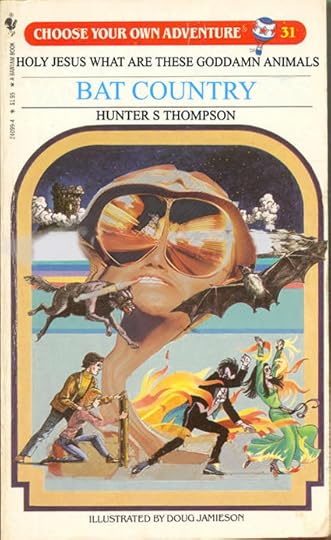
Not, I want to be clear, an unpolished or poorly-written style – just one that is pitched at a teenage reading level. A style that primarily promotes an accessibility of voice and language, that clearly describes the appearance of people and places in mentally-reproducible details, that presents the characters and story and then gets out of the way. It is not the kind of thing we get from Don deLillo or Milorad Pavic, is what I’m saying. (Although now I’m wondering how you could use Pavic’s ergodic approach on YA fiction – like a longer, more complex Choose Your Own Adventure story. Hmm.)
 This is certainly the bit where I struggle with YA, because I like my prose to be interesting in and of itself, as both writer and reader. I don’t much like transparent writing; I like stunt-writing that shows off its tricks and puts technique in the spotlight, which is not what I think YA is about.
And this is where I draw my line in the sand between the two books I’m writing right now, Arcadia and Raven’s Blood. Both are about young women trying to define themselves and their place in the world, but they have very different prose styles. Arcadia is all about exploring voice, the use of nested narratives, drawing story from structure – all that kind of high-falutin’ stuff that is probably going to alienate or irritate a lot of adult readers, let alone teenagers. Raven’s Blood, meanwhile, is where I’m trying to write in a clear, straightforward style (with occasional dips into moderate ornament), and that’s why I think that it could be considered YA and why it’s worthwhile trying to write more towards that genre and that market. Once, you know, I actually understand it.
–
So these are the elements I think of when I think about YA fiction. Am I right or wrong? How would you define the genre – or would you even bother? Most of all, if you’re a YA reader – why do you read it, and what about it speaks to you? If any of what I’ve written is correct, why do those elements appeal to you as an adult reader?
Get in there and leave comments, people – I’d really appreciate it.
(Seriously, comment. I don’t get enough comments, and it leaves me feeling like I’m typing into a void and that the world is empty and the darkness has leaked down from the moon to drown everyone else’s souls and I’m alone SO ALONE if a trees falls onto the blog and nobody comments then my words don’t make a sound.)