
Sanora Babb, author of Whose Names are Unknown
While living in Southern California during the Great Depression of the 1930s, Sanora Babb (April 21, 1907 – December 31, 2005) learned of the plight of the Dust Bowl migrants.
Babb began working for the Farm Security Administration (FSA), taking detailed, copious notes about the lives of migrants. She aimed to write a novel based on the notes, hoping that it would foster sympathy and understanding for the plight of migrant workers.
Her FSA boss, Tom Collins, introduced Babb to novelist John Steinbeck. Collins asked Babb if she would allow Steinbeck to review her notes. Random House already planned to publish Babb’s “exceptionally fine” novel, but before she finished it, Steinbeck’s Grapes of Wrath (1939) was flying off the shelves.
Random House reneged on Babb’s book deal, claiming that there wasn’t room in the market for two novels about Dust Bowl migrants. It was only many years later that it came to light that Steinbeck used Babb’s notes extensively in writing The Grapes of Wrath. Babb didn’t seem to hold a grudge and went on to lead a singular and exceptional life.
The Early Life of Sanora Babb
Sanora Babb was born in 1907 in the Oklahoma Territory to Walter and Jennie Babb. Though white people settled the town, Red Rock sat in the midst of Otoe–Missouria territory. As she grew up, Sanora was drawn to the Native ways. The loving family unit, kindness, and sharing were in stark contrast to her own volatile home life.
It’s unclear why Sanora Babb’s father called her Cheyenne. But thanks to her later writing, we learn that added Riding Like The Wind to Cheyenne.
Chief Black Hawk enjoyed having little Sanora around. One day, he brought Sanora a pinto pony. After he set her on the pony, a loud noise spooked it, and the pony, with her sitting on its back, ran off. The chief leapt on his own horse and soon caught up with them. Seeing Sanora still secure on the pony’s back, the chief named her “Cheyenne Riding Like The Wind.”
In that one gesture, Chief Black Hawk gave Sanora Babb something that would stabilize her for her entire life: a name. It could be that in naming her Cheyenne Riding Like The Wind, Chief Black Hawk gave a little girl a sense of power she would harness for the rest of her life.
Sanora must have observed the subtleties and powers of the wind; it is almost a character in much of her writing: The way a gentle breeze carries pollen across tall stalks of broomcorn or, in an instant, becomes powerful enough to bend a crop down in long, shimmering rows.
. . . . . . . . . . .
. . . . . . . . . . .
A Dugout in Eastern ColoradoAs a child, Sanora moved around quite a bit. Her father, Walter Babb, was an accomplished baker, but preferred gambling and playing semi-pro baseball to day-to-day labor. He was often gone from home, which left Sanora’s mother, Jennie, to work in the bakery and cover for her husband’s absence.
When Sanora was seven years old and her sister Dorothy five, Walter spent the family’s money on a 320-acre piece of land in Eastern Colorado. The family moved into a dugout with Alonzo Babb, Sanora’s grandfather (whom they called Konkie), with high hopes of becoming successful broomcorn farmers.
At first, Sanora missed her Otoe family, her pony, and town life, but soon grew fond of the wide open sky, with its nighttime glory of stars and big moon. She loved the never-ending plains covered in buffalo grass and ground cacti. In their years on the plains with farms miles and miles apart, Sanora befriended many animals and appreciated the local plant life.
Sanora saw animals as equal to humans, living their lives the same as she was living hers — they had eyes to see, and she could look into them. From horses to chickens, horny toads to prairie dogs, she gave every animal and plant she encountered a place of importance. Every waft of sage or knot of buffalo grass, or honk of a goose, each howl of the wolf or coyote. Every sword-leaf of the yucca plant, and soft fluff of the cottonwood, inspired Sanora’s empathy.
Sanora Babb’s Writing Career Begins
The family came close to starving on several occasions, sometimes drinking red pepper tea to assuage their stomachs. They emerged from the dugout and other bare and rank homesteading attempts on the long prairie to land in Elkhart, Kansas, when Sanora was eleven and her sister nine years old.
Over several years, the girls had only read from either Konkie’s only book (about Kit Carson) or the newspapers glued to the walls of their dugout. Sanora had to study hard to get into a class with students her own age, and she, like the rest of her family, was thin and weak from their privations on the plains. That was when she decided she wanted to be a writer when she grew up, and set things into motion to make it happen.
She stepped into the writing arena with her first English assignment at her new school, an essay entitled How to Handle Men, a piece about women and families, and against the violent oppression her family suffered at the hands of her father.
When Sanora was twelve, the family moved to Forgan, Oklahoma, where she began working for a printer, and then at a newspaper. She wrote plays that her troupe of classmates performed for the town, and discovered her passion for writing short stories.
Sanora graduated from high school as Valedictorian of her class. After earning a teaching certificate, she worked as a school teacher for a year while continuing to submit her poetry and short stories to newspapers and periodicals. The Associated Press dubbed her the “Prairie Verse Writer” and announced her successful poetry contributions in newspapers across the country.
When she left teaching, Sanora attended Garden City Junior College and earned an Associate’s degree. She took a job as a reporter for the Garden City Herald, advancing in this post while gaining national attention as a talented poet.
Relocating to Los Angeles
In 1929, Babb moved from her parents’ volatile home in Kansas to Los Angeles in the hopes of finding work as a journalist. In the aftermath of the stock market crash, newspapers weren’t hiring, so she took work as a secretary at Warner Brothers and as a scriptwriter for the radio station KFWB. When she lost her job at the radio station, she began ghostwriting screenplays.
These jobs allowed her enough spare time to spend at the public library, enriching her reading habits. She continued to publish poetry and short stories in literary magazines across the country. Babb met many fellow writers who also spent their free time at the library.
In 1933, a little magazine entitled The Midland published Babb’s short story, The Old One. Her talent for short fiction was evident; her prose was immersive and evocative. Babb published some work in a socialist magazine, The Anvil; her stories and poems were also published in the Prairie Schooner.
Babb’s professional acquaintances included up-and-coming writers, including Carlos Bulosan, William Saroyan, and John B. Sanford (b. Julian Lawrence Shapiro). Many writers of the time professed to be Marxists and wrote for popular leftist publications such as The Daily Worker, The Anvil, New Masses, and others.
Although Babb was not a political activist per se, she “was attracted to … the idealism of saving the world.” Babb continued to stay true to her vision of exploring the human experiences, writing with a “quiet intensity and brooding beauty which is missing in most of the hard boiled, out house fiction to be found in the average revolutionary (left wing) little magazine.” (Dunkle)
. . . . . . . . . . .
. . . . . . . . . . .
Working for the FSABy the mid-1930s, Dust Bowl migrants were flooding into Los Angeles and the surrounding region. The drought, dust storms, and Great Depression continued to devastate farmers of the hardest-hit panhandle area that encompassed Oklahoma, Kansas, Colorado, New Mexico, and Texas. This forced hungry, tatter-clothed families to go west in search of jobs.
Babb saw an opportunity to help migrant families, something she was already doing in her writing as well as editing of union journals. She also volunteered for the Farm Security Administration, working alongside Tom Collins to set up government camps for migrant workers. During the eight months Babb worked with the FSA, she took copious notes from her interviews with hundreds of families.
She was sometimes joined by her sister Dorothy, who took photographs. They hiked the dirt roads of the Imperial Valley, documenting the living conditions in the camps with the intent of increasing awareness and sympathy. Her experience as a reporter made her adept at taking thorough and useful notes.
. . . . . . . . . . .
. . . . . . . . . . .
The Grapes of Wrath — from Sonora Babb’s NotesIn Riding Like The Wind: the Life of Sanora Babb, Iris Jamahl Dunkle describes a blatant instance of one writer stealing from another in telling how John Steinbeck obtained the material for writing The Grapes of Wrath:
“Little did Babb know that the copy of her field notes she would willingly give Steinbeck would not only inspire him as he began his third and final attempt at writing the Dust Bowl novel, but would also make the publishing of her own novel impossible. As she later reflected, ‘Tom Collins…had asked me to keep detailed notes of our work every day, of the people, things they said, did, suffered, worked. I thought it was for our work, or for him, but it was for Steinbeck’ and ‘Tom asked me to give him my notes. I did. Naive me.’”
The Grapes of Wrath sold 450,000 copies within the first five months of its release in 1939. It won the National Book Award and a Pulitzer Prize. John Ford made it into a film in 1940. The book was a catalyst for bringing the plight of Dust Bowl migrants to the center of American conversation. The book was so popular that when Babb delivered her novel to Random House, although they felt the story was “exceptionally fine,” the publisher explained that the market couldn’t support two Dust Bowl novels.
The publication of Whose Names Are Unknown was canceled, even though it was quite a different novel from Steinbeck’s. The Grapes of Wrath portrayed the migrants — or “Okies” — as poorly mannered and undereducated. Babb’s interpretation, in contrast, presented loving, humane, honest, and steadfast families who lost everything they ever knew to the perfect storm of Dust Bowl and Great Depression conditions.
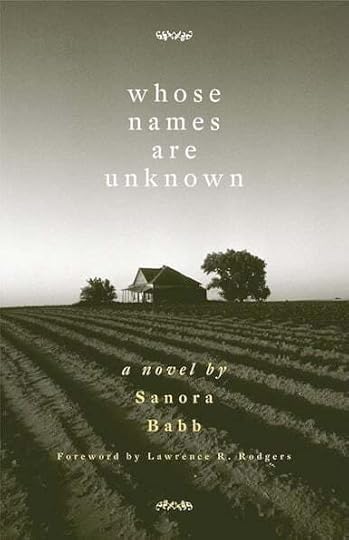
The title Whose Names Are Unknown reflects the eviction notices on the doors of failed farmers. It’s the story of farming families and their neighbors, with all their dreams and aspirations. With Babb’s background as a poet and short story writer, she chose the exact word to captivate hearts and minds. Here is such a scene in chapter seven, when Milt’s longed-for son is stillborn:
The coyotes are liable to dig him up some night, he thought. It made him feel sick. He walked quite a ways beyond the cane into a field that was lying fallow and dug a very deep hole. The earth was dry and hard beneath the moisture from the rain. He got on his knees and put the baby carefully in the hole. He could not resist looking once more. The little boy was curled up, wrinkled and queer-looking as if he had been alive a long time …The puckered face looked unborn and helpless.
Recovering From Her Loss
Although Random House had commissioned her manuscript, now it seemed permanently shelved. Babb worked her way through the disappointment, and returned to writing for newspapers, magazines, and small presses. The Best American Short Stories (1950) published her short story The Wild Flower before it was translated into twenty languages.
She also edited for friends and literary magazines. In the ensuing years, she became friends with Ralph Ellison, and joined a writers group that would gather for forty years. Ray Bradbury was also a regular participant. She and husband James Wong Howe (whom she married in 1937, though the marriage wouldn’t be legally recognized until 1948, when the California Supreme Court overturned the state’s anti-miscegenation laws) owned and operated a star-studded Chinese restaurant in Chinatown. Her sister, Dorothy, was their bookkeeper.
. . . . . . . . . . .
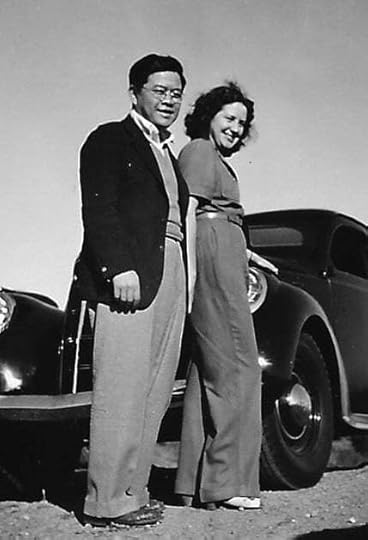
James Wong Howe and Sanora Babb (photo by Dorothy Babb, 1937)
. . . . . . . . . . .
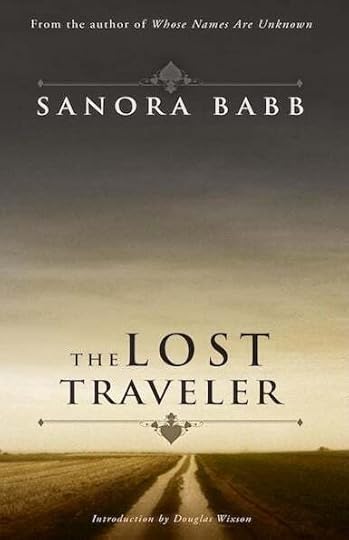
Publication of The Lost TravelerIn March 1958, The Lost Traveler was published in the United States and England. It was the second novel Babb’s had written (the first, of course, was Whose Names are Unknown), but her the first to be published.
With The Lost Traveler, Babb present a strong female character while also telling the story of a gambling father. After many rejections from publishers who preferred a gentler, more acquiescent female and upright father figure, she finally found a publisher who allowed her to tell the story in the way she wanted.
In his syndicated column, Literary Lantern, reviewer Caro Green Russell quotes Babb: “I feel very grateful to my father, who was a professional gambler, because the uncertain life he provided gave me so many and varied experiences from an early age …” and “We rode in wagons, and covered-wagons for trips; lived in a dugout in the ground, went to the creek for water for bathing, tried to farm without rain, and nearly starved.”
The April 14, 1958, Los Angeles Mirror newspaper gave The Lost Traveler a fair review, first a nod to the father in the story, Des, then to the family, and finally to the daughter, Robin. In the review, Bob Campbell wrote, in part:
“Sanora Babb has done a remarkable job of making the hero, Des Tannehill, sympathetic and understandable in spite of his occupation and occasional brutality. In fact, she has made the whole Tannehill family come alive, particularly Robin, the older daughter, the only member of the family with fortitude enough to stand up to her father.”
Babb refused to write complacent women and heroic men into her work to please publishers. Babb wrote about women and children who were too often at the mercy, whims, and fists of men. She committed to her singular goal, akin to Robin (the sixteen-year-old daughter of Des in The Lost Traveler), who tells her father she was alive with purpose:
“Well, I feel so alive I could burst!” She leaped up from the chair and whirled to the door, turning her back on him, pretending to look out, saying passionately, “I feel connected with everything, buffalo grass, meadow larks, lizards, rocks, wind — everything! I feel in tune with the universe!”
A few lines later, Robin tells Des about her feelings and dreams:
“I think they’re like seeds, moving in the ground, bursting with sprouts, ready to grow into beautiful and useful plants. Like wheat or a peach or a rose or even a weed.”
The Lost Traveler is full of rich, vibrant prose. Each word places the curious reader in the middle of the scene, designed to deliver a wealth of lived experiences to the poetic soul.
Throughout her writing career, Babb was quite faithful in looking after Dorothy, who suffered from mental issues. Babb was also painstaking in her care for her husband in a rather traditional fashion, often traveling to film locations all over the world as his career soared. She also continued to help her writer friends whenever they asked anything of her.
Best American Short Stories and an Autobiography
Best American Short Stories (1960) featured The Santa Ana, which first appeared in the Saturday Evening Post. It was described in the press as romantic and beautifully written with a “fine appreciation of the weather on human emotions.” (The Gazette, Cedar Rapids, Iowa, September 18, 1960)
In 1970, Babb published An Owl On Every Post, an autobiographical novel. She carefully altered the names and descriptions of the characters and some of the places. The book took more than ten years to write, but once published, it sold very well.
Babb was gratified to learn that so many people were reading the book, which described her family’s experiences in dry farming on the Great Plains from 1913 to 1917. For several years, Babb presented talks, attended luncheons, and gave interviews about An Owl On Every Post.
. . . . . . . . . . .
. . . . . . . . . . .
Working Through To The Final Days To Get Stories ToldAfter her husband’s death in 1976, Babb dedicated several years to archiving his work. She went on to publish collections of her short stories: The Dark Earth; The Killer Instinct and Other Stories from the Great Depression (1987); Cry of the Tinamou: Stories (1997); and a collection of her poems, Told in the Seed (1998).
Not long after the publication of Whose Names Are Unknown, the extent to which Steinbeck used Babb’s research became known in literary circles. Her field notes, along with photos taken by Dorothy, are collected in a 2007 book, On the Dirty Plate Trail: Remembering the Dust Bowl Refugee Camp, arranged and presented by Douglas Wixson. Ken Burns’ 2012 documentary, The Dust Bowl features Babb and Whose Names Are Unknown.
Sanora Babb passed away in 2005, with a promise from her good friend, Joanne Dearcopp, to keep her works in print for as long as possible. Keeping to her word, Whose Names Are Unknown was finally published in 2006. Readers may prefer it to Steinbeck’s Grapes of Wrath for its humanity, its beauty, and its living, breathing life on the page.
Sources and further readingDunkle, Iris Jamahl, Riding Like the Wind: The Life of Sanora Babb (pp. 100, 173)
“Those Good Old Days: Pioneering in a Soddy” by Jack Conroy. Kansas City Star, December 29, 1970.
Poetry in The Prism magazine and The Northern Light, The Hutchinson News, Friday Sep 30, 1927
https://www.newspapers.com/image/8026170/?match=1&terms=sanora%20babb
https://www.newspapers.com/image/9180...
view clip prairie verse writer https://www.newspapers.com/article/the-gazette-and-daily-poet-of-prairies/177800118/
The Daily Worker, January 26, 1935, page 7.
communist short story: https://www.newspapers.com/image/754603372/?match=1&terms=sanora%20babb
Santa Ana, Saturday Evening Post https://www.newspapers.com/image/524708895/?match=1&terms=sanora%20babb
“Wife of Motion Film Cameraman Writes of Childhood on Plains”
“Short Story Art Growing” (Pittsburgh Post Gazette)
https://www.newspapers.com/image/683092461/?match=1&terms=sanora%20babb
weather, human emotions. https://www.newspapers.com/image/5492...
The post appeared first on Literary Ladies Guide.


