How to Use AI To Maintain a Competitive Advantage (A Strategic Guide)
Remember when having a website was a competitive advantage? Then everyone got one, and suddenly it was just the price of entry.
That’s exactly what’s happening with AI right now. Except it’s moving about 10x faster.
The companies gaining ground aren’t the ones with the fanciest AI tools. They’re the ones who figured out that AI isn’t really about technology at all—it’s about creating compounding advantages that get stronger over time.
Think about it. Your competitor buys the same AI software you do. You both have access to ChatGPT, Claude, and Gemini. So where’s the advantage?
Here’s the thing nobody talks about: how to use AI to maintain a competitive advantage isn’t about the AI itself. It’s about combining AI with the unique assets only you have—your proprietary data, your customer relationships, your team’s expertise.
This guide breaks down exactly how to build that combination. Not theory. Not hype. Just the strategic moves that create lasting separation between you and everyone else in your market.
Starting now.
The Core Differentiator: How to Use AI To Maintain a Competitive Advantage with Proprietary DataHere’s the truth most businesses miss: the AI models themselves aren’t your competitive advantage. ChatGPT, Claude, Gemini—everyone has access to these.
Your competitive edge? It’s the data only you possess. This is how to use AI to maintain a competitive advantage that actually lasts.
Superior Data Analysis and Predictive IntelligenceAI can process datasets that would take human analysts years to comprehend. We’re talking millions of data points across structured databases, unstructured documents, customer emails, and market signals—all analyzed simultaneously.
But here’s where most companies go wrong. They use AI for descriptive analytics—understanding what already happened. That’s table stakes.
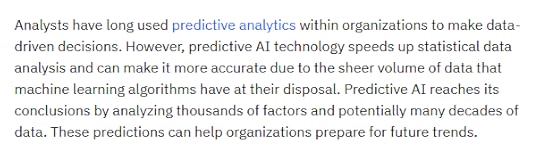
The real competitive advantage comes from predictive analytics. Forecasting market shifts before they occur. Anticipating customer churn before it happens. Predicting supply chain disruptions weeks in advance.
Financial institutions are already using AI for real-time risk assessment, processing thousands of variables to make lending decisions in seconds instead of days. Manufacturing companies use predictive models to forecast equipment failures, scheduling maintenance before costly breakdowns occur.
The question isn’t whether AI can analyze your data better than humans. It can. The question is: are you feeding it the right data to predict what matters most to your business? That’s how to use AI to maintain a competitive advantage in data analysis.
Building the “Data Moat” (The Flywheel Effect)This is where sustainable competitive advantage lives. Think of it as a self-reinforcing cycle that gets stronger over time.
Here’s how it works: More customers use your product → You collect more proprietary data → AI learns from that data to improve your product → Better product attracts more customers → Cycle repeats.
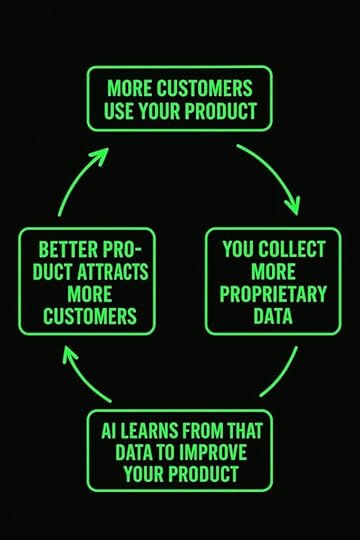
Each cycle makes your AI smarter and your product better. Competitors can’t replicate this because they don’t have your data history. They’re starting from zero while you’re already ten laps ahead.
The strategic move? Blend public LLMs with your proprietary internal data. Use Gemini or Claude for general language understanding, but train models on your customer transaction history, support tickets, internal documents, and operational data.
This combination creates something unique—AI that understands general knowledge but specializes in solving your specific business problems. That’s a moat your competitors can’t easily cross. This is exactly how to use AI to maintain a competitive advantage over the long term.
Operational Excellence: How to Use AI To Maintain a Competitive Advantage Through EfficiencyLet’s talk about immediate wins. These are the AI applications that free up resources and capital you can reinvest into innovation and growth. Understanding how to use AI to maintain a competitive advantage starts with operational excellence.
Hyper-Automation of Repetitive and High-Volume TasksWe’re not talking about basic robotic process automation here. That’s 2015 technology.
Modern AI goes way beyond clicking buttons and filling forms. Generative AI can now draft code, write legal documents, create financial reports, and generate marketing copy—all from simple prompts.
The strategy? Identify processes that are high-volume, repetitive, and rules-based. These deliver the highest ROI for automation.
In HR, AI screens resumes and matches candidates to job requirements in seconds. What used to take recruiters hours per candidate now happens instantly, and often with less bias than human screening.
In finance, AI processes invoices, matches them to purchase orders, flags discrepancies, and even handles basic vendor communications. Finance teams report 50-80% time savings on these tasks.
Check out this table by Centime, which compares manual and modern automateed AP:
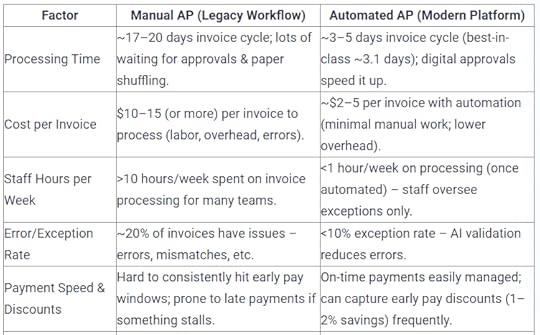
The key insight: automate the mundane so humans can focus on strategic work that actually moves the business forward.
Optimized Supply Chain and Demand ForecastingTraditional demand forecasting uses historical sales data and some basic trend analysis. AI takes it to an entirely different level.
AI algorithms integrate weather patterns, social media trends, economic indicators, competitor pricing, historical sales, and dozens of other variables simultaneously. The result? Demand predictions with accuracy rates that traditional models can’t touch.
For supply chain operations, this means fewer stockouts and less overstock. Both directly impact your bottom line.
Predictive maintenance is another massive opportunity. AI analyzes sensor data from equipment to predict failures before they happen. Manufacturing companies report 25-30% reductions in maintenance costs and 70% fewer unexpected breakdowns.
Here’s the competitive advantage: while your competitors are reacting to supply chain disruptions, you’re anticipating and preventing them. You’re never out of stock when customer demand spikes, while competitors scramble to catch up. This proactive approach shows how to use AI to maintain a competitive advantage in operations.
The Customer Edge: How to Use AI To Maintain a Competitive Advantage in Customer ExperienceCustomer experience is where AI creates the most visible competitive differentiation. It’s what customers actually feel and remember. Learning how to use AI to maintain a competitive advantage in this area separates market leaders from everyone else.
24/7 AI-Powered Customer Service and SupportThe numbers tell the story: AI-powered virtual agents can now handle 80% of routine customer queries without human intervention. That’s millions of interactions resolved instantly, 24/7, in multiple languages.
But here’s what matters more—your human support team gets freed up for complex, high-value problem-solving. The cases that require empathy, creativity, and deep product knowledge. The interactions that turn frustrated customers into loyal advocates.
Modern AI agents aren’t the frustrating chatbots of five years ago. These are context-aware, multi-turn conversation systems powered by generative AI. They understand intent, remember conversation history, and can handle nuanced requests.
The competitive advantage? While customers wait hours or days for your competitors to respond, yours get instant resolution. Response time is now a key differentiator, and AI makes instant the new standard.
Dynamic Personalization and Targeted MarketingNetflix doesn’t just recommend shows you might like. Its AI analyzes when you watch, what you pause, what you skip, and what you binge—then personalizes your entire interface based on those patterns.

Amazon’s recommendation engine drives 35% of total sales. That’s not luck. That’s AI analyzing real-time behavior to offer hyper-personalized product recommendations, pricing, and content at scale.
Here’s the strategic insight: personalization at scale was impossible before AI. You couldn’t manually analyze millions of customer interactions to customize each experience. Now you can.
AI tracks customer behavior in real-time and adapts. Dynamic pricing adjusts based on demand, inventory, and customer willingness to pay. Content recommendations shift based on current context, not just past behavior. Marketing messages personalize down to the individual level.
The result? Higher conversion rates, increased lifetime value, and customers who feel understood. That’s how to use AI to maintain a competitive advantage that your competitors will struggle to match without comparable AI capabilities and data.
Strategic Blueprint: How to Use AI To Maintain a Competitive Advantage Long-TermStrategy matters more than technology. You can have the best AI tools in the world and still fail if your implementation approach is wrong. Here’s how to use AI to maintain a competitive advantage that actually sustains over time.
Developing an AI-First Strategy and RoadmapHere’s where most AI initiatives fail: they’re technology experiments disconnected from core business goals. Someone gets excited about AI, launches a pilot project, maybe gets some results, and then… nothing scales.
AI adoption must be strategic from day one. It needs C-suite alignment, clear business objectives, and a roadmap that builds momentum.
Start with a high-impact, low-effort use case. Your quick win. This proves value, builds internal credibility, and secures buy-in for bigger initiatives.
Define clear KPIs upfront. Time-to-value. Cost savings. Revenue impact. Customer satisfaction scores. Whatever matters most to your business, measure it from the start.
Here’s your implementation sequence:
Identify your quick win – Find a use case with high business impact and low implementation complexityDefine success metrics – Establish KPIs before you start, not afterSecure C-suite alignment – AI initiatives fail without executive sponsorship and cross-functional supportStart small, scale fast – Prove value with a pilot, then rapidly expand to adjacent use casesBuild feedback loops – Continuously measure, learn, and refine your approachThe competitive advantage goes to companies that move fast and scale successfully. Not those with the fanciest AI tech stack.
Talent, Upskilling, and Workflow RedesignAI implementation is fundamentally a change management challenge. Technology is the easy part. People and processes are where implementations succeed or fail.
You need AI fluency across your organization. Not everyone needs to be a data scientist, but everyone needs to understand what AI can do, when to use it, and how to work alongside it effectively.
Here’s the critical mistake: adding AI to existing broken processes. If your current workflow is inefficient, automating it with AI just makes you inefficiently automated.
Instead, redesign workflows around AI capabilities. Ask: “If we could do this instantly with AI, how would we restructure the entire process?” Often, the answer is radically different from your current approach.
Train teams not just on AI tools, but on AI-assisted decision-making. When to trust AI outputs. When to question them. How to combine AI insights with human judgment for better outcomes than either could achieve alone.
The competitive advantage? While competitors struggle with AI adoption and resistance, your team embraces AI as a force multiplier. They’re more productive, more strategic, and deliver better results.
Governance, Ethics, and Risk Management (The Trust Factor)Let’s address the elephant in the room: AI can be wrong, biased, and potentially harmful if deployed without proper safeguards.
Your competitive advantage depends on trust. One AI-driven mistake that goes viral can damage your brand for years.
Key risks you must actively manage:
Inaccuracy and hallucinations – AI confidently generates wrong information. Always implement human review for high-stakes decisions.
Bias and discrimination – AI models can perpetuate or amplify existing biases in training data. Regularly audit outputs for fairness across demographics.
Data privacy and security – AI systems process sensitive data. Ensure compliance with regulations and implement robust data protection.
Intellectual property concerns – AI-generated content can inadvertently reproduce copyrighted material. Establish clear guidelines for AI use in creative work.
The solution? Human-in-the-loop systems. AI augments human decision-making but doesn’t replace human judgment entirely, especially in customer-facing applications.
Transparency matters too. When AI drives decisions that impact customers, be clear about it. Explain how AI is used and provide paths for human escalation.
Companies that build trusted AI systems—ones that are accurate, fair, transparent, and accountable—will win customer loyalty and regulatory approval. Those that don’t will face backlash, legal challenges, and lost trust.
FAQs: How to Use AI To Maintain a Competitive AdvantageWhat’s the biggest mistake companies make when trying to use AI for competitive advantage?Adding AI to broken processes instead of redesigning workflows around AI capabilities. If your current process is inefficient, automating it with AI just makes you inefficiently automated. The winners redesign from scratch, asking “If AI could do this instantly, how would we restructure everything?”
How long does it take to see ROI from AI implementation?Quick wins can deliver ROI in 30-90 days if you start with high-impact, low-effort use cases. The data moat and sustainable competitive advantages take 12-24 months to build. Start with automation wins that show immediate cost savings, then layer in strategic initiatives that compound over time.
Do I need a data science team to maintain a competitive advantage with AI?No. You need AI fluency across your organization, not a room full of PhD data scientists. Focus on upskilling existing teams to work alongside AI effectively. Many competitive advantages come from combining off-the-shelf AI tools with your proprietary data and domain expertise—not building custom models from scratch.
Ready to Gain Your Competitive Advantage with AI?Here’s what you need to understand: knowing how to use AI to maintain a competitive advantage isn’t about having AI. It’s about combining AI’s power with your unique data, talent strategy, and customer insights in ways competitors can’t easily replicate.
But here’s the thing:
It’s not always easy.
Maybe you’re not sure where to start.
You don’t have a blueprint to follow that’s specific for your company.
That’s where we come in.
At First Movers R&D AI Labs, we give you personalized solutions that help you integrate AI into your business flawlessly, seamlessly, and efficiently.
We guide you and lead you hand-in-hand through processes unique to your own business.
Not generic stuff.
Not stuff made for other businesses.
And it doesn’t cost an arm and a leg.
In fact, you can get all the expert consultations, courses, guidelines, and blueprints you’ll ever need with a tiny $250 investment.