Decentralizing the Next Layer of Ethereum Infrastructure with Anti-Slashing & ZK-Readiness
Anndy Lian
Decentralizing the Next Layer of Ethereum Infrastructure with Anti-Slashing & ZK-Readiness
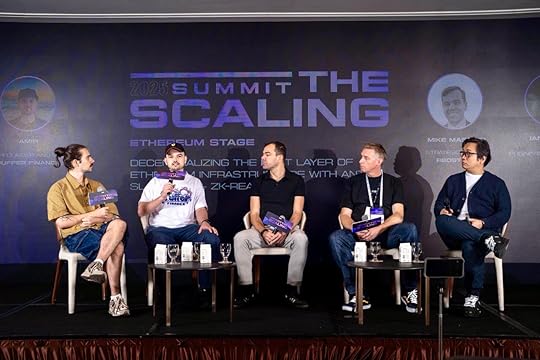
At the Scaling Summit Singapore, a pivotal conversation unfolded on the Ethereum Stage, where builders, researchers, and visionaries gathered to confront one of the ecosystem’s most pressing dilemmas: How do we scale Ethereum without sacrificing its foundational ethos of decentralization? Moderated by Luca Donno, a researcher at L2Beat, the panel featuring Amir (Puffer Finance), Mike Massari (Redstone), Ian Wallis (Linea), and Anndy Lian (Intergovernmental Blockchain Advisor) delved into the tension between idealism and pragmatism in blockchain infrastructure.
The Centralization Conundrum
The discussion opened with a stark reality: while decentralization remains Ethereum’s “biggest asset,” market forces often incentivize centralization for speed and user experience. As Amir of Puffer Finance noted, “If you look at where biggest asset holders are now parking their assets… they’re trusting Ethereum for a reason.” He pointed to USDT and USDC 45% and nearly 100% of their supplies, respectively, reside on Ethereum precisely because of its trustless nature.
The path to mass adoption is rarely pure. Luca framed the dilemma: “We were very much in a situation in which decentralization was the most important thing… Now it’s not anymore. That is not the focus of institutions.” This shift demands a recalibration. Anndy Lian, speaking from a macroeconomic lens, admitted bluntly: “Most users, including VCs like myself, you know, we don’t really care [about decentralization]… we want to make money.” His candid remark underscored a broader truth user incentives today prioritize yield and UX over ideological purity.
But the panelists agreed: decentralization must remain the north star, even if the journey begins with centralized stepping stones. “It is okay to start slightly more centralized,” Amir argued, “but having decentralization on the roadmap as the main goal is the only way we can scale the entire blockchain to its full capacity.”
Anti-Slashing: Guardrails for a Risky Landscape
A key innovation discussed was anti-slashing a critical safeguard in the era of liquid staking tokens (LSTs). With LSTs now dominating Ethereum’s staking landscape, systemic risk looms large. As Luca observed, many protocols hold more LSTs than native ETH, creating concentration points that threaten network security.
Amir explained how Puffer Finance addresses this: “We didn’t stop at permissionless restaking. We launched bonded validators operators must stake their own capital. If slashing occurs, it’s their money on the line.” This “skin in the game” model, combined with hardware-based anti-slashing modules (like trusted execution environments, or TEEs), prevents malicious or accidental validator misbehavior. “These modules act like a Ledger wallet,” Amir said, “but even more restricted you can only sign permitted transactions.”
Mike Massari echoed the sentiment: “The moment you detach risk from the person managing the capital, you create systemic risk.” Anti-slashing, therefore, isn’t just technical it’s economic alignment.
Ian Wallis added context from Linea’s perspective, noting their plan for a “native yield” bridge that stakes ETH directly, reducing reliance on dominant LST providers like Lido. “We’re consulting closely with the Ethereum Foundation,” he said, emphasizing collaboration over competition in securing the ecosystem.
ZK: Promise, Peril, and Patience
The conversation then turned to zero-knowledge (ZK) technology the cornerstone of Ethereum’s scaling roadmap. While optimistic about ZK’s potential, the panelists acknowledged its immaturity. “ZK is still experimental,” Luca warned, citing recent bugs in foundational libraries like Circom and Halo2. “A multi-billion-dollar bug on Ethereum L1 could shatter trust in the entire paradigm.”
Amir, however, offered a solution in progress: “We’re researching 2FA for ZK running a full Ethereum client inside a TEE alongside the ZK prover. If outputs mismatch, you halt the transaction.” This dual-verification approach could catch bugs before they cascade.
Ian, whose team at Linea operates a ZK-EVM rollup, remained bullish: “Compare where we were five years ago to now we’re light years ahead. ZK improvements are coming quarterly.” He pointed to Swift’s recent partnership with Linea as validation: “If the kings of centralized finance see potential here, that’s an endorsement.”
Anndy Lian urged patience: “Give the technology time. The big boys are coming. Adoption will follow.”
Toward a Redistributed Future
Ultimately, the panel converged on a shared vision: Ethereum must evolve progressively. As Luca summarized, “We shouldn’t decentralize for decentralization’s sake but where user funds are at stake, decentralization equals security, and security equals good UX.”
The road ahead involves balancing short-term pragmatism with long-term principles. Whether through anti-slashing economics, ZK verifiability, or middleware that enforces decentralization standards, the goal remains clear: build infrastructure that can onboard trillions not just billions without compromising Ethereum’s soul.
As Amir put it: “If we want to bring repo markets or supply chains onchain, it has to be fully decentralized and secure. Hyperliquid won’t cut it for JP Morgan.”
In that spirit, the Scaling Summit didn’t just showcase technology it reaffirmed a covenant: scale with integrity, or don’t scale at all.
The post Decentralizing the Next Layer of Ethereum Infrastructure with Anti-Slashing & ZK-Readiness appeared first on Anndy Lian by Anndy Lian.