
INTERVIEW: with author Bryn Hammond
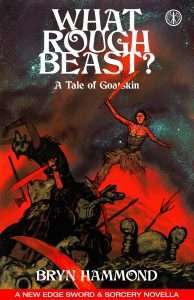
Alex here at Grimdark Magazine recently got the chance to catch up with indie author Bryn Hammond, an Australian writer of historical novels and standalone sword and sorcery novellas. Bryn grew up reading ancient and medieval tales which have heavily influenced her writing style. Alex caught up with Bryn to discuss her latest novella What Rough Beast and her other projects.
 [GdM] Thanks so much for speaking with me! Can you tell our readers who you are and what sorts of stories you write?
[BH] I’m an Australian writer of historical novels and sword & sorcery short fiction – where ‘short’ includes novellas. Historical, by tradition, can be as epic in size as fantasy, and both my Amgalant books were over 200,000 words, after which the sword & sorcery novellas do seem nicely succinct. I like writing a sequence of them, though, and find that gives the chief satisfactions of novel-writing: you can still explore character and theme over time and space.
It’s important to say each novella is a standalone – you don’t need to read in sequence, you can pull out one. But for me, the writer thereof, I can make the kind of music I enjoyed over large novels, I can play rhymes and contrasts and the echo game. Sword & sorcery has a history of serial characters, and for me as a writer, that’s a perk. That’s room for character and theme, those things I most value in the novel, without a requirement of your reader to read at size, or in a series. S&S serial characters aren’t a series of events, they can be taken up and put down wherever you like.
[GdM] This is not your first story with Goatskin. Where did she come from? How has writing her changed from story to story?
[BH] I get to know her better. I am putting more of my truths and experiences into her, [BH]which, I’ll argue, might be thought a bad thing to do in your early writing years, but in your later years, can feel like learning to write more genuinely.
I conceived her as a goatherd nomad astray in settled society – a classic sword & sorcery outsider, but lowly, in fact contemptible to those around her. She wasn’t going to have any touch of the admired ubermench, the splendid physical specimen that your big barbarian can edge into; far from that, I was interested in writing a person at the bottom of society. In her first story I laid down for her the sort of psychology I thought leads one into a sword & sorcery existence: she resists ordinary employment but can’t ever resist a dare, she has an impious casual violence that comes out of her restlessness, she flouts authority, and she simply won’t give in even when it’s reasonable.
[GdM] Goatskin and her stories are inspired by and take place within Mongolian culture. What got you interested in the subject and what is it that you enjoy about it?
[BH] I was always drawn to nomadic or tribal societies, whether that meant reading travel, ethnography, or fiction. Nothing, of course, beats arts from the cultures themselves, and what won me incontrovertibly to the Mongols in particular, was reading the Secret History of the Mongols. This is a life of Chinggis Khan, drawn from communal memoirs shortly after his death, in prose and verse, with both a concern for history and artistry from oral epic. Before that, my biggest obsession was Beowulf, but, I’m sorry Beowulf, the Secret History blew you out of the water. Probably the same heart-strings drew me, though, to each of these.
There’s a dude called A.T. Hatto who was a professor of medieval Germanic lit, I have his translations of the Nibelungenlied and Parzival and Tristan, but after he retired he turned his efforts to Turkic epic, and I also have his translation from the Kyrgyz of Manas. I think of his trajectory often. (Why is his work on Turkic epics not in his Wiki?)
Seen from the inside, historical Mongol culture looks a great deal different from most Western portrayals of it. I have a bit of an axe to grind on that one.
[GdM] I first encountered Goatskin in your novella Waste Flowers in Double-Edged Sword & Sorcery . The Goatskin we meet in What Rough Beast? is a very different person from the one in Waste Flowers . One of major features of a sword & sorcery story is their unconnected nature—some Conan the Barbarian stories by Robert E. Howard may have him as an older king in one story and a young bandit it another, for example. Does Goatskin have an arc that you’re working towards, or do you write her stories based on interest?
[BH] I’m glad she comes across differently – I don’t want to be same-samey. Although What Rough Beast? starts soon after Waste Flowers, she’s in a different state of mind, she’s gone off on her own tangent. I tend to write in slightly different styles, too, to suit a different story, and we are closer to Goatskin in this one. This story’s more about her, and what matters to her.
Goatskin won’t have an arc. I feel the idea of character arcs aren’t S&S. Funnily enough, I got to pop in an extra-short extra story for the 2025 issues of New Edge Sword & Sorcery, and at request I did old Goatskin. I wrote it in resistance to common arcs: she’s still wandering on her own with a camel, and happy to be so. She doesn’t have regrets, she isn’t embittered; she doesn’t have life lessons to tell you, nor does she feel old and wise. You know why? I gave her the age I am now, and I haven’t followed those story arcs.
Qi Miao, known as Sister Chaos, on the other hand, has a story ahead that fits into the history, because she’s based on a historical bandit, Yang Miaozhen, and her dealings with the Mongols as they conquered China. For her years of life, Goatskin always has Sister Chaos to bounce off, wherever she’s at with the Mongols, and Goatskin has the Mongol conquests themselves, to respond to. Things change around her.
[GdM] Where do we find Goatskin in the beginning of What Rough Beast?
[BH] She’s on her wanders, alone, the way she likes, in between travels with friends. For no reason other than her own sweet whim, she’s come to the high summer meadows of the yak herders. In our world, think Amdo, the northeast of traditional Tibet, China’s Qinghai. This is not far from her own people, and she has an investment at once in their troubles, even though she came here to get away from commitments.
 Author Bryn Hammond
[GdM] Do you have lots of other Goatskin stories you’re just itching to write?
[BH] I have that wide canvas of the Mongol conquests, and the Mongol thirteenth century, to place her on wherever my whim takes me. It has such scope, and I do itch to explore.
[GdM] What were some of your first sword & sorcery stories that got you into the genre? Is there a specific S&S character or story trope that you’re really fond of? I often find myself drawn to Conan—he’s a classic for a reason—and Michael Moorcock’s Elric of Melniboné—everybody loves an antithesis.
[BH] Pretty obviously, I am fondest of women with swords, and always was. Amazons!, the 1979 anthology edited by Jessica Amanda Salmonson, is what sticks in my mind as my early encounter with ideal reading material, and Dossouye, Charles Saunders’ character, stood out in that as the most well-rendered woman with a sword. I’m not often into women in sorcery, who have been too easy a way for traditionalists to include women in the genre. But then I care about the sorcery side much less altogether.
One type I’m keen on, that is being explored in contemporary S&S, is characters with ethics. You don’t have to be a cynical bastard to star in S&S. Hanuvar leads the charge on this, of course, Howard Andrew Jones’ hero based on a hero of mine, Hannibal of Carthage. And I’d count James Enge’s Morlock, who despite his terrible frailties, has an understated ethics that not only wins my heart but interests me in his situations and his ways out of them. Can I say I have a bit of a queer-girl crush on Morlock, who’s more likeable than he thinks.
I like messes, for sure. Morlock’s a mess. I guess I find hard to relate to those who have it too much together. In sword & sorcery, characters can remain imperfect, they don’t have to solve their issues, they don’t even have to grow in that self-help-speech kind of way. I never did grow up.
[GdM] What Rough Beast? is part of a larger funding campaign with Brackenbury Books, and, as explained earlier, you’ve worked with them before. Can you talk about what that experience has been like?
[BH] It’s lovely to ‘get in on the ground floor’ as Oliver [Brackenbury] has put it, with a new publisher. Since the first title from Brackenbury Books was our double, Double-Edged Sword & Sorcery, with back-to-back novellas, my Waste Flowers and Dariel R.A. Quiogue’s Walls of Shira Yulun. It’s lovely because you can strike up trusted relationships and you can feel you have an input. I hope Brackenbury Books goes gangbusters, but it’s exciting to participate at the inception. Oliver has a strong aesthetic and goes to great trouble for the physical beauty of a book. That doesn’t hurt: I end up with a little treasure in my hands I can be truly proud of.
[GdM] What are you reading now?
[BH] You know how you dig in your heels at popular things? I’ve dug in my heels at Aubrey-Maturin, Patrick O’Brian’s series, right up until this year, and I’m now on my seventh in a row. I’m picking up pointers for sword & sorcery writing from his remarkable art of leaving out the unnecessary, and his skill at putting excitement on the page. His battles are among the best in the business.
Before those I caught up with C.L. Clark’s second, The Faithless, following The Unbroken. What can I say, these are my kind of women, in a setting that offers great fodder for themes, not-North Africa and not-France. I think the second did its stuff more deftly than the first – though the first felt rawly weighty, felt real – and I look forward to the third at the end of September. Oh, and a few months ago – this qualifies because I’m about to re-read it – Metal From Heaven by August Clarke knocked my socks off, for its writing and for where it delves. In a florescence of sapphic rep that often feels knee-deep or unanchored in historical queer lives, these books, Clark and Clarke, spoke to me. Both have a welcome complexity, and characters with ballast. With layers.
[GdM] Do you have any other projects that you’re working on and can talk about? Do you have anything coming out soon that we should look out for?
[BH] I’ve just started a Goatskin novelette that gets into steppe epic, that glances into the wondrous and under-translated world of oral or once-oral epics in Turkic languages. It’s about the distinction between heroes and knights. ‘Turks invented the knight’ – that’s a cheeky quote, don’t ask. While in the old epics, your hero is a rough wild beast of thing, scary to his friends. Or hers. They had women like you wouldn’t believe.
Soon out: I have a poem in Old Moon Quarterly’s Arthurian issue. I love writing poetry and didn’t for years, so I’m particularly happy. It’s titled, straight out of Malory, ‘And He Swiped Off His Wife’s Head.’ That’s meant to intrigue you.
Bryn Hammond’s novella What Rough Beast? is currently funding on BackerKit.
The post INTERVIEW: with author Bryn Hammond appeared first on Grimdark Magazine.


