The Great Infra Wars: How Web3 is Forging the Future of Decentralized AI | Taipei Blockchain Week 2025
Anndy Lian
The Great Infra Wars: How Web3 is Forging the Future of Decentralized AI | Taipei Blockchain Week 2025
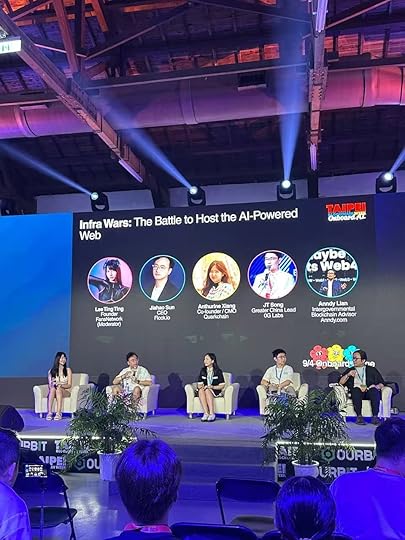
Taipei, Taiwan – Sept 2025 – As artificial intelligence reshapes the digital landscape, a critical battle is unfolding beneath the surface: the fight to build the infrastructure capable of hosting truly decentralized AI. At Taipei Blockchain Week 2025, the panel “Infra Wars: The Battle to Host the AI-powered Web” cut through the hype, revealing the profound technical and philosophical challenges at the intersection of Web3 and AI. Moderated by Lee Ting Ting, Founder of FansNetwork, the session brought together infrastructure pioneers to dissect how blockchain can solve AI’s most pressing limitations, from computational bottlenecks to data sovereignty crises.
The Speed vs. Decentralization Dilemma: Rethinking ConsensusThe panel opened with a fundamental tension: AI demands blistering speed, while blockchain prioritizes decentralization, often at the cost of performance. “We all know AI models have immense complexity, and users care about speed,” noted moderator Lee Ting Ting, framing the core conflict. “How are emerging consensus mechanisms being redesigned to handle AI’s computational demands?”
Jiahao Sun, CEO of Flock.io and a former financial infrastructure lead, argued that traditional blockchain architectures are fundamentally mismatched for AI workloads. “The public chain design predates the AI boom,” he explained. “Even if on-chain transaction speed is fast, a single consensus layer cannot solve the demands of AI.” Sun’s solution lies in modular consensus: “We’re using a multiple and modular consensus mechanism. We built single processors for decentralized storage and computing, but we align all different modules, data service, cloud service, and computation on top of a PoS system. This creates unlimited transaction possibilities and aligns computing with storage.”
Anthurine Xiang of Quarkchain added nuance, distinguishing between monolithic (e.g., Solana) and modular (e.g., Ethereum) chains: “For modular ecosystems, we need a shared data availability (DA) layer. Solutions like Celestia or EigenDA help store data on-chain forever, making it traceable and preventing losses like the infamous NFT storage failures.” Her point was stark: “When centralized storage fails, like when a team stops paying for AWS, your NFTs become broken links. For AI, this is unacceptable.”
JT Song of 0G Labs (ZG) took this further, announcing their new IFT standard (likely “Immutable File Token”): “For AI agents, all data must be stored on our decentralized service and trace the entire training process. This makes data verifiable and tradeable on-chain, a radical shift from traditional ERC-721.” Crucially, Song revealed ZG’s collaboration with China Mobile: “We ran decentralized training for a 100-billion-parameter model faster than centralized alternatives. Decentralized computing isn’t slower, it’s a different paradigm.”
Data Sovereignty: The Privacy ImperativeThe conversation pivoted to AI’s data crisis: Big Tech’s monopolization of user data for training models. “How can infrastructure enable true user ownership while allowing decentralized training?” asked Lee.
Jiahao Sun spotlighted federated learning – a Google-originated technique now supercharged by blockchain. “Your phone predicts your typing locally; raw data never leaves your device. But Google controls the aggregation – it’s still centralized. Blockchain changes this: none of the users’ raw data is ever submitted. Instead, we submit model gradients – changes to the AI itself – which merge into a larger model. Everything is transparent on-chain.” He emphasized the breakthrough: “You don’t have to trust a third party; you see the transactions.”
JT Song reinforced this with ZG’s vision: “We’re building full-chain data services. If an AI project uses our IFT standard, all training data is stored in a decentralized manner. Even if the operation team disappears, the AI agent and its data remain self-sovereign and verifiable.” This tackles the “black box” problem of open-source AI: “Models claim transparency, but the data and process remain hidden. Blockchain forces process transparency.”
Anndy Lian, Intergovernmental Blockchain Advisor, injected pragmatism: “Full decentralization remains a big challenge. Security must be managed effectively, no hacks, no losses. But I’ve discussed zero-data AI architecture with Southeast Asian governments. Blockchain can enforce rules and enable fair audits, creating a win-win for AI and Web3.”
The Killer App: Why Decentralized AI Isn’t OptionalThe panel’s most heated debate centered on the “killer app” for decentralized AI: Why bother with Web3 when centralized AI works?
Jiahao Sun targeted enterprise pain points: “Privacy isn’t just ‘nice to have’, it’s necessary in banking, healthcare, and public sectors. But mass adoption needs retail applications. Imagine a virtual companion where conversations are secured on-chain. You know no one, not even the platform, can access your private chats. That’s a healing application blockchain enables.”
Anthurine Xiang pushed for Web3’s evolution beyond finance: “Ethereum aimed to be a ‘world computer,’ but most apps are still token-trading. We need diversified use cases: AI agents, decentralized content platforms. Our ‘supercomputer’ infrastructure must enable non-financial apps with mass appeal, faster speeds, more capacity, lower costs.”
JT Song unveiled ZG’s “Air Wars” AI agent marketplace (boasting 2.3 million testnet users): “Agents can evolve, be verified, and classified. This isn’t just about functionality, it’s about ownership. Users control their AI’s data and evolution.”
But Anndy Lian delivered the most provocative insight: “The best way to onboard people to AI + Web3? Teach them how to make money. AI agents that help users make smart trades or generate income will drive adoption faster than ideology. And let’s be honest: today’s ‘Web3’ isn’t truly decentralized. We need Web4, a more decentralized, less controlled, AI-driven future.”
The Road Ahead: Beyond the HypeAs the session concluded, a clear consensus emerged: The “infra wars” aren’t about which chain wins, but how Web3’s core innovations – decentralization, transparency, and user sovereignty – can solve AI’s existential flaws. Federated learning plus blockchain enables private AI training; modular data layers prevent catastrophic data loss; and new consensus models unlock scalable compute.
The panelists acknowledged the journey is nascent. “Papa, this will be a slow process,” admitted JT Song. Anndy Lian tempered expectations: “From a productivity standpoint, putting everything on-chain remains challenging. But give us time.”
The most profound takeaway? Decentralized AI isn’t a niche experiment, it’s the only path to an AI future where users own their data, models are transparent, and infrastructure serves people, not platforms. As Jiahao Sun succinctly stated: “We’re not just building faster chains. We’re rebuilding the entire operating system for decentralized AI.”
In the battle for AI’s soul, Taipei Blockchain Week 2025 made one thing clear: Web3’s infrastructure warriors aren’t just participants in the AI revolution, they’re building its foundation. The “infra wars” have just begun, but the stakes, a truly user-owned digital future, couldn’t be higher. As Lee Ting Ting closed the session: “This isn’t about technology alone. It’s about who controls the future.” With 2.3 million testnet users already engaging with decentralized AI agents, that future may arrive sooner than we think.
The post The Great Infra Wars: How Web3 is Forging the Future of Decentralized AI | Taipei Blockchain Week 2025 appeared first on Anndy Lian by Anndy Lian.