Spring Fever
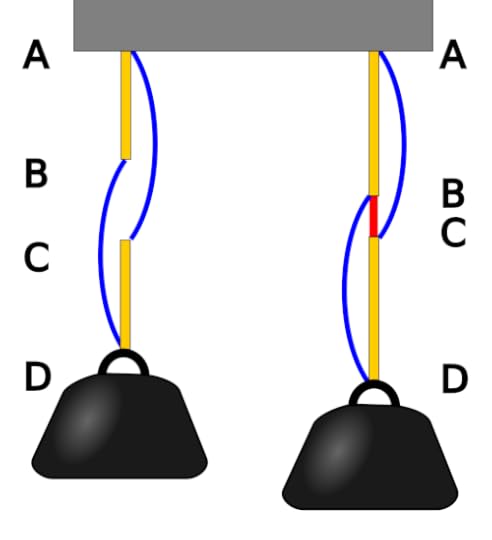 Image: Wikimedia Commons
Here’s an oddity: In the figure on the right, a weight is suspended by two springs (AB and CD) connected by a short length of inelastic rope (BC). The blue curves are lengths of string, which are slack here.
Surprisingly, when the rope is cut, the weight rises (left). Why? In the initial state the springs were arranged “in series,” one above the other. When the rope is cut, the blue strings go taut, and now the two springs are arranged “in parallel,” working together and thus more effective in resisting the weight’s pull.


No comments have been added yet.