
KDP IS TRASH
I was a major supporter of Amazon’s Kindle Direct Publishing (KDP). This was especially true when it was paired with CreateSpace for print books. In fact, I published several projects through those platforms and really loved how accessible self-publishing felt.
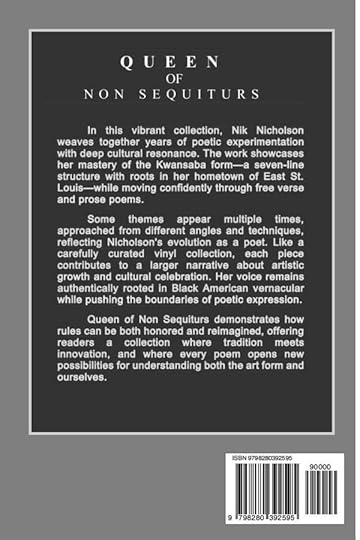
As a poet, I write regularly and have shared my work on stage. After performing my poetry book, Seeking Sex Without Armor, I got some honest feedback from fellow poets. It wasn’t all praise. They said my book had too many poems packed in. This made it feel heavy, like someone talking nonstop for five hours without a break. Ouch. When I attempted to publish my latest collection, Queen of Non Sequiturs, I made sure to keep it concise. It did not have more than 77 pages.

 [image error]
But their point stuck: poetry needs space to breathe. Readers deserve time to contemplate and process what they’re reading, especially when the themes run deep. One friend showed me her book. She created pages in it for readers. They could jot down their own reflections on heavy poems.
After years away from publishing, I returned with excitement as KDP had merged its functions, replacing my former go-to, CreateSpace, which initially handled print.
Having designed covers for other writers, I watched the changes on KDP closely. While other platforms offered more pricing control, I valued KDP’s permanence and all-in-one setup. Plus, being familiar with their tools and standards made publishing feel less intimidating.
That’s been my journey with KDP so far — a mix of learning, adapting, and holding onto the things that make self-publishing feel like home.
Self-publishing is a marathon, not a sprint. There are many steps involved, and trying to do it all alone isn’t realistic. For me, that meant setting a production schedule, coordinating with editors, and gathering beta readers for honest feedback.
Once I started working with editors, I realized how slow the process could get. Some were booked months out or charging more than before, which was discouraging. The excitement faded as the waiting dragged on.
To keep momentum, I started designing book covers for upcoming projects. This forced me to estimate page counts and gave me a visual reminder of my goals every time I logged into KDP. It wasn’t perfect, but it helped me stay accountable while the longer parts of publishing unfolded.
When it comes to editing, I prefer hard copies. Holding a physical book and turning pages helps me focus. My first editor is a beast—in the best way. She doesn’t just fix mistakes; she asks questions in the margins without assuming my intent, pushing me to see my work through a reader’s eyes. That’s incredibly powerful.
Some editors rewrite your work like an AI, replacing your voice with theirs. Not my editor. She preserves my style, guiding me without taking over. Using a hard copy stops me from rewriting on the fly and teaches me to trust myself. When you step away from your work and return later, you might forget why you wrote something a certain way — only to realize what seemed unnecessary is actually essential.
Before sending my manuscript to her, I do my own edits. I print it out, mark it up with a pen, then revise and read it aloud. For novels and stories, I don’t add breath marks, but for poetry, I insert commas and periods to match how I perform each piece. That often means reading a poem several times until it feels right — but that’s a whole other conversation.
When reading a novel, I pace most of it in my head. Still, I add punctuation to reflect how each character speaks. A stuttering character might have commas or extra periods where they don’t normally belong. Fast talkers use commas where others would pause. Thoughtful characters get ellipses for long pauses as they consider their words. For accents, I spell words phonetically, and with a few colloquialisms, you can usually tell who’s talking without dialogue tags.
Editing isn’t just fixing mistakes — it’s shaping voice, rhythm, and character. For me, that all starts with a hard copy in hand.
I was so excited when my edits came back from my last editor, and I carefully incorporated their suggestions. They even organized the edits in a flow that made it easy for me to follow and decide what I agreed with. Once I put the manuscript together, I couldn’t wait to jump on KDP and publish. My plan was to do a print book. I wanted physical copies for in-person events and book clubs. There’s something special about everyone holding the same book.
I submitted the manuscript to KDP, but it was denied. Now, if you know me, you know I make covers for other writers, so I’m familiar with KDP’s book cover templates. The problem? Their cover template doesn’t match the publishing preview. This hadn’t been an issue before because the books I usually formatted were at least 250 pages. For my poetry book, I wanted to end on page 77, and though the actual count was closer to 95 with front and back matter, the table of contents was longer—each poem had its own entry.
When the book was rejected, I thought, okay, I’ll shrink the text and check the print previewer again. But the guidelines in the previewer were so tiny I couldn’t fix the problem — the spine guidelines were basically a single thin line. There was no room to adjust anything, not even at 5-point font.
So, for the first time ever, I called KDP’s publishing support. Right out of the gate, the customer service rep started talking to me like I was crazy. I used to work in customer service, so I know how tough frontline workers can have it. I stayed calm and polite, even trying to lighten the mood with my usual finesse. But this rep was so rude I had to hang up and take a break. It was painful trying to be pleasant while someone clearly found me frustrating. I even felt like I was the one doing the hard work while they acted like the customer. I used every de-escalation tactic I knew: “I understand this could be frustrating. Please take your time,” and “Feel free to put me on hold if you need a moment.” I smiled as much as you can through a phone line — you can hear it, trust me.
But this first rep was mean as hell. It actually hurt my spirit, and my eyes started burning. Maybe I’m a little sensitive, but I didn’t expect that level of hostility. I didn’t get her name.
When I called back, I started fresh, but I wasn’t as friendly. The lesson was still fresh in my mind. The second rep, Cara, told me to just use KDP’s templates. I explained that I was using their templates exactly as instructed. She said, “Well, when I look in the print previewer, I can see where you can fix the text.” I told her on my end, there was no room — the lines were so tight. I also pointed out that the KDP template had more space than the previewer showed.
She insisted, “You have to use our template to be in compliance.” She suggested I ask the KDP community for help. When I reiterated that I was using their template but the previewer was incongruent, she got visibly annoyed and told me, “If you’d used the right template, you wouldn’t have this problem.”
I didn’t want to argue, and I was emotionally drained. I told her I understood her frustration, that maybe I wasn’t explaining myself well. I even asked if she could give me an email address to send screenshots illustrating the problem.
She refused and started yelling, repeating that if I didn’t use the right template, my book wouldn’t be approved. Her escalating anger made me escalate too — but I stayed calm and asked to speak to a manager. I kept apologizing for frustrating her and acknowledged I might be hard to understand.
Her response? “No, I work here. You don’t understand.” I was really telling myself that to stay calm because, honestly, I wanted to curse her out.
That experience crushed me. I never imagined a company I once loved would treat me like that — especially when I’m just trying to publish something meaningful.
Cara initially told me I’d have to wait until the next day if I wanted to speak to a manager. I stayed quiet for a moment, and then she relented with a curt “fine.” Just before putting me on hold, she yelled “I understand” three times, then ended with “You don’t understand,” and clicked off before I could say anything else.
Looking back, it’s hilarious. At the time, it was just shocking.
The manager who finally came on was already irritated. She immediately told me I should use the template if I wanted my book approved. I informed her that I was indeed using the template — but it didn’t match the publishing preview.
She sighed, exhausted and frustrated, then proceeded to tell me where I could find the template. Me — someone who designs covers for other writers and regularly tweaks templates so their books get approved — being told where to find the tool I use all the time? No thanks.
I asked to speak to the next manager up. That’s when things took a strange turn. The manager started threatening me, saying, “You didn’t give me an opportunity to assist you. I’ve already provided a solution. If you’d just listen.” The irony was thick, especially after I’d told her multiple times I was already using their template.
She said she didn’t know when a higher-level manager would get back to me — maybe in a few days, maybe longer. Then she put me on hold for what felt like forever. I hung up, then tried to call back through the system, only to find I was blocked from the number I’d dialed. I was also blocked online.
After some digging, I found the KDP chat feature — something I didn’t even know existed. An hour later, I discovered managers were actually available on chat. But from there, it was the same broken record: “If you just use the template.” They kept sending me links to the template page, which I already knew inside and out. Eventually, they even sent downloads of the exact same templates I’d been using all along. These templates vary based on page count, paper type, and book size — all things I’d been managing from the start.
This frustrating loop went on for literal weeks.
Meanwhile, a friend shared that due to medical challenges, holding and reading a print book was difficult. They needed large text for it to be accessible. So, I decided to upload a Kindle version, expecting another rejection.
Surprisingly, the Kindle version went through on the first try. That was a small win in the middle of a long, exhausting battle.
Finna end this long ass post. I’m literally getting triggered.
After nearly a month of being treated like the village idiot, I finally took matters into my own hands. I added about 30 pages and created a whole new cover. That didn’t immediately fix the problem, because the publishing preview is still wildly inaccurate. So, I sat there—online and in Word—moving the text so slightly you wouldn’t even notice unless you were staring at the grid lines. Five or six times. For hours. I adjusted that cover until it finally, finally matched.
Then I submitted it for approval.
If this crap didn’t work, I was done. Ready to go local, find a publisher who actually gives a damn—because I had zero other options left.
The next day, the book was approved. A KDP manager called, and I got four emails. Two were from execs congratulating themselves on “resolving” the issue. Newsflash: they didn’t. I did. I created the extra binding space and did what I’ve done for countless other writers.
Here’s the bitter truth: KDP’s system is broken. Their customer service is dismissive at best, hostile at worst, and their so-called “help” often feels like gaslighting. If you’re self-publishing with KDP, be ready to fight tooth and nail. Know your tools better than they expect, trust your gut, and don’t let their incompetence kill your momentum. Sometimes you have to do the impossible just to get what should be simple.
This industry owes self-publishers better. Until that day, brace yourself, keep your rage close, and keep pushing. No one else will.
And here’s the last bit of bullshit.
Some knucklehead rep insisted I “just let him explain.” Dude, after 50 emails, countless chats, and phone calls, they still hadn’t fixed their own mess. I refused. I knew he’d just repeat, “Use our templates.”
He wrote a long chat blaming me for not reading carefully and swore they’d sent me a file to fix the problem.
WHAAAAAT? I went looking for that “fixed” cover—because someone promised they corrected it. But KDP rejected that too. Someone even admitted the files were incongruent and said they’d have to get the tech team and publishers involved. Meanwhile, she’d “fix it.” When her “fix” got rejected, I contacted KDP again.
Enter the confident ass hat who claimed he saw the issue and could fix it on the spot. I knew he was lying because I’d been through this circus with these gaslighting con artists before.
I don’t care why your system is broken. I just want my damn book approved. But he needed my help. Two things, he said. I asked, if you know what should have happened, why haven’t the other fifty agents noticed? Lazy? Incompetent? Liars? He couldn’t answer—he hadn’t seen previous emails. He was literally making shit up.
Cool. Since you’re the only one who “knows what’s going on,” don’t explain. Approve it or have a manager who speaks English as their first language call me tomorrow.
He sent a long message saying they’d sent the file from the start, and if I’d just listened, this wouldn’t be a problem. I asked for someone fluent in English—not being rude, but why the hell don’t you understand what I’m saying? I told myself it was a language barrier rather than accept they were just idiots or torturing me for fun.
Over thirty emails later—not counting chats and calls—and before I fixed it myself, I reviewed everything from 4/28 to 5/19. The file they sent? The fucking template.
I hate KDP. And, well… they hate us too.


