Mental Health Matters: How I Healed Myself: What the Experts Have Told Me (PART III)
Sometimes, I get pushback from lay people about the idea of self-healing/self-therapy. There are a few implications:
Everyone needs a mental healthcare professional to guide them through a process of healing or life, in general.I am not equipped to figure out how to resolve my childhood trauma (i.e., I may be able to read, but I am not licensed to heal myself).Paying for a therapist is the only way to heal unresolved trauma.But licensed mental healthcare professionals have said the opposite.
MARNIE FERREE, LMFT, CSATMarnie Ferree retired as the leading female-sex addiction specialist in the country in 2023. She’d worked as a certified sex addiction therapist (CSAT) for 30 years. A few months prior to publication, I cold emailed her to review Salve. After some hesitancy, she agreed. And then, she texted me throughout the weekend as she read in disbelief that my words matched her experiences as a clinician and a recovered sexual addict. She not only validated what I’d shared about my life, but also my healing practices.
However, Marnie still struggled with writing the review and wanted to speak with me. During our two-hour convo, she said this: Over the past 30 years, she’d consistently told clients there was no way they could do this work on their own. Sexual addicts need professionals. I’m summarizing, but in essence, she wanted to speak with me to see if I really did what I said I did. By the end of our convo, she was convinced.
“You, my dear, are a unicorn,” she said.
Then, she sent the glowing blurb that is located on the back of Salve.
ROY KIM, LMFT, CSATRoy Kim is a licensed family and marriage therapist (LMFT) and a CSAT. He is also the host of SA Speakeasy, the first podcast interview I did. After reading Salve, Roy also validated my experiences and healing practices. At the end of our interview, he gave one of the best compliments I’ve received about my journey.
“I can tell that from what you’re sharing with me that your brain is changing in a really healthy way,” he said. “I really believe in how good the brain is at adapting to things, especially adapting to healthy routines and health, in general. It really does sound like your brain is adapting well over these years. So, good for you!”
Even though the social stigma of addiction has decreased, what happens during the addiction cycle is not always common knowledge. Many do not realize that addiction develops when the pleasure circuits in the brain get overwhelmed. No matter if it’s substances or behavior, an addict’s brain becomes wired differently. If you’ve ever wondered why your loved one won’t just stop doing fill-in-the-blank activity, it is probably because they literally cannot. Your healthy brain tells you to stop eating the cookies; the addict’s brain seeks to continue the habit, no matter how detrimental. When Roy said he could tell I’d changed my brain, it meant a lot. It confirmed that the process I’d used for self-therapy had worked in ways recognizable to a professional.
ANDREA DINARDO, PhDDr. Dinardo, or as I call her, Dr. D., is a positive psychology expert and psychology professor at St. Clair College of Applied Arts & Science in Windsor Ontario Canada. She also has a popular TedTalk about how to turn stress into strength. Dr. D. and I met via WordPress, recorded a popular video about situational anxiety, and presented together at St. Clair during my 2023 healing/book tour.
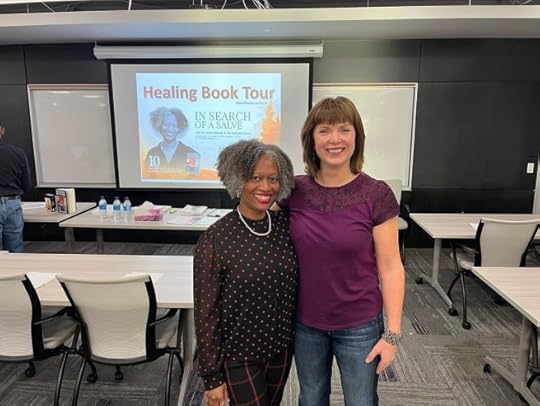
Dr. D. was in awe of Salve’s contents. She told my family and me that the world has the most psychologists and healthcare professionals ever and the most mentally unhealthy people ever.
“There’s a disconnect,” she said. Later, she praised Salve for doing what the mental health field should be doing—helping people to dig deep into their past, in order to provide a pathway for healing in the present.
ANNA LINDE, Msc, Certified Sex Coach, Somatic Sex Educator, SexologistAnna is a sexologist and certified sex coach, and she specializes in somatic sex education. She helps people learn to have healthier sex lives, specifically if they have trauma in their backgrounds, including, but not exclusive to being an adoptee.
Anna and I spoke once a week for three months, primarily because we were planning a workshop centered on adoptees and sexual health. In our second Instagram live, I confided that “people give me a lot of flak about self-therapy,” and then I told her about the disclaimer I share before speaking in public. Anna smiled and said:
This is also why this conversation is so important because I am a licensed mental healthcare practitioner. But that doesn’t mean that we know how to explain these things…so the person needing the information actually understands what it means for them. Because if I know how to diagnose the trauma, that doesn’t mean that that’s helping a person, really, which is also why I think this conversation is a way to bridge two worlds that are separately important: the personal experience and the professional side of healing. (IG Live, 4/10/25)
She also affirmed that writing a book—as well as engaging in other types of art (i.e., painting, dancing, singing, sculpting, creating music, etc.)—is a valid way to heal and integrate trauma. According to Anna, the point is to get the thoughts out of your head in a way that works for you.
Anna’s words are the perfect ending for this post and series. There is a place for licensed clinicians in some folks’ healing journeys. But whether you are a wounded healer or not, you are central in your healing. While some people need psychotherapy, others can use alternative methods to achieve the same goal. Neither is more valid or worthy. Finally, I don’t want to be irresponsible in my message. Some mental illnesses cannot be resolved independently and require professional guidance and medication; however, self-therapy should not be discounted as a valid method for many mental health issues. It is possible to take your mental health into your own hands.
Postscript: Shout out to Brooke James, LCAS, LMFT, who said that I “nailed it” with Salve and David B. Bohl, MA, CSAC, MAC, an adoptee who also self-therapized because the religiosity of Alcoholics Anonymous wasn’t helping him to achieve sobriety. He was happy to know someone else had successfully used non-traditional methods for healing.
RELATED POSTSMental Health Matters: How I Healed Myself: Years of Self-Therapy Strategies (PART II)Mental Health Matters: How I Healed Myself: Chiron and the Concept of the Wounded Healer (PART I)Acknowledging the Primal Wound: How Relinquishment Can Lead to an Intimacy Disorder3 Things I Hoped to Accomplish with In Search of a SalveMonday Notes: Guest Interview on SA Speakeasy