Emotionally Intelligent Communication
For a number of years now I’ve been an advocate of emotionally intelligent communication and I think it can improve the way local government talks with its customers and how writers can gain traction, and thereby generate sales, on social media.
“What’s emotionally intelligent communication?” I ask myself rhetorically for your benefit. Well let me set the scene.
If you’ve driven any length of highway in the United States you’ll have seen advertising billboards. Constructions three storeys high encouraging you to buy fried chicken or visit Yosemite or seek the services of a local attorney-at-law – in case you’re using said highway to flee from imminent justice.
In Britain we don’t have those. Sometimes you’ll see a generic green sign advising you that at the next turn-off there will be “services”. And by services we mean fuel, dead flowers and charcoal briquettes – we almost never mean dry cleaners, undertakers or even vehicle mechanics. The road signs in Britain are a model to be envied and if all you did was drive from John O’Groat’s to Land’s End (the top bit to the bottom bit) you’d boggle at our minimalist efficiency and think we’d lost the war to both the Germans and the Japanese (but not the Italians).
However, the workplaces, city centres, corner shops, residential streets, parks, beaches, woodlands and farmlands of Britain are dominated by instructional signs. Easily the most infamous and ridiculed is “Keep Off The Grass” or “KEEP OFF THE GRASS” or the very strangely capitalised “Please Keep off the grass” shown below.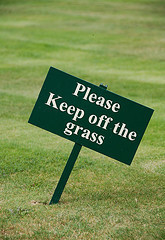 PKotg is a solid example, but just a few of his chums are included in the little gallery below - all sourced from Flickr.

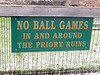
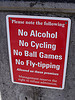 That middle sign in particular seems rather mean-spirited since the priory is already in ruins. Unless the priory was destroyed by a ball game that went way too far, this sign is overkill.
What's interesting about some of these is they aren't providing information. For example - dog fouling and fly-tipping are crimes for which you can receive substantial fines. Even on private property you wouldn't be allowed to say "Dump your old couches here and if you're dog's full up, it can poop too." These signs are the equivalent of putting up a notice that simply reads "DON'T BREAK THE LAW."
They may be well-intentioned, but as Derren Brown showed in one his specials, continually stressing what people should not do (negative reinforcement) makes them feel compelled to do it. The surest way of plunging a country into anarchy is to erect a sign in every street that commands people "DON'T BREAK THE LAW."
Luckily, while Britain is the only country in the world that really understands how to queue, we have an equal level of expertise in irreverence. We like the Queen. And if the Queen asked us not to walk on the grass we'd probably respect that. Anyone else and we'd be swarming over that manicured lawn doing our best Ministry of Silly Walks just to demonstrate the totality of our disregard for the instruction. Leaving the public realm and going into private enterprises, Barbara T Armstong writing in Forbes calls this kind of signage "Workplace Graffiti" and claims it can be detrimental to the way organisations operate. For me the office signs placed by irate or over-zealous co-workers are clear attempts to control the universe by fiat, to substitute good planning and understanding of human behaviour for mechanistic control. And because they don't work as intended, they only serve to create further frustration for their authors.
I've worked in local government for almost a decade and I've found that all the problems of local government fall into four distinct groups: people doing things they shouldn't; people not doing things they should; disproportionate or misdirected anger; and indifference. And the way local government has tried to influence these things for two generations is through forbiddance (the signs above) and denial (for example - speed bumps, parking wardens, ASBOs). It's only quite recently that we've seriously attempted persuasion of anyone who isn't an unruly teenager - and that's where emotionally intelligent communication comes in.
EIC differs from other kinds of communication in that it seeks to change understanding, and thereby behaviour, through empathy. This may be by making it clear to the person receiving a message that the broadcaster understands and empathises with them, or it may be by making the person receiving the message consider the emotions of others.
If you've seen an Innocent advert, or bought one of their products then you've experienced a much more engaging, much more human tone than you'd fine with most brands. Innocent have a gallery of their packing online and it's well worth a look. The overall effect is to generate empathy and I - while fully comprehending that this is the company's intention - genuinely believe that Innocent are more ethical and just nicer than their competitors. As I result of this belief, I view their products more favourably.
They know what they're doing and they do it well, but Innocent aren't alone in attempting to engender empathy. Daniel H Pink - from whom I first learned about emotionally intelligent signage several years ago - collects examples on his blog. Amongst those examples are a growing number of municipal authorities using EIC to prevent speeding, littering, promote care for the environment, cross the road safely and generally just encourage people to be good to each other.
This is a growing phenomenon and it's growing because it works. Okay, so what? Let's start with why we aren't already considering the emotional impact of the messages we send out. Well, I think that's probably because we're not used to doing it.
The most appealing of local government communications tends to be "COME ALONG AND HAVE FUN AT OUR COMMUNITY EVENT." The people who write it really do want others to come along and have fun - but it's still an instruction and it doesn't create any emotional attachment.
Even writers, who should know how to craft a message for effect, set up their Twitter accounts to endlessly spam "READ MY BOOK" messages. Or the far worse "READ MY FREE SHORT STORY" messages. (I'm now personally committed to never reading a short story I haven't paid for. You did this, Twitter authors. Congratulations).
However, as much as it is due to habit, I think empathic messages can make us (the broadcaster) feel weak and it puts us at greater risk of feeling foolish than an authoritarian message.
For local government in particular that's an issue - to the extent that it's easier by far to communicate Message A (which appears consistent with a corporate voice, but won't work) than to communicate Message B (which deviates from the corporate voice, but will work). Anyone who works in local government in the UK will tell you the same issues are occurring around staff access to social media where the corporate centre still has the illusion of control over communications in an age where a local authority is a creature with ten thousand mouths.
The effectiveness of EIC relies on lowering shields. In local government we're often instinctively defensive and writers - especially new writers - are urged to seem professional. The structures we've relied on previously are the ones which are now limiting our reach and effectiveness because they provide so little impetus for others to engage with us.
The reasons for not using EIC are real.
The reasons in favour of using EIC are better. EIC can generate action, it can create attachment and it can increase perceived value far better than authoritarian broadcast messages can. And if nothing else, it must be helpful to us all to stop, before we communicate to our customers, and consider what the emotional impact of our messages will be.
(Though this will not necessarily stop me drunk-tweeting). Okay, now what? At this point I could give some advice about how to make your messages more appealing using EIC. I've been working on some pratical projects for a while that I could talk you through. I think both of those would be interesting. But what I'd really like is to get feedback on how people feel about this and conduct a small experiment.
Over the next week I'll send out two different tweets with links to this blog post. One link will come with an emotional appeal, while the other will be more traditional - reflecting what I see as the way Twitter is often used by authors to communicate at the moment.
Using Hootsuite I'll monitor the number of click-throughs for each message and in a week I'll come back and share my results. (Unless there are no click-throughs, in which case I'll delete this post and we'll never speak of it again. Never). At that point I'll also present some tips about how to improve the emotional appeal of your messages using EIC.
If you liked this post and want to read more, you can help by retweeting both links to your own Twitter followers.
Thoughts and comments in the box below are very welcome.
“What’s emotionally intelligent communication?” I ask myself rhetorically for your benefit. Well let me set the scene.
If you’ve driven any length of highway in the United States you’ll have seen advertising billboards. Constructions three storeys high encouraging you to buy fried chicken or visit Yosemite or seek the services of a local attorney-at-law – in case you’re using said highway to flee from imminent justice.
In Britain we don’t have those. Sometimes you’ll see a generic green sign advising you that at the next turn-off there will be “services”. And by services we mean fuel, dead flowers and charcoal briquettes – we almost never mean dry cleaners, undertakers or even vehicle mechanics. The road signs in Britain are a model to be envied and if all you did was drive from John O’Groat’s to Land’s End (the top bit to the bottom bit) you’d boggle at our minimalist efficiency and think we’d lost the war to both the Germans and the Japanese (but not the Italians).
However, the workplaces, city centres, corner shops, residential streets, parks, beaches, woodlands and farmlands of Britain are dominated by instructional signs. Easily the most infamous and ridiculed is “Keep Off The Grass” or “KEEP OFF THE GRASS” or the very strangely capitalised “Please Keep off the grass” shown below.
PKotg is a solid example, but just a few of his chums are included in the little gallery below - all sourced from Flickr.
That middle sign in particular seems rather mean-spirited since the priory is already in ruins. Unless the priory was destroyed by a ball game that went way too far, this sign is overkill.What's interesting about some of these is they aren't providing information. For example - dog fouling and fly-tipping are crimes for which you can receive substantial fines. Even on private property you wouldn't be allowed to say "Dump your old couches here and if you're dog's full up, it can poop too." These signs are the equivalent of putting up a notice that simply reads "DON'T BREAK THE LAW."
They may be well-intentioned, but as Derren Brown showed in one his specials, continually stressing what people should not do (negative reinforcement) makes them feel compelled to do it. The surest way of plunging a country into anarchy is to erect a sign in every street that commands people "DON'T BREAK THE LAW."
Luckily, while Britain is the only country in the world that really understands how to queue, we have an equal level of expertise in irreverence. We like the Queen. And if the Queen asked us not to walk on the grass we'd probably respect that. Anyone else and we'd be swarming over that manicured lawn doing our best Ministry of Silly Walks just to demonstrate the totality of our disregard for the instruction. Leaving the public realm and going into private enterprises, Barbara T Armstong writing in Forbes calls this kind of signage "Workplace Graffiti" and claims it can be detrimental to the way organisations operate. For me the office signs placed by irate or over-zealous co-workers are clear attempts to control the universe by fiat, to substitute good planning and understanding of human behaviour for mechanistic control. And because they don't work as intended, they only serve to create further frustration for their authors.
I've worked in local government for almost a decade and I've found that all the problems of local government fall into four distinct groups: people doing things they shouldn't; people not doing things they should; disproportionate or misdirected anger; and indifference. And the way local government has tried to influence these things for two generations is through forbiddance (the signs above) and denial (for example - speed bumps, parking wardens, ASBOs). It's only quite recently that we've seriously attempted persuasion of anyone who isn't an unruly teenager - and that's where emotionally intelligent communication comes in.
EIC differs from other kinds of communication in that it seeks to change understanding, and thereby behaviour, through empathy. This may be by making it clear to the person receiving a message that the broadcaster understands and empathises with them, or it may be by making the person receiving the message consider the emotions of others.
If you've seen an Innocent advert, or bought one of their products then you've experienced a much more engaging, much more human tone than you'd fine with most brands. Innocent have a gallery of their packing online and it's well worth a look. The overall effect is to generate empathy and I - while fully comprehending that this is the company's intention - genuinely believe that Innocent are more ethical and just nicer than their competitors. As I result of this belief, I view their products more favourably.
They know what they're doing and they do it well, but Innocent aren't alone in attempting to engender empathy. Daniel H Pink - from whom I first learned about emotionally intelligent signage several years ago - collects examples on his blog. Amongst those examples are a growing number of municipal authorities using EIC to prevent speeding, littering, promote care for the environment, cross the road safely and generally just encourage people to be good to each other.
This is a growing phenomenon and it's growing because it works. Okay, so what? Let's start with why we aren't already considering the emotional impact of the messages we send out. Well, I think that's probably because we're not used to doing it.
The most appealing of local government communications tends to be "COME ALONG AND HAVE FUN AT OUR COMMUNITY EVENT." The people who write it really do want others to come along and have fun - but it's still an instruction and it doesn't create any emotional attachment.
Even writers, who should know how to craft a message for effect, set up their Twitter accounts to endlessly spam "READ MY BOOK" messages. Or the far worse "READ MY FREE SHORT STORY" messages. (I'm now personally committed to never reading a short story I haven't paid for. You did this, Twitter authors. Congratulations).
However, as much as it is due to habit, I think empathic messages can make us (the broadcaster) feel weak and it puts us at greater risk of feeling foolish than an authoritarian message.
For local government in particular that's an issue - to the extent that it's easier by far to communicate Message A (which appears consistent with a corporate voice, but won't work) than to communicate Message B (which deviates from the corporate voice, but will work). Anyone who works in local government in the UK will tell you the same issues are occurring around staff access to social media where the corporate centre still has the illusion of control over communications in an age where a local authority is a creature with ten thousand mouths.
The effectiveness of EIC relies on lowering shields. In local government we're often instinctively defensive and writers - especially new writers - are urged to seem professional. The structures we've relied on previously are the ones which are now limiting our reach and effectiveness because they provide so little impetus for others to engage with us.
The reasons for not using EIC are real.
The reasons in favour of using EIC are better. EIC can generate action, it can create attachment and it can increase perceived value far better than authoritarian broadcast messages can. And if nothing else, it must be helpful to us all to stop, before we communicate to our customers, and consider what the emotional impact of our messages will be.
(Though this will not necessarily stop me drunk-tweeting). Okay, now what? At this point I could give some advice about how to make your messages more appealing using EIC. I've been working on some pratical projects for a while that I could talk you through. I think both of those would be interesting. But what I'd really like is to get feedback on how people feel about this and conduct a small experiment.
Over the next week I'll send out two different tweets with links to this blog post. One link will come with an emotional appeal, while the other will be more traditional - reflecting what I see as the way Twitter is often used by authors to communicate at the moment.
Using Hootsuite I'll monitor the number of click-throughs for each message and in a week I'll come back and share my results. (Unless there are no click-throughs, in which case I'll delete this post and we'll never speak of it again. Never). At that point I'll also present some tips about how to improve the emotional appeal of your messages using EIC.
If you liked this post and want to read more, you can help by retweeting both links to your own Twitter followers.
Thoughts and comments in the box below are very welcome.


No comments have been added yet.