
Mapping Kjartansson’s The Visitors
The Visitors, Ragnar Kjartansson’s nine-screen audio-video masterpiece, has been on display at SFMOMA in its own dedicated room for just over two years, and I’ve lost track of how many times I’ve seen it. I stopped by the museum on November 26, a Tuesday, for another hour-long viewing.
If you haven’t seen, or heard of, The Visitors, it’s a popular art installation that has toured the world. In it, a group of musicians play the same single, simple, hypnotic song comprised of just a few repeating verses for approximately an hour straight. Each musician is in a different part of an 1815 mansion in New York’s Hudson Valley, and each gets their own screen, though occasionally a member of the ensemble will cross from one to the next. If you observe what is happening closely enough, you can sort out which spaces are near each other within the mansion.
Each time I go, I tend to sit near one or two screens, and I pay attention to them specifically, and also listen to how the audio from the other screens correlates with what is happening in their part of the house. On the ninth screen, a small audience sits outdoors on the house’s porch, and just to keep things interesting — as if they are not enough already — there’s an elderly man who not once but twice sets off a portable cannon.
There are some electric instruments in the mix — guitars, a bass — but the majority are acoustic: banjo, cello, accordion, and so forth, including a lot of singing. And, even though every musician is wired for video and audio (and to each other through headsets), the vibe remains very acoustic, with a deep resonance that is as harmonically and tonally rich as it is melodically straightforward. A testament to the musicianship — members of the bands Múm and Sigur Rós are in the group — is how little they all do, no one hogging the spotlight, no one showing off.
This time around, I focused on the drummer, Þorvaldur Gröndal, and I noticed something I hadn’t before, something that at first looked like sheet music or a page from a notebook. It was resting on a chair near Gröndal’s drum set. This is a close-up:
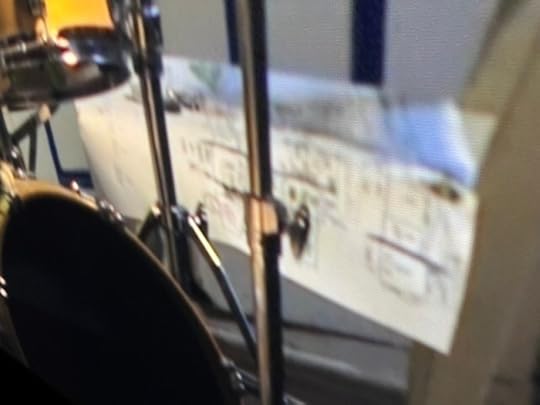
I went back toward the end of the video, when all the musicians wander down the hillside together, and pretty much everyone in attendance at the museum had gathered around that one screen. I walked back around to the other screens, where no one was lingering, and looked more closely. This will sound funny, but I felt more comfortable looking then because the musicians had all vacated their rooms. With their individual performance spaces uninhabited, I didn’t feel like I was encroaching on their privacy.
The drummer’s document no longer looked like sheet music; it had started to look to me like a map of the floor plan of the mansion. I then recalled this image from the fantastic aural history of The Visitors by Sebastian Smee, Gabriel Florit and Joanne Lee that the Washington Published back in 2021:
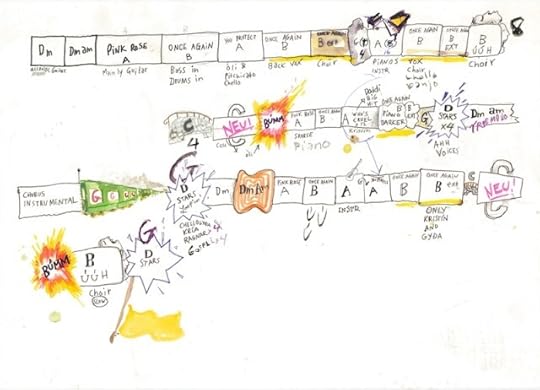
A lot is revealed in this document, which is essentially a score in the form of graphic notation. For example, there are the two “búmm” (or “bomb”) markers when the cannons go off, and there are the spots labeled “Neu!” in a way that nods to the covers of albums by the great German band of that name.
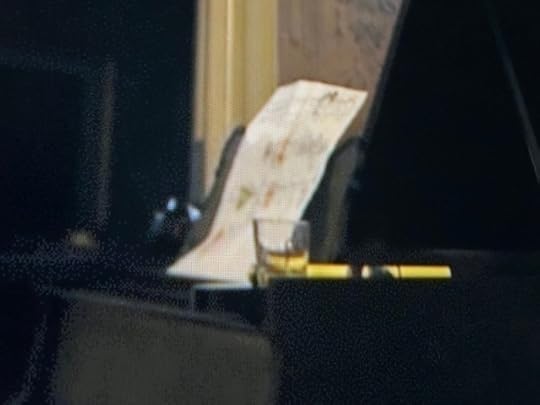
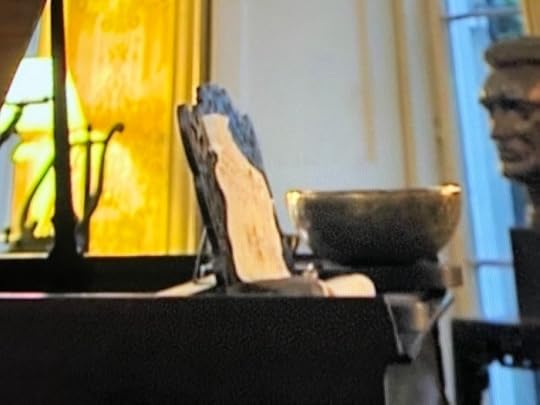
I confirmed after I left the exhibit that the drummer’s sheet and this image were the same. Gröndal’s version does seem to have been marked up, with thick vertical lines identifying several junctures. It also appears that at least two other musicians had these same charts in plain view. Here are details from each of the two pianists’ screens:
Every time I visit The Visitors I hear and see something new. It’s running at SFMOMA until January 26, 2025, and I’m sure to spend at least two or three more hours in the dark with it between now and then.


