Let us save the native plants
 Oplus_131104
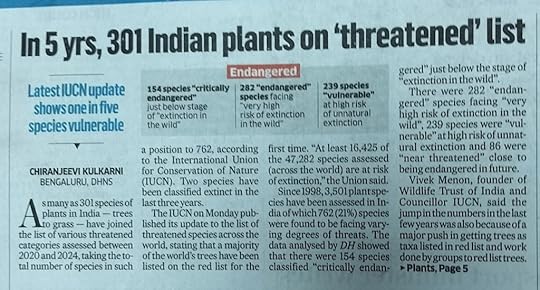
This news report should come as no surprise. Till now the extinction of animals and birds have been the subject of much public discourse. It is not that plants have not been getting extinct. What could be alarming is that there could be plants that have become extinct without coming to our notice for being in existence.
Coming to native plants, here are a list of plants which find mention in Kalidasa’s Ritusamhara. This is not an exhaustive list of native plants. The plants that come into limelight depending upon the seasons are mentioned here. But this can be taken as a starting point. Maybe, the reader can check how many plants he or she can identify as having come across somewhere.
Summer: Bhadramusta // Palasha // Sindhura // Bamboo // Salmali // Patala //
Rainy season : Padma // Kandali // Utpala // Bimba // Kadamba // Sarja // Arjun or Kakubha // Ketaki // Bakula // Aguru // Malati // Yuthika //
Autumn: Kasa // Saptaparna // Bandhuka // Kovidara // Kutaja // Sephalika // Nipa or Kadamba // Nilotpala (Blue water lily) // Padma or Kamala or Pankaja (Lotus) // Kumuda (white water lily) // Priyangsu // Asoka //
Hemanta or Dewy season : Lodhra // Kunda // Kaliyaka //
Spring: Amra // Kusumbha // Karnikara //Atimukta // Kurubaka //Saileya // Asoka // Jasmine
My maternal grandparents had a huge garden surrounding two sides of their house. It was a small village and theirs was the corner house. The garden contained a sample of most of the fruit / flower plants native to Odisha. The garden had ten to fifteen varieties of native mango plants, lots of banana, lemon, palm(tala) and coconut trees. In addition it had at least one plant of these (as far as I remember):
Shikakai
Amla (Amalki)
Harida (Haritaki)
Bahada (Bibhitaki)
Narakoli (Nurphal)
Karamanga (Kamrakh, Star Fruit)
Ramphal
Sitaphal
Dalimba (Anar)
Bela, Kapitha (wood apple), Tarata, Mandara(Hibiscus), Madhu malati, Ganga- shiuli(Har singar), Bakula, Kaniara
I might have missed some. To keep it simple I have given mostly their desi names. Hope many would be able to identify them. For those who want more hints, of course Google does help.
Last year I visited their village. I did not have time to scan the entire garden. But I could spot only a few of those plants.
For various reasons, our road sides and barren lands were planted with many imported trees. Or with plants that needed less water. Modern landscapes around posh houses are mostly about grass and imported plants. We as human beings do have fascination for exotic things. There was a time when even in the name of forestation, plants like Eucalyptus etc. were preferred over native trees. These could be some of the reasons why we see less of native plants in private gardens and public spaces in India.
In vedic astrology the apparent movement of sun has been divided into twelve zodiacs and twenty seven Nakshatras. Each zodiac and Nakshatra has been mapped with a particular plant. This comes from the tradition of Indian Rishis.
Our ancients also prescribed particular food for particular festivals. Even particular flowers have been associated with particular festivals and deities. Many may not agree with their esoteric significance. But, can we deny that such traditions made us care for our native plants?
I am sure such things must be happening in other countries also. There are reports that massive deforestation is happening in African countries to meet the demands of developed countries. Countries in South America are also facing the same issue.
Whatever has happened has happened. At least now on let us take the warning bell seriously and start concerted efforts to preserve the native plants. All of us can do something in this regard. Whenever we get the opportunity to plant something, let us give priority to native plants. And if you are a social media influencer, you can spare some time at least to create awareness about this. Who knows, our small individual efforts may turn into huge collective impact in due course of time.