
CMP#208 Rosella by Mary Charlton, part 3
 “If your niece is really sane, which I have some reason to suppose, I trust that her past danger will henceforth teach her to pay a little more deference to the established usages of society than I hear she has lately done.” --Mr. Mordaunt to Mrs. Delavel in Rosella CMP#208 Mary Charlton Week: Rosella, or, Modern Occurrences, part 3
 “For my own part, I am excessively fond of a cottage" At the beginning of the third volume, we are wandering about the romantic landscapes of Scotland and also we’ve wandered deep into Spoiler territory. So if my previous blog posts have convinced you to read Rosella for yourself, perhaps leave this post alone until you've read Rosella. It is available online and there is also a
modern Chawton House
edition (your local university library might have a copy).
“For my own part, I am excessively fond of a cottage" At the beginning of the third volume, we are wandering about the romantic landscapes of Scotland and also we’ve wandered deep into Spoiler territory. So if my previous blog posts have convinced you to read Rosella for yourself, perhaps leave this post alone until you've read Rosella. It is available online and there is also a
modern Chawton House
edition (your local university library might have a copy).As Sophia Beauclerc, our heroine Rosella, and their servant Nancy travel through Scotland, escorted by young Mr. Oberne, Sophia is of course drawn to the ruins of every castle and every sublime sight of nature. This section of the novel is part travelogue, which would have been great for Regency armchair travelers.
An encounter with the poverty-stricken locals gives Rosella a chance to perform an act of charity for a poor widow and her ten children. As I’ve written elsewhere, having the hero be entranced at the sight of the heroine performing an act of charity was a frequent trope in novels of this era, and Charlton plays this straight; the scene is not handled as say, Austen handles the same idea in Emma, with Emma being deluded about Mr. Elton's feelings for Harriet. By now the reader is pretty certain that Mr. Oberne is developing feelings for Rosella.
 "A group of half-naked children...ran before her, barefooted on the rocky ground..." Instead of spoofing the trope itself, Charlton adds the comic touch that Sophia Beauclerc assumes the poor widower must be the greatly reduced daughter of gentlefolk: “To the hut therefore she went, but after a very minute and useless exordium to induce the afflicted widow to repose her private sorrows in the faithful bosom of a new but tender and affectionate friend, she found, to her unspeakable disappointment, that the poor woman[‘s] …father, instead of being the ennobled Lord of a fine old castle, containing a fine old skeleton, and a fine old mysterious manuscript, was no other than a wretched fisherman, who caught and cured herrings on the Isle of Arran.”
The reality is hard for Sophia to accept. In fact she is so disappointed with the dismal appearance of cottages in Scotland that she secretly, and at great expense, sends orders for one particular cottage near the village of Dunkeld be decorated and furnished. When they arrive there, it turns out the cottage adjoins Lord Morteyne’s estate. What looks again like a ridiculous novel coincidence is in fact part of Sophia and Selina’s scheming. It is here that his Lordship brings his new bride along with a houseful of guests. When Sophia and Selina learn that Lord Morteyne is married, Selina ships (again at great expense) Rosella’s harp from Richmond all the way to Dunkeld, so they can dump it in Lord Morteyne’s front yard with an haughty message from Sophia about how he’s broken Rosella’s heart and will have to live with his conscience. Morteyne, of course, never had a second thought about Rosella, and never behaved inappropriately toward her, either.
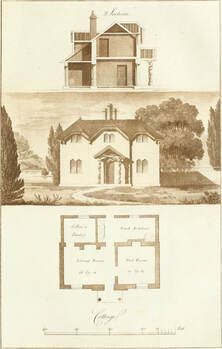 Cottage ornee Sophia also engineers a dramatic scene because she wants to confront Lord Morteyne with the doings of his now deceased uncle, the Mr. Estcourt who offered the large loan to her late husband, as described in part one.
 Picture the scene: Lord Morteyne comes to visit Sophia at the cottage. She dramatically unfurls some old documents.
“You had an uncle?” said the gentle elucidator, after a pause of some moments.
“I had three, Madam,” returned her auditor.
“It may be,” resumed Miss Beauclerc, rather disconcerted: “but the man to whom I owe all the hours of sorrow I have known—the man whose vices were destined to be a scourge to me and mine! –Alas, my Lord…. Your Lordship cannot wonder that I should suffer my anguish to relieve itself in the bitterness of complaint.”
“Perhaps, Madam,” said he rather gravely, “I should wonder less, if you would do me the honour to give me some intimation of the injuries you seem to deplore.”
“I entreat your patience,” cried the lady: “surely, my Lord, you will allow for the imbecility of grief?”
“I compassionate imbecility of whatever kind it may be,” replied Lord Morteyne; “but give me the liberty to observe, that my impatience to learn the grievances you hint at, is in part the effect of an earnest wish to alleviate them.”
“That, my Lord, is not in your power,” said Miss Beauclerc, with something of anger in her manner.
“If it is so,” observed he, “you will pardon me, Madam, that I am at a loss to comprehend why you have given yourself this trouble.”
Then Miss Beauclerc, in a sublime moment of heroism, gives him her “note,” that is, her personal check--for the full nine thousand-odd pounds of her late husband’s debt to the late Mr. Estcourt, which will mean she has nothing to leave to Rosella, which will “beggar” Rosella—who, of course, knows nothing about any of this. Lord Morteyne refuses to take the money and things get crazier and funnier after that. Lord Morteyne comes away convinced that Rosella is in the hands of a very unstable woman but it would be risky to interfere. Rosella herself is so filled with doubt as to Miss Beauclerc’s credulity and judgement that when she finally reveals that she is Rosella’s mother, Rosella can’t believe her.
News of Miss Beauclerc’s eccentric behavior reaches her cousin Mr. Bristock, the next heir to the Beauclerc estates who fears that there will be nothing left to inherit by the time Miss Beauclerc dies (and she’s not old, she’s not even forty). He colludes with Miss Beauclerc’s land agent in Scotland to have her examined and then confined in an insane asylum. This, in turn, leaves Rosella alone, far from London, with almost no money—since her avaricious relative only knows her as a mysterious orphan who is the ward of the Ellingers and therefore, no responsibility of his. Luckily, young Mr. Oberne has been keeping an eye on her and he’ll do everything in his power to help, but, as a respectable young lady, she cannot stir until she has a proper escort to return to London.
Rosella recalls a female relative of Miss Beauclerc’s, an aunt, who lives in Dumfries. She and the servant Nancy travel there, and she soon discovers that Mrs. Delaval is a victim of what we’d call elder abuse. She is kept as a virtual prisoner in the slovenly home of her friend Mrs. Macdoual. Mrs. Macdoual’s husband is a frightening man who bullies gifts and loans of money out of his house guest. Mrs. Delaval leaps at the chance to return to London with Rosella, and she in turn is the suitable escort Rosella needs. Rosella rescues her from the MacDouals, and though Mrs. Delaval has a leg injury, they set out for London, where they seek legal assistance to get Miss Beauclerc out of the insane asylum.
The Gothic conceits ended, of course, when Sophia Beauclerc was sent to the asylum. What the death of her bridegroom did not achieve, being locked up for several months as a lunatic did; with the assistance of Mr. Mordaunt, her kindly financial advisor, she is rescued, and she comes out chastened. She sees the error of her ways and the harm that she did to Rosella. Sophia is restored to her life interest in the family estate and wants only to live out her life in peace there.
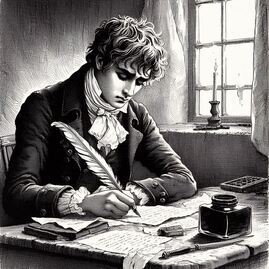 Her aunt Mrs. Delaval is not long settled back in London, when she dies of blood poisoning, after having remade her will to leave most of her estate to her lovely great-niece, Rosella. I will say that this introduction of sudden riches for the heroine is handled with much more finesse than is usually done in novels or this era, when a rich uncle from the West Indies just suddenly shows up. Rosella has earned the esteem of her great-aunt through her courageous and principled behaviour. At any rate, Rosella now has more than twenty thousand pounds which brings on more complications and love rivals for both Oberne and Rosella. One of the “men of fashion” who tormented and insulted her, now sends a letter proposing marriage! She of course refuses him. But rumours start to circulate that she is going to marry Mr. Lesley, the brother of Lady Morteyne, which brings a “farewell forever!” letter from Mr. Oberne. Propriety prevents Rosella from answering him and setting him straight because girls just can't do that.
Meanwhile, Selina Ellinger has left her grouchy husband, so Rosella can't live there any more. She stays with Mr. Mordaunt and his snooty sister Mrs. Methwald, a female pedant who looks down her nose at Rosella. Rosella suffers the usual jealousy and coldness that beautiful heroines experience from both Mrs. Methwald and her daughter Mrs. Cressy. Except for Mr. Mordaunt, most of the people who surround Rosella are irritating or foolish or both. Happily, Lord Morteyne’s kind sister Lady Lucy invites Rosella to visit her at her London home and who should be waiting for her there but-Mr. Oberne! He is now Lord Clanallan, due to the offstage death of his older brother. With two independent fortunes between them now, there are no impediments to true love.
The story wraps up. The snooty people who looked down on Rosella are confounded now that she's going to marry an Irish peer: “Mrs. Methwald and her peerless daughter [ha, see what she did there?] received a shock by the intelligence of the approaching marriage of Rosella, which required all their fortitude and self-command… for the circumstance was a strong libel on their judgment and discernment which had led them to predict that Rosella would remain the insignificant, unnoticed, mysterious little personage they would fain have thought her; and they now foresaw that they must toil hard in the trammels of forced civility and repulsed attentions, before they could induce the future Lady Clanallan wholly to forget the time, when neither maxim nor philosophy could make them overlook her offensive youth and beauty and discover her claims to kindness.”
More thoughts about Rosella in my next post.... Previous post: Rosella, part 2 Next post: Rosella, final thoughts


No comments have been added yet.


