Book Review: Trust in Numbers
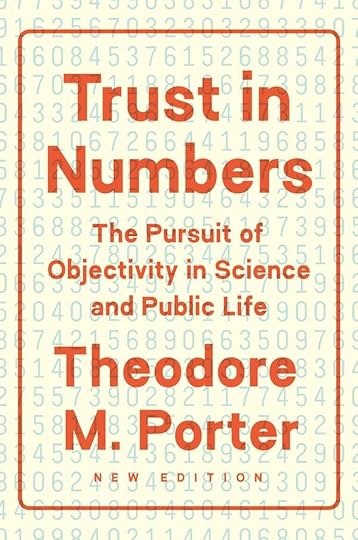
Trust in Numbers: The Pursuit of Objectivity in Science and Public Life by Theodore Porter, Distinguished Professor Emeritus of History, UCLA.
There are two general approaches to decision-making. One way is to make a judgment call. Informally, you could call this “trusting your gut”. Formally, you could describe this as a subjective, implicit process. The other way is to use an explicit approach that relies on objective, quantitative data, for example, doing a return-on-investment (ROI) calculation on a proposed project to decide whether to undertake the project. We use the term rigorous to describe these type of approaches, and we generally regard them as superior.
Here, Porter argues that quantitative, rigorous decision-making in a field is not a sign of its maturity, but rather its political weakness. In fields where technical professionals enjoy a significant amount of trust, these professionals do decision-making using personal judgment. While professionals will use quantitative data as input, their decisions are ultimately based on their own subjective impressions. (For example, see Julie Gainsburg’s notion of skeptical reverence in The Mathematical Disposition of Structural Engineers). In Porter’s account, we witnessed an increase of rigorous decision-making approaches in the twentieth century because of a lack of trust in certain professional fields, not because the quantitative approaches yielded better results.
It’s only in fields where the public does not grant deference to professionals that they are compelled to use explicit, objective processes to make the decisions. They are forced to show their work in a public way because they aren’t trusted. In some cases, a weak field adopts rigor to strengthen itself in the eyes of the public, such as experimental psychology’s adoption of experimental rigor (in particular, ESP research). Most of the case studies in the book come from areas where a field was compelled to adopt objective approaches because there was explicit political pressure and the field did not have sufficient power to resist.
In some cases, professionals did have the political clout to push back. An early chapter of the book discusses a problem that the British parliament wrestled with in the late nineteenth century: unreliable insurance companies that would happily collect premiums but then would eventually fail and would hence be unable to pay out when their customers submitted claims. A parliamentary committee formed and heard testimony from actuaries about how the government could determine whether an insurance company was sound. The experienced actuaries from reputable companies argued that it was not possible to define an objective procedure for assessing the a company. They insisted that “precision is not attainable through actuarial methods. A sound company depends on judgment and discretion.” They were concerned that a mechanical, rule-based approach wouldn’t work:
Uniform rules of calculation, imposed by the state, might yield “uniform errors.” Charles Ansell, testifying before another select committee a decade earlier, argued similarly, then expressed his fear that the office of government actuary would fall to “some gentlemen of high mathematical talents, recently removed from one of our Universities, but without any experience whatever, though of great mathematical reputation.” This “would not qualify him in any way whatever for expressing a sound opinion on a practical point like that of the premiums in a life assurance.”
Trust in Numbers, pp108-109
Porter tells a similar story about American accountants. To stave off having standardized rules imposed on them, the American Institute of Accountants defined standards for its members, but these were controversial. One accountant, Walter Wilcox, argued in 1941 that “Cost is not a simple fact, but is a very elusive concept… Like other aspects of accounting, costs give a false impression of accuracy.” Similarly, when it came to government-funded projects, the political pressure was simply too strong to defer to government civil engineers, such as the French civil engineers who had to help decide which rail projects should be funded, or the U.S. Army Corps of Engineers who had to help make similar decisions about waterway projects such as dams and reservoirs. In the U.S., they settled on a cost-benefit analysis process, where the return on investment had to exceed 1.0 in order to justify a project. But, unsurprisingly, there were conflicts over how benefits were quantified, as well as over how to classify costs. While the output may have been a number, and the process was ostensibly objective, because it needed to be, ultimately these numbers were negotiable and assessments changed as a function of political factors.
In education, teachers were opposed to standardized testing, but did not have the power to overcome it. On the other hands, doctors were able to retain the use of their personal judgment for diagnosing patients. However, the regulators had sufficient power that they were able to enforce the use of objective measures for evaluating drugs, and hence were able to oversee some aspect of medical practice.
This tug of war between rigorous, mechanical objectivity and élite professional autonomy continues to this day. Professionals say “This requires private knowledge; trust us”. Sometimes, the public says “We don’t trust you anymore. Make the knowledge public!”, and the professionals have no choice but to relent. On the subject of whether we are actually better off when we trade away judgment for rigor, Porter is skeptical. I agree.