Two Jews in a Canoe Loose on Moose Lake (try saying that fast 5 times)
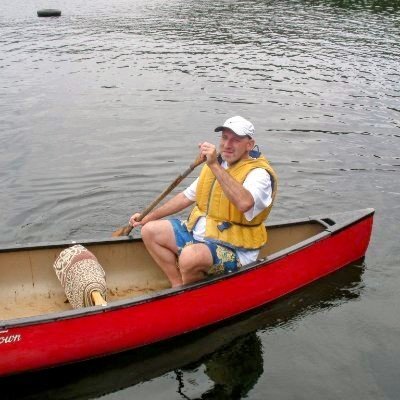
When I was a child, my happy place was my overnight summer camp on Moose Lake in Haliburton, Ontario. Getting out of the city to a beautiful forest setting and away from the oversite of parents was the ultimate thrill.
I met my good friend Ted at the camp 57 years ago. Since 2007, I have been returning each summer when I’m able to attend an alumni weekend with my old cabin mate Ted. The weekend is a steady routine to relive those memories aided by alcohol and drugs. Included in the ritual is a one-mile lake swim for the better swimmers.
The swim is a highlight for Ted. The camp requires that each swimmer have two people in a canoe alongside them. One is watching the swimmer while the other steers the canoe. This year Ted had difficulty finding two people. I stepped forward to take on the job, or I should say jobs. I would just keep on eye on Ted and control the canoe. I mean what could go wrong?
I snap on my life vest and hop into the stern (back) of the canoe. Ted carefully gets into the bow (front) and we head out to the starting point. About 100 feet from shore Ted realizes he forgot his swimming goggles. I want to turn around and return to shore. Ted has a better idea. There’s a sailing dock right next to us and he insists that he can get out at the docks and run to the shore for the goggles. Sure. Why not? What Could go wrong?
I pull the canoe alongside the dock and grab hold to stabilize it. Ted leans over to step out of the boat and the next thing I know, I’m upside down in the water and so is the canoe. The camp’s canoe staff come running onto the dock to help these two klutzy old guys in the water with a capsized canoe. As we struggle to empty the water from the canoe, one of the staff bends down and grabs the bow. He stands up, lifting the boat out of the water which causes the water to rush out. In one motion, he flips over the empty canoe and drops onto the water.
Ted scampers to shore to retrieve his goggle and I steer the boat back to shore, not wanting to repeat the canoe flipping when Ted tried to get back in. Getting in and out of the canoe is much easier from shore than from a dock. Wet but determined we paddle our way to a camping site on the lake. I noticed the water is choppy, and there is a strong current pulling us back to the shore. I find a large flat rock to anchor ourselves so that Ted can get out without turning us over again. He pulls his google down to protect his eyes and begins the one-mile swim. The toughest part of the trek is past us. I just had to follow Ted as he slowly swam back to the camp. What could possibly go wrong?
Now when you are solo in a canoe, you do not sit in the stern. You sit in the bow facing the back of the canoe to provide better stability. Well, I had forgotten this detail. Trying to stay close to a slow swimmer while battling waves and a strong current requires in an unstable boat requires a lot skill. I may fallen a little short in this department. As the current pushed towards the shore, I struggled to keep the canoe in the middle of the lake close to Ted. Suddenly I found myself in the water with the canoe overturned. Lovely.
It takes a lot of effort to get water out of a canoe in deep water. You need to rock it from side to side trying to get the water to slosh out. We tried this for a few minutes and it only got us exhausted. Instead, we slowly pushed the canoe to the shore, making sure we didn’t lose our paddles. The shore is lined with large rocks and overhanging tree branches. I noticed a spot with a flat rock above the waterline that I could stand on. I pulled the canoe to that spot and used all my strength to lift one end of the inverted boat out of the water. Ted stood under the other end and lifted it over his head. As the water rushed out, we flipped to canoe over.
I slowly climbed back into the canoe, being extra careful about not tipping it over. I pulled the paddles back into the canoe and Ted pushed us away from the rocks on the shore. He returned to swimming and I went back to fighting the current and staying afloat. At this point, I was well aware what could go wrong. And it did go wrong. The canoe tipped again several minutes later.
An hour into the trek and we had maybe traveled 200 yards. Again, we pushed the canoe back to the shore. This spot I found had a lot of overhanging branches and I had to maneuver us so that there was enough clearance for me to stand. As I’m struggling to get us there, the camp’s pontoon boat loaded with alumni passed by about 100 yards out from the shore. We hung our heads in shame expecting the boat to come to the rescue of the two water-logged shlubs. No, that’s not what happened. The people in the boat enthusiastically waved at us as if we were having the time of our lives in a flipped canoe.
We decided it was too difficult to control the canoe alone. We were going to empty the canoe and paddle back to camp together. We followed the same process and I got in the bow this time, and Ted sat in the stern. But the strong current kept pushing back to the shore and we got tangled in tree branches which were hitting me in the head and torso. At one point I had to lie flat on my back as we passed over a 4-inch thick branch that was about to clobber me in the head. When we finally got out, the canoe was filled with twigs, branches, cedar needles.
When we were able to take control of the canoe and paddle in a straight direction, a sense of relief set in which was followed by hysterical laughter. We were soon laughing so hard that we stopped paddling and for a moment I was sure we would tip again. The lake gods felt pity for us and we finally got back to the camp. The ever vigilant canoe staff didn’t even notice the debris on us and in the canoe. The other swimmers looked at us wondering what took us so long. We would soon be telling stories about canoe tipping and flipping over a glass or two of wine.