
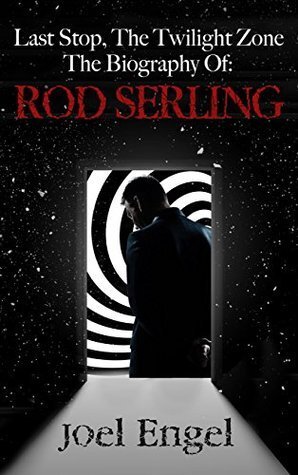
“LAST STOP, THE TWILIGHT ZONE, THE BIOGRAPHY OF: ROD SERLING,” BY JOEL ENGEL
Many years ago, I was sitting in a bar in Burbank, drinking a beer, while waiting for a prescription to be filled next door at the pharmacy. I picked up a discarded magazine and started reading an interview with the great music producer, George Martin. At the end of the interview he used a saying I heard many times before but coming from him it affected me differently. He said, “If you have heroes, do yourself a favor and never meet them because you will only be disappointed.”
I worked at a very famous/infamous restaurant where I came in contact with famous people from all walks of life, but especially the movie business. Whether greeting people at the door or waiting tables I met famous people all the time. I had many conversations with a few of them over many years. My conversations with Ray Liotta were so great that when he died it was like I had lost a close friend. The same with Sam Shepard, and Don Rickles. I would say, that 98 percent of the so-called famous people I came in contact with were polite and nice. The two percent that were far from nice or polite, I lost all respect for, regardless of their accomplishments.
I have never been star struck nor have I ever asked for an autograph. In truth, all my heroes…except for a few…have been dead for awhile and in some cases nearly a thousand years. When a friend of mine asked me if I would like to meet Martin Scorsese I politely said “no,” the words of George Martin ringing loudly in my ears. First impressions can seriously be long lasting and I wasn’t going to take a chance. When given an opportunity to meet Frank Sinatra I almost gave in but George Martin’s wisdom won out, again.
So you must be saying what does this have to do with a biography on the late Rod Serling. Another thing I very, very seldom do is read biographies on movie people, dead or alive. But of late, I have made a few exceptions. I read a biography on the late Mary Tyler Moore because for over twenty years I walked by the studio her husband and she made famous, MTM, nearly every day. I learned a lot about this amazing lady that I had no idea about and was happy I read the book.
Rod Serling has been an individual who has fascinated me nearly my whole life and there are three reasons why: 1) The brilliance of The Twilight Zone. 2)His military service during World War 2. He tried to enlist but was turned down because he unknowingly received his draft notice. He could have asked for a deferment because he was accepted at a number of universities but declined. When he told the Colonel in charge that he wanted to be a paratrooper he was rejected because of his height. He was 5ft.5inches tall. He continued to harass the Colonel until the Colonel finally gave in and said, “if you want it that bad, go ahead. You’re in.” He passed basic training and was assigned to the 511th paratrooper infantry division. Being a paratrooper is the most dangerous job you could have in the military, even more dangerous than being a regular infantry combat soldier. Rod Serling was sent to the Pacific arena where he and the rest of the 511th division saw some of the worst combat in the entire war. The 511th was spared the attack on Japan when the Atomic bombs were dropped and the war ended. Ironically, later in life he became a strong advocate against the use and building of nuclear weapons. 3) When asked what he wanted on his tombstone after he had become famous he simply replied, “He left friends.”
Joel Engel’s biography, ” Last Stop, The Twilight Zone, The Biography of : Rod Serling,” was the first biography to come out about Mr. Serling ten years after his death at the age of 5o. It is a comprehensive look at a complex individual who grew up in Binghamton, N.Y., fought in World War 2, graduated from college where he ran the college newspaper, and went to New York City and found success on Kraft Television Theatre with a play called “Patterns,” and at Playhouse 90 television theatre with “Requiem for a Heavyweight.” Before and in-between these two successes there were many rejections of material he had submitted for publication. Rod Serling started his career when Television was in its infantry and companies who advertised on these programs literally had final say on what was acceptable and what wasn’t. Without their advertising dollars there was no programming. This would be a sour point with Mr. Serling throughout his career, even when he became a spokesperson for many of the companies that controlled what the audience saw or didn’t see.
As television grew Mr. Serling moved his family to Los Angeles where most of the T.V. shows were now shot. He was a prolific writer, and when I say prolific I mean prolific. He literally hit it out of the ball park when it came to submitting material. With the success of “The Twilight Zone,” he was able to easily sell many of his rejected scripts that he had piled up throughout the years. He wrote two-thirds of “The Twilight Zone,” episodes over its five year run which is simply astonishing.
Mr. Serling adapted fairly quickly to Hollywood. In no time he was sporting a tan, driving around in convertibles, and smoking two packs of cigarettes a day, even though he was warned numerous times by his doctors that he had to stop smoking. The smoking got so bad that he lost his circulation in one of his fingers and couldn’t type anymore. From then on, he tape recordered his scripts and plays and his longtime secretary Majorie Langsford would transcribe the recordings.
The success of “The Twilight Zone,” made Mr. Serling very possibly the most famous writer in America at the time. One reason being that he narrated parts of each show and was on camera for the audience to see. Mr. Serling was a very generous individual who gave to many charities, picked up almost every check when out to dinner with friends, left three-hundred dollar tips, and never turned down a person who asked for an autograph.
Despite the success of “The Twilight Zone,” he continued to write scripts, plays, and adapt other writers’ novels for the movies or T.V. at an unusually fast pace. He was naturally paid handsomely for his work but very little of it ever made it to the big screen or T.V., and if it did it was heavily edited by another writer.
Mr. Engel contributes this desire to continually write at such a fast and prolific pace, sport a tan, drive beautiful cars, and always wanting to be in the spotlight to an “Inferior Complex,” because of his height…5 feet, 5 inches tall, and a latent knowledge that he was meant to die young like his father who passed away while he was in the military.
Mr. Serling would never again reach the peak he hit with “The Twilight Zone.” “Night Gallery,” was a very short lived show which the author attributes to lack of good material. Strangely, this reader at times seemed to get the impression that Mr. Engel, the author, got a certain satisfaction out of Mr. Serling’s failures. He put a heavy emphasis on his failures, and his constant need to be recognized, and what he perceived as an ‘inferior complex,’ coupled with an obsessive compulsive disorder.
After finishing reading this book, I wished I had continued to follow Mr. Martin’s advice about meeting your heroes…or in this case reading biographies about people who you greatly admire.
After a little time passed, I realized that what I read and which disturbed me was the author’s impressions of Mr. Serling. Mr. Serling suffered from insomnia, and his compulsion to constantly work might not have been so much the effects of an ‘inferior complex,’ but his experiences during the war which were gruesome. Even though he wrote about the insanity of war quite a bit, what he and his buddies experienced fighting the Japanese was never far away and when he did get some sleep he dreamed of his military experiences but strangely enough most of the dreams had a happy ending.
Mr. Serling was a great talent, undeniably flawed, and who lived with many regrets but in his short life he contributed handsomely and a person who actually lives life will always have their share of regrets like Mr. Serling had. Even in “The Twilight Zone,” regrets among many of the characters played a major part in driving the magnificence of the show.


A Curious View: A Compilation of Short Stories by Joseph Sciuto
- Joseph Sciuto's profile
- 169 followers

