The Gravitational Wave Background Detected
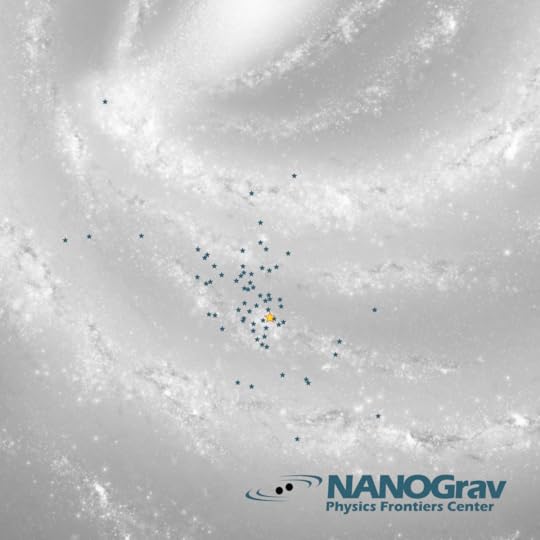
An illustration of positions of Milky Way’s pulsars included in NANOGrav’s 15-year dataset. Blue stars indicate pulsars, while the central yellow star represents Earth’s position. (Image credit: NANOGrav)
On Earth, gravitational wave detectors have in recent years enabled the detection of specific gravitational wave events such as mergers of black holes and neutron stars. However Earthbound detectors are nowhere near sensitive enough to detect a background of gravitational waves, though such background has been theorised.
Now, a collaboration worldwide has enabled detection of that background by an ingenious use of a “galaxy-wide antenna”. Observations of 70 pulsars in our galaxy over the last 15 years have amassed sufficient data to extract this background signal. These millisecond pulsars are dead stars that are spinning up to a 1000 times a second and send a pulse of light with each rotation – they are incredibly accurate clocks at different known places within the galaxy. If the space between Earth and the pulsar was empty and “still” then the pulse would be detected with total regularity. But gravitational waves lengthen and contract the space between us and them, and therefore lengthen and contract the time taken for the pulses to arrive.
It is the pattern in these timing-variations that has been teased out of the data which shows the gravitational wave background “hum” – it is presumed to arise from the mergers of supermassive black holes throughout space and throughout the age of the universe.