ANNA ESPARHAM | HARNESSING STRATEGIES CHILDREN CAN BEGIN USING FOR THEIR OWN EMOTIONAL WELL-BEING
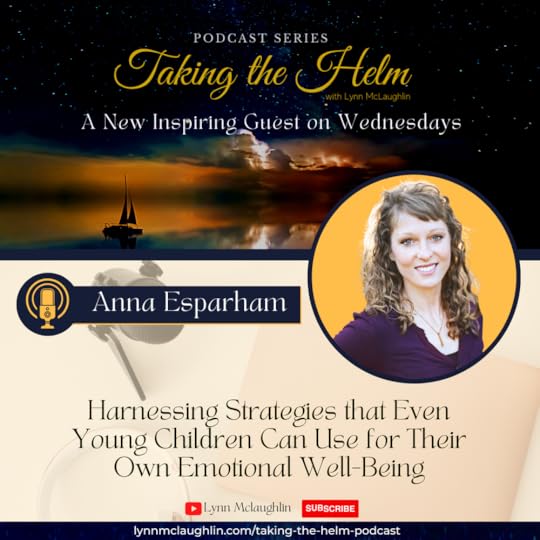
Hello, everyone, and welcome back as we take the helm, focusing on our and our children's mental health. If you want to learn some new strategies that you can teach your children as young as three and four years old, listen up. Anna Esparham is our guest today.
00:00:18 Music Intro
Are you facing a crisis in your life or business? It's time to steer yourself in the right direction through the real experiences, passion, and courage of our guests. We're taking the helm with your host, Lynn McLaughlin .
Well, let me do a brief introduction and turn it over to Anna. She is just leaving Children's Mercy Hospital to pursue another academic qualification. She's trained in headache, pain in sleep clinics, a medical clinic. She's a certified physician in acupuncture pediatrics. My goodness. Well, Anna, we are beyond excited to have you today with us to talk about children's emotional health, children's well being, and you come with a wealth of information that we really need to tap into and share around this world.
00:01:05
I am so excited. Yeah, thanks for having me, Lynn
Okay, well, we look at your big transition right now, but what have you been doing for the last little while in your career?
Well, okay, yeah, I've kind of jumped around a little bit, but currently I'm triple board certified in pediatrics, so that's my main pediatric residency. So board certified in pediatrics and board certified in integrative medicine, and then I'm board certified in medical acupuncture. And it's only because I had my own chronic health issues that were not well treated with just conventional medicine, with pharmacologic care, surgery, things like that. So I went and got more training because I knew my patients, they were dealing with a lot of chronic health issues. I was dealing with a lot of chronic health issues. And so I really had to have a foundation in integrative therapies and all these different alternative modalities, but also emotional and spiritual wellbeing, because that was one of the bigga shifts that I had to go through in order to heal my chronic pain. And my autoimmune disease is these underlying emotional, trauma and spiritual issues that I was dealing with where when I was taking care of all the pharmacologic pieces, the surgery, the conventional piece, the integrated, the nutrition supplement piece, I didn't deal with the emotional piece, the trauma piece, and the spiritual piece. And until I did that, that was when I really started getting better. And so that's how I started incorporating that into my practice where I worked at an academic I always worked at academic medical centers. I built a pediatric integrative medicine clinic, and then I went on to do more pediatric pain and headaches. I directed this headache treatment center where we did a lot of acupuncture and hypnosis and mind body therapies for children with pain and headaches because the mind body therapy piece really gets to a lot of the root cause issue of chronic pain, sleep issues, chronic health issues. Those emotional pathways are so connected to our nervous system, which is so connected to the endocrine system, the immune system, to almost every other system. And so really, you can actually shift quite a bit of healing by just doing a lot of mind body therapies. And so that's the power of it. That's why I love it. I'm certified in clinical hypnosis as well. I try and do as much. And then now I left the Academic medical center where I directed a headache treatment center because I'm going to go and get trained and become board certified in osteopathic neuromusculoskeletal medicine.
00:03:53
Oh, my gosh. Oh, there's so much to impact on what you just said. Holy mackerel. So you and I have talked at length. We have a lot in common. No, I certainly don't have that level of expertise, but the academic piece, and we've all been trained, and I'm going to say this over and over and over again, because we've got to change our mindset to wait till we have symptoms to go get things checked out. Right. And we do all the things that you just mentioned we do. We're looking at the pharmacological, the physical piece, and this whole other realm is something we really need to better understand. So, you know, Anna, that our prime purpose right now on taking the helm is to take people back to a proactive place. You've just said off the top of your head as if it's nothing five or six different alternative and maybe alternative. Maybe the alternative isn't the right word. Compatible.
00:04:45
Yeah, they're calling it more integrative now. Integrative modalities. Because more and more of us in the conventional health system when we're dealing with chronic health issues, are trying to integrate a lot of these modalities into medicine. It's good medicine is what we're calling it. We're actually even trying to get away from the word integrative medicine. That is just medicine.
00:05:11
Yeah. And I was using the word alternative, and someone helped me understand that. That doesn't really explain it very well either. Okay, but regardless, regardless of what the word is, if we could go back, if I could take my kids back to the ages of three and four years old, what kinds of things would you based on all of the experiences you've had personally and professionally, and I know you could give us like, 20 different things. What are some top things that you would recommend we should be doing to set our kids up for life in this very complex world that they're living in today?
00:05:39
Yeah, well, there's actually a little bit of research around this that emotional regulation is really key, especially for the younger kids. And we don't teach this in preschools or even in elementary schools. I think there is some movement towards teaching a lot of the mindfulness piece in some of these mind body therapies. But really it's coming to terms with having these younger kids become aware of why they're feeling the way they're feeling. It's called my psychoanalyst. When I was getting some psychoanalysis, he called it name to tame the emotion. And for younger kids, they can do this. It's just you have to do it in a way that's applicable to them, so developmentally appropriate for three and four years old. But there is a way to do it. And a lot of us who have more psychoanalysis training or therapy training or psychology training can do this. But there are many, many resources to teach parents, to teach teachers. A simple way to do it is actually using an emotional spiral where these kids can almost name the emotion in maybe relation to like an animal. Why do they feel like a super hungry tiger that's just really loud and roaring and impulse it and so they can relate to like an animal, for example. So why if they're happy and they feel like a monkey because they're eating like a great snack, I mean, you can kind of have them start naming to tame that emotion and make it fun for them. Like what animal are they feeling like today? What color are they feeling like? Are they feeling like red? Fiery? So it's just making it fun for these kids but trying to get them to understand their feelings and naming their feelings.
00:07:42
Okay, I have to jump in because I am so excited. I'm so excited that this was yesterday morning. Yesterday morning I was invited to read in one of our children's books from The Power of Thought to two kindergarten classes and a grade, four or five class. And it's it's they're not animals, but they're make believe aliens that live on another planet. And I have to tell you, I was so blown away. They knew the word lonely. They described times like, these are little four and five year olds. We're starting to do the right things. But it's bigger than that, I think is what you're saying. And I agree with you totally and so does my co author. We can name the emotions, but we have to understand, first of all, why am I feeling this way? I am feeling worried. I am feeling scared. Why? And then what can I do as a proactive way to say it's, okay, I can feel this way, but how am I going to take it to a positive outcome? I got to tell you, and I taught kindergarten for a year. I'll be open and honest about this. I did not enjoy being a kindergarten teacher for a lot of reasons. I think I was expecting my second child at the time. But I loved it yesterday and man, it just really pumped me up. So okay, that's fantastic. Let's talk about you mentioned to me skills that we can use, like tapping self care. What would that look like?
00:08:56
So there's actually a couple of skills that I actually incorporated into just the conventional practice, especially for kids or teens who were dealing with sleep issues, they had a lot of anxiety, they had a lot of racing thoughts, really uncomfortable feelings, like even depression and sadness and grief. Just feelings that they just didn't want in their body that they could actually even visualize. And so when they talk about those types of feelings, we actually can do some hypnosis. And young kids can learn this as well because of the power of imagination. So really, young kids can learn as long as if they can imagine, they can do hypnosis. So say they're having an uncomfortable feeling of anxiety, even if it's test anxiety. For example, they could visualize as they get relaxed, they can get into their favorite place. Like, a lot of my kids love Disney World, so they'll go to Disney World or Disneyland or something like that. And so they're like watching the fireworks, but then they're like, oh wow, they can pull that anxiety. That anxiety looks like some of them it looks like red fire. Some of them looks like a sticky black substance. Some of them, it looks like just a smoky little area in their body and their stomach, for example. And they can actually just pull it out with their magic hands and put it into a firework and shoot it off and watch it fly up into the universe and just poof, dissipate and explode and go away. And so physiologically, what happens when they're doing that visualization of releasing that anxiety into that firework, letting it fly out into the universe, it actually changes their physiology and their body, releasing their anxiety in their physical reality. So it's super cool, super easy. It only takes a few minutes. It's much easier to teach than meditation, since meditation for younger kids and for adolescents, it's a little bit more boring as what they say. And so when you invite a lot more imaginative, creative, visualization elements, something fun, that they're in control, they have autonomy, it's their idea, it's their visualization, it's their imagination. They actually love to do it, and they do do it. And so when I teach them, say, in clinic, they're actually doing this, which is so surprising. I never thought they would start implementing this at home and imagine them learning.
00:11:27
How to do that before they need a clinic, before they need intervention, right tool for life.
It's almost like, sorry, no, I wish they could. I wish they would teach it earlier on. And we do try and advocate for a lot of these mind body therapies to be taught in the school system. But again, it's just so tough because they have to meet so many requirements. There's so little time. It's just a tough system. But I meant to mention that's only one modality, there's another one tapping, which you had just mentioned, and tapping. When I first learned about this, I was in medical school. There's regular tapping and then there's emotional freedom Technique. And both are similar in that they use tapping of Acupressure points. There's nine specific points that you use. And so it's a combination of almost, like, cognitive behavioral therapy, in a way, with Acupressure, with positive Affirmations, and there's, like, over 100 some studies on this that shows actual, real data, that it decreases anxiety, it decreases depression, it helps you sleep, it decreases cortisol, it shifts your autonomic nervous system. And so it's pretty cool. I really thought this was not like I thought this was just some made up thing back in the day, but it is, like, legit science. It's fun.
00:12:58
The tapping, does that align with if we have a certain rhythm and, whoa, we're up here, we can bring it down, we can bring it down, we get into a certain rhythm. It's kind of like I have well, this is different. But the demons in our brains that tell us something that makes no sense. I call mine Henrietta, and I know when Henrietta is talking to me no offense to anybody whose name is Henrietta, but okay, Henrietta is not making any sense right now. But that takes a long time to be able to figure out when what you're thinking is actual reality and true, and when it's that other person trying to say, stop, go away, push her aside and carry on. Oh, my gosh, we could go on and on. Self hypnosis. Can children learn self hypnosis?
00:13:42
Yeah, actually, I teach self hypnosis. People can always go and just get clinical hypnosis or hypnotherapy, and they just go to the visit, and then they get that done to themselves. But what's more powerful is the self hypnosis, and that's what I teach. So I generally when I do the hypnosis and I typically do it online, because kids and teens I tried doing it in clinic. It didn't really work super well. The kids were not comfortable in the clinic. It was sterile room. No one wants to go to the doctor. Everyone feels uncomfortable. It's anxiety inducing at the doctor's office, but they feel more comfortable at home. So that's why I think, like, zoom or doing telehealth hypnosis is great. And they can actually do this themselves. They just need to know the structure. And after about three to four sessions, typically, most teens and most kids learn after about three sessions. Some people need a little bit more, but once they learn the structure of how to do the hypnosis, they can actually get pretty creative with it and just do it every single day. And they typically recommend twice a day, so just a few minutes, twice a day, being consistent with it every single day, that shows positive benefits. And it's self hypnosis is really what we teach. That's how we were taught, is really teaching the kids how to do it for themselves.
00:15:00
How is that comparable to meditation?
00:15:05
The difference is meditation is about sitting still, being present with yourself, even if you're distracted, you can just watch those thoughts and just come back to the present moment kind of being in the void, really. And hypnosis is more about if you're relaxed but you're using your imagination with a specific goal in mind. And meditation doesn't necessarily have a goal every single time. So it's like, okay, I want to get rid of my headache right now. So that's your intention, that's your goal. So then you go into a specific visualization that's going to help you get rid of that headache that feels right to you
00:15:49
So headache was a question I wanted to bring up and I've got people in my family that have debilitating, take a few medications that have been prescribed, go to sleep for 4 hours to get rid of those horrendous migraines and once again I bring up the we think about it as a physical cause. Is the air pressure changed? Has this changed? What's happening? Can you find a commonality so what are you helping teens who are experiencing debilitating migraines headaches? What's one key piece of advice you would give?
Okay, so the number one trigger for headaches, especially in teens is stress. And it doesn't mean it has to be like automatically, right? As you experience stress from a test or bullying or your friendships are kind of going down the tube, it could be a couple of days later. So sometimes they don't make that connection because the stress hits and then it's like two days later that migraine or headache hits. So it's really about mitigating. The biggest thing is mitigating that stress is stress coping, is having that resilience, self regulation, emotional regulation. Emotional intelligence is actually really key. There's been a lot of studies on emotional intelligence in kids and how it relates to happiness and better health outcomes. And so that would be my biggest key is like that. And that's the hardest. It is one of the hardest things for kids and teams to learn is to cope with stressful situations. We're always going to have them, but it is tough, especially in a doctor's visit, just like one or two visits to teach them how to cope with stress. So they need a whole team of people helping these kids, especially the parents, the teachers, friends, everyone involved needs to teach them that stress coping well.
00:17:35
And we as parents, this is a big thing that I've learned with my niece and our children's book. It's older siblings and parents that are saying thank you very much for teaching us these strategies. We didn't know them ourselves. So if we can model, if we can look in the mirror ourselves and say, okay, I got to learn some things now because my kids are going through something, my grandbabies are going through something I've never experienced in my life and learn new strategies to model for them right from birth 234-5678. They're going to be like these kindergarten children. I was talking to yesterday, who are getting there, who have some skills that I never had as a kid. Because we never talked about it. We never talked about it. So you just made me think about stress. And we all have it. Like you said, it's a part of our life. It's going to be a part of our kids lives. But how can they learn to manage it in as positive a way, I guess, as they can? So they don't have these physical, emotional, whole self issues, I'll say, because your mind and body is obviously connected.
Oh, totally. 100%. And yes. And modeling this, it's funny because everyone always makes fun of us who are pediatricians because it's like, oh my gosh, I could never become a pediatrician. Because you have not just one patient. You've got all the patients because you got the parents and you've got the kid.
And you really have to take care.
00:18:51
Of the parents before you take care of the kid. So you really do have to teach the parents this stuff. And so it can be hard to get by, and especially if the parent is so busy and it's got their own thing going on and can't learn a lot of these strategies because it just gives the kid that much better chance.
Yeah. If you could wave a magic wand, what do you think we should be? What would be happening in this world with our children right now? Anything is possible. I threw this out you without giving you any warning, but possible.
00:19:21
I love it. Honestly. It would be about helping them with connecting with their true, authentic self so many times. In fact, most of my patients, when they get sick, there is always and this is not I haven't studied this for any reason, but they always have issues with doing or being someone who they really aren't and trying. To impress or get validated by someone else, live up to someone else's expectations, be there for their friend that they really would rather not. So it usually is this disconnect with who they are and who they're trying to be. And so it does create some type of obviously emotional issues, but it can create a lot of physical health issues because there is that mind body spirit connection. And once you disconnect that, it is very difficult in terms of healing from any chronic health issues until you get that back. So really advocating because I know we teach so here's the problem, and this is a big problem, both in medical, in the medical system, but also in the school system and how else are.
We going to do this?
But I don't know. There might be some magic wand too for this. But we're teaching the masses, right? We're teaching the masses. So we have to treat everyone the same, but everyone's different. We've learned different. We've got different personalities, different behavior, different environments. It's very hard to individualize and tailor every teaching and every healing system to that particular individual. And so I think it also makes it tough for that individual too in the school, in the society and health care.
00:21:17
I go by the premise long lifelong educator, essential for some, good for all. And I'm going to answer my own question. I would love to see every single classroom right across the world, every single classroom sorry, having a period every single day of time for mindfulness activities and what that looks like will differ, will differ based on the culture, based on the tradition, based on where we are in the world. But if that becomes normalized so it's not just me doing these activities, it's not that teacher choosing to do it in her or his classroom and it's not happening over here. It becomes normal. It becomes something that we all just learn to do and it's a regular part of our day. Just like talking about mental illness should be a regular part of our day. Talking about suicide should be a regular conversation we have so far to come. But I like to imagine the magic wand.
It changes the culture too because it parallels the health system right now. Because, you know, a lot of doctors, a lot of nurses, a lot of staff are burned out. So many even the hospital that I just left is really short staffed and it's growing. And what happens is it's like, well, they want us, every individual to learn mindfulness or these mind body therapies on our own for our own well being. But if it was a big shift where everyone is doing this together, just imagine what could happen. It's just that power of synergy. So that would be cool for people in the workplace too.
00:22:47
Make it part of the curriculum. Make it part of the phys ed curriculum. We teach sex ed as part of physically hold the mind and spirit in there as well. Wow, I hope I love to drink there. Hey it's talking about it is going to put ideas in other people's heads about how we can make this happen. So I really appreciate that.
Yeah, I agree.
Okay, so I'm going to pause. Wait. So about parents being more aware, why don't you should have could have, you've heard me say this to listeners and viewers many, many times. But if I could go back in time and understand that trauma for a child can happen at a very, very young age and Anna, you can speak to this, there's lots of research about it. But one of my children difficult birth RSV at three months old, ventilan treatments at home, childhood asthmatic. And if I could go back way back when she was childhood asthmatic or something, there's something that I could have done or we could have done at that time to help her deal with the fears that occurred at that age, then that trauma is not going to spiral and become something bigger as they grow older. Am I right?
00:24:07
Yeah. And actually they're doing a movement right now in many of the academic children's hospitals to try and provide as much comfort and safety as possible during even just heel sticks or vaccinations or even just difficult procedures. Actually, a lot of hospitals are now it's called the Comfort Promise. But we also are using a lot of hypnosis too, during where children need shots, for example, children need to get a blood draw. We do a lot of distraction methods as well. We get child life on board. We make it a very pleasant experience. We also give the kids more control too, because holding down a kid that's screaming, it's a very traumatic experience.
00:24:52
I remember that day vividly. So my heart is warm even though I'm still as a parent of it and what she's gone through, my heart is warm. Knowing that changes are happening to pull in that emotional piece and that care and the realization that yeah, by helping them now, we might be able to avoid some of those challenges later in life.
It is awesome. It's super cool. I still think we have a little ways to go. The research showed that if they do have some kind of traumatic issue, even if it was just a crying episode during a heel stick, like when they have to get a heel stick in the newborn nursery, that is still a traumatic event, especially if they don't have that kind of comfort promise surrounding them. And they do cry, for example, circumcisions, it's very similar. There's some research showing that if they have a lot of needle pokes and heel sticks and they have a very difficult experience even as a baby and they're crying and crying during these procedures, it shows that it changes their pathways, their nervous system. Pathways develop mentally and then they can lead to issues down the road like chronic pain, for example. It has caused central sensitization, which leads to chronic pain when they do experience these needle pokes over and over again, that were traumatic. So, yeah, it is scary.
If we only knew that and what we know now.
00:26:26
Yeah, so hypnosis is great. That's why I think a lot of studies are using, especially in the younger kids are using hypnosis during these difficult procedures, blowing bubbles, doing a lot of distraction. It's very, very important to keep the child as calm and as happy as possible.
Well, and if you're a parent listening and your child's about to go in for a procedure, you make sure you tell them about this. Let's start advocating in the places where it's not happening all right, there's one really important piece. So there's so many more, but we got to end it on sleep. Let's talk about sleep.
00:27:02
Anna yeah, so sleep is really big right now, especially after it was actually big before the pandemic. But it really became a much bigger issue after COVID. And so that's why you're seeing a lot of, like, melatonin overdoses, because all these kids and teens are not sleeping. They're on the screens all day long. There was a lot more anxiety and mental health disorders that just revved up around the pandemic, the fear, the anxiety, the change. 80% of teens now are having actually, children and teens are having either poor quality sleep or not sleeping enough. And so this is where a lot of these mind body therapies, there was actually an NIH funded intervention program that was done in a school health system out in the East Coast, and they actually showed a lot of these mind body therapies. These kids and teens were implementing the tapping. They were implementing the mindfulness the mindful breathing. They were implementing a lot of, like, the self massage and even just a lot of emotional letting go and surrendering to all this emotional gunk that's been built up inside fear and anxiety and worry. For example, right before bed, they actually showed significant improvements by implementing these mind body therapies for their sleep, but also for their emotions as well. So these mind body therapies are super key. A lot of people think, oh, kids and teens won't do this.
They do.
00:28:35
They want to do it. This study actually showed that they did. It's actually published, and they love it.
Okay, so again, I'm excited. But you said, let's say that percentage again, 80%, everybody. So whoever's listening, chances are your children are falling in that 80%. Or you are or we are, regardless. But we're about to publish our fourth book in the series called I Can Call My Mind, and we actually take them through techniques to calm their mind before falling asleep at night. Yeah, I guess so. Nice to be I have to say. My co author is a clinician. She's a social worker, my niece, actually. So having her on board has been fantastic. Oh, my goodness. Anna wow. We could go on and on and on. And maybe at some point when you're done, when you have your new qualification, we have to have you back because we didn't talk about Occupancy, so many other things. So where can people go to find information about you and they want to learn more?
00:29:28
Well, it's probably my website. So health is power. It's powher.com. And my podcast is health is power as well. So you can find us on itunes and Spotify, I believe. And there should be a contact form on my website, health ispower.com, and also a free call as well if they want to learn more about how we can help. So, yeah, thanks so much for. Having me. I'm so excited for taking the helm. I love it.
Thank you. I'm excited that we're really honing in and focusing specifically on children's emotional well being and total health connected, as you said, mind, body and spirit. All right, thank you. All the best in your is it an internship?
It's a residency fellowship, yeah.
Okay. All the best and we'll be in touch.
Thank you.
00:30:21
Well, a little bit different for me, wearing a headset, if you're watching on YouTube, but I've got a lot of background noise happening on my property today, so this was the best solution. Next week oh, my gosh. We talk about children. We're going to have children. As our guests on our podcast. You won't believe what these little people are doing. Ten, 1112 years old, to take charge of their own mental health and well being. I can't wait to have them. We'll see you in two weeks time. Stay healthy and safe.
00:30:50 Music Outro
Thanks for tuning in and posting your review of taking the helm on your favorite platform. We'll give you a shout out in a future episode to be inspired by people who are steering us in the right direction. Go to Lynn McLaughlin .com, where you can search previous guests by the topic of your choice. And while you're there, download Lynn's gift. There's more than one way to get through a crisis.