The Marks We Leave Behind: A Writing Exercise for Memoirists
 After my father died, I found the marks he’d left: the wooden handles of tools, scraped and splintered from the pincers of his prosthetic hands—his hooks as he always called them; the clamped edges of pages in his Bible from where he’d held them. I can still recall him sitting at our dining table, working patiently with the point of one hook to lift the corner of those tissue-thin pages enough so he could clamp it with his other hook. For me, these marks begin to build a metaphor for what his life must have been like in the years following his accident—the constant effort to maintain some degree of delicacy in a world that often looked upon him with a freakish curiosity, and that effort rubbing up against the anger and temper that often rose in him and the brute force it took to do the work he did, those scraped tool handles evidence of the strength and power he often had to exert in order to hoe and saw and hammer. Perhaps I saw my father most clearly in these marks he left behind.
This is a post primarily for those who write memoir, but I imagine what I have to say might easily apply to fiction and poetry as well. This is a post about the signs the dead leave us to decipher. It’s a post about how to resurrect our loved ones via memory and detail and metaphor.
Miller Williams’s poem, “Let Me Tell You,” is one of those poems whose title becomes part of the first line. It’s a poem about how to write a poem, and its first two lines are: “how to do it from the beginning./ First notice everything:” Although the poem goes on to express how important it is to shape experience into something artful, the advice with which Williams begins is this: “Miss nothing. Memorize it.”
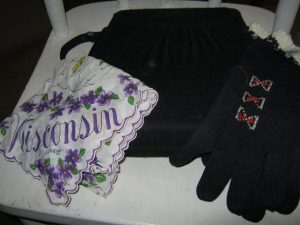
So it is for the memoirist. We can’t begin to write until we know the details. One way to access those details is to begin with what people leave behind them when they go. My mother left a pocketbook with an embroidered handkerchief from the Wisconsin Dells, a pair of black knit gloves, and a wallet containing a coupon to be used at a Druther’s restaurant. Taken together, these items speak to what my mother’s widowhood must have been like for her—the handkerchief and the gloves representing her gentle, and often meek, nature; the coupon that promised a lunch out with friends (my mother didn’t drive) standing for the loneliness she must have felt.
Here’s a writing exercise. Take an inventory of what a family member left behind them—the scraped tool handles, the clamped Bible pages, the embroidered handkerchief, the knit gloves, the coupon. Let one of those details be your first step onto the page. You might begin with something like, “After my mother died, I found. . .” Let the detail become a way of writing about your relationship with a person who played a significant role in your life. Can you use that detail to build a metaphor for what that person’s life may have been like? Or can you build a metaphor for what was at issue when it came to your interactions with that person? Details hold the marks of how we rub up against one another during our lifetimes. Metaphors provide a way to think more deeply about our own experiences and the lives of others. As Orson Scott Card says, “Metaphors have a way of holding the most truth in the least space.” If we begin in the concrete world, we have a better chance of portraying the emotional truths we’ve come to the page to explore.
The post The Marks We Leave Behind: A Writing Exercise for Memoirists appeared first on Lee Martin.