
Creating the Future
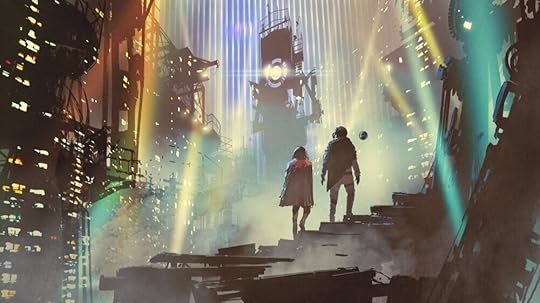
When people ask why I write, it’s always a strange question to me because it reminds me that there are people out there, in fact, most of humanity probably, who don’t makeup stories and write them down. For me, I guess I’m a little bit of a writer cliche. My father was an English major, and a consequence of that was that we as a family always had novels in our home, and usually quality literature too. Another consequence was that we always, as children, had a set of notebooks and pens within arm’s reach. And, if you’ve read previous posts of mine, you’ve probably gathered that my childhood was a little unconventional, so for the formative years of my life, we didn’t have such distractions as television, electricity, or running water - other things that might distract someone from the arts.
In a sense, my fate was sealed at an early age.
Occasionally, though, people wonder how we writers come up with the different possible futures that I write about (after all, science fiction - unless you’re doing revisionist history sorts of things - is about the future and the possible). How do concepts such as a proton rifle come into existence?
For me, that answer is years and years of study of two things - society and computer science. You’ve probably read on my author’s bio that I have a bachelor’s degree in Applied Computer Science in Bioinformatics. That gave me cutting-edge insights into the state of bioengineering, which fed into Models and Citizens. To supplement and stay current, I’ve worked in the computer science industry for more than twenty years, so I’ve witnessed first-hand the global transition from Assembly Language programming (I’ve written code that directly interfaces with hardware registers moving a handful of bytes at a time) to basic websites to the evolution of mobile apps and platforms, to cloud storage. This has given me a certain amount of insight into the evolution of technology, which is a cornerstone of science fiction if you write Hard Sci-Fi like I do.
So how does technology evolve? Well, in fits and starts. Think about the Model-T for example. For 19 years, the Ford Model-T dominated the nascent automobile industry. Before that? Horses. And buggies. The buggies kept getting better and better, more and more comfortable, but they were still buggies. So for most of Victorian history from as far back as Roman history and before, even, horses and buggies were the mode of transportation for those with means.
Then, suddenly, cars.
And then flying cars, right? Wrong! The next logical step in automobiles was flight, but it turned out that flying cars is really, really hard. So for the next century, we were steeped in cars. They may have gotten better, more efficient, faster, but the bottom line is that the automobile was a staple in society. In the meantime, other evolutions took place (like the invention of the television and movie theatres and entertainment generally). But there we were, stuck with cars.
This is how society evolves. Some aspects of technology leap forward while others stay stuck in the past. And it isn’t limited to technology. If we observe the past, then we can extend this lesson into society as well. Look at slavery, for instance. We evolved multiple advances in agriculture from a technology perspective, from better irrigation to the cotton gin (for instance), but we still held firmly to that one constant for centuries. Then, suddenly, it was over-ish. This post isn’t about that institution though - I’m only using it as an example here.
In Models and Citizens, I hold hate groups and the mentality that nurtures them fixed as a staple in a dystopian future. In fact, that’s a large part of what makes the Reality Gradient series dystopian - the over-representation of hate groups. The outclass - models (clones that have been genetically engineered for specific types of labor) - are on the receiving end of a lot of hate. Even though they were created to supplement a dying population, most of society sees them as encroaching and stealing jobs and livelihoods. I also hold corporate influence as a staple. In fact, if you read between the lines, you get a glimpse of a global corporate take-over that occurred just before Models and Citizens opens. The subtext, in case you were wondering, is that it is directly because. of the off-scene global corporate take-over that models were reduced to second-class citizens in the first place.
That may seem fantastical, but it’s taken directly from history, fed by my study of human society. If you’ve heard the term ‘banana republic” then you can understand how corporate manipulation in government can create two-tiered societies, creating a clear and enforced line between the haves and the have-nots. The only thing I had to do with this idea was to blow it up to a global scale.
You can think of creating the future as making soup. I start with a base, a handful of things that don’t change and pour in changes in certain specific areas. For example, volantrae, or flying cars, in this future aren’t your traditional flying cars. I took the idea of the flying automobile and threw away the “must look like car” limitation. There are all sorts of volantrae in this future, from flying breadboxes to flying Mobius strips. After all, if you’re flying, do you really need the wheels? This is more apparent in Bodhi Rising, and if you look closely, you can see that the volantrae in Models and Citizens and those in Bodhi Rising are actually a little different. Even within the series, the volantrae continue to evolve. They move from internal combustion to distributed ion engines, which is part of what allows their shape to stray.
Fun fact: distributed ion engines are based on ion thrusters, used in space travel today and in recent history. The ‘distributed’ part is the science fiction bit. Engines in Reality Gradient don’t have a sole exit for thrust, but multiple pin-point exits, which allow the various shapes to emerge.
So when I think about science fiction universes, the first thing I look for is a believable evolution in technology and society. I look for what’s the same and what’s changed. If the world is fifty years in the future, and everyone has a personal spacecraft, well - that’s not as believable for me. But if everyone has access to space travel, I’d buy that. A good hard science fiction story shouldn’t have too much change in it without connecting the dots on how to get there from here. If we’re honest with ourselves, we discover that society doesn’t evolve that quickly, and when it does, it’s not as though everything changes at once, at least with regard to technological advances.


Reality Gradient

- Andrew Sweet's profile
- 55 followers

