
Obaluaye: Ancestry Is Complicated
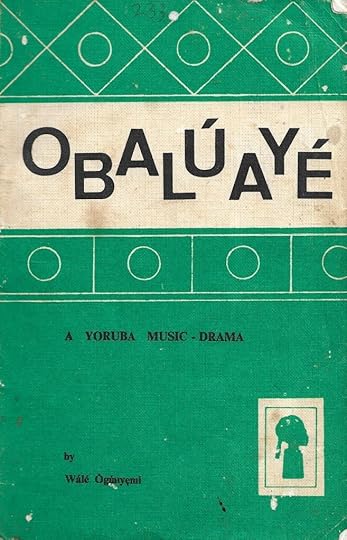
Of all the deities of the Yorubas, Obaluaye is the most feared. You probably know him by the name Sonponna, the deity that the Yorubas of old believed can inflict small pox even on the vaccinated.
The Yorubas of the South Western part of Nigeria are very accomplished in dramatic arts. Growing up in the South West, we were spoiled for choice with a variety of quality drama programs, both in Yoruba and English Language. Some of them were contemporary, others were historical.
There were several giants of performing arts. The biggest name of course, was Hubert Ogunde. Ogunde was a pioneer in cinema. Two of his productions, Aiye and Jaiyesinmi were hugely successful. Kola Ogunmola and Duro Ladipo were also big names in performing arts. Sadly, early deaths truncated the career and contributions of Ogunmola and Ladipo. There must have been a demand for entertainment in the South West of Nigeria because many of these performers, including the less known ones like Ishola Ogunsola, traveled across the whole of South West and beyond, effectively, taking their performances directly to the people.
One of the big names, who was inspired by the works of Kola Ogunmola and Duro Ladipo was Wale Ogunyemi, you can navigate the link to read more about him. One of his works was the play “Obaluaye”, which he wrote in 1972.
This is the story in a nutshell. A low ranking king in a small Yoruba town converted to Christianity and stopped his people from worshiping the deities, including Obaluaye. Obaluaye summoned a council of the deities. In attendance were Obaluaye (Sonponna), the god of small pox, Ogun, the God of Iron, Esu, the trickster, Osanyin, Orunmila, Egungun (masquerade) and Osun, a river goddess. They agreed to place a curse on the town so as to catch the attention of the people.
I am not writing a review on the book today but just wanted to highlight something that caught my attention in the very first page of the book. As Obaluaye was summoned, the drummers were praising him with these words:
Nupe god, strong like rain drop
As he danced out, the drummers changed tune:
Huku Huku comes, Gambari comes
Even Sonponna, a Yoruba deity is not quite Yoruba! The Nupe people are dominant in Niger state, though they are also minorities in Kwara and Kogi states of Nigeria. They have their own language. Who are the Gambaris? Some say it is a variant of the word “Kyamberi”, from Zamfara state in the North. Since this is a play that is rooted in Yorubaland, we just need to know who the Yorubas think Gambaris are. There is no doubt that to the Yorubas, Gambaris are Northerners.
Obaluaye, the most feared deity among the Yorubas of old, was probably a deity that the Yorubas acquired from outside their own people group, from communities that spoke different languages, probably from Nupe or Hausa speaking people.
When did our great ancestors acquired this deity? Who knows! Samuel Johnson, in “The History of The Yorubas” claimed that Oduduwa, the father of the Yorubas, Kings of Gogobiri and of the Kukawas all descended from Lamurudu. It is of note that Gogobiris and the Kukawas are people groups from the Hausas of Northern Nigeria.
If we shared deities with the Nupe and the Hausas, who knows what else we share? DNA?
When you think about it, the earliest civilisation found in Nigeria is the Nok Culture, centred at a village in Kaduna state bearing the same name, and dates back to 1500BC. Archaeological excavation at Nok revealed sculpture similar to that found at Ife and Benin. If the sculptures are similar, what else is? DNA?
The people of modern day Nigeria are very ethnocentric: we see ourselves as Yorubas, Hausas, Fulanis, Ijaws, Igbos, etc. However, no man is an island. An ancient civilisation like the Nok Culture, which independently had iron smelting technology, must have exerted influence over a vast area. Is it possible that the same ancestors from the Nok Culture gave birth to all these proud cultures, each of whom believe in its exceptionalism?
I don’t know. I just feel that ancestry is complicated. As you go on and on about how wonderful the Yorubas are, as you write and post about how having a Yoruba nation will cure all the problems that you are experiencing in Nigeria, have some humility and note that it is possible (just a possibility) that many of the nations of Nigeria share the same provenance.


