
Oluwa Lo Mejo Da (God is the fair and wise judge) – Act 1 Scene 1
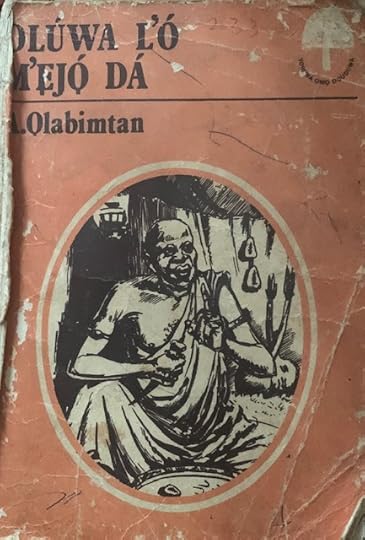
This is an old book, written in 1966. The last reprint was in 1971. Admittedly, my copy is very worn and rugged.
One of the main characters in the book is depicted on the cover. Please meet “Dr” Raimi Ewedogbon. By the way, he is a native doctor and also a priest of one of the foremost deities of the Yorubas, Ifa. Raimi is the same as Raheem, therefore, I guess that apart from being an Ifa Priest, he was probably also raised as a Muslim. In those days in the South West, this was not unusual.
His surname, “Ewedogbon”, hints at his wisdom in “herbs”. A native doctor is capable of prescribing “herbs” to solve physical health problems (such as headaches, stomach ache, cancer) but also for spiritual problems (for example, bad dreams, inability to prosper because of enemies “from your father’s house”, breaking curses, etc).
The author of “Oluwa Lo Mejo Da” was Afolabi Olabimtan, an academic from South West of Nigeria, with a PhD in African Languages. Later, he became a politician. He died in 2003. The book was written in my mother tongue, Yoruba.
Raimi Ewedogbon also had an alias “Ogboju Onisegun Ti Mba Esu Muko”. “Ogboju” could be translated “bold”, “brave”, “experienced”. Onisegun means physician but in this case, not a western style one. The full translation of his alias is “The bold, brave experienced Native Doctor-cum Ifa Priest who breakfasts with the “Devil”). I put “Devil” in quote because there are controversies on whether the deity “Esu” is the same as the “Devil” that the Bible describes. Regardless, of the controversy, the key thing to take away is that we are dealing with a very powerful individual.
The book opens with a scene in Raimi Ewedogbon’s house. His first client was an “Alufa”, which you could be translated as “Vicar”, “Pastor”, “Rev Father”, etc. Raimi quickly recognised his visitor, which showed that was not the first visit. Raimi’s greeting was “Se mejeeji ni ti-nyin, ise Orun l’e nse laiye”. Raimi affirms that the Vicar is mixing two things together: Christianity and African Traditional Religion (ATR), as he tried to do God’s work on earth. He then went on to quote a verse of Ifa, followed by an ifa rhyme:
Aiye o fe roAiye o f'osikaAiye o fe roAyie o f'oskiaOna gbonrangandan laiye a feTranslatedThis world does not want a liarThis world does not want the wickedThis world does not want a liarThis world does not want the wickedThis world does not want honestyThe message of the rhyme became clearer when Raimi Ewedogbon expounded the Ifa verse by telling a short story. A man came from heaven to earth, determined to be honest but in the end, the people of the earth destroyed him. Therefore, Raimi concluded that if you are on earth, you are better off adjusting to how people on earth behave and when you get back to heaven, you can behave as they do there. The admonition is rather blunt when you think about it: you cannot be honest and straightforward in this world, according to the wisdom of our Yoruba ancestors.
What was the purpose of the visit of the Vicar/Pastor? He came to thank Raimi that the fetish device he secured earlier was a game changer. Everybody in the church had fallen in love with him. The elders that were a pain in the neck are now his bosom friends. The Vicar/Pastor then gave Raimi the offering that he brought for him. The services offered by Ewedogbon was “try before you pay”.
Before the Vicar could leave, another visitor turned up. Akanni was a robber who stole 1,000 pounds (in those days, the currency of Nigeria was the pound). Raimi concocted some fetish for him and he escaped jail. Unlike the Vicar though, he claimed he was broke because he had to pay the lawyer and bribe the police. Akanni did not want to fulfil his obligation, partly because he wanted to use some of the stolen money to marry a new wife.
Akanni was shocked to find the Vicar/Pastor consulting the Ifa Priest and challenged him. He had two issues with the Vicar. The Vicar prevented Akanni’s sibling who had a set of twins from doing the necessary rituals. Moreover, he also prevented one of Akanni’s acquaintances from making a concoction for his child. In both cases, the Vicar said Christians should not consult native doctors/Ifa priests.
Raimi intervened and chided Akanni saying “the world does not want this”, he continued:
Who is not doing God's work? Who made work, who made man?The work and the one doing it, who owns both, but God?Leave the Vicar/Pastor aloneWhere are you going with this? This is where I will stop the review of Act 1, Scene 1.What was South Western Nigeria like in 1966? I have no idea. Through this book, I can allow my imagination to take me there. Some issues sounded very familiar: the bribing of policemen, the insinuation that a man of the cloth was mixing together Christianity and ATR; the role of a powerful individual like Raimi in society who is believed to have supernatural powers, able to solve problems; allegations of hypocrisy in the pulpit; the belief that prison can be avoided by consulting an Ifa priest to intervene, yet the bribing of the police and hiring of a good lawyer to hedge your bet (just in case the supernatural solution did not work) .
There is a theme running through the first scene. Raimi represented the thinking that Christianity and ATR can mix together. That was the viewpoint of Raimi. Reflecting on this, it goes much further than that. The power relationship between the Vicar/Pastor and Raimi suggests that ATR was considered more powerful, at least by the Vicar/Pastor. After all, it was the Vicar/Pastor, who went meekly to bow before the Ifa priest, looking for a solution to his problem and not the other way round. Furthermore, it was a discreet visit, immediately another visitor turned up, the Vicar/Pastor became uncomfortable and hurriedly departed.
The narrative that ATR is very powerful endures, even in South Western Nigeria of today. It carries on as urban myths. I once heard about a very “powerful” General Overseer who “supernaturally” knew some of the pastors under him were sourcing “power” from ATR priests. I received the information not directly from anybody who was present. How can I be certain such an information is authentic?
Another source of evidence for the belief that ATR is considered more powerful than prayers can be found in Nollywood films with similar theme.
The problem with the “power” of ATR is that evidence for it is very scant. The demonstration of ATR “power” no longer appear to happen where people can witness it. There are very few credible evidence. Instead, there is abundance of second or third hand information and of course, numerous urban legends and Nollywood films to back it up.
The Yorubas of old believed that small pox was inflicted on people by Sonponna. We do know now that Small Pox is a virus that has been around for thousands of years and one of the wonders of modern vaccination program is the eradication of small pox, robbing Sonponna of his one weapon. Sango is believed to be the god of thunder, yet secondary school physics paints a different picture.
Even if a phenomenon does not exist, the moment we start discussing it, we have given birth to it!


