A basic introduction to the Solar System
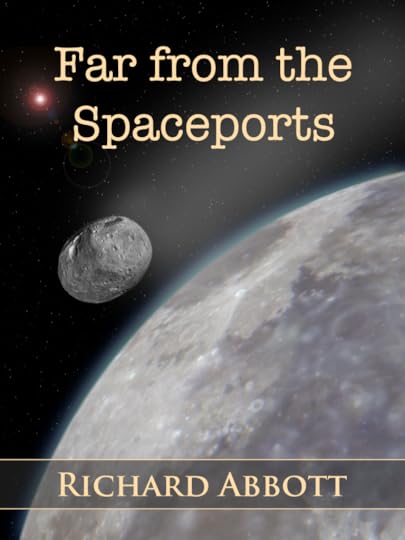 Cover – Far from the Spaceports
I needed to write a sort of general introduction to the solar system assumed by Far from the Spaceports and its various sequels – the exact reason for this must wait for another day to reveal, but I found the exercise interesting in its own right. Most of the future facts are pretty obvious when you are immersed in the books, but it may be helpful to have them all summed up in a neat way.
So here it is: the future history of the solar system – or at least edited highlights thereof – spanning the next century or so.
The solar system of the Far from the Spaceports series
The great breakthrough that allowed widespread human colonisation
of the solar system was the development of a reliable high-performance ion
drive for spaceship propulsion. The first successful deployment of this
technology in experimental form was in 1998, and successive improvements led to
near-complete adoption by around 2050. By the time of Far from the
Spaceports and the sequels, old-style chemical rockets are now only used
for shuttle service between a planet’s surface and orbital docks, with the ion
drive taking over from orbit.
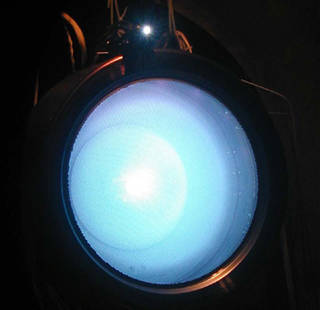 NEXT ion drive in operation (NASA)
The great virtue of the ion drive is that it provides
continual acceleration over a long period of time, rather than big delta-v changes
at start and end of the journey followed by a long weightless coast period.
Thus, although the acceleration rate is very low, the end result is a much
faster trip than when using chemical rockets. With the kinds of engine available
in the stories, a journey from Earth to the asteroid belt takes an average of
three weeks, the exact time depending on the relative orbital position of the
target as compared to Earth. Longer journeys are more efficient if you avoid
making interim stops – breaking a journey half way makes the travel time nearly
half as long again as just going direct, because of the time wasted slowing
down and then speeding up again. As a result, trade or passenger routes typically
go straight from origin to destination, avoiding intermediate stopovers.
At around the same time, artificially intelligent software
reached a stage where the systems were generally accepted as authentic
individuals, with similar rights and opportunities to humans. Known as
personas, they are distinguished from simpler AI devices which are simply
machines without personality. Personas have gender and emotion as well as logic
and algorithms. Slate is the persona who features most prominently in the early
stories in the series. In terms of early 21st century AI development,
Slate is a closer relative to digital assistants such as Alexa, Siri or Cortana,
than she is to humanoid robots. As a result, she can – with effort and care –
be transferred into any sufficiently capable computer system if the need
arises.
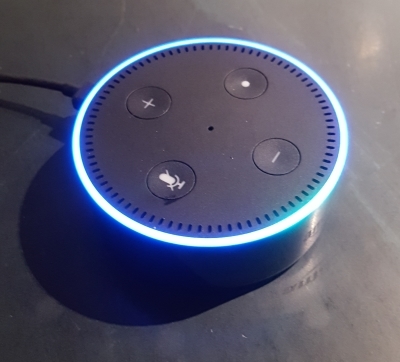 Amazon Dot – Active
The first generation of personas to go out on general release were called the Stele class – Slate is one of these. About a decade later, around the time of The Authentication Key (in progress), the Sapling class was released, and after another decade the Scribe class appeared. Steles are regarded as solid and reliable, while Saplings are more flighty, being prone to acting on impulse. Scribes are stricter and more literal. They first appear in The Liminal Zone (in progress). There are plenty of sub-persona machines around, serving specific tasks which do not require high levels of flexibility of intelligence or awareness.
Solar system colonisation has proceeded in a series of
waves, and at any time some habitats are flourishing while others have been
left behind the crest of the wave. The original motivation for settlement was
typically mining – bulk extraction of metals and minerals could be done more
cheaply and with fewer political constraints away from Earth’s surface. However,
there are many places which appeared at first sight to be profitable, but which
subsequently proved to be uncompetitive. Many settlements have had to rethink
their purpose of being, and the kinds of industry or service they can offer. Very
often, as you get to know a new place, you see the signs of this rethink –
perhaps an old warehouse or chemical extraction factory has been converted to a
new function such as accommodation or finance.
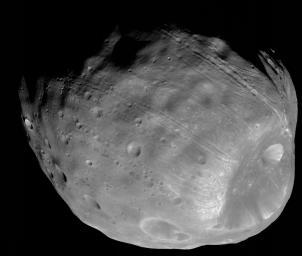 Phobos, NASA/JPL
A habitat is routinely called a dome, even though few are actually
dome-shaped. Very often several units will be loosely connected by passageways
or flexible tubes, as well as delving underground if the surface rocks permit.
The first stage of settlement was usually to deploy one or more giant three-D
printers to construct the habitat shells from native material. After that,
individual customisations have been added according to need, taste or whimsy. The
biggest single threat to a dome is typically some kind of fault or crack
exposing the occupants to the surface environment of the planet, asteroid or
moon – normally this is quickly fatal. Hence each dome has its own set of rules
for managing this risk, which are very strictly enforced.
There is no unified solar system political or economic authority.
Each habitat manages its own internal affairs in broad alignment with its
current purpose for existence. Some are essentially puppet offices for large
corporations, others are scholarly or academic research stations, but most have
achieved a degree of economic independence and are self-governing. It is generally
believed that travel lags of a few weeks or months prevent effective government
from elsewhere. Notions of political control are usually set aside because of
the constant need to cope with the many external hazards faced by anyone in a
spaceship, or on the surface of an inhospitable planet or moon. Each habitat,
then, protects its own interests as it sees fit, including monitoring the
volume of space immediately nearby, and adopts a laissez-faire attitude to
other habitats.
 Alexa Timing logo
Most habitats are culturally and racially mixed, and people’s
names are often the most obvious memories of the Earthly heritage of their
family. A few places, depending on the circumstances of their foundation, reflect
a particular single culture group. It can be difficult for outsiders to integrate
into these. But generally speaking, a person gets the reaction that their conduct
deserves, regardless of their place of family origin. It can be very difficult
to recover from a bad impression created on first meeting. Conversely, a person
who shows that they are respectful of local customs, and have particular skills
that contribute to the life of the habitat, will find no difficulty fitting in.
Welcome to the world of Far from the Spaceports!
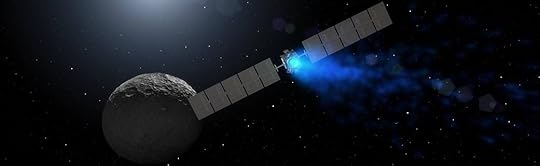 Artist’s impression – Dawn’s ion drive (NASA)