
A bit more on the history of fans

When parties and balls became fashionable in England in the Elizabethan period, the fan became de rigueur. The heavy, hot atmosphere of unwashed overdressed people jammed into a candlelit room made them a necessity to keep one's makeup from running. At first paddle-shaped or made from feathers, they were fairly uninspiring until the arrival of the Huguenots.
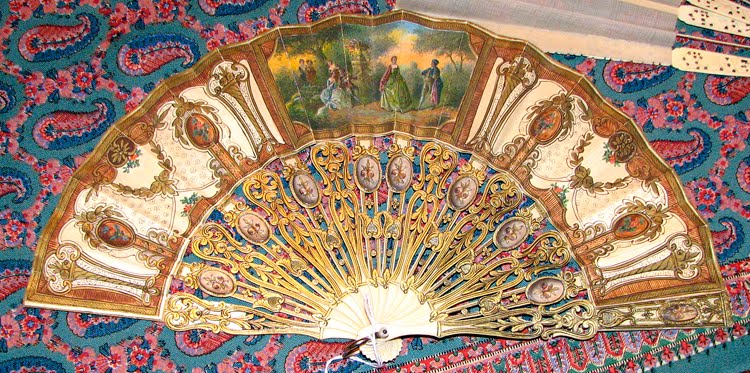 The French excelled at the creation of beautiful fans. A Watteau style fan.
When Jacob Chassereau settled in London fans became a work of art, enlivened by the Chinese export market.
Fans were then constructed uniformly, and no bigger than twelve and a half inches long. The decoration was chosen by the lady. The sticks were made of wood, ivory, mother-of-pearl, gold and the leaves made either paper or lamb's/kid's skin.
Painters specialized in decorating fans. In England the shepherds and nymphs of Watteau and later Boucher were popular. (Watteau himself painted fans, including the bridal fan of Adelaide of Savoy in 1709.)
 In 1711, the craze for expensive fans reached such proportions that Joseph Addison felt the need to mock it roundly in his coffee house publication, The Spectator. His excellent article, 'advertising' his Academy for the Instruction of the Use of the Fan explains how he drills young ladies in fan etiquette in a military fashion.
 The Fluttering of the Fan is the last, and indeed the master-piece of the whole Exercise; but if a lady does not misspend her time, she may make herself mistress of it in three months...There is the angry flutter, the modest flutter, the timorous flutter, the confused flutter, the merry fluttter, and the amorous flutter...I have seen a fan so very angry, that it would have been dangerous for the absent lover who provoked it to have come within the wind of it...I need not add, that a fan is either a prude of coquet according to the nature of the person who bears it.
p.s. I teach young gentlemen the whole art of gallanting a fan.
Spectator, no. 102
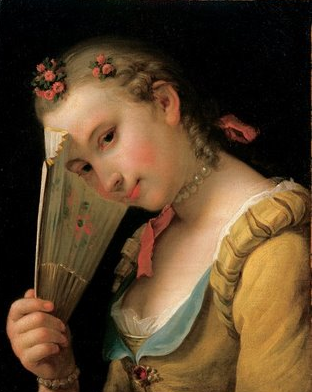 He mocked the 'Language of the Fan'. The Rotari portrait of circa 1750 of the girl with the butcher's hands seems to indicate there was some kind of message to be imparted by particular postures. Whether such a language was ever used by young ladies at fashionable parties was possibly only a romantic notion: Common themes:
Fan closed, tip to lips: we are overheardDitto, tip to right cheek: yesDitto, tip to left cheek: noDitto, tip to forehead: you are out of your mindChin on tip: you annoy meDitto, tip to heart: I love youLower open fan until pointing at the ground: I hate you
The fan disappeared from fashion until 1829 The Duchesse de Bern's ball began the renaissance of the fan at the Tuileries in Paris. Madame la Duchesse de Berri had undertaken to get up a Louis XV quadrille, and was seeking everywhere for fans of that period. Some old fans were found at a perfumer named Vanier, who lived in the Rue Caumartin. Vanier collected them. His fans were taken to the palace; in the quadrille they created a furor, and were all purchased.
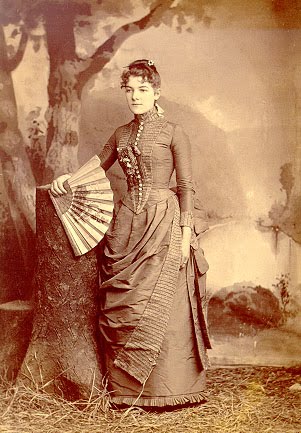 Victorian lady with fan Source: Georgian London by Lucy Inglis Georgian London the book will be available in hardback in the summer of 2012, published by Penguin Books. http://www.georgianlondon.com
Images: The Alice T. Miner Museum
Victoriana.com [image error]


No comments have been added yet.


