Why I Don’t Collect Books
This is not about Marie Kondo.
In fact, had it not been for so many bookish types angrily misinterpreting her advice, I may not even know who she is. No, this is about how I came to decide that book collecting isn’t for me. Oddly enough, the revelation hit while attending a rare books and maps fair.
Before I explain my reasoning, note that this isn’t meant to be prescriptive. Few things irritate me more than those who judge how others spend their discretionary time and money. You want to build a book tunnel in your home and live off instant noodles to fund your obsession? You do you.
A Collector at Heart
I get it. I completely understand the desire to catch ‘em all. At various times in my life, I have collected everything from baseball cards to stamps to Simpsons action figures to – this is embarrassing – all six binders of Wildlife Fact File sheets.
The hunt, the organization, the display. Collecting is intoxicating.
But it can also be a fool’s errand. When the Simpsons playsets and talking action figures first released in 1999, I bought every one of the first series. Three years and hundreds of dollars later, I realized I had neither the money nor the shelf space to possibly keep pace as the “World of Springfield ” grew to include dozens of playsets and hundreds of action figures. I sold my lot.
Amazon existed first as a bookstore because Jeff Bezos was smart enough to know that books were the one category of merchandise that a normal store couldn’t ever fully stock. And that was back before self-publishing. Nowadays, over 600,000 books get published each year in the United States alone (on average, they sell less than 250 copies each, according to Forbes).
Having the time to read them all is the least of a collector’s difficulties.
Collecting My 5-Star Favorites
Of course, nobody, not even every Amazon warehouse aligned end-to-end has the room to collect every single book. Estimates suggest the average American moves 11 times in their life. As someone who blew their car’s transmission towing an overloaded U-Haul across the country, I can assure you that even modest collections quickly become problematic.
I sold nearly all of my books before embarking on the bicycle tour that inspired Tailwinds Past Florence, only to see my love of reading intensify during our travels. My book consumption quadrupled and I became hooked on Goodreads (follow me here).
Goodreads allows readers to rate, review, and maintain a digital collection of shelves. Updates are shared amongst your friends and followers. It’s one-part Facebook, one-part digital bookshelf. And when it comes to shelves, it allows you to create as many as you want and arrange them however you see fit. One of my Goodreads shelves is labeled “5-Star Favorites.”
My 5-Star Favorites represent my absolute favorite reads. The books I wouldn’t hesitate to recommend. The books I would happily display in my home.
Halfway through our trip, I decided to collect hardcover copies, preferably first-editions, of each of the books that landed on my 5-Star Favorites shelf. The first one, an “investment purchase,” was a first edition of Player Piano by Kurt Vonnegut. His very first novel.
At holidays, I point those seeking gift ideas to this list. This past year, my sister gave me an absolutely gorgeous, illustrated hardcover copy of Paulo Coelho’s The Alchemist , complete in a faux-leather slipcase. Much joy was sparked (sorry, I couldn’t help slipping in a Kondo reference).
The Rare Books Fair
I encountered many of the books on my 5-Star Favorites list at the Seattle Rare Books & Maps Fair, from a first-edition of John Krakauer’s Into the Wild to Hemingway’s For Whom the Bell Tolls
 . Some were quite affordable while others boasted prices rivaling that of a small house. Or a nice RV.
I walked the aisles, pen and notepad in hand, keeping tabs of potential purchases, jotting down which bookseller had what, and for how much. And as my feet grew tired and my stomach hungry, my desire shifted. For as much as I love the smell of bookstores and pages yellowed by time, what I love even more is reading new books. Stories I hadn’t read.
We left the fair and went in search of a pub for lunch. On the way, we passed by Mercer Street Books, a small used bookstore. And there my wife and I bought a small stack of books, none of which we had already read, none costing more than ten dollars. Eight books for the price of one of the modestly-priced first-editions I was considering.
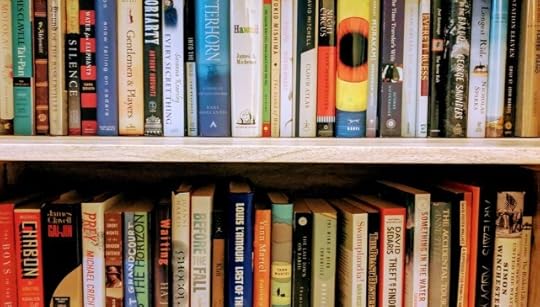
A glimpse at the entirety of my non-collection.
My Two Shelf System
My reading is split these days, almost in equal thirds between physical books I own, eBooks, and books from the library.
The bookcase in my office has two shelves devoted to books, each coincidentally holding thirty books (not a Kondo byproduct, I promise you). The top shelf contains books I’ve read. The lower shelf houses those waiting their turn on my nightstand. They’re both full.
As I read from the lower shelf, I seek space for them on the top shelf, but only if I enjoyed it more than the ones already there. My 5-Star Favorites don’t get bumped. That’s the rule. For now.
If no space exists, I put the book in a box within my closet where it waits to be sold at Half-Price Books.
A recent unexpected casualty of this system was The Dead Zone by Stephen King. As the first novel I ever read on my own accord (i.e. not school-assigned reading), the book had a special place in my heart. A couple years ago I encountered a first-edition hardcover copy at a farmer’s market, complete with stains and a torn dust-jacket. I bought it for three dollars. I re-read it this past year for the first time in nearly thirty years. It was really good, but not great. Greg Stillson’s disturbing likeness to He Who Must Not Be Named certainly played a role in souring my appreciation of the book. And it now sits in the box, waiting to be sold.
It was one of three or four books I ever re-read. Yet the lack of desire to re-read books plays little role in my decision to not collect.
The Downside of Not Collecting
This isn’t a completely satisfactory solution. Part of me wants to collect all the books of my favorite authors. Sentimentality has me holding onto books I read in my youth. My need for organization wants to double the shelf space and split fiction from non-fiction. The collector-at-heart wants to buy physical copies of the eBooks I’ve read.
But we rent. And I know we’ll one day move. And probably move again after that. Maybe we’ll even do the full-time RV thing one day. Books are bulky. Heavy.
What I’m trying to say, I think, is that I don’t collect books despite wanting to. I don’t find joy in not collecting books. I especially miss the opportunities for conversation presented by a well-displayed book collection.
The bookcase is the first thing I look for in a person’s home. The findings often yielding an abundance of topics to discuss, sparing us the tedium of discussing the weather. Or politics. Some in the writing community like to say a story is a window into a writer’s soul. I’d say the bookcase is an even better indicator of a person’s true self (probably why so many people read 50 Shades of Grey on a Kindle).
My current bookshelf is in my office, not in plain sight of visitors. Sixty books seems hardly worth showcasing. Still, I mourn the book-related conversations that never occur, the lost opportunities to recommend something, the thoughtful reading suggestions only possible by those who can see and get what it is you like to read.
No, I don’t collect books for a number of practical reasons. But I really, really wish I did.
The post Why I Don’t Collect Books appeared first on Doug Walsh.