I Advent
 December 2, 2018
Luke 21.25-36+ This morning is a special morning. You can tell. No, it’s not just Pledge In-Gathering Sunday (which is very important, mind you)
But, yes, it is the First Sunday in Advent.
We are lighting the Advent wreath.
We have the Sarum Blue
And we are praying the Great Litany.
The Great Litany is one of the treasures of Anglicanism and the Book of Common Prayer. In some churches the Great Litany is recited while in procession. Well, we don’t have the room here at St. Stephen’s to do it in procession. We could try. But I don’t think it would work very well.
But we do it on this First Sunday of Advent. We will do it again in Lent. And, of course, the Supplication of the Great Litany is also prayed, according to the Book of Common Prayer, “in times of war, or of national anxiety, or of disaster.”
The Great Litany is special for many reasons. It is the oldest piece of original-English liturgy we have, published 1544. Thomas Cranmer, the great Archbishop of Canterbury and the person almost single-handedly responsible for the Book of Common Prayer, used several sources in his writing of this version of the Great Litany. He used the Sarum Liturgies for Rogation, Processions and Death, the Litany written by Martin Luther, and the litany from the liturgy of St. John Chrysostom.
So, in a very real way, it represents our Anglican blend of Catholic, Eastern and Protestant theologies—our Via Media, our Middle Way. It’s appropriate that we pray this liturgy which essentially includes EVERYONE in the prayers on this First Sunday of Advent.
After all, we are now in this anticipatory season of Advent. Anticipation is a very good word to sum up what Advent is. We are anticipating. We are anxiously expecting something.
And in that way, I think Advent represents our own spiritual lives in some ways. We are, after all, a people anticipating something. Sometimes we might not know exactly what it is we are anticipating. We maybe can’t name it, or identify it, but we know—deep inside us—that something—something BIG—is about to happen. We know that something big is about to happen, involving God in some way. And we know that when it happens, we will be changed. Life will never be the same again.
Our world as we know it—our very lives—will be turned around by this “God event.” It will be cataclysmic.
What I find so interesting about the apocalyptic literature we hear this morning in our scripture readings is that we find anticipation and expectation for this final apocalypse. And that anticipation and expectation is a good and glorious thing, I think. That is what this season of Advent is all about. It is about anticipation and expectation being a wonderful thing in and of itself.
Because by watching and praying in holy expectation, we grow in holiness. We recognize that despite the doom and gloom some people preach when it comes to prophecies, doom and gloom doesn’t hold sway over us as Christians.
Still, despite this view, we are a people living, at times, in the dark doom and gloom of life.
In Advent, we recognize that darkness we all collectively live in without Christ. But we realize that darkness doesn’t hold sway.
Darkness is easily done away with what? With light!
And so, in Advent, we are anticipating something more—we are all looking forward into the gloom. And what do we see there? We see the first flickers of light. And even with those first, faint glimmers of light, darkness already starts losing its strength.
We see the first glow of what awaits us—there, just ahead of us. That light that is about to burst into our lives is, of course, Christ’s Light. The Light that came to us—that is coming to us—is the sign that the Kingdom of God is drawing near, as Jesus says in today’s Gospel, is near.
It is near.
Yes, we are, at times, stuck in the doom and gloom of this life. But, we can take comfort today in one thing: as frightening as our life may be, as terrible as life may seem some times and as uncertain as our future may be, what Advent shows us more than anything is this: we already know the end of the story. We might not know what awaits us tomorrow or next week. We might not know what setbacks or rewards will come to us in the weeks to come, but in the long run, we know how our story as followers of Jesus ends.
Jesus has told us that we might not know when it will happen, but the end will be a good ending for those of us who hope and expect it. God has promised that, in the end, there will be joy and happiness and peace. In this time of anticipation—in this time in which we are waiting and watching—we can take hope.
To watch means more than just to look around us. It means to be attentive. It means, we must pay attention. It means waiting, with held breath, for the Kingdom of God to break upon us.
So, yes, Advent is a time of waiting and it is this waiting—this expectant anticipation—that is so very important in our spiritual lives. Advent is a time of hope and longing. It is a time for us to wake up from our slumbering complacency. It is a time to wake up and to watch.
The kingdom of God is near. And we should rejoice in that fact.
In preparation for Advent, I have been re-reading some of those poets and writers that inspired me many years ago—way back when I was a teenager. One of the poets/theologians that I have been re-reading intensely lately is the great German Protestant theologian and poet, Dorothee Soelle. I’ve mentioned Soelle many times before. If you do not known Soelle, read her. She is incredible and important.
When I was in high school, I first read her book, Of War and Love, which blew me away.
But a poem of hers that I have loved deeply and that I have been re-worked as a poet myself is her poem, “Credo.” I was going to just quote a part of the poem here, but it’s just so wonderful, I actually have share it in full. This is the poem as I have adapted it.
The poem is
Credo
after Dorothee Sölle
I believe in a Godwho created what we walk uponnow in this holy moment
is something to be moldedand formedand tried.
I believe in Onewho rules not by tense lawswritten in stone
with no real consequencesnor with distinctions between those who have and those who have not,
geniuses or idiots,those who dominate and those who are dominated
I believe in a God who demands a creationthat protests and, if need be,
questions God.I believe in us,who must work to change
the failures of creationby any means.I believe in Jesus
who, as “someone who could do nothing”as we all areworked to change
injustice against God and humanity.He allowed me to see
how limited we are,how ignorant we can be,how uncreative we have consistently been,
how everything we attempted falls shortwhen we do not do it
as he did it.We need to do itas he did it.
A day does not go byin which I do not feara reality in which
he died for nothing.Nothing sickens me morethan the thought
that he lies at this momentdead and buriedin ornate churches
and cathedrals,laid out covered in goldand jewels,
encased in glass, to be gazed at and worshippedbut not touched or embodied.
I fear more than anything that we have failed himand his revolution
because we feared insteadthose self-absorbed authoritieswho dominate
and oppress us. I believe in a Christ who is not dead
and buriedand left in the groundbut rather who lives
and is resurrected in us,and in the flame of freedom that burns away
prejudice, presumption,crippling fear
and destroying hatred.I believe in the ongoing revolution he set into motion
and the reign of peace and justice that will follow.I believe in a Spirit
who came to us where we were,and with all those with whom we share
this Lenten place of tearsand hungerand violence
and darkness—this city of God—this earth.
I believe in peacewhich can only be createdwith the hands of justice.
I believe in a life of meaning and of true purpose
(adapted by Jamie Parsley)
Yes, we do live in “this place of tears/and hunger/and violence/and darkness—/this city of God—/this earth.”
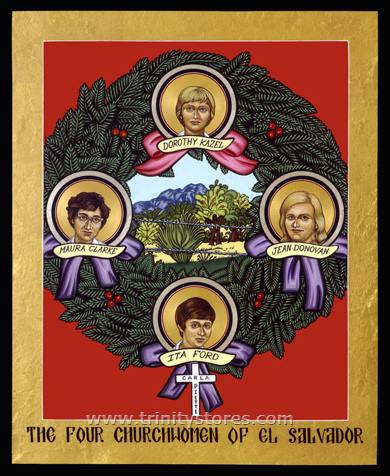
It was on this day in 1980 that four American women—three nuns, Sister Ita Ford, Sister Maura Clark and Sister Dorothy Kazel, and a layperson, Jean Donovan—were brutally murdered in El Salvador. It was a story that shocked all of us and challenged many of us, myself included. They reminded us that following Jesus means following him not only through the good times, through the happy stories of his birth, but through the violence and darkness of his life as well, through the story of the jealous despot who wanted to kill Jesus, through the slaughter of the Innocents, through the darkness of Gethsemane and the Cross.
This IS a place of tears/and hunger/and violence/and darkness—/this city of God—/this earth.”
But, like those women who died on this day in 1980, we too are hoping, in this Advent season, for “God’s future world/of love and peace.”
It is near.
The Kingdom of God—with its incredible revolution—is so close to breaking through to us that we can almost feel it ready to shatter into our lives.
So, in this anticipation, let us be prepared.
Let us watch.
Christ—the Messiah, God’s Anointed One—has come to us and is leading us forward. Christ—the dazzling Light—is burning away the fog of our tears and hunger and violence and is showing us a way through the darkness that sometimes seems to encroach upon us. We need to look anxiously for that light and, when it comes, we need to be prepared to share it with others, because is telling us that the God’s future world is breaking through to us.
This is the true message of Advent.
As hectic as this season is going to get, as you’re feeling overwhelmed by all the sensory overload we’ll all be experiencing through this season, remember, Watch.
Take time, be silent and just watch.
For this anticipation—this expectant and patient watching of ours—is merely a pathway on which the Christ Child can come among us as one of us.


No comments have been added yet.