
GMCD
I recently participated in a two-week workshop with the infamous Lori Wilde, where she went through my entire first draft. At the end of about every scene, her comment was "What's the GMCD of this scene?"
Most every author who's been at this writing thing for awhile knows about Goal-Motivation-Conflict. But D? I had no idea what that even stood for. Even some so-called experts in the writing business don't address it.

Turns out, the "D" stands for DISASTER. Every scene has to end with one. Big or little, the players in the scene have to be worse off at the end than at the beginning. Or they think they've reached their goal, but at what cost?
Obviously, this is an area where I'm weak, as an author. It's a hard concept to wrap one's head around. So, I decided to apply the approach to everything in my life, come up with a GMCD in real life events. Maybe if I can get used to the approach in a practical way, it will become second nature when I write.
As most of you know, I'm trying to sell my house. That's a definite goal that's been set, so it seemed the most logical GMCD to pursue right now. Here's the way it went:
GOAL--Sell the houseMOTIVATION--I need to reduce my monthly billsCONFLICT--(Usually divided into both internal and external) Internally, I'm comfortable living in Oberlin. I know my way around, have made some friends here, have nice neighbors, hate the thought of packing up again. Externally, the house is cumbersome to live in, many sets of stairs, and is way too big for me. DISASTER--The first inspector through the house uncovered a problem I wasn't aware of. And it's a biggie. Cue scary music.
It only makes sense that the disaster is in the basement. Isn't that where every horror show ends up? Yes, friends, one of my basement walls is in danger of collapse, and for some reason, every potential buyer is frightened away by the prospect. I can't fix it myself (see Motivation), yet I must disclose the hazard to all potential buyers.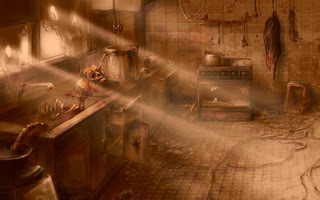
Scenes must end at which point you ask yourself Was the goal met? If the answer is no, things must be worse off than at the start of the scene. Got that covered, in spades. If the answer is yes, it must be followed by a "but." The "but" here is the buyer now has a huge bargaining chip to bring the price down. So far, I haven't found anyone who will play out the scene with a yes, but...
I'll keep looking. Somewhere out there is a person who wants to take on the challenge of owning this home. And I can't wait to complete this scene and move on to the next.
Most every author who's been at this writing thing for awhile knows about Goal-Motivation-Conflict. But D? I had no idea what that even stood for. Even some so-called experts in the writing business don't address it.

Turns out, the "D" stands for DISASTER. Every scene has to end with one. Big or little, the players in the scene have to be worse off at the end than at the beginning. Or they think they've reached their goal, but at what cost?
Obviously, this is an area where I'm weak, as an author. It's a hard concept to wrap one's head around. So, I decided to apply the approach to everything in my life, come up with a GMCD in real life events. Maybe if I can get used to the approach in a practical way, it will become second nature when I write.
As most of you know, I'm trying to sell my house. That's a definite goal that's been set, so it seemed the most logical GMCD to pursue right now. Here's the way it went:
GOAL--Sell the houseMOTIVATION--I need to reduce my monthly billsCONFLICT--(Usually divided into both internal and external) Internally, I'm comfortable living in Oberlin. I know my way around, have made some friends here, have nice neighbors, hate the thought of packing up again. Externally, the house is cumbersome to live in, many sets of stairs, and is way too big for me. DISASTER--The first inspector through the house uncovered a problem I wasn't aware of. And it's a biggie. Cue scary music.
It only makes sense that the disaster is in the basement. Isn't that where every horror show ends up? Yes, friends, one of my basement walls is in danger of collapse, and for some reason, every potential buyer is frightened away by the prospect. I can't fix it myself (see Motivation), yet I must disclose the hazard to all potential buyers.

Scenes must end at which point you ask yourself Was the goal met? If the answer is no, things must be worse off than at the start of the scene. Got that covered, in spades. If the answer is yes, it must be followed by a "but." The "but" here is the buyer now has a huge bargaining chip to bring the price down. So far, I haven't found anyone who will play out the scene with a yes, but...
I'll keep looking. Somewhere out there is a person who wants to take on the challenge of owning this home. And I can't wait to complete this scene and move on to the next.


No comments have been added yet.


