Wiretapping and Spies and Writing Thrillers
By Jamie Freveletti
 1930's Telephone OperatorWiretapping is in the news this week and I have been following with interest the articles regarding the need for warrants --or the lack of them. Of course, as a former attorney I am always interested in the procedure and protocol for anything that our government does. But also, as a writer of spy fiction, I think that I, and probably some of the other Rogue Women Writers on this blog, could probably tell you that there are numerous ways to access a smartphone and a whole host of them are utilized without a warrant. How do we know this, you ask? Research! Those of us that write spy novels spend quite a bit of time researching the issues that are important for the type of novel that we're writing. We have to, because our readers love to learn about the life of a spy, and the only way to add such detail is to research it. In fact, as I write this Wikileaks announced that it will release 9,000 pages of CIA documents purporting to give up their wiretapping secrets. I'll be reading those pages and will write a follow up to this post when I'm done.
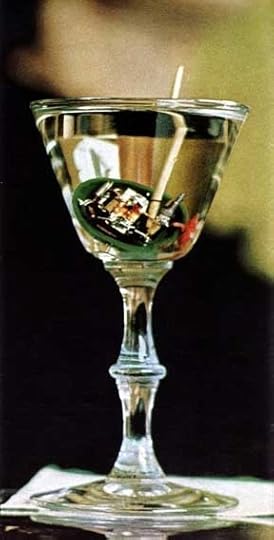 1965 Martini Olive BugBack in the day, a person wishing to wiretap someone had a lot of ways to get it done. As early as the 1930's a device called the "Detectifone" could be hidden in a room and record a conversation much like a dictaphone would. The 1950's and 1960's saw the emergence of small, ingenious devices: watches, (think Dick Tracy), pens and cigarette boxes, and, yes, even a martini glass. In 1965 private detective Hal Lipset created the martini olive bug.
Now the devices are far more advanced and we, as citizens, have unwittingly assisted in the effort by carrying the equivalent of a GPS locator device in our pockets. Yes, I mean that smartphone. And it's not just the government that spies on us, it's our apps as well. Like Uber? Have the app on your phone? That company is currently being questioned with regard to its use of alleged software called "greyball" where the app records your location and collects data. It then uses the data to determine whether you are a threat to Uber. Let's say you spend too much time in City Hall or government buildings (just about every litigator does), the greyball software then decides that you potentially work for taxi or government regulators and might be trying to hail an Uber to see if the company is operating in violation of local laws. If you activate the app it pretends that it's calling a car, but doesn't. The "driver" cancels over and over again. It's an open question whether this data collection is illegal, because you may have agreed to it on the terms of service page for the app.You can read more about greyball and Uber's denial of any illegal use here.
And finally there's the hated Stingray device. There's a current lawsuit here in Chicago over this one. The stingray pretends that it's a cellphone tower and dupes your smartphone into connecting with it. It collects your texts, information, and some say can even pretend to be you and send a text from your phone to another in your contact list. Police departments across the country own them and deploy them. They can collect information off a whopping 65,000 people when pointed at a crowd. A stingray was allegedly deployed during a Black Lives Matter protest here in Chicago. But while most of us would never know if a stingray grabbed our phone, in this case the stingray got stung, because it hit the one person at the protest who could figure it out. The device zeroed out the phone of a lawyer who, as part of his pro bono work (we all have to do a certain number of free cases each year to keep our licenses) attended protests on behalf of legal aid in order to act as an observer. He knew immediately what had happened and the suit, which claims among other things that the search was a violation of the Constitution's Fourth amendment against unreasonable searches and seizures, is currently winding its way through the court system.
A thriller writer not only has to research the ways one can be tapped, but also needs to know how a spy or other person can avoid the tap. In the case of the stingray? Wrap your phone in aluminum foil before you head out.
James Bond would approve.
.jpg) 1930's Telephone OperatorWiretapping is in the news this week and I have been following with interest the articles regarding the need for warrants --or the lack of them. Of course, as a former attorney I am always interested in the procedure and protocol for anything that our government does. But also, as a writer of spy fiction, I think that I, and probably some of the other Rogue Women Writers on this blog, could probably tell you that there are numerous ways to access a smartphone and a whole host of them are utilized without a warrant. How do we know this, you ask? Research! Those of us that write spy novels spend quite a bit of time researching the issues that are important for the type of novel that we're writing. We have to, because our readers love to learn about the life of a spy, and the only way to add such detail is to research it. In fact, as I write this Wikileaks announced that it will release 9,000 pages of CIA documents purporting to give up their wiretapping secrets. I'll be reading those pages and will write a follow up to this post when I'm done.
1930's Telephone OperatorWiretapping is in the news this week and I have been following with interest the articles regarding the need for warrants --or the lack of them. Of course, as a former attorney I am always interested in the procedure and protocol for anything that our government does. But also, as a writer of spy fiction, I think that I, and probably some of the other Rogue Women Writers on this blog, could probably tell you that there are numerous ways to access a smartphone and a whole host of them are utilized without a warrant. How do we know this, you ask? Research! Those of us that write spy novels spend quite a bit of time researching the issues that are important for the type of novel that we're writing. We have to, because our readers love to learn about the life of a spy, and the only way to add such detail is to research it. In fact, as I write this Wikileaks announced that it will release 9,000 pages of CIA documents purporting to give up their wiretapping secrets. I'll be reading those pages and will write a follow up to this post when I'm done. 1965 Martini Olive BugBack in the day, a person wishing to wiretap someone had a lot of ways to get it done. As early as the 1930's a device called the "Detectifone" could be hidden in a room and record a conversation much like a dictaphone would. The 1950's and 1960's saw the emergence of small, ingenious devices: watches, (think Dick Tracy), pens and cigarette boxes, and, yes, even a martini glass. In 1965 private detective Hal Lipset created the martini olive bug.
Now the devices are far more advanced and we, as citizens, have unwittingly assisted in the effort by carrying the equivalent of a GPS locator device in our pockets. Yes, I mean that smartphone. And it's not just the government that spies on us, it's our apps as well. Like Uber? Have the app on your phone? That company is currently being questioned with regard to its use of alleged software called "greyball" where the app records your location and collects data. It then uses the data to determine whether you are a threat to Uber. Let's say you spend too much time in City Hall or government buildings (just about every litigator does), the greyball software then decides that you potentially work for taxi or government regulators and might be trying to hail an Uber to see if the company is operating in violation of local laws. If you activate the app it pretends that it's calling a car, but doesn't. The "driver" cancels over and over again. It's an open question whether this data collection is illegal, because you may have agreed to it on the terms of service page for the app.You can read more about greyball and Uber's denial of any illegal use here.
And finally there's the hated Stingray device. There's a current lawsuit here in Chicago over this one. The stingray pretends that it's a cellphone tower and dupes your smartphone into connecting with it. It collects your texts, information, and some say can even pretend to be you and send a text from your phone to another in your contact list. Police departments across the country own them and deploy them. They can collect information off a whopping 65,000 people when pointed at a crowd. A stingray was allegedly deployed during a Black Lives Matter protest here in Chicago. But while most of us would never know if a stingray grabbed our phone, in this case the stingray got stung, because it hit the one person at the protest who could figure it out. The device zeroed out the phone of a lawyer who, as part of his pro bono work (we all have to do a certain number of free cases each year to keep our licenses) attended protests on behalf of legal aid in order to act as an observer. He knew immediately what had happened and the suit, which claims among other things that the search was a violation of the Constitution's Fourth amendment against unreasonable searches and seizures, is currently winding its way through the court system.
A thriller writer not only has to research the ways one can be tapped, but also needs to know how a spy or other person can avoid the tap. In the case of the stingray? Wrap your phone in aluminum foil before you head out.
James Bond would approve.


No comments have been added yet.