
Screenwriting: How to Use Every Inch of Real Estate on the Page
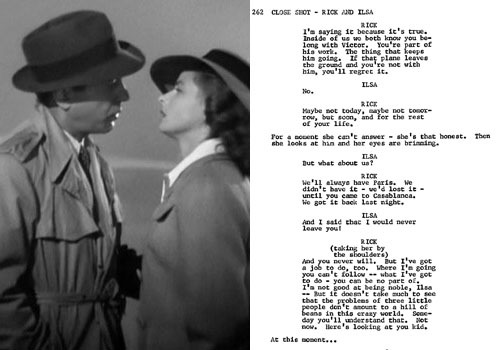
We’re getting ready for Camp NaNoWriMo this April! This month, we’re talking to Wrimos who are using the Camp format to work on non-novel projects. Author, editor, and screenwriter Julie Gray shares some writing tips that working on screenplays has taught her:
Screenwriting is a form of writing that is almost universally under-estimated. This probably has to do with the immersive, satisfying experience of seeing a film–and who doesn’t love a good movie? Writing one seems easy, right?
Wrong. What seems like a series of images and dialogue flying by is actually very demanding to write for a number of reasons. The format of screenwriting itself is totally unforgiving. But the biggest challenge for screenwriters–and there are many–is that they have very little time in which to tell their story.
A feature script should be at the most, between 100-120 pages long. For you prose writers, that’s maxing out at around 24,000 words. For the whole story. Compare that word count to a novel of say 100,000 words. And yet screenwriters have to do the same thing novel-writers do: backstory, subtext, plot twists, character development and theme. In a fraction of the words.
Because the competition is so tough, with hundreds of scripts landing in Hollywood every day for consideration, there is no room for variation or error. Hollywood readers are notoriously brutal. I should know. I used to be one.
These extremely challenging conditions give screenwriters a distinct advantage, however. They are, in a word, very muscular writers. Screenwriters must distill words into as powerful a vehicle as they can to convey not just narrative, but the emotional ride of a narrative, in as few words as possible.
“Don’t miss even one opportunity to ensure that your narrative evokes emotion and gets us to think and to feel.”Prose writers can do well to read scripts and behold the expediency with which screenwriters “show don’t tell”. Screenwriters must rely on conveying the most subtext, emotion, and atmosphere possible in the least amount of words. For screenwriters, characters never walk into a room. They mince, they sidle, they march, slide or slither. That walk–simply entering or exiting a scene–has to matter. It has to say everything about that character in that moment. Screenwriters simply don’t have the real estate to expand on the way a character moves or how the rain feels.
That is what screenwriters can teach prose writers–use every inch of real estate on that page; don’t miss even one opportunity to ensure that your narrative evokes emotion and gets us to think and to feel.
If you are a prose writer and are not familiar with reading a film script, the experience can be a bit frustrating. Scripts are written in a particular format, with “slug lines” and voice overs, etc. that you may find confounding. But if you read the “action lines” (anything that’s not dialogue or a slug line) you will quickly see how fewer words can sometimes have a bigger impact.
Overall, prose writers are in a better position than screenwriters, despite the seeming glamor of writing for the screen. Your stories will get read. But for a screenwriter, the only people who will read their story are agents, story analysts, and, if they are lucky, a producer. But if the story does not get purchased and produced and distributed, nobody will ever hear that story. It goes without saying that the number of scripts that grab the brass ring is vanishingly small compared to the number of scripts submitted.
Prose writers will share their stories on at least some level, whether you publish traditionally or self-publish. Even if the only people who read your story are your family or your friends. Your story did get out there. This is not the outcome of stories for the vast majority of screenwriters.
So before you get stars in your eyes about screenwriting as a writing path, take a cue from the way screenwriters write, and apply that potency to your prose. One good resource for perusing produced scripts is the BBC Writer’s Room. Get your story out there!

A former Hollywood story analyst living in Tel Aviv, Julie Gray is a UNESCO media literacy advocate in the Middle East and edits fiction and non-fiction manuscripts from writers all over the world. Her book Just Effing Entertain Me is a go-to for both screen and prose writers. A long time Huffington Post and Script Magazine writer, Julie is currently writing a non-fiction book describing life abroad and the curiously intertwined nature of national and personal identity.
Julie’s Facebook Group, the Fabulists, is for writers of all mediums, who find it self-evident that stories matter, words rock, and that writers need more coffee. Visit Julie’s website or follow her on Twitter @JulieGray972.
Top photo of Casablanca, via Writers Guild of America, West.


Chris Baty's Blog

- Chris Baty's profile
- 63 followers

