“Hate Speech”: Then and Now

John Adams, who signed the Sedition Act
It is interesting that a number of signatories of the Declaration of
Independence later in their careers took actions that jeopardized the
foundations of liberty, and specifically of freedom of speech, or the First
Amendment of the Constitution.
The greatest enemy
of liberty is fear. When people feel comfortable and well protected, they are
naturally expansive and tolerant of one another’s opinions and rights. When they
feel threatened, their tolerance shrinks. By 1798, the euphoria surrounding the
American Revolution, the sense of common purpose and a common enemy, was gone. Everyone
agreed that the new nation, founded amid high hopes and noble ideas was in
danger of collapse. The one thing they could not agree on was who to blame. (p.
1)
What went on in the mid- to late-1790s has reverse parallels today.
Where the Mainstream Media (MSM) today, by its own admission, intervened to
slander, libel, and smear presidential candidate Donald Trump (now the
President-Elect), to aid in and guarantee the election of a criminally
irresponsible, scandal-rich, unstable Hillary Clinton, the Democratic
candidate, the writers and newspapers of the 18th century came under vicious
attack from the government and the Federalists, the party of John Adams, who as
President signed the Alien and Sedition
Acts passed by Congress. The MSM failed ingloriously in its efforts. But
Adams, who was the main target of criticism by “Republican” (the name of the
early Democratic Party) writers and newspapers, unleashed the dogs of
censorship on them when he
signed the Alien and Sedition Acts on June 18th, 1798.
The Sedition Act outlawed what one could call the 18th century
equivalent of “hate speech.” It was impermissible and punishable now to hate
President John Adams (the second President after George Washington) and the
Federalists and their national and foreign policies, and to voice one’s anathema
for them in print or vocally. Those who did so and drew the attention of large
numbers of people were arrested and jailed. Adams and the Federalists would not
otherwise have heard or read the dissatisfaction but for informers who reported
the transgressions to Adams and his political allies.
A history of that time, Liberty’s
First Crisis: Adams, Jefferson, and the Misfits Who Saved Free Speech ,
by Charles Slack, came my way
and further educated me on the pernicious consequences of the Sedition Act of
1798 and the scope of the evil. The consequences and injustices were wider than
I had previously imagined. As Slack points out, one need not have been a conspicuous,
widely known opponent of Adams, the Federalists, and the Sedition Act to attract
the attentions of the 18th century speech “police.” An idle, disparaging remark
overheard and reported by a neighbor could land the speaker in jail and earn an
enormous fine, as well.
Here is the key section of the Sedition Act under which several men
were prosecuted and jailed for “blaspheming” the government, President Adams,
and other individuals in the government.
An Act in Addition
to the Act, Entitled "An
Act for the Punishment of Certain Crimes Against the United States."
SEC.
2. And be it farther enacted, That if any person shall write, print, utter or
publish, or shall cause or procure to be
written, printed, uttered or published, or shall knowingly and willingly assist
or aid in writing, printing, uttering or publishing any false, scandalous and
malicious writing or writings against the government of the United States, or
either house of the Congress of the United States, or the President of the
United States, with intent to defame the said government, or either house of
the said Congress, or the said President, or to bring them, or either of them,
into contempt or disrepute; or to excite against them, or either or any of
them, the hatred of the good people of the United States, or to stir up
sedition within the United States, or to excite any unlawful combinations
therein, for opposing or resisting any law of the United States, or any act of
the President of the United States, done in pursuance of any such law, or of
the powers in him vested by the constitution of the United States, or to
resist, oppose, or defeat any such law or act, or to aid, encourage or abet any
hostile designs of any foreign nation against United States, their people or
government, then such person, being thereof convicted before any court of the
United States having jurisdiction thereof, shall be punished by a fine not exceeding
two thousand dollars, and by imprisonment not exceeding two years. [Italics
mine]
Although Adams
signed the Alien (or “Naturalization” Act), but did not enforce it, it was the
Sedition Act that drew the chief attention and ire of its foes and was the tool
Adams used to retaliate against his and his administration’s vociferous
critics. It is the Sedition Act that is the focus here.
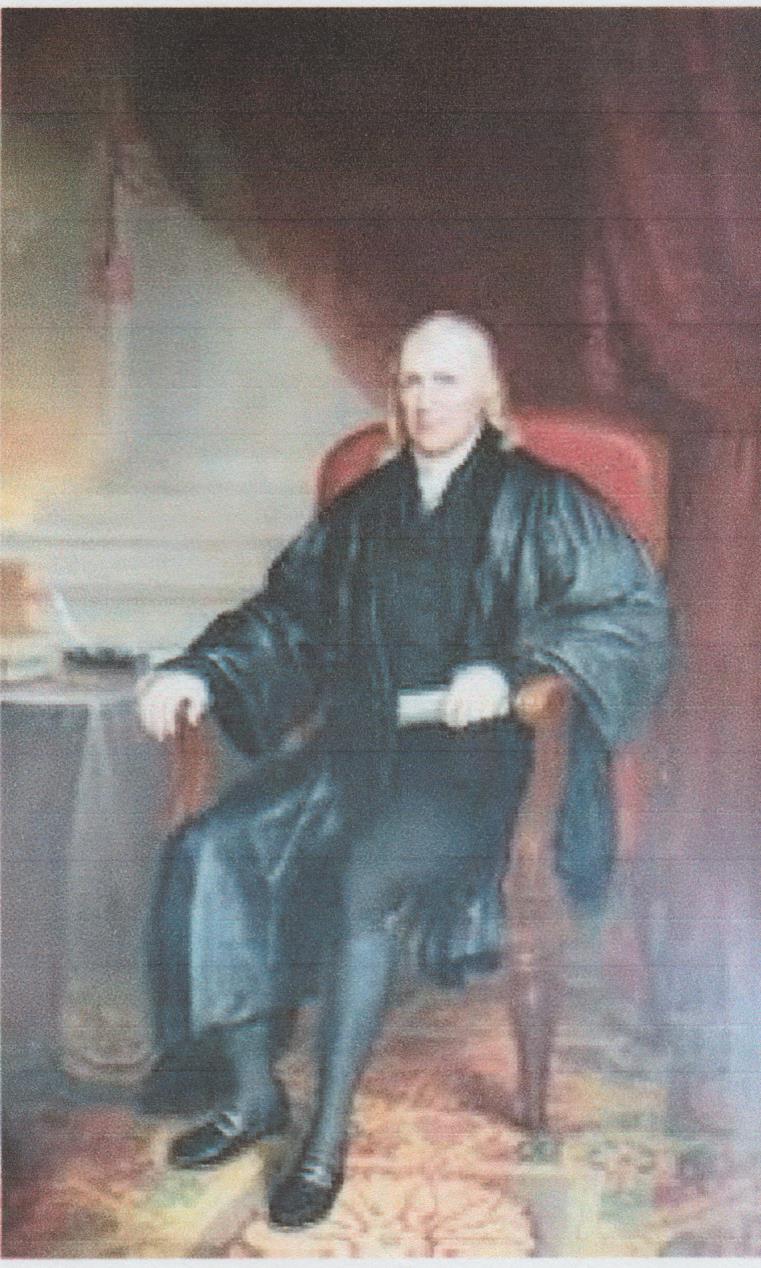
Associate Supreme Court
Justice Samuel Chase, who
presided over the prosecution
of men for violating the
Sedition Act
The Alien and
Sedition Acts were promoted and passed by the Federalists in Congress, who were
the majority in the Senate and the House of Representatives. Federalists also
dominated the Supreme Court. All the men
tried under the Sedition Act were tried by Federalist appointees. The legislation was
passed because Adams and many Federalists thought that a war with France (and
possibly another with Britain) was imminent, and so extraordinary restraints on
speech and the press were justified. French privateers raided American
shipping. The French, once an ally who helped Americans win the Revolution,
were now hostile to the U.S. The French
had undergone a revolution of its own. Its reign of terror
horrified Adams and the Federalists. The French bridled under American
criticisms of the conduct of the revolutionary government and became so hostile
to the U.S. that the government refused to receive or acknowledge the new
ambassadors from America, instigating the X,Y,Z Affair, during
which the French foreign minister’s agents sought to bribe the American
diplomats before negotiations for more amicable relations could even commence. Feeling that war was certain, and smarting
from the Republicans’ criticisms, the Federalists wrote and got passed the
Sedition Act, on July 4th, 1798.
Its known and principal victims, all of
whom argued that the Sedition Act was a violation of the First Amendment
(Congress shall make no law respecting an
establishment of religion, or prohibiting the free exercise thereof; or abridging
the freedom of speech, or of the press; or the right of the people peaceably to
assemble, and to petition the government for a redress of grievances). There might have been many more victims, but
records from the period are incomplete. The better known, as detailed and
described by Charles Slack, were:
Matthew Lyon, an Irish immigrant and a
Democratic-Republican congressman from Vermont. He was the first individual to
be placed on trial under the Alien and Sedition Acts He was indicted in 1800
for an essay he had written in the Vermont Journal accusing the administration
of "ridiculous pomp, foolish adulation, and selfish avarice." Lyon
was always spoiling for a “fight” against the Federalists. He spit on a Federalist
political foe, Roger Griswold, on the floor of the House; Griswold retaliated
by taking a cane to Lyon. Griswold was not charged with any misconduct. Found
guilty of violating the Sedition Act, Lyon was fined $1,000 and sentenced to
four months in prison. From inside his jail cell, Lyon won reelection to
Congress for Vermont. He later in life moved family, business, and home to
Kentucky.
James Thomson Callender, a
Scottish citizen and immigrant, had been expelled from Great Britain for his
political writings. Living first in Philadelphia, then seeking refuge close by
in Virginia, he wrote a book titled The Prospect Before Us (read and
approved by Vice President Jefferson before publication) in which he called the
Adams administration a "continual tempest of malignant passions" and
the President a "repulsive pedant, a gross hypocrite and an unprincipled
oppressor." Callender, already residing in Virginia and writing for the
"Richmond Examiner," was indicted in mid 1800 under the Sedition Act
and convicted, fined $200, and sentenced to nine months in jail.
Benjamin Franklin Bache, a
grandson of Benjamin Franklin, was a printer and editor of the "Aurora,"
a Democratic-Republican newspaper. Bache had accused George
Washington of incompetence and financial irregularities, and "the
blind, bald, crippled, toothless, querulous Adams" of nepotism and
monarchical ambition. He was arrested in 1798 under the Sedition Act, but he
died of yellow fever before trial. Bache’s widow, Margaret, inherited the
“Aurora” and picked up where her late husband left off, excoriating Adams and
the Federalists.
Anthony Haswell was an
English immigrant and a printer in Vermont. Among other activities, Haswell
reprinted parts of the "Aurora," including Bache's claim that the
federal government had employed Tories. Haswell was found guilty of seditious libel by judge William Paterson, and sentenced to a
two-month imprisonment and a $200 fine.
Luther Baldwin, a river
boat man who made his living plying the waters carrying passengers and trade up
and down various rivers including the Hudson, was indicted, convicted, and
fined $100 for a drunken incident that occurred during a visit by President
Adams to Newark, New Jersey. Upon hearing a gun report, fired during an
artillery salute during a parade, he yelled "I hope it hit Adams in the
arse."
David Brown, in November
1798, led a group in Dedham, Massachusetts, including Benjamin Fairbanks, in setting up a liberty
pole with the words, "No Stamp Act, No Sedition Act, No Alien Bills,
No Land Tax, downfall to the Tyrants of America; peace and retirement to the
President; Long Live the Vice President." Liberty Poles sprouted all over
the colonial landscape before and during the Revolution, but the Federalists
saw them now as incitements to civil disobedience and sedition. Brown was
arrested in Andover, Massachusetts, but because he could not afford the $4,000
bail, he was taken to Salem for trial. Brown was tried in June 1799. Brown
pleaded guilty, but Justice Samuel Chase asked him to name others who had assisted
him. Brown refused, was fined $480, and sentenced to eighteen months in prison,
the most severe sentence ever imposed under the Sedition Act.

John
Adams and Benjamin Franklin read and
revise
Jefferson’s Declaration of Independence
Thomas Cooper, an associate
of Joseph Priestly,
the noted scientist who with Cooper moved to America in 1793 to escape
persecution in England, was arrested for questioning Adams’s declaration of a “National
Day of Humiliation, Fasting, and Prayer.” In a local newspaper he questioned the
propriety of the declaration. Cooper was arrested, tried and jailed in
Philadelphia by Samuel Chase of the Supreme Court for violating the Sedition Act.
Writes Slack,
It had been passed “in
defiance of the plain and obvious meaning of the words of the constitution.”
…To Cooper freedom
of speech had a deeper meaning and purpose than just ensuring open government. At
stake was the right to of each individual to his own life, to form his thoughts
and express them as he pleased. The most insidious aspect of the Sedition Act,
he believed, was its direct transfer of rights from the speaker or writer to a
faceless, unaccountable mob. Cooper saw in the law an invitation to tyranny in
which unaccountable, ignorant men would pass judgment on “the most elegant
writer.” Cooper added, “They may find him guilty of what they do not
understand.” (p. 190)
Cooper was reminding his readers that Adams’s declaration was a sign of
where religion and rights “should not go,” that there should be a separation of
church and state, as expressed in the First Amendment.
Another outspoken enemy of the Sedition Act was Charles Hay, who
served as James Callender’s defense attorney, wrote and published a long essay, An
Essay on the Liberty of the Press , and in it offers one of the best
intellectual defenses of the freedom of speech of the period.
As Slack writes, Hay’s explication of the Bill of Rights, especially
of the First Amendment, in relation to the repressive Sedition Act, “galvanized”
the distinction.
“The words, ‘freedom
of the press,’ like most other words, have a meaning, a clear, precise, and
definite meaning, which the times require, should be unequivocally ascertained,”
Hay wrote. “That this has not been done before, is a wonderful and melancholy evidence
of the imbecility of the human mind.”
Hay continued: “This
argument may be summed up in a few words. The word ‘freedom’ has meaning. It is
either absolute, that is exempt from all law, or it is qualified, that is,
regulated by law. If it be exempt from the control of law, the Sedition Bill
which controls the ‘freedom of the press’ is unconstitutional. But if it is to
be regulated by law, the amendment which declares that Congress shall make no
law to abridge the freedom of the press, which freedom may however be regulated
by law, is the greatest absurdity that ever was conceived by the human mind.”
…Likewise, “if the
words freedom of the press, have any meaning at all, they mean the total
exemption from any law making any publication whatever criminal,” since the
only way to stifle objectionable voices would be to exercise “a power fatal to the
liberty of the people.” (pp. 170-172)
Hay does not state it, but he meant by that fatal power: by force.
Clearly something had
to be done to silence Matthew Lyon, Bache, Callender, and others. Vice
President Jefferson sensed the coming storm, noting in a letter to James
Madison, that President Adams “May look to the Sedition bill which has been
spoken of, and which may be meant to put the Printing presses under the
Imprimatur of the executive. Bache is thought to be a main object of it.” (Jefferson
to Madison, May 3, 1798) (pp. 64-65)

Thomas Jefferson, the Republican
enemy of John Adams, a Federalist
One of Jefferson’s
first acts as President in 1801 was to grant general pardons to any surviving,
jailed victims of the Sedition Act, which expired on March 31st, 1801, “written
into it to coincide with Adams’s last day in office,” notes Slack. “The pardon
automatically freed the two remaining prisoners who remained in jail: James T.
Callender and David Brown.” (p. 224)
Charles Slack’s opus is highly recommended
for anyone who wishes to understand the struggle to defend freedom of speech
and of the press over two hundred years ago, and to better grasp how low the
press has stooped to ally itself with parties hostile to freedom of speech and
of the press.
Liberty’s
First Crisis: Adams, Jefferson, and the Misfits Who Saved Free Speech . By Charles Slack. New York: Atlantic
Monthly Press, 2015. 340 pp.
Posted by
Edward Cline
at
5:05 AM

No comments:
Post a Comment
Older Post
Home
Subscribe to:
Post Comments (Atom)
Edward Cline, American Novelist

Edward Cline was born in Pittsburgh, Pennsylvania
in 1946. After graduating from high school (in which he learned nothing
of value) and a stint in the Air Force, he pursued his ambition to
become a novelist. His first detective novel, First Prize, was published
in 1988 by Mysterious Press/Warner Books, and his first suspense novel,
Whisper the Guns, was published in 1992 by The Atlantean Press. First
Prize was republished in 2009 by Perfect Crime. The Sparrowhawk series
of novels set in England and Virginia in the pre-Revolutionary period
has garnered critical acclaim (but not yet from the literary
establishment) and universal appreciation from the reading public,
including parents, teachers, students, scholars, and adult readers who
believe that American history has been abandoned or is misrepresented by
a government-dominated educational establishment. He is dedicated to
Objectivism, Ayn Rand's philosophy of reason in all matters.

Popular Posts

It Didn’t Start With Marx
An extraordinary book came my way, one
which alters to some degree my own focus on the current conflict between
socialism and conserv...

Islam Inculcates Criminality
I am more and more convinced that, aside
from its totalitarian elements, Islam, from a psychological perspective,
deliberately plants t...
Brexit and My Exit
Readers will note that there is a new
feature on this site, a PayPal button at the top or bottom of a new
post, which anyone may use if ...

“A Complete Way of Death”
A Coffin Called Islam On May 26,
Family Security Matters reprinted an article, co-authored by Clare
Lopez and Retired Admira...
Islam on My Mind
I've been criticized by some readers as having "Islam on the brain." It's not a very kind criticism considering the seriou...

The Totalitarianism of Modern Airports
Your Body is the State's Business I
hate flying, and have hated it for years ever since 9/11, and have sworn
never to fly again...
Last Call
This is my last post on Rule of Reason
and http://edwardcline.blogspot.com/ , at least for a long while. The
blog sites might remain u...

The Ubiquity of Lies
The Clintons: The liars who came in
from the cold of 2016. I can’t think of a better way to open a
column on the ubiquity of l...

What Donald Trump Should be to Americans
John Paul Jones, American Naval Hero
Instead of an essay, I offer an image of John Paul Jones by N.C. Wyeth
(1928). It is what Trump sho...
The Evil Unleashed on us by our Governments
The face of Islamic evil is so evident
now, given the Nice butchery of July 14th that even the most morally
dissolute and corrupt amo...
Gadget
This content is not yet available over encrypted connections.
Search This Blog
Blog Archive
▼
2016
(83)
▼
November
(8)
“Hate Speech” Then and Now
Inhuman Islamic “Human Rights”
The Morality of Corruption
Shut Up! Or Go to Jail!
Jail House Rock
America’s Kristallnacht
The Celebrity Departure Lounge
The Ubiquity of Lies
►
October
(13)
►
September
(6)
►
August
(9)
►
July
(10)
►
June
(4)
►
May
(6)
►
April
(8)
►
March
(6)
►
February
(5)
►
January
(8)
►
2015
(103)
►
2014
(97)
►
2013
(89)
►
2012
(2)
►
2011
(1)


No comments have been added yet.