Winnie-the-Pooh: The Forgotten Connection
Special thanks to CBC Radio for an interview that resurrected this little known story about the origins of Winnie-the-Pooh. Here’s a summary.
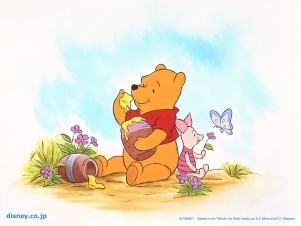
Winnie-the-Pooh was born in Canada! Well, sort of.
It all began in 1914. The First World War was underway in Europe. The Canadian Army was in desperate need of trained personnel to care for the thousands of horses used by the cavalry.
A young veterinarian in Winnipeg heeded the call.
Harry Colebourn soon found himself on a train with scores of other young men destined for the army base in Val Cartier, Quebec. A few hours into their journey the train stopped in White River, Ont., to take on water and coal for the steam engine. Like many other soldiers, Harry stepped off the train to stretch his legs.
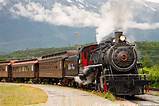
Standing beside the tracks was a man who turned out to be a trapper. He was holding a tiny black bear cub, only a few days old. He had trapped and killed its mother. Harry loved animals of every kind. He offered the trapper $20 for the cub. That was a handsome amount in 1914. They made a deal.
Harry took the cub on board the train. He named her Winnipeg, but soon shortened it to Winnie. Harry could not have known that in a few years she would become the namesake for the most famous bear in the world.
During their time in Val Cartier, Harry fed her at first with a baby bottle, he played with her, and he took her with him wherever he could. Winnie slept under Harry’s cot in their troop tent.
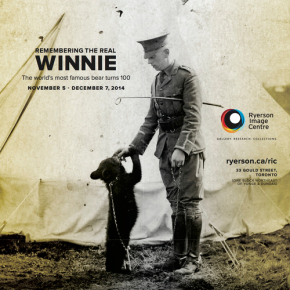
Soon, Winnie became the mascot for Harry’s regiment, the famous Fort Gary Horse (Winnipeg) Regiment.
After basic training in Val Cartier, the troops boarded the S.S. Manitou to England. Capt. Harry somehow snuck Winnie along with him on the ship.
Harry and his regiment trained on the Salisbury Plains of England for about four months. Then came the day when his regiment was ordered to the front lines in France. He was told Winnie could not accompany him.
Harry made a deal with the London Zoo to look after Winnie until his return. He made a note of it in his diary dated Dec. 9, 1914. Legend has it that Harry drove Winnie from the Salisbury Plains to London with a car he borrowed and somehow got the near-adult sized Winnie to ride in.
During the years that followed, Harry visited Winnie every time he got leave. He planned to take Winnie home with him to Winnipeg after the war. That was not to be. Harry returned home to Winnipeg in 1924, alone. We’re not sure why.
We do know that during those years at the zoo, Winnie became something of a celebrity. Her gentle nature and fondness for people earned her a special enclosure. There, Winnie enjoyed doing tricks for visitors, and children and adults were allowed to play with her. She even gave them rides on her back.
A zookeeper at the time said Winnie was the only bear they ever had that they fully trusted.
One of Winnie’s visitors was a young boy who stopped often at the zoo with his father. The boy’s name was Christopher Robin Milne. His father was a writer whose work at the time was gaining prominence. His name: Alan Alexander Milne, better known as A. A. Milne.
As it happened, Christopher Robin had a stuffed bear at home along with a collection of other stuffed animals, all with names except his stuffed bear. He had been unable to settle on a name. After his visit to the zoo, he named it Winnie.
In an interview last fall, Harry’s great granddaughter, Lindsay Mattick of Toronto, told Anna Marie Trimonti of CBC Radio that Christopher Robin would bundle up Winnie along with his other stuffed animals and take them for adventures in the woods near their home.
Those adventures inspired his father to create Winnie-the-Pooh and the fictional Christopher Robin, as well as Eeyore, Tigger, Piglet and the host of other critter-characters that A.A. Milne made famous.
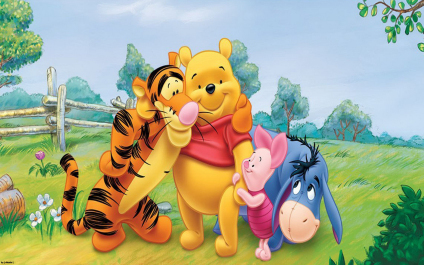
The first Winnie-the-Pooh book was published in 1926, ninety years ago. Winnie has since become known as the most famous bear in the world.
As the well-known radio commentator Paul Harvey used to say, “And now you have the rest of the story”.
*
“Winnie-the-Pooh: The Forgotten Connection” is Copyright © 2016 by James Osborne. All Rights Reserved
*
Source Credits: 1. CBC Radio, interview of Lindsay Mattick by Anna Marie Trimonti, carried on Michael Enright’s radio show “Rewind”, Oct. 24, 2016 ; 2. Lindsay Mattick is the great granddaughter of Capt. Harry Colebourn and the author of “Finding Winnie”, a book celebrating the 90th anniversary of Winnie-the-Pooh; 3. Earlier interviews on CBC Radio of Ann Thwaite, author of a biography of Winnie, “The Brilliant Career of Winnie-the-Pooh”, by Peter Gzowski, Barbara Frumm and by Eleanor Wachtel, which were incorporated in Michael Enright’s program, “Rewind”.
Image Credits: 1. Winnie – disney.co.jp; 2. Harry & Winnie, Ryerson Image Centre (ryerson.ca/ric); 3. Steam Engine – http://news.softpedia.com; 4. London Zoo – http://www.weblo.com; 5. Winne & friends group – pcwallart.com;