THE BRIGHT STREAM at ABT
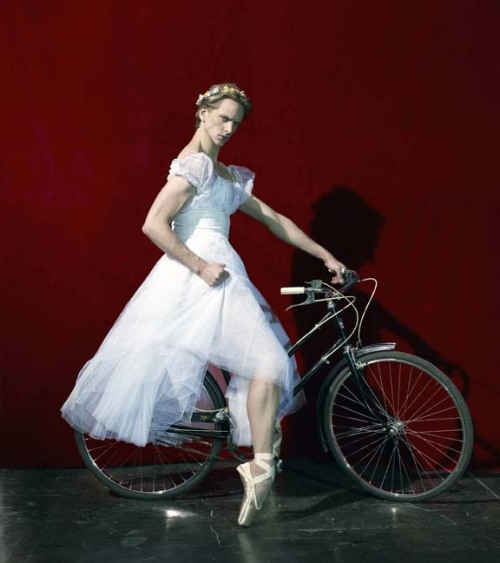
David Hallberg in Ratmansky's The Bright Stream, Rosalie O'Connor photo.
I'm not exactly sure yet what to think of this ballet, which made its premiere at American Ballet Theater last week. There are a couple more performances left this week and I think I may see it one or two more times. Right now I kind of feel like the history of the production (as told by Marina Harss in ABT's Playbill) is more interesting than what I actually saw.
According to Harss, the production was originally choreographed by Fyodor Lopukhov and premiered in Leningrad in 1935. But Stalin hated it so, he banned it, and eventually even sent the man who helped write the libretto to the Gulag. It was the last ballet Dmitri Shostakovich ever composed. Alexei Ratmansky (artistic director of the Bolshoi from 2004-2009) restaged it during his reign there, and the Russians loved it.
With a history like that, you have to wonder what it was that angered Stalin so. I can't see it. I just see it as a rather silly ballet – kind of reminiscent of Shakespeare's Midsummer Night Dream but not quite there – that takes place on a collective farm during one harvest season. According to the newspaper Pravda, Harss writes, the producers' crime was "balletic falsehood," meaning, she says, it wasn't a realistic portrayal of what people are like who live on a collective farm. In other words, there was too much silliness, and farmers are serious workers, not goofs. But Ratmansky explains that, in reviving the ballet, he was attracted both to the "lovely, danceable" music and the lightly humorous vaudevillian aspect of the tale, as well as to an underlying darkness, an edge, he found in Shostakovich. "There is always something hidden in Shostakovich," he says.
To me, that's fascinating, and is the reason I'm going to need to see it again … and the reason I'm going to need to listen to more Shostakovich.
I think, though, the problem to me may have been more that the Russians have a keener sense of how to put on something like this, where basically every role has bravura parts. I plan to go see the Osipova / Vasiliev / Simkin cast this week to see if I feel differently about it. I saw the third cast – Veronika Part as the main character, Zina (and Part was beautiful, and the one perfect thing I felt about this cast – she was the heart and soul of the ballet), Alexandre Hammoudi as her straying husband, and Cory Stearns and Stella Abrera as the main ballet dancers in the theatrical troupe that comes to town and shakes things up. I liked Cory too. He had the cross-dressing role that David Hallberg is pictured in above and he was very good. He's a good actor, good with both comedy and romance and has a charming, very stand-0ut stage presence.
Anyway, the plot is rather complicated, and when I expressed that to my friend she laughed and said she'd given up on the synopsis and decided just to enjoy the beautiful music and the humorous dancing. She liked it much better than I did, probably because she decided to stop trying to figure things out and just enjoy… The plot: Zina works as a local amusements organizer. Her husband, Pyotr, has a wandering eye. When a traveling theatrical troupe comes to town to stage a ballet, Zina recognizes the main ballerina – they once took classes together. They dance together, and reminisce — it's really Zina reminiscing about her dancing past (and Part did this just beautifully) – while Pyotr becomes enchanted with the ballerina. There are also a couple of older, long-married dacha dwellers, who are rather goofy and humorous (danced by past ABT greats Victor Barbee and Martine Van Hamel). The male dacha dweller falls for the ballerina, and the female becomes enamored of the male ballet dancer. When it becomes clear how attracted to the ballerina Pyotr has become, Zina begins to cry. The ballerina calms her, promises her she has no intentions of returning his affections, and suggests they all play a trick on the married dacha dwellers and on Pyotr whereby she will dress as the male ballet dancer and the male ballet dancer will dress as her. So, that's why the whole cross-dressing thing happens. There are many subplots as well, one involving a milk maid and her companion, a handsome tractor driver (who decides to dress as a dog), but this theme of married man falling for someone who is not his wife, then realizing how much he does value her, is the main theme of the ballet.
It was pretty funny to see Cory Stearns try to dance on pointe, but funnier to watch his character get carried away with the spread-legged, very masculine-looking jumps in that white sylph dress. He and the ballerina are, after all, ultimate hams in need of audience applause, so it makes sense that he forgets himself for a time and starts really acting like a man. I really wonder how David Hallberg does that part – and that makes me want to see his cast as well. Stella Abrera was fine as the ballerina, and mildly funny when she becomes a boy, but she's not as spectacular of a dancer as, for example, Natalia Osipova, and I'd think that role should go to an allegro dancer like her. I imagine Osipova must be absolutely perfect in that role (since she can do mind-blowingly crazy high jetes better than many men).
Alexandre Hammoudi did well as Pyotr, though there didn't seem to be a whole lot to that role, which makes me curious to see Marcelo Gomes and Ivan Vasiliev in the part.
I feel like, because the story-line is so slight, and because, as I said earlier, practically every role has some bravura parts, that this is a ballet that needs really spectacular dancing, that needs people cast in every part who are the kind of dancers who are constantly saying, "Hey, look at me, I can jete to the ceiling!" or "I can develope over my head!" or whatnot. And ABT dancers just aren't trained to be that way – at least most of them aren't.
One other gripe is the costumes, particularly for the men. The blasted pants. The mens' lines were clumsy and unfinished and I think it was because the pants were too restrictive. It's unusual that every single man would be unable to do a proper straight-legged jete or lift his leg more than a couple inches off the ground in arabesque – especially Gennadi Savliev, who always comes through on the stunning athletics. It had to be the pants. I understand why Ratmansky wanted to set the period with the costumes, but as with classical ballets, can't the tops be the period-setters and the bottoms just be regular tights? Ballet is all about form!
Did anyone see the other casts yet?