
Brian Solis's Blog, page 35
September 8, 2021
readwrite: Customer Experience Speakers for Your Event
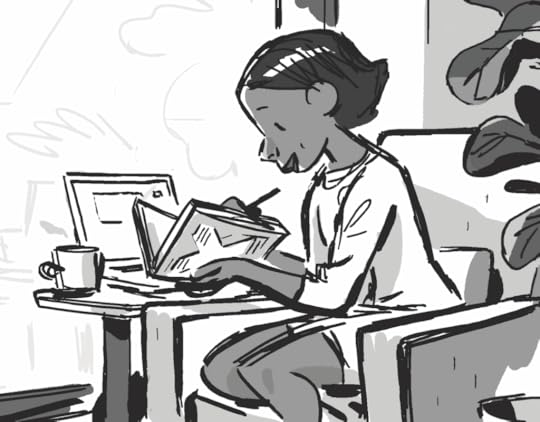
Disney Pixar Storyboard Developed for X: The Experience When Business Meets Design
Readwrite published an article that lists the top CX speakers for events exploring customer trends and the future of behaviors, expectations, and preferences. Brian Solis was named to the list along with many of his long-time friends
As a pioneer in digital anthropology, we believe Brian should be ranked at the very top of the list for events where audiences need to understand the human side of the evolving digital story. Brian outlines in a very approachable and engaging way exactly how customers are different from executive impressions of them. The best approach is through empathetic storytelling, understanding ways digital-first behaviors change the very fabric of CX strategy online and also in a hybrid world. After all, Brian literally wrote the book (actually two!) that sparked the experience design movement, What’s the Future of Business? Changing the Way Businesses Create Experiences, and, X: The Experience When Business Meets Design.
The post readwrite: Customer Experience Speakers for Your Event appeared first on Brian Solis.


August 23, 2021
Webinar: Digital Wellness for a Remote Workforce and the Role of IT

With the haste to roll out additional technology to support remote work and an expectation for employees to rapidly adopt that technology, there can be complaints and consequences as it relates to tech adoption.
Quartz research points to three key consequences:
• Productivity distractions – constant pings from colleagues and context switching between apps
• Perpetual connectivity – the need to be “always on”
• Decision fatigue – an overwhelming array of tools and systems
Each of these consequences of tech adoption can weigh on the emotional well-being of teams. So much so that 67% of Quartz research respondents believe being “always-on” has a significant negative impact on their health and wellbeing. Over time, this leads to burnout.
The good news is, with the right leadership and the right technology, these consequences can be avoided or overcome.
So what is the role of IT in digital wellness? At the height of the pandemic, IT teams were the true heroes, keeping the workforce productive in a time of uncertainty. But where should IT teams be focusing now?
With hybrid working set to continue, how can IT best support workers to remain not just productive, but balanced in an ‘always on’ world.
During this webinar hear from Brian Solis, Global Innovation Evangelist at Salesforce and author, including his latest book focused on digital wellness – LifeSCALE: How to Live a More Creative, Productive, and Happy Life. Solis will share his thoughts on the consequences of constantly being interrupted with the plethora of platforms we rely on, and the role of IT to help find a balance in a digital world.
Gerald Lavin, Product Strategist at Citrix will share how a digital workspace can support digital wellness by limiting distractions and automating work, as well as showcasing some of the microapps you can leverage to help your workforce work smarter, not longer.
Please RSVP for “Digital Wellness for a Remote Workforce and the Role of IT,” here.
The post Webinar: Digital Wellness for a Remote Workforce and the Role of IT appeared first on Brian Solis.

August 18, 2021
Brian Solis Urges Businesses to Look Forward

via 21st Arkansas Business and Century Business Forum
Hall of Fame pitcher Satchel Paige was known for saying, “Don’t look back; something might be gaining on you.” Futurist Brian Solis shares that belief, especially as it pertains to businesses and their need to look forward, not back.
That need is even more poignant in this post-pandemic world, according to Solis, who maintains that businesses should not be yearning for a return to the old normal but rather must adapt to the changed behaviors of consumers in what he calls the “novel economy” — as in the novel coronavirus.
“There’s no need to try to look to the past to see what we did when (instead) you have an opportunity to explore what you could do differently or what you should have been doing differently,” said Solis, who holds the title of global innovation evangelist at cloud computing giant Salesforce.com.
Solis shared his thoughts on the impact of disruptive technology and surviving and thriving in changing times in the July episode of the 21st Century Business Forum, a monthly webcast that features one-on-one interviews with some of the nation’s most prominent business minds and thought leaders. The Business Forum is presented by Arkansas Business and sponsored by CHI St. Vincent.
Solis told the podcast’s host, author Jon Gordon, that businesses need to pay attention to how people are changing, especially in reaction to a pandemic that caused them to become “digital first as a matter of necessity” in how they work, learn and shop.
Before the pandemic, businesses might have said they were consumer-centric, Solis said, “but that may have been more of a mindset.”
“Now you literally have to design the business around the consumer because they are not going back to ‘normal’; they’re only going to continue to evolve,” he said.
Businesses need to recognize this change so that they can create better experiences and build better relationships with consumers, according to Solis. And doing so will require businesses to embrace a spirit of innovation.
The catch, Solis observed, is that most businesses “will find every reason not to do something,” unlike innovators, who shift from idea to action.
Nonetheless, Solis maintains that spirits of innovation and creativity “are within us – they just need to be flexed.” They also need to be practiced, he said, “and that is where culture comes in, and leadership.”
“This is a time for innovation, not just in business models but in mindsets, and how we work together and want to work together going forward,” Solis told Gordon.
It will be critical for businesses to satisfy the needs of a changed consumer because of the next disruption on the horizon, which “is going to be choice,” Solis said.
He cited a study by the McKinsey & Co. consulting firm that showed 75% of North American consumers tried a competitive brand during the pandemic and 83% are going to stick with that brand post-pandemic.
Solis said smart executives and competitors are going “to try to pull those customers away from you because they can.” He said the rapid solution “is to try to figure out why they left and why they’re staying away from you,” then adapt accordingly.
The post Brian Solis Urges Businesses to Look Forward appeared first on Brian Solis.

August 5, 2021
The Future Of Marketing Starts Now
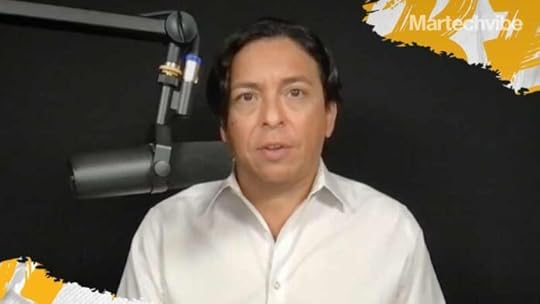
A summary of Brian Solis’ keynote presentation at the recent Martechvibe Fest event in South Africa by Suparna Dutt DCunha
People keep saying it: everything has changed. As the days spent in our homes blur together, outside in the world of marketing, huge shifts in consciousness are happening.
The pandemic is teaching marketers not just to be digital, but to use it to bring new experiences that are more intuitive, productive, efficient and exciting for customers, and also be empathetic, according to Brian Solis, the global Innovation evangelist at Salesforce. Speaking on Day 2 of the Vibe Martech Fest South Africa about the new role of integrated marketing and CX in a novel economy, he said, “The novel economy is the term I came up with to describe the new normal. It’s not an old new normal, it’s not necessarily a new normal, it’s a future without a playbook yet.”
Even before the pandemic, customer experience was becoming an area for differentiation among brands that really got it, Solis said. Now, in a world where digital has exposed weaknesses and opportunities in every company, experience is the foundation for surviving and thriving in every company in the novel economy.
But what really changed in 2020 and 2021? How has digital and pandemic stress affected customer behaviours and expectations? What does “brand” mean now? Who owns CX moving forward? What is the new role of marketing now?
Looking out in the future, there are several trends playing out, but digital-first consumer behaviour tops the list. “It’s not just accelerating digital transformation, but human transformation as well,” said Solis. Emphasising the new behaviour is bringing new expectations and merging real-world and hybrid experiences, he said, “the next big disruption is loyalty, retention is critical, and acquisition is an opportunity.”
Solis, also an author, a former analyst, publisher of over 60 plus reports, and also an aspiring digital anthropologist, said last year he witnessed the rise of Generation-Novel. “Basically, they are those hand-in-hand in the novel economy, which is about how digital changes us all equally. How the internet, social media, apps, games, online economy, working from home and learning from home changed us, and how we can bring these data-driven insights to give us visibility into what people love and what people expect.”
The experience a company provides is as important as its products and services. It is critical, said Solis. “Experience is not transactional. It is emotional. We want people to feel great every single time they touch us. And this is where disruption becomes a card, a factor in the novel economy.”
All around the world, people are experimenting with new brands, new services. McKinsey’s research illustrates that 75 per cent of consumers have tried different stores, websites, or brands since shutdowns. And, 60 per cent of those consumers expect to adopt new brands and stores into their post-pandemic lives and routines.
“Why are people doing this? Is it convenient? Is it personalisation? Is it innovation?” asked Solis. “Brands must prioritise to understand the change in behaviour. Customers have been telling us for several years, but more so now in this pandemic driven anxiety, divisive world, that they want us to understand their unique needs and expectations.”
“They want us to demonstrate empathy, they want integration throughout their journey. Now, they are emphasising to use digital, not just to digitally transform, but use it to bring to life new experiences that are more intuitive, productive, efficient and exciting,” added Solis, who was called by Forbes as “one of the more creative and brilliant business minds of our time”.
Digital ImperativeThe digital imperative is more than digitisation. Over 85 per cent of customers expect companies to accelerate digital initiatives, 69 per cent of customers say companies should offer new ways to get existing products and services, 54 per cent want companies to expand customer engagement methods, and 54 per cent want companies to innovate, offer new types of products and services.
A new generation of customers is taking shape and with it, new standards for experiences and values emerge. “Generation-Novel now wants brands to demonstrate values and to align with their values.” In fact, number one on the list of where customers want to see the brand transformation is in trustworthiness. “They want you to stand for something, beyond corporate social responsibility, beyond the trendiness of being sustainable or human-centred,” said Solis.
According to Solis, brand engagement and experiences are opportunities to align with customers. According to a survey, over 60 per cent of customers have stopped buying from companies whose values didn’t align with theirs. Environmental practices, action on racial injustices, treatment of employees during pandemics and action on economic injustices are some of the things that influence the decisions of the customers to buy from a company. “Now, customers are more conscious, more awake, and they are exercising their power of discovery,” said Solis.
Customer experienceSo who owns the customer’s experience?
According to Solis, the customer owns their experience. “We just do our best to be stewards of delivering an experience we feel that they are going to love. Not just align with it, but seek out and tell everyone around.”
When it comes to customer experience, CMO has a significant role in transformation, according to Solis. “It’s not just about brand style guides, advertising, messages and email, digital touchpoints and conversion, those things are important, but what is really important is how you use marketing to communicate what you stand for in this new world, and why they should align with you moving forward.”
In the Salesforce State of Marketing report 2020, almost 80 per cent of high performing organisations say they lead customer experience initiatives across their organisations. “Remember the customer’s experience is the sum of all engagements a customer has with your organisations, in every touchpoint, throughout their journey. Together they all add to form the brand from their perspective, from what they see and what they feel,” said Solis.
Solis says that it is essential to find out what the customers are seeking and innovate what they don’t know they are seeking in that journey. “Today, there are things that are broken in the journey that we can fix, there are also moments we can create that doesn’t exist in that journey.”
There’s an opportunity to innovate everywhere by using technology as an enabler for better experiences. Based on those experiences, companies must work cross-functionally together to deliver, foster meaningful relationships and drive growth. “How we talk, how we email, how we advertise, how we market, how we message, how we serve, how we sell, all become part of an experience style guide,” he added.
It is imperative that marketing leaders make change happen, starting with the shift from promoting brands and products as their purpose to plugging into 360 customer insights and driving experience innovation.
Marketers are the change agents, said Solis. “When you look in the mirror, are you willing to see somebody who has the courage to take responsibility, even without authority, to start the process of change? It is an external transformation, but at the same time, it is an internal transformation.”
For marketers, it is important to embrace storytelling, bringing to life who the new customers are, how they feel, what they think and how they make decisions. “We have to champion their voice and their aspirations. It’s important to be a centre for growth.”
While profit is part of the growth, Solis said, so is the relationship. “Better experiences drive those new relationships, and that’s what success looks like.”
Needless to say, Covid-19 memories have opened new connections between brands and consumers. Brands need to understand this evolving customer and how it shapes their epochal memory.
“These times are not easy. Right now, we are all paying attention, in our own way, we are reevaluating everything. Because these times are so profound, they create moments where brands can create new connections with customers. The memories we are forming are epochal because they are definitive, it’s going to last for a long time.”
There are opportunities companies can use to re-enliven their brand. “It’s time to upgrade, update, modernise and humanise our brand. To represent not just things that are trendy, cool and digital, but things that matter,” he said.
According to Solis, the new pillars of memorable brand experiences or the novel economy include cultural relevance, innovation, purpose, trust, customer-unified, digital-first and wellness, among others. “This is a relationship business, and it’s crucial to define what those relationships are supposed to look like. Create value that is mutually exchanged. Create a dashboard with meaningful metrics that measure what matters to customers and what matters to the business.”
Presenting a playbook for the novel economy, Solis outlined the importance of unifying the organisation, technology and people around customers, upgrading the brand for modern times, values and aspirations, identifying missing areas for experience innovation, unleashing artificial intelligence for personalisation and optic-channel journeys and centralising real-time analytics for trends and insights among other things.
“Every time you touch a customer, it’s not just a moment to transact, but also a moment to communicate empathy, to deliver something that people want, to deliver magic,” said Solis. “That’s what marketing is all about, bring that into everything that you execute, how you sell, how you serve. That touchpoint is an ignite moment, a moment to ignite a new relationship in a novel economy. And you are that champion. The future of marketing starts now, the future of marketing starts with you.”
At his parting shot, Solis said that brands can now become the light customers are seeking.
—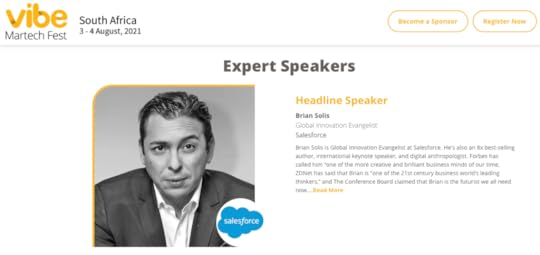 Keynote Description: The New Role of Integrated Marketing CX in a Novel Economy
Even before the pandemic, customer experience was becoming an area of differentiation for progressive brands. Now in a world where digital has exposed weaknesses and opportunities in every company, experience is now the foundation for surviving and thriving in a post-pandemic economy. But what really changed in 2020 and 2021? How has digital and pandemic stress affected customer behaviours and expectations? What does “brand” mean now? Who owns CX moving forward? What is the new role of marketing now? Tune in to this can’t-miss session to gain insight from global innovation evangelist Brian Solis.
The post The Future Of Marketing Starts Now appeared first on Brian Solis.

August 3, 2021
The Augmented Workforce: How Artificial Intelligence, Augmented Reality, and 5G Will Impact Every Dollar You Make
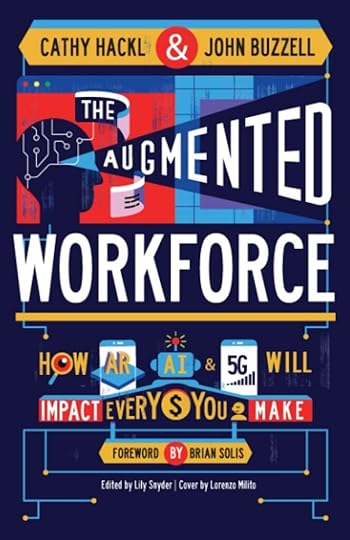
When my friend Cathy Hackl asked me to write the foreword for her new book with John Buzzell (@buzzxr) the answer was of course, “yes!” Not only is she a long-time friend, but the’s also a leading authority on virtual reality (VR), augmented reality (AR), and spatial computing. I geek out on this stuff! But when I actually read the manuscript, I felt lucky to have been asked. It’s an incredibly important and timely topic for every business and for entrepreneurs and dreamers everywhere.
Geek factor aside, the convergence of AI, AR/VR, and 5G (and beyond) has already set the stage for a new experiential canvas that spans digital, real, and hybrid worlds. This means that we need to think differently about how we navigate the future. What we know versus what we can dream is where this journey begins. And everything starts with reimagining…everything, how we interact with one another, with our environments, with space itself, how we work, learn, shop, play, and explore the undeveloped, nascent world ahead.
My only ask of Cathy and John was that when the book was released, that I could share the foreword with you here. Without further ado, please read the introduction to “The Augmented Workforce: How Artificial Intelligence, Augmented Reality, and 5G Will Impact Every Dollar You Make.”
I’d love to hear what you think.
This Is the Virtual Sign You’ve Been Waiting ForImagine you’re in the “Metaverse.”
It’s an incredible escape from the limitations of reality, as you explore new worlds, meet new people, and indulge in mind-bending experiences. You become someone else, the person you always felt you were meant to be. You feel alive and empowered to do so much more than you can accomplish when you unplug. You’re surrounded by amazing things and people you would never have encountered or met, otherwise.
This is more than escape. It’s the Metaverse. To you and millions of others, it’s a real world where you feel relevant, part of a community that’s exploring a new frontier. This. Is. What. Matters.
Avatars in these virtual worlds represent real human beings, and they’re paving the way for more than personal entertainment. They’re broadening their horizons, learning how to connect, learn, and express themselves in new ways while pushing the boundaries of reality itself. For those paying attention, our adventures in immersive realities are evolving how we communicate, connect, work, discover, and share. And when you come back to the real world, you start to question why it is you have to stop. “Why aren’t these experiences part of everyday life?” you ask yourself.
Well, that’s just how the world works, isn’t it?
The truth is that the way the world works today was imagined in a time that no longer exists.
Again: This. Is. What. Matters.
The systems originally built for basically all that we do today are failing. As society advances, dated infrastructure, mindsets, and metrics, not technology, hinder progress.
The future of how we live and work, our relationship with innovation, and our very construct for productivity and engagement, are overdue for a digital, physical, and hybrid renaissance. Who are our artists to imagine and create the future? Who are the da Vincis, Michelangelos, Raphaels, or Donatellos of our time?
The answer is: you.
That’s why you’re reading this. It’s also why Cathy and John wrote this book. You are, they are, we are all curious. We’re dreamers. We’re geeks. We believe that something greater lies ahead, because we’re already experiencing wonders in our personal lives: Artificial Intelligence. Augmented reality. Immersive audio. Virtual reality. 5G.
Why bring these experiences, our ideas, and our passions together to reimagine the future of work, business, engagement, and experiences? Someone has to. So, why can’t it be you? The future needs you to imagine forward—to engineer next-generation relationships between people, between screens and machines, and between virtual and real-world experiences. You can play a role in shaping the future you want to see.
As much as we want to forget it, 2020 was a pivotal year for us. Through disruption and chaos, we found a new way forward. We learned that we are more capable, resilient, and inventive than we previously gave ourselves credit for. But this isn’t the last disruption we’ll face. Another pandemic, climate change, social transformation, political shifts, and the unknown lie ahead. We’re also in the throes of the Fourth Industrial Revolution (“4IR”), which is completely reshaping, well, everything.
Think about it. If not now, when? If not you, then who?
Just because the way we live or work has “always been done this way” doesn’t mean that it is the best way or the only way forward. The 4IR is already forcing human workers to reskill and to reconnect with soft (although really hard) skills including creativity, critical thinking, empathy, problem solving, initiative, and active learning.
What we see and do can be augmented to bring the Metaverse to life in our work. The 4IR can power more incredible experiences that we haven’t yet seen, or even imagined. That’s why you play a more important role than you may think. You have an opportunity to envision the future, today. You can be the architect, the engineer—the builder of immersive, productive, and fantastical digital and hybrid experiences.
Look, I get it. It’s easy to find every reason why we can’t change the rules, throw caution to the wind, or immerse ourselves in something new and different without checking certain boxes first.
But change happens, with or without us. Change also happens to us or because of us. It really is a choice.
The same old thinking and beliefs will never change the world. As the saying goes, “Insanity is doing the same thing over and over again, but expecting different results.” I believe that you believe the world would be a better place because of your ideas.
Thank you for coming along on this journey. You’re in good hands with Cathy and John. Together, you’ll not only transform how you work and live, but you’ll also make a dent in the universe. You’ll inspire remarkable changes in the design of how people, things, and places co-exist, communicate, and come to life.
I can’t wait.
—
About: The Augmented Workforce: How Artificial Intelligence, Augmented Reality, and 5G Will Impact Every Dollar You Make
Business as usual is over. The age of hyper-change is upon us, and technology is at the forefront. Since the dawn of the microchip, exponential growth has defined modern technology. Today, entire industries are being upended by software, sensors, cameras, LiDAR, processors, and optics — all growing smaller by the day. Tech is pushing into every corner of our world, and businesses that ignore the disruption do so at their own peril. The end of the mobile phone is near, and the age of hyperconnectivity is here, with AR glasses, the intelligent edge, and IoT.
Led by globally recognized futurist Cathy Hackl and award-winning emerging-tech leader John Buzzell, this book will arm you with frameworks and examples to tackle the rapid disruption happening in every industry. This book is for business leaders who want to learn more about 5G, artificial intelligence, augmented reality, and other emerging tech. We’ll explain how you can wield this new tech for scale and revenue growth. We’ve seen the effects of this technology on the workforce firsthand, both success and failure. Along the way, you’ll hear real-life examples from business leaders and the authors — industry experts in technology years in the making. By the end, you’ll be seeing the world through AR glasses and AI applications, and at the speed of 5G.
Get ahead of the competition and shape the future you’ll be ready to lead with The Augmented Workforce.
—
Watch Cathy Hackl on Intersections, my show with John Kao at 37:00 
The post The Augmented Workforce: How Artificial Intelligence, Augmented Reality, and 5G Will Impact Every Dollar You Make appeared first on Brian Solis.

August 2, 2021
Marketing Insider Group: 5 CX Speakers You Should Follow in 2021
 via Emma Bentley, Marketing Insider Group
These top CX speakers and influencers will teach you how to cultivate deeper and longer lasting relationships with your customers. They live, breathe, and love CX. Plus, they’re not shy about sharing their mad marketing and selling skills.
What’s a futurist? You’re about to find out when you listen to Brian Solis. He helps audiences understand how to identify and even create corporate and social trends. Solis relies on digital analysis to guide his beliefs, as well as coined the term “Digital Darwinism.” Listen to just one of his speaking engagements and you’ll be sold that he’s the real deal.
Sought after by some of the biggest brands and celebs the world over as a CX speaker and expert, Solis’ concepts can revolutionize your culture. As we’ve all learned, business culture and disruption has a major effect on CX. With a little help from Solis’ writings and teachings, you’ll move the needle on customer trust and retention.
Though he’s in the executive ranks at Salesforce, Solis still attends conferences as a keynote speaker. Most recently, he was a top virtual presenter at Conga Connect 2021.
The post Marketing Insider Group: 5 CX Speakers You Should Follow in 2021 appeared first on Brian Solis.

July 21, 2021
Association of National Advertisers: Why It’s Time to Humanize the Brand — for Real This Time

Brian Solis of Salesforce discusses why people are looking for a genuine connection with companies and organizations now more than ever
Brian Solis, global innovation evangelist at Salesforce, doesn’t mince words when it comes to how the coronavirus will change the way brands and organizations present themselves to the public. “If this pandemic has shown us anything, it’s that it’s time to add several new pillars to the brand that allow it to become much more human,” Solis says.
While his role at Salesforce — focusing on digital anthropology, digital transformation, innovation, and customer experience — is relatively new, Solis has spent the bulk of his career studying and predicting the effects of emerging technologies on business and society. He’s also a sharp observer of the intersection between marketing and consumer behavior. His most recent book, Lifescale, explores how to successfully navigate life in a world of relentless digital distractions.
Having their messages resonate with consumers — rather than being pegged a distraction — is one of the biggest challenges facing consumer brands these days. Their future may depend on it. Solis talked with ANA magazine about the digital transformation companies are now confronting, how the pandemic will fundamentally change marketing, and what the new normal will look like.
Q. Has the way that consumers expect to interact with brands changed as a result of the pandemic?
People have wanted a genuine and authentic connection with the brand. This is why for the last 20 years I’ve been working with organizations to ask them, “What does it mean to be a brand that’s meaningful in the digital era?”
I don’t know that legacy brands have realized that, to use Marshall McLuhan’s famous quote, “the medium is the message.” You have to reimagine the brand for a digital world, because it shows up differently. I believe that if this pandemic has shown us anything, it’s that it’s time to add several new pillars to the brand that allow it to become much more human.
I’ve often talked about this as experience design: What is the experience your brand creates? What does that experience look and feel like? Complement your brand style guide with an experience style guide.
Q. Is there something brands should be doing now that will help them come out ahead in terms of digital transformation?
When social media was first born, it was an opportunity. We as businesses and organizations were given a platform through which we could humanize — humanize our messaging, humanize our brands, humanize our employees — and build a greater community with customers and stakeholders around the world that was less hierarchical and more dynamic. Instead, social media led to the creation of marketing roles that were more about getting followers and showing this staged persona of the brand.
The opportunity was to show a side of the brand that could be a human being. Very few companies understand that, and very few companies understand the value of those roles within the organization. Here we are, 14 years later, and we’re still not really sure of the value of person-to-person marketing. We still email people in much the same way. We have access to artificial intelligence and machine learning platforms now that aren’t scaling humanity, they’re scaling the previous generation of broadcast-oriented marketing. There’s still much to learn.
One of the brands that I think sets a great example today is Steak-umm. That is probably one of the most authentic brands out there right now. It’s slices of steak, but it stands for something.
Q. Should marketers continue to put stock in data they collected from before the pandemic, or is this environment so different that marketers have to reevaluate what they thought they knew about their audiences’ behaviors?
Over the years, we had already learned that e-commerce was on the rise, but there was a sudden, overnight shift when everybody was placed in shelter‑in‑place. This is important because it insinuates that the consumer had a shock to the system and had no choice but to shop mobile first and desktop second. As a result, consumers started creating new patterns and behaviors.
If you think about the psychology of this, it takes 66 days on average for a person to adopt a new behavior that becomes automatic. You could infer that because we’ve been in shelter-in-place for longer than that in some places, over the next 36 months, you’re going to see this [e-commerce] behavior become much more concrete.
I gave this new generation the name “generation N” because it’s not organized by age, like millennials. It’s organized by a pandemic that has changed the world’s behaviors. Any data that you have from before March 1 should be disregarded. The behavior post shelter-in-place is what we want to start studying because it shows the emergence of a new customer, a digital- and mobile-first customer.
This goes back to the thread of humanity in the discussion: the customer is not done evolving. It’s not just about how they use devices; it’s about how this pandemic has changed who they are as a person. Chances are, consumers are going to be much more mindful of their money; they’re going to be much more mindful of what matters to them.
This is why we’ve seen incredible creativity on TikTok, YouTube, and Instagram, because people are being much more thoughtful about what they do, what they say, and what they express, because they have the time to do it. I think that’s going to reshape what people stand for and what status means to them. I think those things will reset brands and what brands create, sell, and market.
Q. How does generation N blend in with traditional generational marketing, or does that not matter anymore?
It depends on the organization. What’s really important right now for marketing is to partner with data science in some way to remove bias and to allow the data to reveal who the customer is right now, and who the customer is becoming. You also have to show how targeting the customer psychographically, not demographically, is going to yield a return now or over time that transforms marketing from a cost-center to an investment.
Coming into the pandemic we did talk about centennials, millennials, boomers, gen X, but that was just basic marketing. Anyone can stereotype a generation, but what’s your message? Who are you really trying to connect to? What’s that human being stand for, and what’s their aspiration when they attach their personal brand to your brand?
When you identify those things, you can connect with a 16-year-old, and a 26-year-old, and a 36-year-old. That’s why this idea of generation N forces businesses to use data to look at the common sets of behavior. It becomes bigger than generational marketing, and it becomes more meaningful.
Q. From a marketing standpoint, what do you hope will be part of the “next normal,” that evolves in the months and years ahead?
New and unusual is going to define the next 36 months, for better or for worse. Because it’s new and unusual, there is no playbook for how we’re supposed to survive and thrive. I think in the back of [business leaders’] minds, there’s this assumption that things will go back to the way they were.
For example, I have this delusion that it’s summer and I go to my favorite restaurant, sit outside, and have a glass of wine. That’s a great image to hold on to, but in reality until there is some type of treatment — not even a vaccine but some type of treatment — chances are that that restaurant is going to be less densely packed, service is going to look a little strange with masks and maybe gloves, and food and beverage handling will be unique. So I don’t even allow myself to entertain that visual experience because I haven’t experienced it yet. But it’s going to be much different than what I know.
Q. What are the major differences between the digital-first marketing strategies that brands are having to adopt today and the traditional/digital-hybrid strategies that people were using just a few months ago?
I’d like to say that it’s driven by the customers, because brands studied their behavior and their preferences and genuinely developed an engagement strategy that was going to better match what today’s customer expects. But the honest answer is that it took a jolt to the system for marketers to be awakened to the reality that the customer is digital-first.
Digital isn’t just a mechanism for engagement, it isn’t just a channel for your message. There’s a human being on the other side of the screen, and this pandemic has shown that human beings don’t respond well to marketing messages. Human beings want genuine engagement.
What we saw in the first weeks of the pandemic was marketing using digital to share [the company’s] coronavirus empathy, or to communicate in “these uncertain times.” Ultimately, I think that exercise showed that digital marketers need to be much more human and empathetic in their engagement, and use digital as a means to be more personal at a time when people actually are looking for that type of sanity, that type of empathy, that type of engagement, and that type of meaning while the whole world is in a state of chaos.
Q. Is a digital-first strategy really just thinking about the actual person on the other end of the digital connection?
Exactly. When it comes to throwing marketing messaging out into the void, the first wave was pre-COVID. The second wave was the “these uncertain times” emails and marketing messages. Taking that a step further, marketers are realizing, “Wow, I guess we really have to think about what we’re going to send next, because these are different times and people are looking for engagement that is meaningful.”
The post Association of National Advertisers: Why It’s Time to Humanize the Brand — for Real This Time appeared first on Brian Solis.

July 19, 2021
The New Trajectory for Digital Transformation and the Role of AI and Automation in a Post-Pandemic World
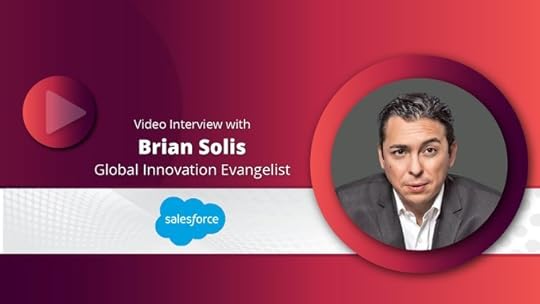
An insightful conversation with Sameer Datta of Enterprise Talk about technology’s boom within orgs around the world and the accelerated rise of AI and automation in the post-pandemic economy. We also explore the impact digital transformations are having on customer experience.
Please watch and share!
[simple-author-box}The post The New Trajectory for Digital Transformation and the Role of AI and Automation in a Post-Pandemic World appeared first on Brian Solis.

Brian Solis to Headline Vibe Martech Fest South Africa.
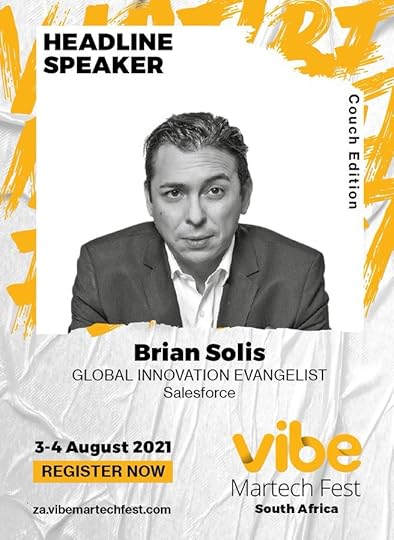
The ambit of marketing is constantly evolving. How can it power business growth?
The marketing landscape of South Africa is changing. With 29% of the marketing budget allocated to marketing technology in 2021, there is a greater emphasis on marketing automation, efficiency and growth.
And this is the time to decode Martech.
While 2020 crammed decades of evolution into months, marketers who kept technology, consumer experience and data at the centre of their strategy ultimately not only survived but surged.
Join Salesforce Global Innovation Evangelist Brian Soils on August 3-4, 2021, at Vibe Martech Fest South Africa, the biggest CX, Marketing and Advertising Technology Summit in the region.
Register now at https://bit.ly/3xnizCt
The post Brian Solis to Headline Vibe Martech Fest South Africa. appeared first on Brian Solis.

Shifting from Customer Experience to the Customer’s Experience: The Role of Marketing Post-Pandemic

Salesforce Global Innovation Evangelist, 8x Best-Selling Author, and World-Renowned Keynote Speaker Brian Solis will host a special virtual event for the CMO Club, “Shifting from Customer Experience to the Customer’s Experience: The Role of Marketing Post-Pandemic.”
July 27, 2021, 1 p.m. ET
Members, please RSVP here. Not a member but interested in attending? Request to register here!
About this eventThe pandemic didn’t just accelerate digital transformation. It completely disrupted customer behaviors. It fundamentally reset customer expectations. It drove a profound recommitment to customer values, and a reframing of their aspirations. Even as vaccines become more widely available and the eventual light at the end of the tunnel becomes clearly visible to more people, the shifts that started with the pandemic continue to evolve around what Salesforce Global Innovation Evangelist Brian Solis calls, “Digital Darwinism.”
Technology, innovation, and markets will continue to push businesses to continually transform to keep pace with the evolution. But who’s going to champion and lead that change? Who’s going to set the standards for customer engagement and experiences throughout their journey in ways that align with the forward movement of society and markets? A new generation of marketing leaders is emerging: they understand what matters to customers at a data and empathetic level. And what doesn’t. They are stepping up to own the next-gen outcomes and experiences.
In this session Brian explores the next generation marketing leader that will blaze the trail in this post-pandemic era, where customer’s journeys are reimagined and customer’s expectations are redefined.
The post Shifting from Customer Experience to the Customer’s Experience: The Role of Marketing Post-Pandemic appeared first on Brian Solis.


