
Brian Solis's Blog, page 100
September 12, 2015
Apple’s Odd, Yet Effective, Social Media Strategy
CIO’s Matt Kapko recently explored why Apple’s social media strategy seem to play the game differently, according to its rules, and not the best practices of everyone else. We talked at length about it now and over the years. This time, I focused specifically on the question about why/why not have an @Apple account. Part of my thoughts made it into the final article, the rest is below for you to see.
Apple does social media differently than its peers in the tech world, and though it isn’t ignoring social to the extent it did in the past, you shouldn’t expect to see any official @Apple account on Twitter anytime soon.
Why isn’t @Apple the voice of the company on Twitter?
This is a question that rears its head every few months. And it’s a valid question at that.
Let’s not forget or belittle the fact that the company boasts highly followed accounts for Beats, iTunes, AppStore, et al. Even Tim Cook Tweets from his personal account. Let’s also remember that Twitter is an information network unlike Facebook, which is more of a social network.
Twitter binds people together around shared interests mostly creating an interest-graph. Facebook is largely comprised of relationships creating the world’s largest and most connected social-graph. Apple doesn’t need to, nor does it have a history of, communicating updates to either graph.
In a post-Jobs era, who or what is the voice of the company?
Having a Twitter account, if you want it to mean something, takes care, intention and thoughtfulness. At the moment, all of Apple’s needs, and more importantly its customers and stakeholders on Twitter, are covered. Anything else requested by those posing the original question might benefit from taking a step back to think through their question. Maybe the question is why would Apple, a highly strategic, secretive and possibly introverted company need a Twitter account? The answer can’t be, “because, every company should open a branded account to talk to people.”
If you believe that, I have some shares in a shady startup I can sell you.
Think about the majority of branded accounts out there, who’s running them, the voice + person, the governance (of lack thereof) of its engagement.
It’s an art, not a mandate. I think too many companies talk more than they listen and act before they think through mutual value.
Let’s start there.
Connect with me… Twitter | LinkedIn | Facebook | Youtube | Instagram | Pinterest


September 10, 2015
New Media and the Path to Business Transformation
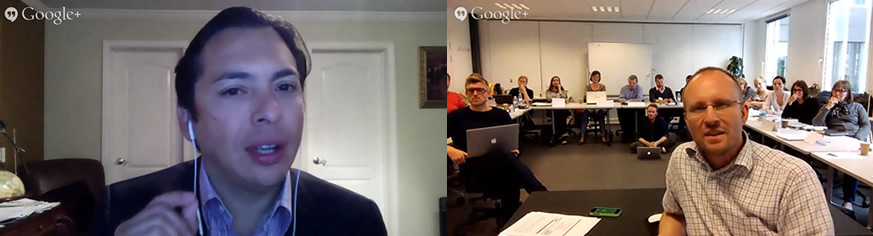
I have a standing offer to all universities (around the world) that use my books as part of the editorial program. I will happily make time to speak to the class to address discuss the material and also answer student questions. In one such case, I joined my friend Kristian Strøbech who teaches budding media professionals at The Danish School of Media and Journalism along with his students for what turned out to be a fantastic conversation. I hope you agree.
For your review, I have embedded the full session. Here are 6 short cuts to Kristian’s personally selected highlights from our Google Hangout:
The path to digital transformation: Timecode: 09:13.
“A simple, but key question to ask yourself: What would my digital customer do differently than my traditional customer? Focus on behavior, not technology and suddenly, things like social and mobile start to come alive”.
Struggling to meet business goals: Timecode 12:08.
“Why is it so persistently difficult for many organizations to align social media strategy with clear business goals?”
Experience architecture is your challenge in social media: Timecode 17:14.
“Everybody is competing for the moment and it’s a bad habit. Think about content in social as a social object and start designing for the experience around that object.”
Organizational models for implementing social media. Time code 31:41.
“The holistic model is when use of social media is widespread throughout an organization and people use it like they use email. In the holistic model which is honestly far away, people are self governing, self aware, educated and also strategic.”
My advice on social media policy: Timecode 37:11.
“If you’re going to use social media in your job and it wasn’t part of your job when you were hired, you deserve a reward.”
On Lady Gaga and the force of community: Timecode 41:19.
Lady Gaga puts a smiley up on her Facebook wall and it receives 93.000 likes. Can we still talk of social media with such a mass phenomenon?
Connect with me… Twitter | LinkedIn | Facebook | Youtube | Instagram | Pinterest

September 8, 2015
The Hero’s Journey to Digital Transformation
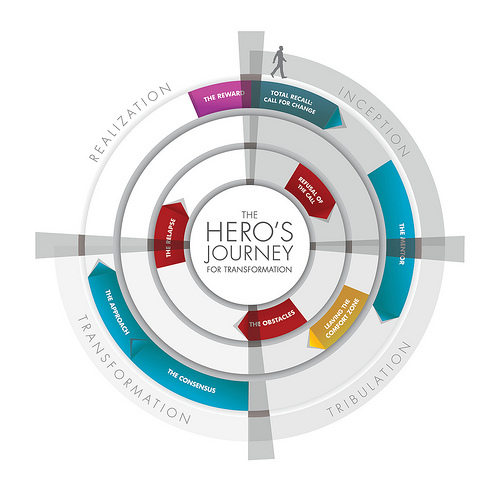
I spent some time with Bernhard Steimel to help him with research for his “Smart Service” series. He sent over the audio files from our conversation for review. He organized them into snackable formats to make it easier for me to follow the conversation. It was so well done that he’s allowing me to share the discussion with you.
Each audio segment ranges between two and four minutes.
I hope these brief segments help you in some way…
1. The End of Business as Usual and state of the business technology landscape
2. The dynamic customer journey, the four moments of truth and the need for internal collaboration and innovation
3. Generation-C (Connected), the new customer and inspiration for business transformation
4. The Hero’s Journey and the psychology of change
5. The six stages of social business maturity
6. This is a time for leadership not management…and, leadership can come from anywhere
7. The road to digital transformation
8. The “hero” in the hero’s journey is you & the human algorithm
Connect with me… Twitter | LinkedIn | Facebook | Youtube | Instagram | Pinterest

September 1, 2015
The 10 Commandments of Content Marketing

Marketers often confuse content marketing with engagement. Just because you get someone’s attention doesn’t mean your audience actually cares. You spend all of this time following the work of others, listening to experts who preach soundbites and executing against a programmatic calendar only to miss the very thing that connects with people…relevance.
It’s hard to gauge or appreciate something so contextual however when we base our work on the measurement of the wrong things. Numbers do not reflect engagement. They measure activity. And, whether or not that activity matters to your business or brand, doesn’t matter too much at the moment. Campaigns are planned, executed and measured by outdated KPIs every day. A view isn’t the same thing as a connection. A “Like” isn’t an opt-in nor a reflection of a targeted community. An impression isn’t symbolic of a prospect. R.O.I. isn’t calculated by vanity metrics…that would be the other R.O.I (return on ignorance.)
The are human beings on the other side of your content. There are frustrations, aspirations and willing attention spans on the other side of the screen. Engage them. Entertain them. Inspire them. Only three things matter as you develop your content strategy, relevance, resonance and significance (R.R.S). Everything you do should incorporate these three pillars of engagement.
To help, I developed a fun set of “commandments” to shake the mediocrity out of the marketing ecosystem. More so, seeing possibilities for what they could be rather than basing them on what exists allows us to ctrl-alt-del or command-ctrl-power content strategies to be more relevant, engaging and ultimately resonant.
The 10 Commandments of Content Marketing
1. Don’t chase shiny objects. Examples include newer channels like Periscope, Meerkat, Snapchat, et al. There will always be the next big thing, but you don’t have to chase after them. Instead, chase after your customers—be where your customers need you or want you to be.
2. Stop operating against a content marketing calendar. Content calendars make you think about quantity, not quality. Your consumers are already overwhelmed with mediocrity, so don’t flood them with more.
3. Refrain from exclusively following case studies of people “doing great content.” While they may be rock stars in their own markets or at conferences, they don’t have a relationship with your influencers, customers and stakeholders in the same way that is unique to you. Best practices for reaching those particular audiences are yours to figure out.
4. Don’t you dare use technology to “scale your shit.” Technology is forcing us into a trap of scale. While we might preach 1:1 engagement, technology gets us away from that and back to the “one-to-many” broadcast model we always tend toward.
5. Shift from views or impressions as metrics and instead track performance and outcomes. Everything in terms of media has traditionally been about consumption. In the social mobile era, it must instead be about sharing and action. Change perception or inspire behaviors. Cause positive effect in your markets. Move people to mutually-beneficial outcomes.
6. Don’t assume you have one audience. You have many different types of people you need to speak to—all of whom believe they’re special snowflakes. Your audience has an audience who has an audience of their own (aka audience of audiences). Know who they are, and create content tailored for them.
7. Stop creating content for people who will approve it (like your CMO or client). Remember there are human beings on the other side of that screen. They also think they are special snowflakes. Treat them like it. Your job isn’t to assume that you or your organization is special. Your job is to make everyone you reach out to feel like they are the only person you wanted to talk to that day.
8. Stop reaching out to people only when you need them. This business is all about relationships. That’s what marketing is supposed to be all about—it’s based on creating mutual value and earning reciprocity.
9. Stop selling. For every one time you sell, you should have at least four other pieces of content or moments of engagement that help, entertain, solve problems or inspire people. Some call this the 4-1-1 approach.
10. Stop investing in “Mediumism.” Contrary to popular belief, you are not a storyteller. That title is reserved for those who really care about the people they’re trying to connect with specific to the medium of engagement. Mass broadcasting across all forms of media is called spam. It happens so often that I came up with a word to describe it, “mediumism.”
Quite simply, mediumism is placing inordinate value on channels over people. Platforms, channels and technology are merely conduits to human beings. True storytellers are enamored, even obsessed, with relevant story arcs, characters, emotions, outcomes, et al. They aim to immerse people in an experience that matters beyond the moment. It’s thoughtful. It’s informed. It’s relevant. It’s awakening and inspiring.
Think of content as a social object. Aim beyond the moment. In other words, design social objects that stay alive because people can’t stop talking about and sharing it. Don’t just talk to or at people, strive talk to and through them.
Connect with me… Twitter | LinkedIn | Facebook | Youtube | Instagram | Pinterest
Image Credit: Shutterstock

August 25, 2015
Attention is a Gift: Once you have my attention, why should I care?
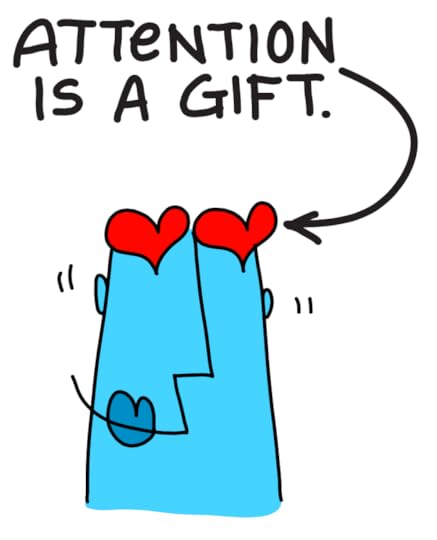
I’m frustrated that my worth is measured more by the numbers of followers, views or visitors that I have and not the merit or impact of my work. You too must start to feel discontent when it comes to your work being judged on hollow numbers alone. The ability to cause effect or change behavior is true influence and that’s the core of what we stand for.
Numbers do not mean much. Without purpose and intention, our work becomes part of the noise and not the signal. It’s easy to fall into this trap though as all day today, you’ll get stuck in meetings where you’ll question the value of why you’re even there, flounder as you try to swim upstream in a relentless stream of email and fall into rabbit holes of introspection as politics, egos and general ignorance force you to re-examine where you are and where you’re going.
There’s just no time or real support to change but that doesn’t mean change isn’t inevitable.
In marketing, there are always trends that people will follow and others will miss. The trick is to not fall into a pattern of mediumism where we place greater value on the channels over native engagement and experiences. The goal most overlook however, and this must change, is the need to earn human relevance and not meaningless numbers. While some people yell “fire!” (although rightfully so in most cases) and point fingers at others, you and I will focus on developing strategies and creating content that engages AND adds value. As in life, investing in experiences and moments where people leave with something (you decide) contributes to relevance and reciprocity.
Meta 2.0: The New Storytelling
To demonstrate this point, I recently went a bit meta and worked on a content marketing campaign designed to help marketers improve content marketing campaigns. In a new, fun ebook I worked on with LinkedIn’s Jason Miller and Hugh MacLeod of GapingVoid. Our goal was to help content strategists and marketers enhance audience engagement by rethinking the approach to content and community engagement.
Storytelling in its truest sense is more important than ever. Yet, we misconstrue the opportunity to tell a sincere story with creating and broadcasting content that barks messaging across social networks without really embracing or even knowing the people formerly known as the audience. Instead, we often create for the people who approve our work rather than sincerely empathizing with those people who have an audience with an audience of their own. It’s our agenda or nothing right?! Wrong.

Humans are emotional creatures and they want experiences that engage them as humans. They’re not eyeballs, impressions, views, likes, shares, clickthroughs, or conversions. And, it is through empathy that we can design for “Limbic Resonance” to engage people emotionally and to plug-in to social graphs as a human distribution network for our story. By doing this over and over again, we can connect people through sharing and conversation to form communities that we can then cultivate.
That takes understanding, purpose, intent and genuineness not campaigns measured by vanity metrics.
LinkedIn has made this ebook freely available and we hope that it inspires you as much as it inspired us to think differently. You can download it here.
In the end, do everything in ways that are culturally relevant, meaningful, shareable and form the ties that bind the right people together.
Connect with me… Twitter | LinkedIn | Facebook | Youtube | Instagram | Pinterest

August 17, 2015
What Do You Stand For? #WDYSF
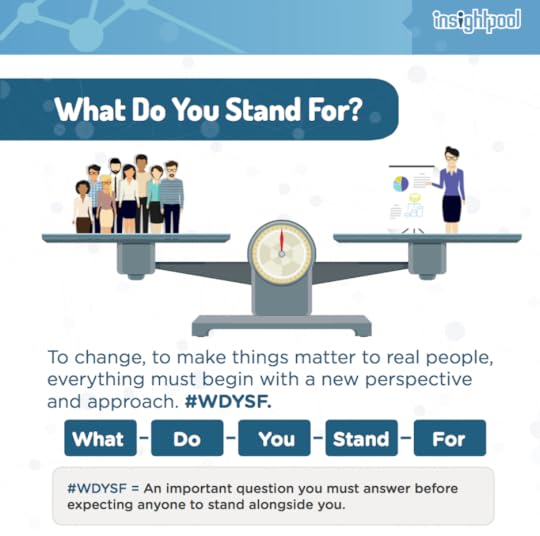
To change, to make things matter to real people, everything must begin with a new perspective and approach.
Ask yourself…What do you stand for?
It’s an important question you must answer before expecting anyone to stand alongside you.
#WDYSF
What is the value you wish to add?
What is the value you wish to take away?
How does engagement make things better or create new possibilities and opportunities for all involved?
No matter how much we say or create, it doesn’t matter.
If we do not see it differently, we cannot approach it differently.
If we cannot show up humble yet poised to offer value, we are just another person in this digital room talking, maybe even yelling, to get people to pay attention. That’s not what this is about.
This is about community. And, community is much more than belonging to something; it’s about doing something together that makes belonging matter.
This is about standing for something.
This is about seeing something that others are missing.
This is about doing what others cannot or will not.
This is about inspiring a movement and building a community to bring your vision to life.
To be honest, this is true for anything and everything—not just marketing or service.
Connect with me… Twitter | LinkedIn | Facebook | Youtube | Instagram | Pinterest

August 11, 2015
It’s About the Customer Experience; So, Why Is Your Brand Ignoring Customers?
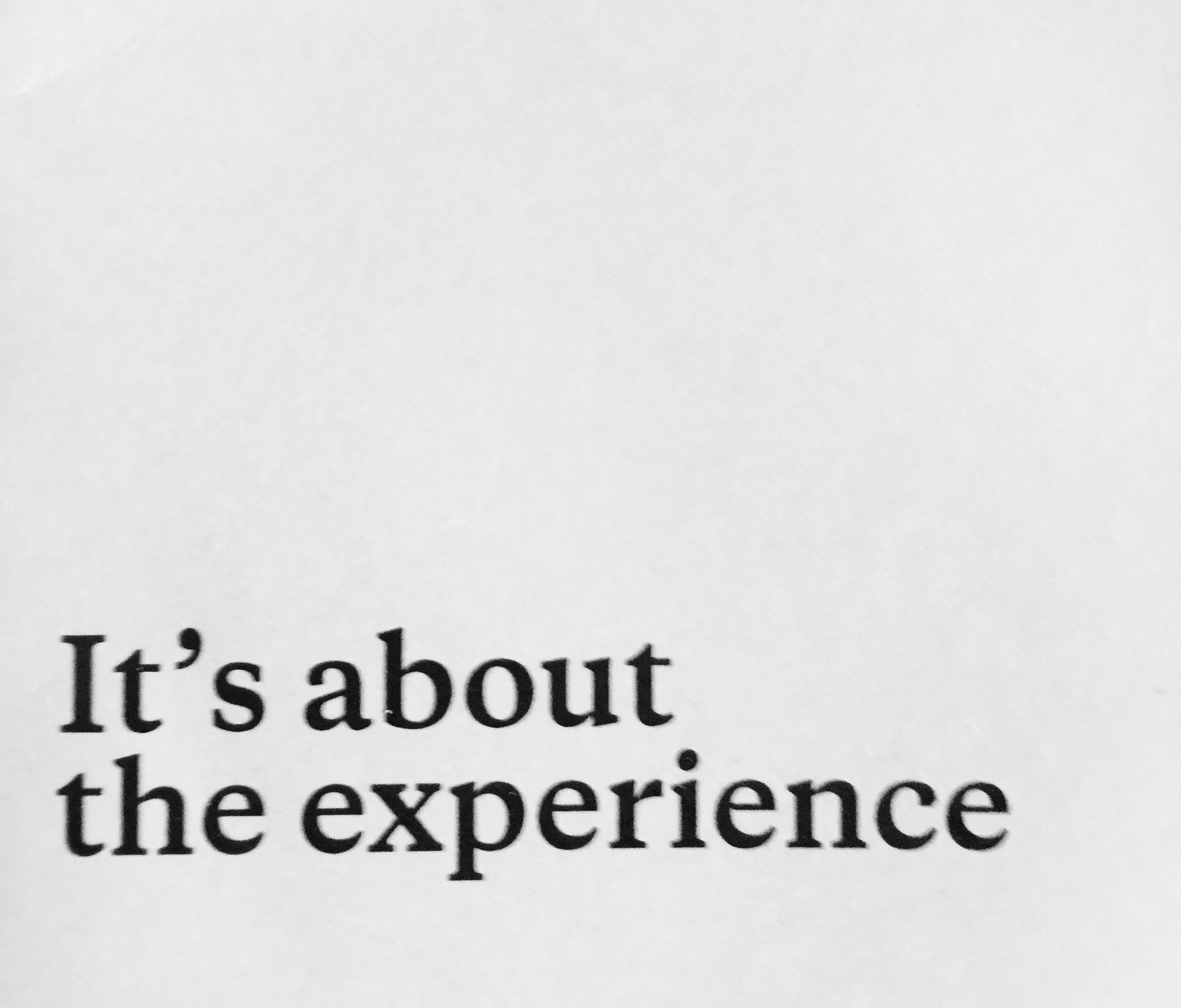
Humans are emotional creatures and they want experiences that engage them as humans. They’re not eyeballs, impressions, views, likes, shares, clickthroughs, or conversions.
A few weeks ago, I visited New York on a beautiful summer day to participate in an event that I would love to repeat everywhere around the world.
Prophet, a global brand strategy firm that recently acquired Altimeter Group, hosted an intimate event to explore the new horizons of digital customer experience (DCX). I was invited to share my thoughts alongside a very enchanting and sage MaryKay Kopf, CMO at Electrolux.
While informal, it was illuminating. MaryKay shared the story of how her team helped change a company founded in 1919 to compete in a digital economy.
Attendees ranging from some of the biggest brands to the hottest startups also shared the challenges and equally solutions. I left inspired and I wanted to share with you highlights from the event so that you may feel the same.
DCX + CX = The Experience: You either add value to it or you take away from it. It’s a choice.
TL;DR: 5 Takeaways to Make Customer Experience a Competitive Advantage
1. Find your “Undercover Boss” moment
Leaders need to reconnect with what it’s like to be a customer. Empathy is key to creating rewarding customer experiences, and it has been lost in today’s corporate culture. When you are empathetic toward your customers they become more than demographics – you understand their full lives, what makes them tick, where they want to be reached and how – and therefore designing a rewarding experience for them is simple. With this level of understanding, you’ll become so in tune with your audience that you’ll be able to provide them experiences they don’t even know they want yet. A true hallmark of a relentlessly relevant brand.
2. Innovation isn’t about technology, it’s about disruption
Use the TV remote control as an example of what innovation should mean. Instead of adding new features to it or making it more powerful, try to completely re-imagine a better way to control the TV. (Hint: it’s wouldn’t be a plastic brick with 100 buttons). To create experiences that matter to your customers, first think about what the experience should be and then use technology to bring it to life.
3. The new “Kodak moment” is a cautionary tale
The rate of disruption has increased exponentially, and many Fortune 500 companies have met their demise because of it. All companies need to embrace change, both in customer behaviors and expectations and in how you think about your business. Are you an automaker or a company that provides personal transportation? If Kodak had recognized new customer behaviors and had a broader sense of their purpose as a company, they could have been the leader of the new world of photography instead of standing still – ultimately losing relevance and share.
4. Swipe right to connect with millennials
Members of this digitally native generation want to shop, work and interact with your brand the same way they date – easily and intuitively. This doesn’t mean your company (necessarily) needs to go out and build a trendy mobile app, but you do need to create an experience that is intuitive, valuable and fun for your audience. Many decision-makers in companies today are from an older generation, so it’s easy to overlook how differently millennial consumers want to interact with your brand. The good news is they aren’t shy about telling you. This generation will provide a constant stream of feedback via social media – you just have to be willing to listen.
5. Love = value creation = shareholder value
Doing the right thing by the customer might not be the most profitable decision in the short term, but it does make good business sense. If your customers love your brand, they will buy your products, recommend them to others and become a customer for life. Foster your customer’s love by delivering excellent customer experiences throughout their journey and across channels. Brand lovers are crucial to a successful company and a healthy bottom line.
(source)

Unabridged: Customer (and Employee) Experience Happens With or Without You; So, Design It
My Opening Remarks
By and large, companies want to do the right thing by their customers. The problem is they simply don’t know how. Companies are not designed around customers. Instead they have processes, budget pressures, silos and systems that reward short-term value for shareholders. When you consider this structure, it’s no wonder that customer experiences have suffered.
Remember customers are going to have an experience with your brand – good or bad – and in today’s social, digital world, they are going to share that experience. It is up to your company to ensure that experience is a good one.
More companies need to find their “Undercover Boss moment.” Leaders need to reconnect with what it’s like to be a customer. Empathy is key to creating a rewarding customer experiences. Companies have gotten good at dealing with the problem without dealing with the problem. They’ve created customer care centers, call centers, but they need to improve the actual customer experience.
Once social media empowered customers and gave weight to their voice, companies started trying to fix the experience. But they came at it the wrong way. They just wanted to shut people up, instead of trying to design/articulate a good experience that you want people to share.
Companies need to ask themselves what are the experiences people have with my brand? And what are my products? There is always a gap between the two. The question is how big is that gap and how do you fill it?
Digital customer experience is different. It can be mind-blowing for those in older generations because it’s not how we grow up. The TV remote control is a metaphor for customer experience. We don’t question it every day, but since the 50’s it’s gotten worse. It’s changed iteratively, but there has been no thought of innovation. If you were to invent the remote control today from scratch, it would look completely different.
Today’s leaders (the older generation) are making decisions by based on their experiences, but digital customers think differently. And it is almost always counter-intuitive to the older generation. Example: Millennials don’t want to buy houses. The idea of the car and car ownership will completely change in our lifetime.

This type of change is happening because companies have screwed it up. Disruption is letting customers demand a different experience.
I recently worked with Google to study micro moments – “I want to …” moments, including “I want to go to dinner, get a cab, etc.” What we found is brands are not investing in what the actual customer experience is. The customer journey is so fragmented. New, “disruptive” companies cater to customers that believe the world literally revolves around them. Think of an app – it usually brings something to you. Millennials don’t like the way most companies work. They want to work like they date – swipe right. Easy, intuitive.
How can companies create experiences that matter to their customers? Think about it should be, design it, build it and use technology to help bring it to life.
Is the rate of disruption accelerating? The book End of Business As Usual looks at how many companies that were Fortune 500, on the Nasdaq, etc. are now gone. It’s scary. The book takes a look at how many were because of bad management or digital disruption. Digital disruption companies had one thing in common. All of their boards had the opportunity to do something to stop their demise and they didn’t. Kodak had the patents for the digital camera. Now a Kodak moment means to fail to recognize a consumer change. Today companies are built around quarterly value and they make decisions based on that short-sighted view.
People at companies don’t make new/innovative decisions because of a lot of human reasons – fear, self-preservation, etc. To be innovative, people need to be safe and empowered. And most people aren’t, companies are actually very risk averse. In an effort to change this many companies are opening innovation centers to get people out of the normal work environment and to think differently.
Sephora just opened an innovation center because they discovered the way the digital generation buys make-up is totally different than their parents. At Birchbox, they try to lead the customer and design experiences that they don’t know they want yet.
Notes via Katie Lamkin
Connect with me… Twitter | LinkedIn | Facebook | Youtube | Instagram | Pinterest

August 3, 2015
Why Marketers Should Care About Millennials and Anyone Living a Digital Lifestyle
What is a Millennial, and why should a marketer care? That was the question Adobe’s Simon Nicholson asked me during Adobe Summit EMEA in London earlier this year.
I joined Simon in a live chat on the topic and have included the fun, casual yet informative conversation below…
Let’s start with this, the definition of Millennials is imprecise, with the consensus being they’re aged around 18-34. But one of the key points that I emphasized in our discussion is that marketers shouldn’t think of Millennials as a generation based on age, but on living a connected lifestyle.
I introduced the audience to the term Generation C (for connected). This would include ‘Millennials’ who have grown up pinching their screens, but also the older generations that have adapted from the heavy bricks with buttons to the connected lifestyle enabled by modern technologies. It’s an important distinction because as a marketer you may be creating your campaigns around mobile and tablet usage, but your target demographic might be older.
I see brands getting into trouble because they don’t make the time to explore this critical distinction, and have started trying to act cool without regard to whether it’s appropriate for their audience. I mentioned ‘Brands Saying Bae’ as an example of this, and it’s certainly worth a look. Sometimes brand try to hard without actually trying.
In our discussion, we also review whether brands need Millennials on their marketing team, how brands are adapting their campaigns to suit Millennials, and how marketers can succeed if they’re not from the Millennial generation.
You can watch a video of the live chat below.

July 27, 2015
Like Every Business, We Too Stand on the Path of Disruption
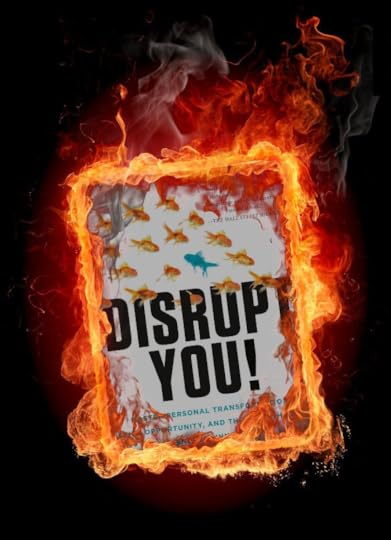
Guest post by Jay Samit (@jaysamit), a serial entrepreneur and author of the bestselling book Disrupt You!
Your career is going to be disrupted. I guarantee it. Office automation is expected to make 40% of the current workforce obsolete by 2020. 3D printing is anticipated to eliminate 320 manufacturing jobs; further impacting the millions of truck drivers replaced by autonomous vehicles. We are now living in an era of endless innovation where technology continues accelerating exponentially while businesses struggle to adapt arithmetically. And for all of you who feel secure in a large multinational corporation, consider this: of the original largest Fortune 500 companies named in 1955 only 57 are still on the list. Yet, for those who see every obstacle in life as an opportunity in disguise, now is the greatest time in history to be a tech entrepreneur.
The self-made billionaire in his twenties, an unheard-of possibility a decade ago, now happens with regular frequency. The startup with little funding and a small staff, displaces hundred-year-old companies with billions in revenues virtually overnight. The consultant, with no background in technology, makes millions of dollars from teaching a course online. The Arab Spring which peacefully overthrew long-standing governments in Bahrain, Tunisia and Yemen, is able to successfully force rulers from power without weapons or international support. What did all of these disruptions have in common? They were led by people who understood how to leverage their talents and the advancements in mobile, social, and communications technology to find opportunities for disruption.
With six billion consumers now just a click away on a smartphone, today’s entrepreneurs can reinvent themselves and the world faster with less capital than ever before. Today, there are 50 times more people on the Internet than in the year 2000 and they are connected at speeds 180 times faster. Entrepreneurs no longer need to own the technological infrastructure to reach the always-on consumer. The same cloud and big data used by international oligopolies is now universally available to those wanting to plot their own destinies at a fraction of the cost off a decade ago. Risk capital, which was once controlled by large banks and private equity firms, is aggregated directly by crowdfunding and micro-lending sites. In 2015, crowdfunding sites will deploy twice as much funds as venture capital firms and for a fraction of the equity. Bitcoin and blockchain technology now empowers ideas and capital to flow seamlessly across borders and trade barriers. Disruption isn’t about what happens to you, it’s about how you respond to what happens to you.
With so much innovation, startup founders and existing corporations can no longer survive by just adding new features or marketing product extensions. In today’s business climate, incremental innovation is like walking on quicksand – it will keep you busy, but you won’t get very far. To thrive, all businesses must focus on the art of self-disruption. Rather than wait for the competition to steal your business, every founder and employee needs to be willing to cannibalize their existing revenue streams in order to create new ones. All disruption starts with introspection. Instead of focusing the traditional planning cycles where companies benchmark their businesses against existing competitors, teams need to be developed to foster internal change and disruption. Self-disruption is akin to undergoing major surgery, but you are the one holding the scalpel. Apple and Google continue to expand and dominate new industries because they strive to create a culture of risk taking, self-disruption and experimentation. Would anyone have predicted ten years ago that either of these companies would be going into the auto industry? Does anyone today doubt that they will be successful?
A half a millennia ago, Florentine philosopher Niccolò Machiavelli said that entrepreneurs are “simply those who understand that there is little difference between obstacle and opportunity and are able to turn both to their advantage. Today’s 2.3 billion millennials have a choice: Disrupt yourself or let others disrupt you.
There is no middle ground.

July 21, 2015
Creating Truly Personal Omni-Channel Customer Experiences
During a recent trip to London, I spent time with the Smart Focus team to discuss the promise and shortcomings of omni-channel strategies. It was a pretty productive collaboration resulting in a video that explores the new digital customer, an ebook focused on omni-channel experiences and a webinar on the future of marketing.
Customers are more connected and more informed than ever. Digital marketers now need an entirely fresh perspective to succeed in a world where customers and prospects experience their brand in multiple ways – online ads, websites, mobile, social, email, call center (help us), web chat, instant messaging and more. Sometimes we even have to talk to people in real life.
Too often though, there is little consistency across these experiences. Too many brands, despite paying lip service to multi-channel marketing, still operate web, email, social, mobile CX, et al., independently (and politically). In a twist of modern marketing, customers might click on a link in an email and be taken to a landing page with a very different look, feel and story. Surprise! Multi-channel marketing for many simply means promoting their eCommerce channels via broadcast or spammy approaches that minimize efforts across critical channels and thus fragmenting critical customer experiences.
The reality is that most brands are still on the starting blocks when it comes to true omni-channel marketing. It’s not just another way of saying multi-channel – it’s a whole new approach, encompassing technology, marketing, perspective and a radical shift in company philosophy and culture.

Customers and potential customers share some common desires – they want to be valued and validated, they need engagement to be efficient and consistent, they want to be able to trust your business and to be in control of their experiences.
But there is an increasing realization that people are individuals – and we all do things differently than you. Imagine that! We’re all human. Well some of us at least. In another words, its futile (and lame) to have one sweeping, scalable marketing strategy. Empathy and understanding serve as the foundation or engagement.
Everything in business is about people. The more we can study who they are, what they like and they don’t like, the better we can build personal journeys that matter.
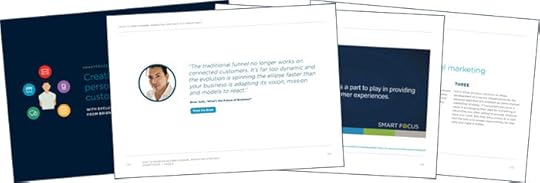
‘Creating Truly Personal Omni-Channel Customer Experiences’, explains how to build those journeys and develop an omni-channel marketing strategy that appeals to each and every customer and prospect in the way that works for them. The eBook includes exclusive video insights from yours truly and covers subjects such as:
What is omni-channel marketing and why is it important?
1) Being human and staying tech savvy
2) Social media – the moment of truth
3) Why email marketing is more important than ever
4) Using your customer date to create meaningful experiences that matter
Watch the video interview here.
Visit Flickr to see behind-the-scenes pictures from this dynamic session.
Connect with me… Twitter | LinkedIn | Facebook | Youtube | Instagram | Pinterest


