
Blair Bancroft's Blog, page 45
December 5, 2015
Character Development - 2

A bit of family promotion to add color to this week's Mosaic Moments. The link below will take you to a family member's e-bay site which features a wide variety of interesting items, including some hand-crocheted dresses & hats for 18" dolls (which, ahem, were made by me).
Beckatastic Treasures
PC Update: Continuing my showcase of remarks illustrating the concept that even something as well-intentioned as "politically correct" can go too far, please investigate the link below, which reports the remarks of a college president who had been pushed too far.
College not a day-care
Character Development
Marriages of Convenience
Okay, I admit it, even when writing Mystery, Suspense, or SyFy, I always have a romance in my books. And of course they all have to end in Happily Ever After, however unrealistic some may believe that to be. After all, isn't that why so many read romance? We need that Happily Ever After, even if it's only fiction. It makes our hearts beat faster. It makes us smile. It makes us glow.But getting that HEA cannot be easy. That's a cardinal rule of writing romance. The hero and heroine have to suffer. It all has to go to hell in a handbasket (as the old saying goes) before that HEA comes on the final pages.
Another rule: no matter how much action you have in your book, the romance gets resolved last. Your readers may know they're going to get a happy ending, but you still have to make them think it might not happen. There's a wonderful expression for what all fiction writers do, the thing that allows us to get away with so very much: Suspended Disbelief. We have to craft our work well enough that our readers are willing to go along with our plot and action, even when they strain credulity.
One of the trickiest bits of Character Development involves marriages of convenience.
Grace Note: A moment's digression: a Marriage of Convenience is not a marriage without sex. That's what the French call, "mariage blanc," or "white marriage." A Marriage of Convenience is a marriage in which two people marry for reasons of family, money, common sense, etc. Sometimes neither couple is particularly fond of the other. In some cases one of the couples may actually love the other but his/her affection is unrequited. But sex is definitely involved, no matter if the two people are near strangers. Clearly, this can create some interesting, if awkward, scenes, as I once again discovered when writing The Welshman's Bride.
So how do you create a romance between two people who are marrying for what some of my readers would consider all the wrong reasons?
I should be able to answer that, as at least nine of my books (including Sorcerer's Bride, not yet out) involve marriages of convenience. And yet the first answer that comes to mind is: "very carefully." Seriously, as I look back, I've definitely done this better in some books than in others. Let's face it, any marriage is going to involve accommodation by both sides, but in a marriage of convenience - without love to ameliorate the problems - tensions can either spin totally out of control, or else one or both parties shuts down, clams up, and the relationship goes nowhere. Either extreme - or variants in between - make excellent fodder for character development. One more aside before we see if we can all learn something while I critique myself.
Grace note: I am currently grinding my teeth over a book by an author I've enjoyed in the past. But this time her characters remained stagnant, offering the same repartee, the same arguments over an inordinate amount of time. Frankly, as well as being bored, I wanted to shake both hero and heroine, hoping common sense would suddenly blossom. And yet I kept reading, searching for the magic of Happily Ever After. But, darn it, the story ended three chapters before the end of the book. (I just kept punching the Forward button on my Kindle, hoping for meat that didn't come until the last two pages in what was clearly a set-up for a second book. (Which I definitely will not read.) But something good came of this clanker, as it helped me emphasize my point for this week:
Working in the necessary character changes to make a marriage (or romance) work is vitally important. Writing a lot of cute dialogue simply isn't enough. Substance is needed - events that demonstrate the main characters are growing and changing, though perhaps interspersed with slips into previous behavior just to keep it interesting. In some cases, even a hint of change will do. But to have your characters go on and on and on without demonstrating they have become wiser, more loving, or whatever change is needed, just leads to deadly boredom.
Examples:
The Sometime Bride. My first book and personal favorite. My very young heroine changes little until well into the last third of the book. Married at 14 to accommodate her father's spycraft, for many years she is too young to do anything but what she's told by the men in her life. So is it any wonder it takes her so long to realize just how badly she's been betrayed by both her father and her husband? But when she does, her reaction is dramatic, and she makes up for all those years letting others call the tune. Does her husband change? Not much. As happens during dramatic moments in history, he is so caught up in the war on the Peninsula that he sometimes scarcely remembers he has a wife. Until it's almost too late to do anything about it. This one's a true cliff-hanger, as it doesn't look as HEA is going to be possible.
Tarleton's Wife. This book was born from my research for The Sometime Bride. I became totally fascinated by the dramatic events that occurred as the French pushed the English army back to the sea, forcing them through icy Spanish mountain passes in the dead of winter, then cornering them at Corunna. This resulted in a battle and evacuation by sea almost as dramatic as Dunkirk during WWII. The heroine in this book is a "daughter of a regiment," and when her father is killed in battle, a dying major marries her so she will have a home when she returns to England. You could call this marriage of convenience one born of desperation. Yes, she is a stalwart young women, who has been following the drum all her life. But now she must learn to run an estate that has fallen on hard times. She even has to deal with rebels reacting negatively to the impact of the Industrial Revolution. And just as she is demonstrating her competency in heroic proportions, perhaps even discovering love, life kicks her so hard she falls apart and runs. Not as much change is required of the hero, another man caught up in war, but in the end he is the one who has to take responsibility for fixing the tangled mess into which they've fallen. (Getting a little help from a deus ex machina.)
Shadowed Paradise. The heroine, who moves with her young son from New York's Upper East Side to Florida's Gulf Coast definitely has to make the most adjustments in this story, which eventually becomes an alleged "marriage of convenience" between two people who are in the process of falling in love. Although her idyllic life was shattered even before moving south, she now has to cope with both cultural shock and the threat of a serial killer. Her only hope, a man who stands for everything she hates.
A Gamble on Love. Faced with relatives who are determined to marry her to a cousin she despises, the young heroine of this traditional Regency (much lighter than the three books above) gathers enough spunk to hire a solicitor to find her a husband - one who will be suitably grateful to acquire a grand estate. Naturally, she gets more than she bargained for, and she must make a good many adjustments in the course of accommodating a much more dynamic spouse than she had envisioned. In this case the hero's character does not actually change much. It's more a case of gradually revealing his true personality, background, ambitions, his hopes for the future. And smiling as the young heroine makes this voyage of discovery with him.
In contrast, The Harem Bride, although a trad Regency, is much more serious. The only way a young Englishman can rescue an equally young Englishwoman from the Sultan's harem at the Topkapi Palace in Constantinople is to marry her. He does so, but between the awkwardness of the situation and the horrified reactions of their respective relatives, they are immediately parted. Their emotions, as well as their lives, become frozen in time. They have no opportunity to get to know each other, no opportunity for love, resulting in two cold, resentful people, both of whom must thaw and change before any form of HEA is possible. I may have overdone the reserve of each of these main characters, but somehow it just seemed they had to be this way. Life dealt them a harsh blow, and it takes nearly a decade for them to recover.
The Welshman's Bride. In this, my latest Regency Gothic, due out in the next couple of weeks, agaom it's the heroine who has to make the most changes in her character. She is wealthy, overindulged, even a bit spoiled. She thinks she is up to marrying a man from an entirely different background, a "foreigner," but she rapidly discovers that's not true. She is met with opposition from all sides, including the nasty surprise of her husband's mistress, and yet she is the one considered weak and immature. Alas, it takes her husband all too long to realize that he too has to change, cleaving more to his beleaguered wife than to his autocratic mother. Major changes of character in this one, perhaps because I've learned just how important that is.
Sorcerer's Bride. This is Book 2 in a SyFy series that isn't out yet, but it needs to be included as the character changes are vital. Both hero and heroine have to make major accommodations. This is an example of a marriage of convenience where the heroine has a secret yen for the hero, but as far he is concerned, she is #3 on his list (or maybe lower) - after her sister and his long-time mistress. He considers her a bratty baby sister - definitely a lot to overcome. Over the course of the book, she changes from a sheltered princess to a rebel freedom-fighter, a woman almost as powerful as her sorcerer husband. Getting in his gradual acceptance of being married to the "wrong woman" was quite a challenge. I can only hope I managed it.
In summary, changes in your main characters over the course of your story make for a more interesting book. One of the all-time best examples of that: Jane Austen's Pride and Prejudice. Both characters have considerable mellowing to do before they can understand each other enough to love.
So keep those characters growing and changing, secondary characters as well. They will move your book from ordinary to sparkling, from ho-hum to Wow!
~ * ~
Hopefully, a holiday photo essay next week. And in case you missed the bear video added half-way through last week's Mosaic Moments, see the link below.
My daughter took this video early Wednesday morning, December 2, 2015. Her husband had just driven the two younger girls to the bus-stop when the oldest girl, who goes to school an hour later, heard knocking on the sliding glass doors of her bedroom . . .
Bear on the Porch
Thanks for stopping by,
Grace
For Grace's website, listing all books as Blair Bancroft, click here.
For a brochure for Grace's editing service, Best Foot Forward, click here.


November 29, 2015
PC Gone Amuck - 2
 This week's bit of color - my son-in-law shared this post from Mandatory
~ * ~
Below is a quote from Facebook that "ties" in well with a blog on Political Correctness:
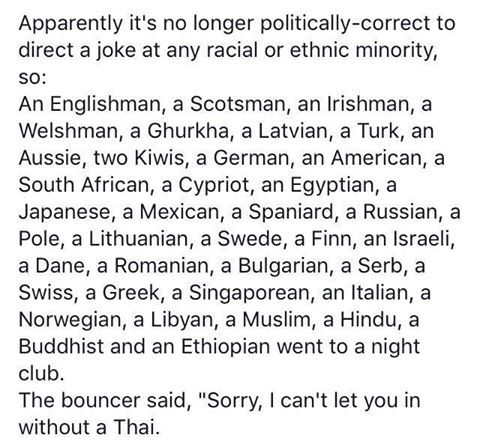
(To my foreign readers - please note the punch line is a sound-alike for "tie.")
Grace Note: I re-typed this entire blog to get rid of the gremlin who turned my words into "fine print." Half worked, half did not. So please forgive, get out your magnifying glasses and read the words of two very well-spoken gentlemen. They're well worth squinting a bit.
Political Correctness Gone Amuck
Over the last few weeks I've been accumulating other people's thoughts on the possibility that being "politically correct" has become a bête noir which, while not as threatening as the fascism of the far right, should still be of concern to all of us. Below are comments from people who, like me, are questioning something we've long advocated: "Political Correctness." Please read these comments with an open mind.
From an editorial in The Orlando Sentinel (11/28/15) by Victor Davis Hanson, who styles his remarks as "On the right." Headline: Campus administrators reaping what they sow
Among Mr. Hanson's points:
Student protests grow more extreme the more they are appeased. "Radical students bully liberal deans, crowd into the offices of college presidents, disrupt students in libraries and shout down public speakers. Mr. Hanson notes that most often the self-appointed activist leaders are among the most wealthy, pointing out that furious protesters who recently rallied against "oppression" at Yale's Silliman College, live in a building with two grand pianos, pool tables, gym, movie theater, indoor basketball court, computer lab, dance studio, four music rooms, a film-editing lab, and an art gallery! Also mentioned is a group at UCLA demanding black-only student housing. Those of us who recall the Civil Rights movement can only boggle at that one. Shades of the Old South! Mr. Hanson's final paragraphs go on to say: "Calls to stop 'cultural appropriation' by prohibiting some groups from enjoying the dress, fashion, music and art of a different ethnicity are nihilistic. Would minority students wish to be denied from appreciating opera, symphony, impressionist art, Platonic dialectic, Shakespearean drama, physics or constitutional government just because these genres were originally created by Europeans?
"The final irony?
"For a half-century, professors have privileged diversity over unity. Faculties focused more on American sins than American virtues. They fixated on the color of our skins rather than the content of our characters. Administrators watered down the curriculum, lowered standards and appeased pampered students.d
"Now they are reaping the liberal whirlwind that they alone have sown."
Grace note: I consider myself a middle-of-the-road liberal and rarely find myself agreeing with anyone editorializing on the "right," but I can't deny Mr. Hanson makes some very valid points. We have raised our children and grandchildren to be so PC, they are in danger of losing all common sense.
Mr. Hanson mentions Yale's Silliman College. Below is a portion of a letter from an outraged Yale alumnus (Steven Kovacs, Yale '68) about the suggestion that Calhoun College be renamed.
"John C. Calhoun was not only a graduate of Yale, but one of the most distinguished political figures in American history. He was a congressman, senator, secretary of war, secretary of state, and vice president of the United States. He was one of a triumvirate of brilliant political figures, along with Daniel Webster and Henry Clay. He advocated states' rights, limited government, and free trade. To reduce him to being the leading champion of slavery is to do him injustice. So what are we to do with such a historical figure? In fact, what are we to do with any historical figure? Take them out of their historical context? Shall we rename all of our many institutions bearing the names of Washington and Jefferson because they owned slaves?
Let's stop being so politically correct and so very, very wrong. Let us accept the wide range of humanity and recognize that we are all situated in a particular historical reality.
I am fervently against renaming Calhoun College. But if, against all good reason and judgment, it is to be renamed, I sincerely hope it will carry the name of Cole Porter, the most brilliant American composer and songwriter of the twentieth century—who also happened to be a Yalie, gay, and disabled, having lost his leg in a riding accident. He's a hell of a lot more exciting than Abraham Pierson [yet another Yale residential college]. And he's politically correct!"
~ * ~
I seem to have begun a topic that could go on forever. (I have a whole stack of recent articles I haven't touched yet. The Episcopal priest at Church of the Resurrection in Longwood (FL) even mentioned the problem of not raising our children with strength enough to meet life head on in his sermon this morning.
It is possible that in the long run, Donald Trump's heinous remarks in the current presidential campaign will actually do us all a service. No idea - in this case, sensitivity to other people's feelings - is so precious that it cannot run amuck, exploding into a chimera so distorted of its original purpose that it threatens us all.
We will definitely revisit this concern at a later date.
~ * ~
Thanks for stopping by,
Grace
For Grace's website, listing all books as Blair Bancroft, click here.
For a brochure for Grace's editing service, Best Foot Forward, click here.
November 21, 2015
Kids & Creative Writing
Bear Update.
A block from my daughter's house in Longwood, a bear broke through a neighbor's pool screen, opened a small fridge, and happily chewed & emptied all the soda cans inside. (Maybe more than one bear?) But please note that the bears were either "teetotalers" or recognized that munching beer bottles isn't a good idea. Note that the beer bottles are still neatly laid out, the bear(s) extracting the soda cans without breaking a single one. Very sophisticated bears in Longwood.


I am postponing the continuation of my comments on Political Correctness until next week in order to write about something very special that happened to me this week. As part of what is called "Dividends" day here in Seminole County, parents and relatives of students were asked to come to school and talk about what they do for a living. My daughter and I were booked together—Susie talking about buying and fixing up dilapidated houses and suggesting ways the children could make money at their age, while I contributed a workshop on Creative Writing.
I had planned to stick to the school regimen of Non-fiction writing (essays), but in the very first of the three workshops I did, the teacher suggested the students be allowed to write Fiction if they wished. A suggestion I was all too happy to oblige. FYI, Florida is a state that "over-tests" students, which results in teachers being forced to teach to the tests rather than teach the students the things they really believe they should know.
I talked a bit about by my sole book written for Young Adults (and suitable to any age interested in Medieval times) - The Captive Heiress. And then I read them two examples of how a student might answer the question: What did you do yesterday afternoon after school? The first example was deadly dull, a scant paragraph marked by short sentences beginning with, "Then I . . . Then I . . ." The second essay, answering the very same question, ran to five full and hopefully colorful paragraphs.
After that, I talked about "why" the second essay was so much better than the first - the details I had added, the more colorful language, the personal viewpoint. I also got in a plug for Fiction - the fun of creating good people, bad people, smart people, stupid people, silly people, etc. And then I asked the students (4th & 5th grade) to write two or three paragraphs, which they would then read aloud.
I gave a list of topics for those who needed it, but added that they could write about anything they wished, Fiction or Non-fiction. The results were astonishing—to the teachers, I'm convinced, as well as to me. Their work was so good—and almost all chose Fiction, something they never get to do in school—that I was truly saddened by not having enough time to hear each child read aloud. It was as if someone had pulled a cork out of a bottle, allowing them to shine. We had nine- and ten-year-olds writing not just narration but DIALOGUE, with "he said" and "she said." And the creativity - oh my! Yes, much of it was Fantasy, but that they could spout it out in 15 minutes with no warning they were going to be asked to do this . . .
Yes, one of the fourth grade classes was for the Gifted, but the other two classes were not. One boy nearly had me in tears as he read about "jays" pecking at a bully. A fifth-grade boy had the class in stitches with a few colorful paragraphs that suggested he was either going to be an author or a stand-up comedian. And a girl in the Gifted class wrote a story so well done that I truly think she may become a successful author.
Let me tell you, I went home glowing. That I had unleashed, however inadvertently, such a torrent of words made my day, my week, my month. Now if only the Florida school system could understand the need for creativity in the classroom instead of sticking to facts and figures in order to answer statewide tests. Sigh . . .!
~ * ~
Next week, back to the problem of Political Correctness gone too far.
Thanks for stopping by,
Grace
For Grace's website, listing all books as Blair Bancroft, click here.
For a brochure for Grace's editing service, Best Foot Forward, click here.
November 14, 2015
PC - Have we gone too far?
In light of the horrible news from Paris and the devastating downing of the Russian passenger jet last week, I am pasting below the immortal words of Winston Churchill (posted to Facebook by Carol Cork).
"You ask, what is our aim? I can answer in one word: Victory. Victory at all costs—Victory in spite of all terror—Victory, however long and hard the road may be, for without victory there is no survival."
- Winston Churchill
(May 13, 1940)
~ * ~
And lest we find our own selves teetering on the edge of extremism, let us consider how easy it is to carry what at first seems right and proper to such an extreme that we become as nonsensical, as unreasoning and fanatical as those we oppose. The following blog was planned before the terror attacks in Paris and refers to incidents much less dire, but the principle is similar. We all like to think we would never fall into extremism, be it religion, politics, even extreme sports. But it happens. I read an article just the week about the number of people being injured because they pushed their bodies too far. And that is as difficult to understand as why anyone would hate—that should probably be written, HATE—someone because they follow a different religion, a different political philosophy, or just because they are immigrants or refugees looking for a better life. And yet that kind of hatred not only exists, it is becoming more prevalent, more vocal, more violent. To the point the world is reeling, threatening to tumble out of control.
In the midst of all this, we need to look inward and ask ourselves if we too have gone to extremes, allbeit in a much less violent fashion. This is where the topic I'd previously scheduled for this week connects with the recent extremism seen in France and Egypt. Quite simply, extremism in any form - declaring there is only one way to do something, while rejecting every other approach - feeds upon itself, becoming blown out of proportion until what might have been a good idea becomes a be-all and end-all in itself, exaggerated to the point of absurdity, harmful to everyone not belonging to the "inner circle" of believers.
And, yes, this exaggeration can apply to something with such good intentions as "Political Correctness." My question is: Are we harming ourselves - and more importantly, our children - by being too Politically Correct?
Anyone who is a regular reader of this blog knows that I am about as far from being a fan of Donald Trump as it is possible to be. And yet he and I may actually agree on one thing: We have carried political correctness to an extreme. I began to suspect this over the last few months, but this week the issue seemed to crop up everywhere I looked. In the Yale Alumni Magazine, on the TV news, and in several different articles in the newspaper, and even on this week's episode of Blue Bloods. And I recalled what I'd been told when I visited the FBI Academy in Quantico, Virginia. One of the men who spoke to us said that the FBI was having difficulty finding agents with "street smarts." Potential candidates seemed to have been chained inside with "play dates" as children instead of being out on the steets, learning to interact with other (read "more diverse") kids, and sitting at their keyboards as they grew older, instead of being out and about, discovering the rough and tumble world as it really is.
These are also the children who grew up in the "PC" era, who learned a well-scrubbed version of "Eeny, meeny, miny moe." Who never sang "Three Blind Mice" or the multitude of glorious music we used to call Negro Spirituals. Children who were taught to avoid the slightest hint of something that might be offensive, thus creating a generation where the slightest thing became offensive .* Creating lily-livered little darlings who cringe over even a hint of something that might offend someone, anyone, anywhere, any time. Lions and tigers and bears, oh my! These are the kids whose parents want every team to get a prize, the ones who want to do away with school report cards, etc., etc. This is not only sad, it is damaging. It turns potentially strong kids in overly sensitive whiners.
*I sympathized with the students at the University of Missouri until I learned the miniscule nature of the slights that began the ruckus. I mean, I remember the time when a governor stood guard at a university door to keep black students out. Now that was truly offensive. I remember those who died in the Civil Rights movement of the 60s. That too was appalling. But a bit of name-calling in a world where some people will always be stupid asses? Aw, come on, kids, that's just plain ridiculous. Suck it up and find better things to do with your life than complain over slights from idiots. In my day we were brought up on "Sticks and stones may break my bones, but words can never hurt me." (They did, of course, but we got the message. Some people should simply be ignored.)
Enough from me. Below is a Letter to the Editor from this month's Yale Alumni Magazine. (And, no, I did not go to Yale - the magazine is sent to me because my husband was a Yalie. At the time I applied for college, no women were allowed at Yale - revealing in light of recent events that Yalies may be smart but they're not always wise.)
Excerpt from a letter by Steen Kovacs, Yale '68:
Subject: the possible re-naming of Calhoun College (a residential unit at Yale)
"John C. Calhoun was not only a graduate of Yale, but one of the most distinguished political figures in American history. He was a congressman, senator, secretary of war, secretary of state, and vice-president of the United States. He was one of a triumvirate of brilliant political figures, along with Daniel Webster and Henry Clay. He advocated states' rights, limited government, and free trade. To reduce him to being the leading champion of slavery is to do him injustice.
"So what are we do to with such a historical figure? In fact, what are we to do with any historical figure? Take them out of their historical context? Shall we rename all of our many institutions bearing the names of Washington and Jefferson because they owned slaves?
Let's stop being so politically correct and so very, very wrong. Let us accept the wide range of humanity and recognize that we are situated in a particular historical reality.
I am fervently against renaming Calhoun College. But if, against all good reason and judgment, it is to be renamed, I sincerely hope it will carry the name of Cole Porter, the most brilliant American composer and songwriter of the twentieth century—who also happened to be a Yalie, gay, and disabled, having lost his leg in a riding accident. He's a hell of a lot more exciting than Abraham Pierson [another Yale college]. And he's politically correct!"
Grace Note: It's become clear this topic is too long for a single blog. Please join me next week for more comments from people who believe we have carried Politically Correct to an extreme where it is more of a detriment than a boost to living a more equitable life.
~ * ~

I am thrilled to announce that Rebel Princess, Book One of the Blue Moon Rising series, has been accepted for publication by Kindle Scout. An extra thank-you to the readers of Mosaic Moments who took the time to read the excerpt and nominate RP. Since this is a new Amazon program, I am not certain how long it will be before the book is available, but I will most certainly let everyone know.
MOVIE RECOMMENDATION.
Each week The Orlando Sentinel publishes a list of the latest movies released on DVD - which I tear out and save until I'm making my next Netflix queue. (I've found some amazing movies that away.) Last night it was the Iranian film, About Elly. This would be an outstanding film in any location and any language, but the opportunity to see the many similarities between East-West cultures, as well as the admitted differences, is truly remarkable. The story is simple: three married couples with children (upper middle class, driving good cars) rent a beach house for the weekend, taking along a young couple for whom they are attempting a bit of matchmaking. And then something goes horribly wrong . . . If you can get your hands on this film, it will be well worth the effort. The characterizations alone are worth watching, including those of the children.
~ * ~
Thanks for stopping by,
Grace
For Grace's website, listing all books as Blair Bancroft, click here.
For a brochure for Grace's editing service, Best Foot Forward, click here.
November 7, 2015
Character Development
 Delivering donations to SafeHouse in Altamonte SpringsAt their 18th annual Halloween Party the Reale family requested donations for SafeHouse of Seminole, a refuge for victims of domestic violence. Here is a photo of the three grandgirls delivering the donations. (The sunglasses were given to them by SafeHouse.) I donated food but was truly impressed by the wide variety of items contributed by thoughtful partygoers last Friday night.
Weather Report.
In spite of "falling back" to Standard Time, the Orlando area has yet to experience Fall. Our air conditioners remain on, and the temperatures hover 10-12 degrees above normal. This week we experienced our 125th 90° (c. 30+ celsius) day this year. Last night, the Weatherman said he went all the way back to the first records kept in 1892 and could not find any November with three 90° days, let alone three in a row, as we've had this week. Come on, Cold Front, we need you. This is ridiculous!
CHARACTER DEVELOPMENT
Character Development has to rank near the top of the requirements for a good book. This week's Mosaic Moments is going to look at only one small portion: dramatic changes in character. This topic cropped up as I began a final edit on my latest, The Welshman's Bride. From the very beginning, I knew I was dealing with a heroine some readers might not like, but that's just the way she was, and there was little I could do about it.
What on earth does that mean, you ask? She's my character. I created her. I can do anything I want with her.
Uh-uh. Once she's on the page, she takes on a life of her own. She is what she is, and I have to learn to deal with it, just as my readers do. Okay, maybe some authors are more ruthless or more uncaring. They can cut and chop, revise and polish, until their heroines become Miss Goody-Two-Shoes, and only the hero has naughty moments. Well, sorry, I can't do that. Once I create a character, he or she takes on a life of his/her own. They grab the reins and off they go, revealing the story to me as we go along.
To expand on that, in most Romances it seems as if it's always the hero who needs to improve his character - the old "rake in need of redemption" theme. Heroines are all too often well-mannered, long-suffering, self-sacrificing, kind, generous, thoughtful - name a good character trait, they've got it. Yes, they may be allowed to be funny, on occasion. They can even be klutzes, but always kind-hearted ones.
In my very first book, The Sometime Bride, the only liberty I took with that concept was creating an unusually young heroine. And though the passing of eight years during the course of the book adds more wisdom, her character doesn't truly become independent until late in the book when she discovers how horribly she has been betrayed by the man she's loved since she was fourteen. Thus setting up a situation where the "hero" has an enormous amount of groveling to do before the book can have its HEA. My second heroine, in Tarleton's Wife, is strong from beginning to end. Again, it is the hero who must change his attitude. Another example: Jack, an important secondary character in Tarleton's Wife, also had to change his stripes before his HEA. In fact, he had to wait almost as long in real time for a happy ending as he does in fiction, not getting the girl until the last book in the series, written almost twenty years after the first. The Regency Warrior series, in order: The Sometime Bride, Tarleton's Wife, O'Rourke's Heiress, and Rogue's Destiny (on the back burner for years as "Jack's book").
But when I wrote those books, I was still using the conventional thinking of women displaying their basically "good" personas, while the men had some "improving" to do. And then one day, I sat down to write a contemporary Romantic Suspense set in Florida. In Shadowed Paradise, I drew from my own experience of moving from Connecticut to the Gulf Coast of Florida. And suddenly I had an upper middle class New Englander attempting to deal with a world almost beyond her comprehension. A character who had to push beyond personal tragedy while learning to cope with a new culture and new kinds of personalities, even to the point of having to protect herself and her son from a serial killer. Here, at last, was a heroine whose character was forced to become stronger as the book progressed.
I expanded on this in The Art of Evil, a mystery set at the Ringling Museum in Sarasota. The heroine is physically damaged, wallowing in grief for a lost love. She's cranky, listless, coming back to life only enough to volunteer as a tram driver on sixty-plus acres of a waterfront art gallery, circus museum, and mansion. Only the sudden arrival of a mystery man in her life begins the process of bringing her back to life. (And yes, I had agents, editors, and reviewers say they didn't like her character. Well, really, was she supposed to be cheerful about losing her fiancé and nearly ending up permanently crippled?)
So for a while - without conscious thought about it - I went back to writing heroines who seldom put a foot wrong. (It's all those other people who cause the trouble.) But in my fourth Regency Gothic, I wanted a different kind of heroine. One not so noble or self-sacrificing. One who doesn't turn the other cheek. A spoiled, head-strong beauty who has a fit when her husband does her wrong. This then is the heroine of The Welshman's Bride, and I suspect there will certainly be readers who don't like her. ("But she isn't supposed to be that way!") Only time will tell. I'm looking forward to finding out if my atypical heroine has reader-appeal.
While on the subject of change, I should add that in most mysteries with a female protagonist, the old rules apply. The heroines maintain their characters, even as their Significant Others fall by the way side. The females are inevitably nosy, perspicacious, courageous (sometimes unwisely), steadfast, sometimes funny, frequently threatened, and inevitably smarter than law enforcement. There are always dead bodies, multiple clues, etc., but to keep readers guessing from book to book, almost all have serious ups and downs in their romantic relationships.
You write mysteries with a male protagonist? You might ask yourself the same question: Should my hero grow and change over the course of the book? Or the course of the series? Because in Mystery, I've noted, this seldom happens. As with female heroines, the main character remains stalwart, while all the changes occur in the people around him or her.
Summary:
As you write, beware of keeping your protagonist's character static. If you feel your genre demands it, then so be it. But surely having your main characters become wiser and stronger, or possibly suffer a severe slump, can only add an extra dimension to your book. Ladies, don't give all the faults to the men. Men, don't be tempted to blame the sins of the world on women. (As did so many Medieval monks!) Balance the books - add a few faults here and there to your oh-so-perfect Main Character. Okay, we may get shot down for it, but surely the more piquant sauce is better than the bland?
~ * ~
Thanks for stopping by,
Grace
For Grace's website, listing all books as Blair Bancroft, click here.
For a brochure for Grace's editing service, Best Foot Forward, click here.
October 31, 2015
Copyediting Challenges - 6
 Another clever Facebook post on Grammar
 A bit of nostalgia, courtesy of Facebook - the grandgirls, 2012
 A new wrinkle - Trick or Treating via U-Haul, 2015
Bear Update:
The great Florida bear hunt ended after two days (out of a proposed week) with 298 bears dead, the Florida Panhandle exceeding its quota of 40 three times over, and Central Florida exceeding its quota of 100 bears by more than a third. North Florida and South Florida did not meet their allowed quotas. The controversy continues. The weight minimum was 200 pounds, and one bear was brought in at 40 pounds, another at 70. There was even a fruitless search instigated for cubs that might have been left motherless, although the Florida Wildlife Commission alleges that spring cubs are well old enough to fend for themselves. There is already talk of another hunt next year. Only time will tell if culling the bears was the right move. Most people I know found the hunt appalling, yet hunters refer to us as "city folk." Frankly, I have no idea which side is right.
Copyediting Challenges - Part 6
1. Variety of dashes.
The most common dash is an "M" dash, called that because it equals the width of the letter M.
Also used is the "N" dash, the width of the letter N.
When writing this blog, I often use: space hyphen space, a form of dash that works well in non-fiction but not in fiction, as it looks really weird when used at the end of an interrupted sentence.
Grace note: Do not use a single hyphen in place of a dash. That's a real no-no.
Grace note 2: Do not use a double hyphen as a dash. This dates back to the days of typewriters and is no longer necessary now that we can write a dash the same way typesetters do.
2. Where to find M and N dashes.
Most word processing programs offer these dashes in their symbols menu. Microsoft Word under "General Punctuation" symbols, Word Perfect from the "Typographic Symbols" menu. (Both are sub-headings under Insert - Symbols. I have an older version of Word, but you will definitely find them if you search around a bit.) I've also heard that some versions of Microsoft Word provide an automatic M-dash if you type 3 hyphens in a row. (My older program does not.) HOWEVER, I don't bother with the Insert menu. I simply use the old ASCII codes that have been built into computers since before PCs. (Many people have no idea they are there.)
To write an M-dash: use Alt + 0151 on your keypad. (It won't work with the numbers at the top of your QWERTY keys.) Num Lock must be off.
To write an N-dash: Alt + 0150
All but one of the examples below are taken from my current Work in Progress, The Welshman's Bride, expected out some time in December.
The M-dash (often written em-dash):
3. The Dash in place of a Colon or Semi-Colon.
Colons and semi-colons are seldom used in Fiction, particularly the lighter fiction represented by the Romance, Mystery, Suspense, Thriller, Paranormal & SyFy markets. As far as I can tell, they are considered "too academic." Not that I don't use both on occasion, but in general these punctuation marks are rare in Fiction. In most manuscripts these days, you will find both replaced by either a period or an M-dash.
Example:
She was a strikingly lovely woman—Hugh never would have ignored her, not after Rhys had put her aside.
4. Dash to indicate an Interruption.
Any time a person's words, or thoughts, are interrupted, you indicate this by using a dash.
Grace Note: To get the correct quotation mark at the end of the M-dash, type the quotation mark twice, then delete the "open quote" symbol. (Something I can't demonstrate here, as Blogger uses san-serif quote marks. A copy from my manuscript reproduces well, however. See example below.)
Grace Note 2: If a bit of dialogue, or a thought, trails away without interruption, then you use an ellipsis. [Scroll down to last week's Mosaic Moments.] A dash is used only when an actual interruption occurs.
Example:
“We will agree to nothing,” Rhys said, “until we have had more time to examine the situation.”
“But—”
“Carys!” I cried . . .
5. Dash used for an insertion.
Sometimes you want to insert a phrase in the middle of a sentence, perhaps a "comment" that simply won't work if only set off by commas. In that case, set off the phrase with an M-dash on each side.
Example:
Though what I am to say to Mama—let alone what I am going to do with her—I cannot even imagine.”
Shortly after I finished my daily meeting with Mrs. Blevins, Matty, Tegan, Alice, and I— feeling like conspirators in spite of my newly altered status—glided through the tapestry room and into the ancient castle.
6. Dash used for clarity.
In a manner similar to #5 above - If you have written a sentence with several clauses needing commas, you can frequently make it easier to read by setting off one of the phrases with an M-dash on each side. (On occasion, only a single dash is needed.)
Example:
Gruffydd and Olwenna Blevins stood before me, boasting nearly identical expressions—that of prisoners poised on the gallows, defiant to the end, waiting for the hangman to thrust their heads through the noose.
7. The dash used to avoid Dialogue Heresy.
As I've stated before in Mosaic Moments, you absolutely, positively cannot use a full sentence as a dialogue tag. You can, however, avoid this disaster by setting off that full-sentence tag with M-dashes on either side.
Example:
“No, I do not regret it,” he added, “but if I had known”—a gargoyle grimace passed over his face—“I never would have subjected you to what you have encountered here.”
8. The dash as an ever-useful tool:
Examples:
A pyrrhic victory—wasn’t that the name for a victory won at too high a cost?
Now that I had matters more firmly in hand, perhaps a diversion was called for—something I had longed to do but could not manage until I had the ordering of the household.
The N-dash (often written en-dash):
The Chicago Manual of Style basically advises the use of the N-dash in place of a hyphen. Which, frankly, surprised me. (I admit to not looking at "en-dash" rules until writing this blog.) They recommend the N-dash for between numbers, such as 1923–1940, or: The Miami–New York train goes through Orlando every day at 2:00 p.m.
To demonstrate the same with a hyphen: 1923-1940; Miami-New York.
I personally like to use the N-dash for "stuttered" dialogue. It's just enough longer than a hyphen to emphasize that a person is having trouble getting his/her words out. Yet I find the M-dash a bit too much. This is a personal choice, however; the CMS recommends the M-dash for just about everything except replacing a hyphen in typography.
Example of an N-dash:
“I–I needed to be up and about,” I added rather obscurely.
Summary:
The M-dash is ubiquitous, being used for myriad purposes, not just the ones mentioned above. The N-dash is less used; in fact, not at all if you prefer to stick to the hyphen for every dash not requiring an M-dash. Do not, however, use "space hyphen space" for a dash when you are writing Fiction.
Suggestions for the other ways to use the dash - and examples - are most welcome.
~ * ~
Thanks for stopping by,
Grace
For Grace's website, listing all books as Blair Bancroft, click here.
For a brochure for Grace's editing service, Best Foot Forward, click here.
October 24, 2015
Copyediting Challenges - 5
My daughter shared this on Facebook - no idea where it originated, but it's certainly found the right home on Mosaic Moments. (I would suggest that the sentiments expressed are indicative of the type of people who failed to acquire good manners as well as good English while in school.)
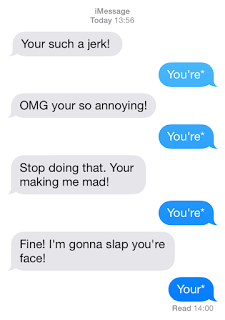
For my foreign readers who might be having trouble interpreting the above. The all-too-common mistakes are on the left. The correct use of "your" and "you're" (you are) is in blue on the right.
Alligator Update.
Visitors to Florida - whether from "up north," "out west," or international - seldom have any concept of Florida other than our beaches and themed attractions in Orlando. Which is why I try to keep my readers updated on happenings that show just how wild so much of Florida still is. The veneer of civilization is truly thin. (Anyone who has read my "Golden Beach" books knows it is a less than 10-mile strip along the edges of our peninsula, with a few inland cities, like Orlando, thrown in for good measure.) I lived 25 years on Florida's Gulf Coast, where we had so many alligators no one would even consider swimming in fresh water. (Two children, an adult male, and innumerable pets were lost to gators in our area during my time on the Gulf Coast.)
When I moved to Orlando, I was astounded to discover people actually ventured into lakes they knew they were sharing with gators. And, as you've seen on Mosaic Moments, this can lead to trouble. On Sunday a 61-year-old man, a swimmer highly experienced in the waters of Blue Springs Park about 30 miles northwest of Longwood/Orlando, was pulled under by a gator and drowned. The first alligator fatality since 2007. The 12-foot gator was later shot and killed.
The newspaper reported 22 fatal alligator attacks since 1948, 338 alligator bites (which would include the woman who lost her arm within a couple of miles from my house earlier this year). And by the way, when we ate lunch this weekend at Snook Haven on the Myakka River (10 miles east of Venice on the Gulf Coast), there were large signs saying, "Beware of venomous snakes." (When I moved to Venice in 1982, rattlers regularly sunned themselves on some of our less-traveled roads.)
The moral of the story: when you venture off the beach or out of a well-manicured theme park, take care. Gators, bears, rattlers, moccasins, oh my! They're not figments of Walt Disney's imagination. (We have a lot of deer, raccoon, and possum, too, but we don't consider them a menace. Unless you feed them, that is. In East Orlando - in a typical modest suburban community - a possum regularly entered my house through the cat door and helped himself to the cat's kibble. I finally had to seal the cat door.)
Bear Update.
Today, Saturday, October 24, is the first day of Florida's first bear hunt since 1972. Against vociferous protests, even from those who live in active bear country, the Florida Wildlife Commission's answer to three bear attacks on women last year is a hunt that most say will do nothing to keep bears from searching for food in trash cans the government refuses to replace with sturdier "bear proof" cans. If anything, I suspect it may drive more bears out of the deep woods and into people's backyards. The situation, as the hunt opens, is so controversial that the FWC has assigned monitors out in the field and law enforcement officers at tag stations where protesters are allowed to gather. (Hunters are required to bring their kill to a tag station. Overall quota for the hunt: 320.) FWC has even e-mailed every permitted hunter to advise them to be respectful of each other and of the protesters. If confronted, hunters are told to, "put your best foot forward and avoid engaging with them." More on the bear hunt as it develops.
Ha! Told you Florida wasn't all beaches, condos, and theme parks!
Copyediting Challenges - 5
Ellipses.
The "modern" compression of the ellipsis is one of my pet peeves. I like to use an ellipsis in my writing to indicate a pause - in dialogue or simply in a person's thoughts. When the classic ellipsis is reduced to three periods, one right next to the other, the significant pause becomes more like a hiccup. It simply does not serve the function for which it was intended. And yet, just because Microsoft made a code for the wrong way to write an ellipsis (Ctrl+Alt+.), everyone seems to think that is how it should be done. I've even heard the excuse that the three periods close together work better in e-books. Don't believe it. Those wide spaces between words are going to happen, no matter which way you write the ellipsis. In summary, all I can say is, Please God, don't let programmers at Microscoft, who did not major in English, tell us how to write.
Grace note: If you absolutely, positively must use those squeezed periods, please put a space on either side so it at least looks close to a pause instead of a typo from someone's fingers left too long on the "period" key. Or nothing at all because the eye skips right over those teeny little squeezed-together periods.
1. Ellipsis - how to write it.
A correct ellipsis has a space before, between, and after each period.
Example from The Welshman's Bride:
“Everyone says . . . well, missus, they say Gruffydd would do anything for Mrs. Gwendolyn."
2. Ellipsis - used as a pause. See example above.
3. Ellipsis -used to indicate a voice or thought trailing into silence, or into another thought
Example from The Welshman's Bride:
The carriage accident, stranding Hugh . . . Oh dear God. Hugh.
Grace note: In non-fiction writing, the ellipsis is used to indicate portions of a quote that have been omitted, and there are occasions when the ellipsis is followed by a fourth period without a space between. Since my Writing & Editing posts are primarily intended for fiction authors, I am not going to confuse you by getting into this use of the ellipsis. Just keep in mind that in Fiction ellipses are three periods, plus spaces. Forget the four.
~ * ~
As I began to scribble down the different ways to use a dash, I realized the ubiquitous dash should wait for its own blog. So we'll leave it for another day.
Thanks for stopping by,
Grace
For Grace's website, listing all books as Blair Bancroft, click here.
For a brochure for Grace's editing service, Best Foot Forward, click here.

For my foreign readers who might be having trouble interpreting the above. The all-too-common mistakes are on the left. The correct use of "your" and "you're" (you are) is in blue on the right.
Alligator Update.
Visitors to Florida - whether from "up north," "out west," or international - seldom have any concept of Florida other than our beaches and themed attractions in Orlando. Which is why I try to keep my readers updated on happenings that show just how wild so much of Florida still is. The veneer of civilization is truly thin. (Anyone who has read my "Golden Beach" books knows it is a less than 10-mile strip along the edges of our peninsula, with a few inland cities, like Orlando, thrown in for good measure.) I lived 25 years on Florida's Gulf Coast, where we had so many alligators no one would even consider swimming in fresh water. (Two children, an adult male, and innumerable pets were lost to gators in our area during my time on the Gulf Coast.)
When I moved to Orlando, I was astounded to discover people actually ventured into lakes they knew they were sharing with gators. And, as you've seen on Mosaic Moments, this can lead to trouble. On Sunday a 61-year-old man, a swimmer highly experienced in the waters of Blue Springs Park about 30 miles northwest of Longwood/Orlando, was pulled under by a gator and drowned. The first alligator fatality since 2007. The 12-foot gator was later shot and killed.
The newspaper reported 22 fatal alligator attacks since 1948, 338 alligator bites (which would include the woman who lost her arm within a couple of miles from my house earlier this year). And by the way, when we ate lunch this weekend at Snook Haven on the Myakka River (10 miles east of Venice on the Gulf Coast), there were large signs saying, "Beware of venomous snakes." (When I moved to Venice in 1982, rattlers regularly sunned themselves on some of our less-traveled roads.)
The moral of the story: when you venture off the beach or out of a well-manicured theme park, take care. Gators, bears, rattlers, moccasins, oh my! They're not figments of Walt Disney's imagination. (We have a lot of deer, raccoon, and possum, too, but we don't consider them a menace. Unless you feed them, that is. In East Orlando - in a typical modest suburban community - a possum regularly entered my house through the cat door and helped himself to the cat's kibble. I finally had to seal the cat door.)
Bear Update.
Today, Saturday, October 24, is the first day of Florida's first bear hunt since 1972. Against vociferous protests, even from those who live in active bear country, the Florida Wildlife Commission's answer to three bear attacks on women last year is a hunt that most say will do nothing to keep bears from searching for food in trash cans the government refuses to replace with sturdier "bear proof" cans. If anything, I suspect it may drive more bears out of the deep woods and into people's backyards. The situation, as the hunt opens, is so controversial that the FWC has assigned monitors out in the field and law enforcement officers at tag stations where protesters are allowed to gather. (Hunters are required to bring their kill to a tag station. Overall quota for the hunt: 320.) FWC has even e-mailed every permitted hunter to advise them to be respectful of each other and of the protesters. If confronted, hunters are told to, "put your best foot forward and avoid engaging with them." More on the bear hunt as it develops.
Ha! Told you Florida wasn't all beaches, condos, and theme parks!
Copyediting Challenges - 5
Ellipses.
The "modern" compression of the ellipsis is one of my pet peeves. I like to use an ellipsis in my writing to indicate a pause - in dialogue or simply in a person's thoughts. When the classic ellipsis is reduced to three periods, one right next to the other, the significant pause becomes more like a hiccup. It simply does not serve the function for which it was intended. And yet, just because Microsoft made a code for the wrong way to write an ellipsis (Ctrl+Alt+.), everyone seems to think that is how it should be done. I've even heard the excuse that the three periods close together work better in e-books. Don't believe it. Those wide spaces between words are going to happen, no matter which way you write the ellipsis. In summary, all I can say is, Please God, don't let programmers at Microscoft, who did not major in English, tell us how to write.
Grace note: If you absolutely, positively must use those squeezed periods, please put a space on either side so it at least looks close to a pause instead of a typo from someone's fingers left too long on the "period" key. Or nothing at all because the eye skips right over those teeny little squeezed-together periods.
1. Ellipsis - how to write it.
A correct ellipsis has a space before, between, and after each period.
Example from The Welshman's Bride:
“Everyone says . . . well, missus, they say Gruffydd would do anything for Mrs. Gwendolyn."
2. Ellipsis - used as a pause. See example above.
3. Ellipsis -used to indicate a voice or thought trailing into silence, or into another thought
Example from The Welshman's Bride:
The carriage accident, stranding Hugh . . . Oh dear God. Hugh.
Grace note: In non-fiction writing, the ellipsis is used to indicate portions of a quote that have been omitted, and there are occasions when the ellipsis is followed by a fourth period without a space between. Since my Writing & Editing posts are primarily intended for fiction authors, I am not going to confuse you by getting into this use of the ellipsis. Just keep in mind that in Fiction ellipses are three periods, plus spaces. Forget the four.
~ * ~
As I began to scribble down the different ways to use a dash, I realized the ubiquitous dash should wait for its own blog. So we'll leave it for another day.
Thanks for stopping by,
Grace
For Grace's website, listing all books as Blair Bancroft, click here.
For a brochure for Grace's editing service, Best Foot Forward, click here.
October 11, 2015
COBRA UPDATE
 Open air Altar - ready for the Blessing of the AnimalsChurch of the Resurrection, Longwood, Florida, October 11, 2015
 Dog & hamster (?) ready to be blessedOther participants, besides almost every kind of dog imaginable, included a cat (uncaged) and a parrot. Also . . .
 Father Paul with a corn snake
Speaking of snakes . . .
COBRA UPDATE
I heard this story on the news last night, but reading the details in The Orlando Sentinel this morning was enough to make my hair stand on end. Nearly everyone in a single family home or condo in the U.S. has a washer and dryer. For many of us in Florida, that means both appliances in the garage. (Where mine is.) Just this week I was freaked by a 12" baby black snake slithering under the wall behind my hot water heater. But a deadly cobra? Here is a portion of the tale of the discovery of the snake that escaped its cage on September 1st.
Article by Stephanie Allen and David Harris in The Orlando Sentinel, October 9, 2015:
Jenifer Porter and her two fellow animal-control officers were corralling the venomous king cobra after it came out from underneath a dryer in a Ocoee-area garage. Suddenly, the snake, named Elvis, escaped their grasp. He extended his body, becoming as tall as the 5-foot 6-inch Porter.
"I was pretty much looking him in the eye," she said, adding he was about 2 feet away which was "definitely within striking distance."
Porter backed away, and animal officer Kirsten Smith stepped on the snake's tail. Using snake tongs, officer Billy Ledford grabbed Elvis' head. When a box normally used to contain captured snakes proved too small, officers put Elvis in a cat cage.
. . . . Cynthia Mullvain found the snake under her dryer Wednesday while she was doing laundry. She heard hissing and called police. "I didn't see it; I heard it," she told Orlando Sentinel partner Fox 35. "It's a big snake. It only hissed when I put something in the dryer."
As Orange County Animal Services spokewoman Diane Summers put it, "It's not a call the officers involved will soon forget."
The article points out that although a great deal of time and effort was spent hunting for the snake, it had gone only a short distance - Ms Mullvain is a neighbor of Dragon Ranch where the cobra was caged. The article goes on to say, the Florida Wildlife Commission has not yet determined if the snake's owner will be billed for the cost of the hunt. And then . . .
It's also not clear how long the snake was under the dryer, where it had been before that or what it ate to survive. It likely chose the dryer because it was a warm place. . . . At the end of the article, Ms Porter is quoted as saying, "We did what we have to do to keep the community safe."
All I can say is, "Yikes!" I'm going to have a few qualms the next time I go out to the garage to do my laundry.
Addendum, Saturday, October 10:
The Florida Wildlife Commission is revoking Dragon Ranch's permit to keep exotic animals. (A ruling that will likely be appealed.)
~ * ~
A "pretty please" reminder to my readers that I would very much appreciate your going to the link below, clicking on "KindleScout," and reading the excerpt from my SyFy venture, Rebel Princess. Serious literature it's not, but I hope you'll find it enjoyable enough to nominate it for publication by Scout, a program that actually provides its authors with "upfront" money, as well as royalties. Thank you, merci beaucoup, muchas gracious, blagadaryoo vas!
Link to Kindle Scout
Thanks for stopping by,
Grace
For Grace's website, listing all books as Blair Bancroft, click here.
For a brochure for Grace's editing service, Best Foot Forward, click here.
October 3, 2015
Copyediting Challenges - 4
A Special Request from Grace:
I uploaded the first book of a SyFy (Futuristic Paranormal) series to Amazon's new Kindle Scout publishing program, not realizing I was supposed to use social media to request "nominations" for my book to be published. Definitely one of life's embarrassing moments, as that's just not my style, BUT the Scout program actually offers advance payments to authors, as well as royalties (something that's been lacking in e-publishing), so I'm gritting my teeth and asking my blog readers to go to the link below, read the first 5000 words of Rebel Princess, and - unless you hate it - nominate it for publication by Kindle Scout. Thank you, thank you!
Link to Excerpt
~ * ~
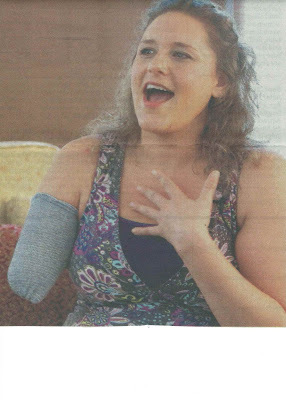
Gator-bite update: The woman in the photo below is the professor at Rollins College (earlier reported as UCF), who lost her arm to an alligator here in Longwood last month. She is planning to return to the classroom in January.
Photo is scanned from The Orlando Sentinel, September 26, 2015. Good luck to a brave lady!
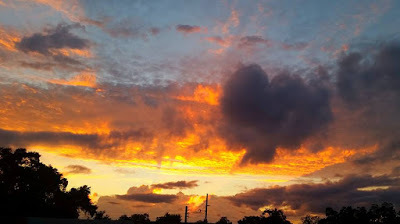 Orlando fall sunset, courtesy of Susie Reale
Copyediting Challenges - Part 4
Although this week's Copyediting Challenges can be confusing, they are not as open to interpretation as some of the previous examples. Most of these are cases of "right" and "wrong," with little wiggle room for subjective decisions. But you'll see from my notes that few rules are truly cut in stone.
1. That vs. Which.
That:
I personally find the choice between "that" and "which" one of the most difficult choices to explain, even to myself. But before I even try, please remember this: Many times the word "that" simply gets in the way. If you can eliminate "that" and your sentence still makes sense, then get rid of that pesky four-letter word.
Example from The Chicago Manual of Style:
The book I have just finished is due back tomorrow.
Use "that" - if necessary - when the "that" clause is essential to the meaning of the sentence.
Example from COS:
The report that the committee submitted was well documented.
Grace note: Personally, I'd eliminate the "that" in the above sentence. It's not needed, as is often the case. Check all your "that" clauses, asking yourself if "that" is really necessary.
Which:
"Which" is used when the clause can be left out without changing the meaning of the sentence.
Examples from COS:
The report, which was well documented, was submitted to the committee.
The book, which I finished last night, is due back tomorrow.
You've written a sentence where the "which" clause is essential to the meaning. Ah-hah! Take another look. Maybe it should be a "that" clause.
Grace Note: As a good example of just how tricky "that/which" can be, the last example above could also be written as: The book I finished last night is due back tomorrow. Thus eliminating both "that" and "which." It might not be "literary" English, but it's perfectly acceptable in both fiction and non-fiction - except perhaps to the most persnickety English professors and authors with aspirations toward writing "literature" far above the tastes of the most of the general public.
2. That vs. Who.
While we're on the subject of "that," I have to bring up one of my own pet peeves, even though it seems to be a lost cause, with even newspapers and TV reporters using "that" when it should be "who."
"That" refers to places and things.
"Who" is used when referring to people.
Bill is the person who had the best idea for the new building.
NOT Bill is the person that had the best idea for the new building.
3. Not, Not only.
To use a comma or not? This seems to be a truly subjective decision based on whether or not you, as the writer, feel a pause or not. The general rule, however, is that if you use one comma, you need to use two - enclosing the clause on either side. [Please note the use of "that" in the previous sentence. This is a case where the sentence would not read right if "that" is eliminated.]
Examples from COS:
We hoped the mayor herself, not her assistant, would attend the meeting.
They marched to Washington, not only armed with petitions and determined to get their senators' attention, but also hoping to demonstrate their solidarity with one another.
but
They were armed not only with petitions but also with evidence.
She decided not to march but merely to collect signatures.
4. More, Less, etc.
A comma should be used between clauses using these words but not between really short phrases.
Examples from COS:
The more I read about Winterbottom, the more I liked her.
The less you eat, the better you'll feel.
but
The more the merrier.
The sooner the better.
5. Apposition.
Quote from The Chicago Manual of Style: "A word, abbreviation, phrase, or clause that is in apposition to a noun is set off by commas if it is nonrestrictive." In other words, if it can be omitted and the sentence still retain its meaning.
Examples from COS:
The committee chair, Gloria Ruffolo, called for a resolution.
Stanley Groat, president of the corporation, spoke first.
My older sister, Betty, taught me the alphabet.
but
My sister Enid lets me hold her doll.
And sometimes the appositive contains a conjunction. Example from COS, 15th ed.:
The steward, or farm manager, was an important functionary in medieval life.
~ * ~
More challenges to come, although sometime soon I hope to get my trip pictures downloaded and will begin sharing those.
Thanks for stopping by,
Grace
For Grace's website, listing all books as Blair Bancroft, click here.
For a brochure for Grace's editing service, Best Foot Forward, click here.
I uploaded the first book of a SyFy (Futuristic Paranormal) series to Amazon's new Kindle Scout publishing program, not realizing I was supposed to use social media to request "nominations" for my book to be published. Definitely one of life's embarrassing moments, as that's just not my style, BUT the Scout program actually offers advance payments to authors, as well as royalties (something that's been lacking in e-publishing), so I'm gritting my teeth and asking my blog readers to go to the link below, read the first 5000 words of Rebel Princess, and - unless you hate it - nominate it for publication by Kindle Scout. Thank you, thank you!
Link to Excerpt
~ * ~
Gator-bite update: The woman in the photo below is the professor at Rollins College (earlier reported as UCF), who lost her arm to an alligator here in Longwood last month. She is planning to return to the classroom in January.
Photo is scanned from The Orlando Sentinel, September 26, 2015. Good luck to a brave lady!

 Orlando fall sunset, courtesy of Susie Reale
Copyediting Challenges - Part 4
Although this week's Copyediting Challenges can be confusing, they are not as open to interpretation as some of the previous examples. Most of these are cases of "right" and "wrong," with little wiggle room for subjective decisions. But you'll see from my notes that few rules are truly cut in stone.
1. That vs. Which.
That:
I personally find the choice between "that" and "which" one of the most difficult choices to explain, even to myself. But before I even try, please remember this: Many times the word "that" simply gets in the way. If you can eliminate "that" and your sentence still makes sense, then get rid of that pesky four-letter word.
Example from The Chicago Manual of Style:
The book I have just finished is due back tomorrow.
Use "that" - if necessary - when the "that" clause is essential to the meaning of the sentence.
Example from COS:
The report that the committee submitted was well documented.
Grace note: Personally, I'd eliminate the "that" in the above sentence. It's not needed, as is often the case. Check all your "that" clauses, asking yourself if "that" is really necessary.
Which:
"Which" is used when the clause can be left out without changing the meaning of the sentence.
Examples from COS:
The report, which was well documented, was submitted to the committee.
The book, which I finished last night, is due back tomorrow.
You've written a sentence where the "which" clause is essential to the meaning. Ah-hah! Take another look. Maybe it should be a "that" clause.
Grace Note: As a good example of just how tricky "that/which" can be, the last example above could also be written as: The book I finished last night is due back tomorrow. Thus eliminating both "that" and "which." It might not be "literary" English, but it's perfectly acceptable in both fiction and non-fiction - except perhaps to the most persnickety English professors and authors with aspirations toward writing "literature" far above the tastes of the most of the general public.
2. That vs. Who.
While we're on the subject of "that," I have to bring up one of my own pet peeves, even though it seems to be a lost cause, with even newspapers and TV reporters using "that" when it should be "who."
"That" refers to places and things.
"Who" is used when referring to people.
Bill is the person who had the best idea for the new building.
NOT Bill is the person that had the best idea for the new building.
3. Not, Not only.
To use a comma or not? This seems to be a truly subjective decision based on whether or not you, as the writer, feel a pause or not. The general rule, however, is that if you use one comma, you need to use two - enclosing the clause on either side. [Please note the use of "that" in the previous sentence. This is a case where the sentence would not read right if "that" is eliminated.]
Examples from COS:
We hoped the mayor herself, not her assistant, would attend the meeting.
They marched to Washington, not only armed with petitions and determined to get their senators' attention, but also hoping to demonstrate their solidarity with one another.
but
They were armed not only with petitions but also with evidence.
She decided not to march but merely to collect signatures.
4. More, Less, etc.
A comma should be used between clauses using these words but not between really short phrases.
Examples from COS:
The more I read about Winterbottom, the more I liked her.
The less you eat, the better you'll feel.
but
The more the merrier.
The sooner the better.
5. Apposition.
Quote from The Chicago Manual of Style: "A word, abbreviation, phrase, or clause that is in apposition to a noun is set off by commas if it is nonrestrictive." In other words, if it can be omitted and the sentence still retain its meaning.
Examples from COS:
The committee chair, Gloria Ruffolo, called for a resolution.
Stanley Groat, president of the corporation, spoke first.
My older sister, Betty, taught me the alphabet.
but
My sister Enid lets me hold her doll.
And sometimes the appositive contains a conjunction. Example from COS, 15th ed.:
The steward, or farm manager, was an important functionary in medieval life.
~ * ~
More challenges to come, although sometime soon I hope to get my trip pictures downloaded and will begin sharing those.
Thanks for stopping by,
Grace
For Grace's website, listing all books as Blair Bancroft, click here.
For a brochure for Grace's editing service, Best Foot Forward, click here.
September 26, 2015
PEN POWER
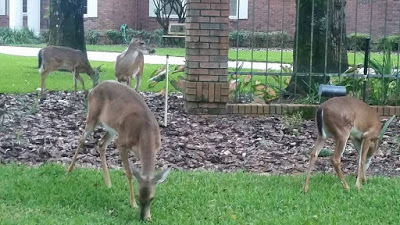
There's something strange, though wonderful, about deer calmly grazing in an area as perfectly landscaped as the homes off Markham Woods Road in Longwood. Obviously, the neighborhood cherishes its wildlife. Many residents are among the angry protesters demonstrating against next month's first bear hunt in decades. (Sparked by three women being mauled by bears this past year within a couple of miles of the scene below.)
PEN POWER
So much has been written about the power of the pen, I decided to go for a slightly different twist on the name for this week's blog. I'm not sure what brought this topic on - perhaps devouring Rose, an old but absolutely stunning, book by Martin Cruz Smith, set me off, I'm not sure. But I got to thinking about what incredible power we have when we write. The power to give life, not just to a child or three, as so many of us do, but to create heroes, heroines, villains, mothers, fathers, sisters, brothers, and myriad odd, funny, beloved, and/or diabolical secondary characters.
We create worlds around these people - everything from a country village to a western ranch, from teeming city to completely alien cultures on planets far, far away. We create balmy nights of romance under the stars, raging storms, claustrophobic traps deep inside the earth, soaring wonder in airplanes, spaceships, even an angel's view of earth.
Through nothing more than black type on a white page - whether on paper or on screen - we invent situations that would challenge the finest minds among us, some no more complicated than the joys and sorrows of everyday life, some that challenge us to follow a maze of clues to find a villain, some that grab us on the scale of a James Bond thriller, some that simply amaze. And, yes, some that seem to tip over into glorifying "blood & guts" far beyond what most of us want to read.
But whatever the words we create, they are ours. They come out of our heads, no one else's - though certainly with a nod to all writers who have gone before us. After all, writing Romance boils down to boy meets girl, they fall in love but must deal with some supposedly insurmountable problem before they finally reconcile. And there you have it, HEA once again. (That's Happily Ever After, for those who don't recognize the acronym.) It's what happens in the details of the three- or four-hundred pages that tells your version of this age-old tale that matters.
The same is true, no matter what genre you write. The author must provide the unique details that makes the story his or hers. You must provide not only characters so well detailed they leap off the page straight into readers' minds, but you must paint vivid backdrops as well. Whether it's the minutiae of a small town in the South or the broad vista of a planet on the far side of the Galaxy, you have to dig the details out of your head and find the right words to create a picture your readers can actually see.
And then there's Plot. Fictional characters need something to sink their teeth into besides each other. If there wasn't something happening beyond boy meets girl, the book would be maybe fifty pages instead of four hundred. So there we go again - the ultimate challenge of thinking up new situations when you have only to check out Amazon.com to know that every variation of every possible plot must have been done a hundred times over. And yet, creativity flourishes. Somehow every story is different, for even if plots sometimes seem to overlap, each author's style manages to be unique. (Okay, yes, there are copycats out there, but they aren't worthy of our attention.)
I read a lot. (I'm often asked where I find the time.) The truth is, late at night I'm too tired to do anything else. And since I do not have a full-time job, I can also take breaks during the day - ten or fifteen minutes to put up my feet and sink into a good book. And I am constantly amazed by the level of creativity in the books I read. Authors seem to have an infinite well of imagination that springs to life in book after book. Case in point - Rose by Martin Cruz Smith. He stunned us way-back-when with a book set in Russia during the period when no American could travel to Russia. His research was so perfect both his Russian detective hero and the world he lived in came across as totally authentic. In Rose, he has done the same for an English coal town. I mean, I was positively shivering with both fear and claustrophobia as the hero crawled through the debris from an explosion a mile underground. The fight scenes had my stomach in knots. And the plot twist? I'm a pretty good plotter, but even I saw only a vague hint of what was to come.
Yes, some of us like to think we're good at what we do. But any time we get above ourselves, we can always read Martin Cruz Smith, and a very few others like him, to take us down a peg or two. Yet all authors have one thing in common - Imagination. The ability to start with a blank page and make it come alive with interesting characters, a well-drawn setting, and a good storyline (be it simple or complex). This is the great Gift. The wonder of it all. This is what makes us writers. (And I make no silly distinctions between being a Writer and being an Author. They are one and the same. Anyone who takes time to worry about an alleged difference surely lacks confidence in his/her abilities. Or is arrogant enough to want to find a word which distinguishes him or her from those who are not yet published. A truly unworthy sentiment.)
It is immensely exciting to sit down each day and ask myself, "Okay, what happens next?" And, astoundingly, the answers are to be found only in my head. In a sense, I get to play god day in and day out, creating something that has never existed before. Wow! I mean, how great is that?
So take heart. Even if you're having an "off" day, those words are still yours. Even if you revise them until the paragraphs are almost unrecognizable, the work remains yours. Your idea. Your effort. Your end result. Yours to edit until it flows as smoothly as an English canal.
So, with due respect to the God who has gifted us with our talent, be proud of your creations. Never hesitate to lay it all out there and then declare, "Let there be light!" Whether you're finishing a novel, a short story, an essay, or a report for school, crafting words into sentences, sentences into paragraphs, and organizing the whole into a finished product is a major accomplishment. You can pat yourself on the back, right before you go back and edit and polish and edit and polish until you feel it's finally come right.
Hold your head high. You've done it. Even if your great opus is only two pages and read by no one other than a teacher, you have made a unique contribution to the World of Writing, one that is totally yours.
Writing is empowering. Writing places you among the rare few who can make worlds dance to their own tune. Revel in it. Be proud. We are so very fortunate to have been granted the special gift of not only creating brave new worlds but the privilege of sharing these worlds with others.
~ * ~
Thanks for stopping by,
Grace
For Grace's website, listing all books as Blair Bancroft, click here.
For a brochure for Grace's editing service, Best Foot Forward, click here.

PEN POWER
So much has been written about the power of the pen, I decided to go for a slightly different twist on the name for this week's blog. I'm not sure what brought this topic on - perhaps devouring Rose, an old but absolutely stunning, book by Martin Cruz Smith, set me off, I'm not sure. But I got to thinking about what incredible power we have when we write. The power to give life, not just to a child or three, as so many of us do, but to create heroes, heroines, villains, mothers, fathers, sisters, brothers, and myriad odd, funny, beloved, and/or diabolical secondary characters.
We create worlds around these people - everything from a country village to a western ranch, from teeming city to completely alien cultures on planets far, far away. We create balmy nights of romance under the stars, raging storms, claustrophobic traps deep inside the earth, soaring wonder in airplanes, spaceships, even an angel's view of earth.
Through nothing more than black type on a white page - whether on paper or on screen - we invent situations that would challenge the finest minds among us, some no more complicated than the joys and sorrows of everyday life, some that challenge us to follow a maze of clues to find a villain, some that grab us on the scale of a James Bond thriller, some that simply amaze. And, yes, some that seem to tip over into glorifying "blood & guts" far beyond what most of us want to read.
But whatever the words we create, they are ours. They come out of our heads, no one else's - though certainly with a nod to all writers who have gone before us. After all, writing Romance boils down to boy meets girl, they fall in love but must deal with some supposedly insurmountable problem before they finally reconcile. And there you have it, HEA once again. (That's Happily Ever After, for those who don't recognize the acronym.) It's what happens in the details of the three- or four-hundred pages that tells your version of this age-old tale that matters.
The same is true, no matter what genre you write. The author must provide the unique details that makes the story his or hers. You must provide not only characters so well detailed they leap off the page straight into readers' minds, but you must paint vivid backdrops as well. Whether it's the minutiae of a small town in the South or the broad vista of a planet on the far side of the Galaxy, you have to dig the details out of your head and find the right words to create a picture your readers can actually see.
And then there's Plot. Fictional characters need something to sink their teeth into besides each other. If there wasn't something happening beyond boy meets girl, the book would be maybe fifty pages instead of four hundred. So there we go again - the ultimate challenge of thinking up new situations when you have only to check out Amazon.com to know that every variation of every possible plot must have been done a hundred times over. And yet, creativity flourishes. Somehow every story is different, for even if plots sometimes seem to overlap, each author's style manages to be unique. (Okay, yes, there are copycats out there, but they aren't worthy of our attention.)
I read a lot. (I'm often asked where I find the time.) The truth is, late at night I'm too tired to do anything else. And since I do not have a full-time job, I can also take breaks during the day - ten or fifteen minutes to put up my feet and sink into a good book. And I am constantly amazed by the level of creativity in the books I read. Authors seem to have an infinite well of imagination that springs to life in book after book. Case in point - Rose by Martin Cruz Smith. He stunned us way-back-when with a book set in Russia during the period when no American could travel to Russia. His research was so perfect both his Russian detective hero and the world he lived in came across as totally authentic. In Rose, he has done the same for an English coal town. I mean, I was positively shivering with both fear and claustrophobia as the hero crawled through the debris from an explosion a mile underground. The fight scenes had my stomach in knots. And the plot twist? I'm a pretty good plotter, but even I saw only a vague hint of what was to come.
Yes, some of us like to think we're good at what we do. But any time we get above ourselves, we can always read Martin Cruz Smith, and a very few others like him, to take us down a peg or two. Yet all authors have one thing in common - Imagination. The ability to start with a blank page and make it come alive with interesting characters, a well-drawn setting, and a good storyline (be it simple or complex). This is the great Gift. The wonder of it all. This is what makes us writers. (And I make no silly distinctions between being a Writer and being an Author. They are one and the same. Anyone who takes time to worry about an alleged difference surely lacks confidence in his/her abilities. Or is arrogant enough to want to find a word which distinguishes him or her from those who are not yet published. A truly unworthy sentiment.)
It is immensely exciting to sit down each day and ask myself, "Okay, what happens next?" And, astoundingly, the answers are to be found only in my head. In a sense, I get to play god day in and day out, creating something that has never existed before. Wow! I mean, how great is that?
So take heart. Even if you're having an "off" day, those words are still yours. Even if you revise them until the paragraphs are almost unrecognizable, the work remains yours. Your idea. Your effort. Your end result. Yours to edit until it flows as smoothly as an English canal.
So, with due respect to the God who has gifted us with our talent, be proud of your creations. Never hesitate to lay it all out there and then declare, "Let there be light!" Whether you're finishing a novel, a short story, an essay, or a report for school, crafting words into sentences, sentences into paragraphs, and organizing the whole into a finished product is a major accomplishment. You can pat yourself on the back, right before you go back and edit and polish and edit and polish until you feel it's finally come right.
Hold your head high. You've done it. Even if your great opus is only two pages and read by no one other than a teacher, you have made a unique contribution to the World of Writing, one that is totally yours.
Writing is empowering. Writing places you among the rare few who can make worlds dance to their own tune. Revel in it. Be proud. We are so very fortunate to have been granted the special gift of not only creating brave new worlds but the privilege of sharing these worlds with others.
~ * ~
Thanks for stopping by,
Grace
For Grace's website, listing all books as Blair Bancroft, click here.
For a brochure for Grace's editing service, Best Foot Forward, click here.


