Doug Walsh's Blog, page 7
February 12, 2018
Historical Fiction Doesn’t Mean Alternate Reality
I’ve recently come to realize that one of my favorite genres, historical fiction, is largely misunderstood. While even writers can struggle to keep the multitude of sub-genres straight, especially within the romance and young adult categories — “urban fantasy” came and went before I ever understood what it was — historical fiction is far too mainstream to suffer such confusion.
Or is it?
Surely I’m not the only one who upon describing The Nightingale as “historical fiction set during World War II,” faced a reply that immediately assumed the book was about Germany winning the war.
It’s not. Nor does the South win the Civil War in Lincoln in the Bardo.
I can see how it’s easy to get confused, especially by those who don’t read much fiction or who have a tendency to take things too literally. Which isn’t to say that books or television can’t be about those things. For example, Amazon’s Man in the High Castle relies upon the premise of Germany & Japan conquering the United States following World War II.
Yes, it’s about historical events, and yes, it is entirely fictional. But it’s not historical fiction. Works of that type are considered “alternative history.”
It’s About the People, Not the Events
To best understand historical fiction as a genre is to accept that the historical events taking place and the figures whose names and actions we may already know are really just backdrop. Historical fiction teaches us about real-world events through the lives of fictional characters. When done well, we are entertained, inspired, angered, and perhaps even moved to tears all while learning about an aspect of history we probably weren’t aware of.
I got the idea to write this blog upon finishing Part IV of James Michener’s epic Hawaii the other day. For those unfamiliar with Michener’s work, he’s known for writing sprawling, meticulously-researched, thousand-page novels about a place: Hawaii, Alaska, Mexico, and Chesapeake to name a few.
Hawaii begins miles below the sea floor, in the Earth’s upper crust, and traverses geologic time to the arrival of the Tahitians a thousand years ago, before jumping ahead to the New England missionaries who came in the early nineteenth century. Onward through the decades the story marches, telling the tale of Hawaii’s history through a cast of characters modeled after many of the real-life missionaries, immigrants, plantation owners, and native islanders who helped shape the islands, for better or worse.
Through the main characters of the story, Abner Hale, Nyuk Sin, and Whip Hoxworth, we are given a reason to care about the Calvinist’s role in upending Hawaiian beliefs; we’re shown the tragedy of those sent to Molokai during the leprosy outbreak; we’re privy to the greed and unjust ways in which the American plantation owners stole Hawaii out from under the people who called it home.
Textbooks are great at teaching us the dates and names that make up the facts of history, historical fiction puts us in the shoes of those it affected and makes us care.
A Hard Day’s Writing
Though novelists should be well-read in their genre, and I really do enjoy reading historical fiction, I have no intention of ever writing it. The research is just too much.
With Tailwinds Past Florence now in the querying stage, I’m left to begin work on my next novel. As such, I’ve amassed a pile of research materials about the location, it’s history and culture, and also several contemporary novels that share the setting. The book will largely be set in Hawaii. So, as I’m reading Michener’s Hawaii, I’m also combing through Martha Beckwith’s encyclopedia-like doorstop Hawaiian Mythology. I have no doubt that Michener relied heavily upon Beckwith’s work (originally published in 1940) when writing his early chapters.
But whereas Michener needed to comb the annals of history to bring the mythology to life, my goal is less lofty. I wish to merely imbue one of my characters with enough campfire knowledge to be annoying.
Similarly, I had no interest in doing the level of research James Clavell must have undertaken when writing Shogun, but it was while reading his book that I first learned about the Japanese Christians of the 17th century. That, in turn, gave me an idea for a character in Tailwinds Past Florence.
Textbooks are great at teaching us the dates and names that make up the facts of history, historical fiction puts us in the shoes of those it affected and makes us care.
I savor doing a day’s or week’s worth of research to further develop a character or their origin — even if it only earns a couple of sentences in the novel — but I know enough about me, why I write, and what I want to write, to know historical fiction isn’t for me. I’ll leave that heavy lifting to others.
Recommendations in Historical Fiction
Much of the historical fiction that I’ve read takes place during war. This is probably because war serves as convenient mileposts for history, but also because stories need conflict and tension and what better source than war? That’s not to say that these books are about war. Some are, but most of them carry themes of relationships or self-discovery. Here’s a few that I’ve read over the recent years that I wouldn’t hesitate to recommend, in no particular order. Descriptions copied from Amazon.
The Nightingale by Kristin Hannah – With courage, grace, and powerful insight, bestselling author Kristin Hannah captures the epic panorama of World War II and illuminates an intimate part of history seldom seen: the women’s war. The Nightingale tells the stories of two sisters, separated by years and experience, by ideals, passion and circumstance, each embarking on her own dangerous path toward survival, love, and freedom in German-occupied, war-torn France—a heartbreakingly beautiful novel that celebrates the resilience of the human spirit and the durability of women. It is a novel for everyone, a novel for a lifetime.
Gates of Fire by Steven Pressfield – At Thermopylae, a rocky mountain pass in northern Greece, the feared and admired Spartan soldiers stood three hundred strong. Theirs was a suicide mission, to hold the pass against the invading millions of the mighty Persian army. Day after bloody day they withstood the terrible onslaught, buying time for the Greeks to rally their forces. Born into a cult of spiritual courage, physical endurance, and unmatched battle skill, the Spartans would be remembered for the greatest military stand in history–one that would not end until the rocks were awash with blood, leaving only one gravely injured Spartan squire to tell the tale….
Hawaii by James Michener — Pulitzer Prize–winning author James A. Michener brings Hawaii’s epic history vividly to life in a classic saga that has captivated readers since its initial publication in 1959. As the volcanic Hawaiian Islands sprout from the ocean floor, the land remains untouched for centuries—until, little more than a thousand years ago, Polynesian seafarers make the perilous journey across the Pacific, flourishing in this tropical paradise according to their ancient traditions. Then, in the early nineteenth century, American missionaries arrive, bringing with them a new creed and a new way of life. Based on exhaustive research and told in Michener’s immersive prose, Hawaii is the story of disparate peoples struggling to keep their identity, live in harmony, and, ultimately, join together.
Her Privates We by Fredrick Manning – The classic novel of the Great War, set during the battle of the Somme. Her Privates We follows the story of Private Bourne, an ordinary soldier dealing with extraordinary circumstances. As well as conveying the camaraderie and heroism of the trenches, the novel explores the terror and monotony of being a soldier. A cloud of fatalism hangs over the narrative, which is brightened up through friendships, a shared, grim sense of humour and colourful conversations between the privates.
The Wind is Not a River by Brian Payton – The Wind Is Not a Riveris Brian Payton’s gripping tale of survival and an epic love story in which a husband and wife—separated by the only battle of World War II to take place on American soil—fight to reunite in Alaska’s starkly beautiful Aleutian Islands.
Silence by Shusako Endo – Seventeenth-century Japan: Two Portuguese Jesuit priests travel to a country hostile to their religion, where feudal lords force the faithful to publicly renounce their beliefs. Eventually captured and forced to watch their Japanese Christian brothers lay down their lives for their faith, the priests bear witness to unimaginable cruelties that test their own beliefs. Shusaku Endo is one of the most celebrated and well-known Japanese fiction writers of the twentieth century, and Silence is widely considered to be his great masterpiece.
The post Historical Fiction Doesn’t Mean Alternate Reality appeared first on Doug Walsh.


January 16, 2018
Upcoming Goodreads Giveaway!
 on your to-read list, that I'll be hosting a Goodreads Giveaway starting January 25th.
 Three signed copies will be available. Best of luck!
November 6, 2017
Vision Goes Quietly
The woman at motor vehicle told me to place my forehead against the headrest and read the top line from the eye chart. I peered in, then backed up. “I think you need to focus this,” I said. She gave me a wry smile and said to do my best. Squinting, blinking, straining, I did just that. “Why don’t you try one more time,” she said.
I took a deep breath and realized that this once-every-decade inconvenience had suddenly taken on grave importance. I was on the verge of being unable to renew my driver’s license.
Near-Sighted
I never understood the difference between near- and far-sighted. Did being near-sighted mean you could see well at close distance? Or did it mean you needed reading glasses? I never knew. I had great vision, so what did I care?
It started several years ago. We’d be in the car, and I started noticing that my wife could read street signs before I could. We’d be in a pub and I’d have to ask her to read the sports scores on the televisions across the room. Then, more recently, I began complaining that the text in Legend of Zelda; Breath of the Wild was too small. We have a 65-inch 4k TV. We’d stream a foreign film and I’d squint at the subtitles, thinking that our TV, one we picked out in the Sony showroom in Tokyo, wasn’t worth nearly what we paid for it.
Sitting at the optometrist’s office, I stared through the eye exam machine, straining to read the eye charts, still believing my eyes were fine. It was the machine that was out of focus. It was all a trick. And what difference does it make if I can’t read tiny text from across a dimly-lit room? We went through chart after chart, the optometrist turning dials, changing the lens, and asking me to choose which is better. “Before or after?” The dials flipped. Again. “Before or after?”
The differences were sometimes so negligible, I could only imagine them. The barrage of tests concluded, she turned the dials to what would be my prescription.
With my pupils freakishly dilated thanks to some eye drops, the ophthalmologist (thank you spellcheck) confirmed I have no glaucoma or cataracts. Healthy-wise my eyes were in great shape. But I had fallen from the land of 20/20 to 20/30 in one eye, 20/35 in the other. Would I consider Lasik? Whoa, hold on a moment. Let’s not get carried away.
Life’s Rich Details
I ordered the glasses, figuring I’d use them while watching television, at the movies, or while driving at night. Do I want to pay extra for transitions lenses that automatically become sunglasses in bright light? No.
That was dumb.
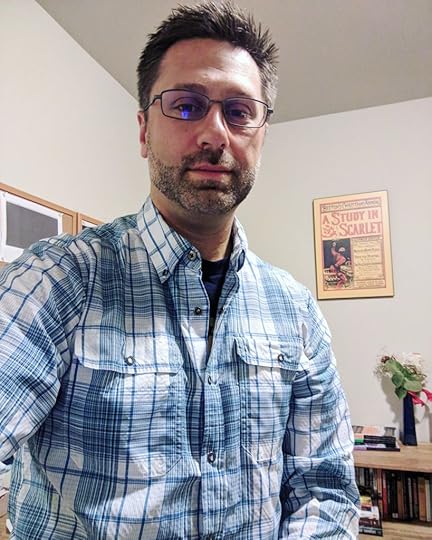
Yours truly in my new glasses.
I got the glasses a week later. I pulled them on and was instantly amazed. Everything was brighter, crisper, and slightly magnified. I pulled them off after a moment,oohing and aahing enough to draw attention. Across the room, a sign read “Johnson.” Or so I thought. With the glasses on, I could see it clearly said “Provident.” I walked outside, a bit self-conscious about the glasses, but simply amazed at how much better I was able to see. I honestly had very little idea that my vision had been deteriorating, other than the aforementioned examples which were of little significance.
At home, I looked at the painting we have over our couch and saw, for the first time in memory, the wonderful detail in the brush strokes. There was a part of the painting that I always thought was intentionally smeared. It wasn’t. Just my vision. The fabric of our wingback reading chairs… the same thing. Such lovely detail in the pattern that I hadn’t noticed in over a year. Maybe longer. And our TV? It’s amazing. Just like I remembered.
I now where the glasses all the time, unless I’m reading or working on the computer. I don’t need them for close-ups. Near-sighted means you struggle with far-off objects. And I’m already looking forward to getting transitions lenses next time.
As for Lasik, that’s a road I’ll cross if I ever get to the point where I can’t mountain bike or go trail running without glasses. Maybe contacts first. We’ll see.
Get Tested
As for my driver’s license, I passed. I was able to read enough of the middle letters in order to pass, but the lady at the DMV suggested I get myself to an eye doctor right away. If you haven’t gone in a few years, I recommend you do the same. My vision had deteriorated at such an imperceptible rate that I had just come to believe what I saw was normal. When it goes south over the course of years, it’s hard to realize something is wrong.
And then, one day, you find yourself asking someone to focus the eye test machine at the DMV for you.
The post Vision Goes Quietly appeared first on Doug Walsh.
October 18, 2017
Why I Shortened My Running Stride
I wanted to high five someone.
Fish leaped from the water on my right. Moss covered the forested hillside on my left, inching its way down the embankment to the edge of the rocky trail. It was a perfectly crisp fall day — no clouds for miles, the temperature just warm enough to keep one’s breath invisible — and I was at one of my favorite places: Moran State Park on Orcas Island. I crested the final hill, accelerated, and covered the remaining steps in a sequence of short, choppy strides that still feel foreign to me. I tapped the stop button on my watch. My stats: 8.7 miles, a smidge over a thousand feet of cumulative elevation gain, and a 9:22/mile moving average. I stopped only to take a few photos along the way, never to walk.
It was my furthest, fastest trail run in recent memory. And it wrapped up a week in which I logged the most miles of any week in over a year, a measly 19.2 miles. And I felt great!
At the car, while family members continued their stroll around Mountain Lake, I peeled my sweaty shirt off, kicked free of my running shoes, and basked in the lakeside sun, tentatively embracing a return of familiar skin.
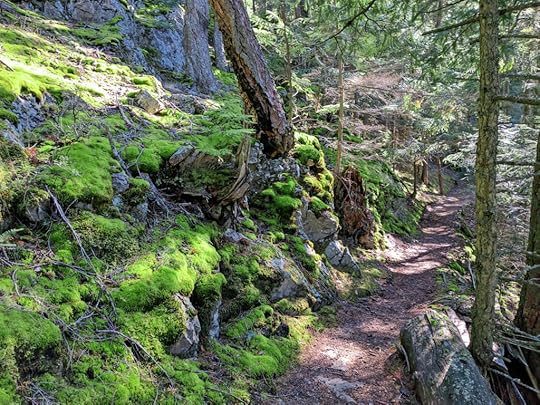
A gorgeous strip of trail at Moran State Park, on Orcas Island.
Birth of a Habit
I used to be fast. Decades ago, in what is best described as a prior life, I used my legs to run myself onto a collegiate track team, Division I, with an athletic grant. In that prior life my name earned a spot in school record books, both high school and college. With a body some thirty-five pounds lighter than the one writing this, I ran. And ran. And ran. I wasn’t elite — someone whose love of running is equaled by their love of beer and Egg McMuffins can never be — but I’m told those records still stand.
Photos show me having a gorgeous stride. Lean, muscular legs attached to airborne feet, rear leg extended far behind, pushing off as the front one searched for ground so far in front of me, it may as well have been foreign soil. It was a stride that drew no criticism, only praise. It worked for me in the 800m, the 1600m, and in the 8k and 10k cross-country races I grew to hate in college. In an odd twist, it even adapted to my forays into marathoning several years later.
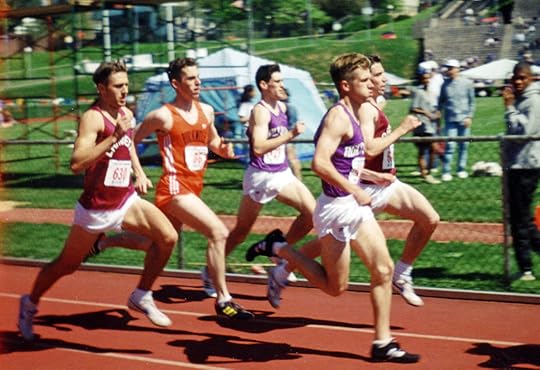
About to make my move down the backstretch during the Patriot League 800m Championships in 1995. Having spent the entire season training in a pool due to a stress fracture, this was the only race I ran that season.
It was a beautiful stride and I could spin it like a DVD. For years I ran with that same motion some four, five, or six days a week, often averaging up to sixty miles per week.
That stride was me. That stride was all wrong.
Why Do I Keep Hurting Myself?
What do you do when something you love not only ceases to love you back, but causes you pain? In reviewing my own experience with this issue, I can pinpoint three approaches:
Seek help.
Ignore the problem until you forget the suffering, then return, only to be hurt again. Repeat.
Search for a new love.
Having worked through each of these steps in what I can confidently say was precisely the exact order one should NOT follow, I will now reveal how I got back to doing what I loved. But first: what was the problem? You have to ask? Even after that wonderful segue I did up above, before the sub-header? My stride was the problem. No, that’s not right. My stride was the cause.
The problem was that I kept spraining my ankle. Or rolling it. Or tweaking it. Call it whatever you want, it hurt like hell and would undoubtedly leave me limping for miles. Each and every time I entered a trail race. Whether it be Orcas Island, Yakima Skyline, or Deception Pass, I always came across the finish line hobbling. And each time it happened, I’d kick my shoes off, throw my arms in the air in disgust, and curse the running Gods for my weak ankles, as if there were such thing.
So I’d swear off running, my original love, and go back to mountain biking. Mountain biking is fantastic fun. It’s more of an adrenaline rush, something I often do socially, and there’s always beer waiting back at the trailhead — and sometimes in our packs during the ride. But nearly every year, usually with the arrival of fall, I’d start running again, having forgotten the pain it brought me. I’d inevitably roll my ankle once or twice on the trails around home, but stick with it through the rainy, muddy season (it’s less of a hassle to go running during the Pacific Northwest’s “wet season”). Then I’d enter a race and end up injured all over again.
You may recall this past spring that I limp-ran my way through a half-marathon on the trails at Dash Point State Park with a strained calf. I didn’t screw up my ankle — my injured calf didn’t grant me the speed needed to hurt myself further. But enough was enough, it was time to see a doctor.
Shortening Up to Go Long
My friend Ben owns a thriving physical therapy practice and though he personally no longer accepts new patients, he was willing to take a look at me. So once my calf healed, I went to see him. He recorded video of me running on a treadmill, inspected my ankles, feet, and legs, and had me perform a number of exercises in front of him. Long story short: the calf tightness/strains I was having were likely related to over-training on soft trails in shoes that were well past their expiration date. Ben rolled my sneaker into a ball, tucking the toe inside the cuff, and gave me a look. It was the look you give someone who ought to know better. He also taught me a number of exercises to help stretch my calves throughout the day and provided me with a foam roller.
When it came time to review the video, it was clear that I had a bad habit of over-striding. Ben is the co-developer of the RunCadence app and had been thinking long and hard about the effect of running cadence (steps per minute) for quite some time. I don’t use the app — it’s still iPhone only?!? — but I run with a Garmin Fenix 3 watch which also monitors cadence. Ben believed that if I shortened my running stride, thereby increasing my tempo, I would not only reduce the risk of rolling my ankle on trails, but I’d lessen the impact on my knee and the strain on my calves and feet as well. He told me to aim for at least 160 strides/min on trails (the inevitable walking sections reduces average cadence) and closer to 180 strides/min when I run on the roads, something I try not to do often.
So I went home, put on my new shoes, and went for a short run using my normal form, and saw that my cadence was only 135 strides/min. Oh.
My cadence is now routinely on the order of 157 strides/min, a 16% increase over where it was before my chat with Ben. I haven’t exceeded 160 yet, but I’ve been running for a month now without injury (or really any discomfort at all). There have been a couple of instances when my foot landed awkwardly on a rock or tree root that I didn’t notice, but instead of rolling over and causing injury, my shorter stride left me in a better position to recover. Instead of nearly breaking my ankle, I barely broke pace.
I feel fixed. All because someone finally told me to shorten it up.
Further Not Faster
My wife and I are headed down to Arizona in December to run a 25-kilometer trail race, an excuse to spend some travel points and visit one of the eleven remaining states I’ve yet to see. I enjoy the 25k distance (just a couple miles longer than a half marathon), but know that I’ll be envious of the folks in the 50k and 50-mile races, wishing I too was heading deeper into the mountains on a more epic course than those doing the shorter races. And that’s why we’ll also be entering the lottery for next year’s Sun Mountain 50k, in Winthrop, WA. If it goes well, I may convince myself to enter a 50-miler next fall.
My last 50k was some 15 years ago, a snow-covered tune-up race before the 2002 Death Valley Trail Marathon. I had a great race at Death Valley, winning my age group by over thirty minutes that year… but I haven’t run half as far — or half as fast — since.
I continue to wince when I hear sports announcers talk about athletes “losing a step” or “being too old” at an age that still feels like yesterday, but I’ve long since accepted the reality that I’ll never be as fast again as I once was, at any distance. Fortunately, speed has nothing to do with why I want to rebuild my base, regain my form, and spend more time running. No, it’s because of the allure of wild terrain.
I’ve joined multiple Facebook groups that fill my feed with inspiration. Photos of runners on alpine ridges, scrambling up impossibly-steep terrain, or gliding through leaf-lined forests. I was invited to accompany an acquaintance on an 18-mile loop in Olympic National Park recently. I wasn’t ready for that kind of challenge just yet, and turned him down. The photos — and his 18 bear sightings — had me kicking myself for days. Why did I let my fitness drop? Another friend just returned from the Grand Canyon, having spent 19 hours running back-and-forth across it. Rim-to-Rim-to-Rim: 47 miles and 11,000 feet of elevation gain.
I want to do that. Clearly, 19 miles a week won’t suffice.
Trail races, usually capped at just a few hundred people (and often far fewer) are fun, intimate affairs (with tons of food!) that offer a sense of camaraderie that I don’t often get in my work-from-home, run-alone lifestyle. But they’re not about speed and medals and podium finishes for me. Not anymore. The race is just the carrot, an excuse to push myself a little (or a lot) further than I have in recent years so that I’ll be ready for the real reward: regaining the fitness needed to attempt the longer routes I dream of completing.
The post Why I Shortened My Running Stride appeared first on Doug Walsh.
September 29, 2017
An Odyssey Away from Florence
The first of two requests to submit my full manuscript arrived four days after I mailed off my queries. It wasn’t supposed to happen so soon. But the agent read my 50 pages over the weekend and wanted more. He wanted to read all of it.
I swallowed hard, yet the lump in my chest remained. It wasn’t my idea to schedule the PNWA conference for July, that’s just when it fell. My first fifty pages were ready to be shared. The first one hundred fifty, even. But not the rest. Not yet. A November pitch session would have been oh so much better. What to do?
Should I lie? Do I ignore the email until I’m actually ready to send the full novel? No, I argued, that’d be a horrible way to begin a business relationship. Look, I know the odds of me landing an agent on my very first submission are slim, but if I’m not going to believe the possibility is real, then what’s the point?
I nervously typed a response. I needed more time. The second half of the novel still has to go through my critique partners, I explained. And complicating matters, I’d only just that day accepted a six-week writing assignment, where I’d be on-site at Nintendo. I told the agent I was thrilled he wanted to see more, but it would be winter before I could deliver. I hoped he wouldn’t hold it against me.
His reply came just two hours later, nearly 11 pm his time, in New York City. He told me to take all the time I needed, to not worry. He had a mountain of other submissions to get through. He’d look forward to reading my book this winter. Cheers!
Literary agents are really just people, after all. Who knew? I went to sleep that night as relieved as I ever felt. And though this particular agent wasn’t even one I targeted during the pitch blocks — instead, he invited me to send him my pages while chatting at the cocktail reception following the literary contest awards — he quickly vaulted to the top of my list. Knowing that one of his other clients had already amassed a thousand positive reviews on Amazon the week her book launched didn’t hurt.
Super Mario Odyssey
Despite what I said this time last year, when I was filled with frustration over how a couple of strategy guide projects went, I was willing to take on another large project (I’d done two smaller ones this spring and summer, which both went very well). A very specific one. Super Mario Odyssey. If you hadn’t seen any of the footage or gameplay trailers thus far, take a moment to watch this:
One look at that trailer in June was all it took to make me lobby the editor at Prima Games for the project, particularly if my friend Joe was able to co-author with me. He was. We did. All of August, and straight through the week after Labor Day, he and I toiled away at Nintendo’s headquarters in Redmond. The book is currently at the printer, in both hardcover and softcover versions, and scheduled to release alongside the game on October 27th.
Naturally, I can’t talk about the game in detail. But I will tell you this: It’s certainly one of the best games I’ve ever played, if not the very best. I’ve been gaming since the days of the Atari 2600 and never before have I played a game filled with such charm, such variety, and such whimsy. A month into the project, Joe and I were still tapping each other on the shoulder, imploring one another to turn and look at the wild/wacky/wonderful surprise we just uncovered.
I can also say that the guidebook is one of the very best I’ve been a part of. The entire team did a great job (and I’m still amazed by what my co-author Joe and the designers were able to accomplish for one chapter in particular).
Real World Travel
Super Mario Odyssey has a heavy travel theme baked into the game. It’s right there in the title, Odyssey. As fun as the game was, and as much as I needed to be working on my travel-inspired novel, Tailwinds Past Florence, I also took a pair of trips these past few months.
The very same day that I got word that I’d be writing the guide for Super Mario Odyssey — on the way to a trailhead, in fact — a friend asked me if I’d be joining him and some others in Lake Tahoe for a week of mountain biking. Then another asked, seconds later, if I wanted to fly there in his plane.
Yes.
Hell yes.
Between the time spent capturing the screenshots for this fantastic piece of Super Nintendo memorabilia and prepping for the writer’s conference, my July went by in a flash, with nary a single ride on my bike. I needed it. And so I went, taking five days I didn’t really have in the middle of my work on the strategy guide. And what a great time it was. My friend Peter, whose cabin we stayed at, had been vacationing in Tahoe since the 70s and knew the trails like the back of his hand. You can read about our Lake Tahoe Fly n’ Ride here.
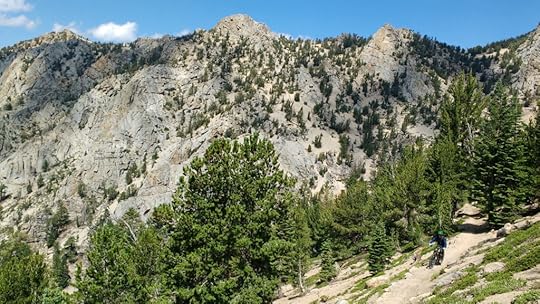
Just a sample of the trails we rode during our week in Tahoe.
This almost brings us up to date. But wait! There’s more!
My wife and I have the for-now goal of traveling to Japan every other year and we just arrived back home this week from a ten-day trip to Hokkaido. It was our first time visiting the northernmost prefecture in Japan, and it was a terrific time to do some hiking — and eating, as it turns out. Sapporo, the capital of Hokkaido, was hosting their weeks-long Autumn Festival while we were there. This proved to be a sweet surprise that helped alleviate the disappointment of Typhoon Tamil having interrupted our plans to ferry out to the tiny island of Rishiri. There’s plenty of photos along with an account of our trip right here.
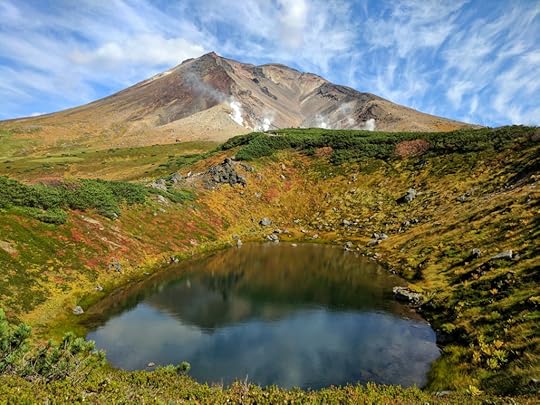
Postcard-perfect day to climb Asahi-dake, Hokkaido’s tallest mountain.
Back to Florence, By Way of London
I didn’t ignore my novel for two months, if that’s what you’re thinking. How could I? It’s in my thoughts, constantly. No, throughout most of August, I adjusted my schedule, I woke at 5am, and got a couple of hours of writing/revising done each morning before driving to Nintendo. And I even attended a few weekly critique group meetings. I had to, it’s the only way I could still hope to be done by winter.
But finally, as of Wednesday, I was back at it. Full time. I spent the afternoon revising a scene I intended to share that night with my critique group. The writing went well, and I have to admit to being somewhat pleased with a few metaphors and turns of phrase as I read the 1400 words to my critique group. But near the end of the scene, I began to feel like I may have strayed into repetition. That my protagonist was expressing the same thoughts and worries as he had at least a couple times before.
My critique partners didn’t hold back. The writing was great, but it sounded familiar. Especially one paragraph at the end. They weren’t wrong. I sensed as much as I read it. We brainstormed ideas until an ah-ha moment hit.
So yesterday I rewrote it again. It’s not a pinch-point scene, and not one of the primary plot points, but one in which I needed to show my protagonist struggling with his best-worst-choice dilemma. Rather than him mulling it over in a woe-is-me kind of way (which he’s done before), I decided to have him get angry. After all, the problem was an intrusion on what was otherwise, a very hot and romantic weekend in London with his wife.
The book is pretty clean, with no explicit sex and hardly any profanity. But damn it felt good to let my main character shout a few f-bombs in his mind. He needed to vent.
No sooner had I finished that scene than I got five chapters worth of feedback from a critique partner. Five chapters filled with the types of suggestions that are going to make the book better, the criticism I need, and the level of praise that makes me blush.
Momentum is building. The odyssey isn’t over yet, but we’re back on the road and gaining speed. Edward and Kara are fast approaching the end of their journey, as I am mine.
The post An Odyssey Away from Florence appeared first on Doug Walsh.
July 25, 2017
A Great PNWA Conference Was Had
I know it’s cliche, but what a difference a year makes! When I attended the annual PNWA (Pacific Northwest Writer’s Association) writer’s conference last summer, I did so not knowing anyone, unaware of the literary contest, and eons away from telling an agent about my book.
This go-around, I could hardly walk into a room or down a hallway without seeing a familiar face, being asked how Tailwinds Past Florence was coming, or being wished good luck in the contest. Sure, the Finalist ribbon dangling from my name badge helped with the latter, but what a treat it was to recognize so many people from last year, put Twitter profiles and personalities together, and feed off one another’s energy.
Yes, I even chatted with the woman whose car I rear-ended last summer. And yes, I even used the horribly corny line “we’ve got to stop running into one another like this,” as an ice-breaker. I then offered to abide a 50-foot buffer if she felt safer that way.
Conference Buddies
I spent much of the time between panels and pitch sessions hanging out with my outstanding critique partner Sandra. While only one member of my critique group was there all four days, along with fellow-finalist Jeff for the awards banquet on Saturday, I certainly expanded the circle of my tribe last week.
What a treat it was to drink and dine and chat with writer/presenters William Kenower, Gerri Russell, and Lindsay Schopfer; to befriend dozens of dedicated writers who, just like me, are taking the steps necessary to follow through on a dream. A lifelong one in many instances. And to collect personalized autographed copies from Christopher Vogler (The Writer’s Journey), the incredible keynote speaker, Natalie Baszile (Queen Sugar), and the eventual winner of the Nancy Pearl award, Lori Tobias (Wander).
Perhaps the biggest difference this year was that I know nearly all of the PNWA staff. And what a wonderful collection of people to volunteer alongside. I don’t know what I did to deserve the volume of support and encouragement the folks at PNWA funnel my way, but it certainly makes a guy feel welcome.
Pitch Session Intrigue
Unlike last year, my conference this time around was all about pitching. I spent the days leading up to the conference researching the agents and editors in attendance, trying to figure out which of the dozens of names would be most appropriate for me to pitch to. And, of course, perfecting my pitch.
Pitch sessions are essentially speed dating, something this husband of twenty years has no experience in. For those who are equally unfamiliar with the concept, allow me to explain. Authors funnel into a room, sixty or so at a time, and line up in front of the agents we want to pitch to next. Some twenty lines form behind a blue piece of tape. Steps ahead, the twenty corresponding agents sit behind a ballroom-length table, arm’s reach from another. Authors take their seat and launch into it, each trying to be heard over the cacophony.
Four minutes isn’t a lot of time to introduce yourself, your book, and hopefully answer and ask some questions. But it’s doable.
I attended a pitch practice session on Thursday and received both praise and some helpful advice on how to tighten my pitch and avoid a touch of confusion from my introduction. It helped.
I woke at 4 a.m. Friday morning, excited, reworking my pitch in my head.
Two o’clock came and it was on. I had seven agents and one editor that I wanted to focus on. Impossible in a single ninety-minute session. Fortunately, my early-bird registration earned me a second pitch block at four o’clock. I was nervous at first, but the agents are just people (so they say!) and it ultimately went well, a brief stumble aside.
“Here’s my card, send me the first fifty pages.”
Those are the words everyone wants to hear.
I heard some form of it seven times. The one agent to pass on account of having zero tolerance for anything magical/fantastical (my novel has a time-travel element) referred me to two members of her agency who might be interested.
In other words, I was effectively eight for eight.
Deep breath. Fist pump. Drinks are on me!
I’d be remiss if I didn’t at least mention the concerns nearly every agent had. Tailwinds Past Florence, they said, sounds very interesting. It’s original. They love the experience I bring to it, but it’s an ambitious concept for a debut author, especially since I’m dealing with multiple points-of-view and a non-linear timeline.
Fortunately, I’m quick on my feet and explained that my antagonist, Alessio, has his introductory scene in Chapter 3. Hint, hint.
“Excellent. Send the first three chapters so I can see how you handle the POV shift.”
Or some version of that. Rinse. Repeat. Just as I hoped.
And, to be perfectly honest, I love this challenge. It is a complex plot, but I do feel I’m up to it, else I wouldn’t have been pitching. I hope they agree.
And the PNWA Contest Winners Are…
After a rather triumphant Friday spent pitching agents (and an editor from St. Martin’s Press who also requested a submission), I returned on Saturday to spend the day moderating panels. My wife Kristin joined me in time for drinks and the awards banquet. Despite being allowed into the ballroom early, and provided with reserved seating, we still ended up sitting far off in the corner.
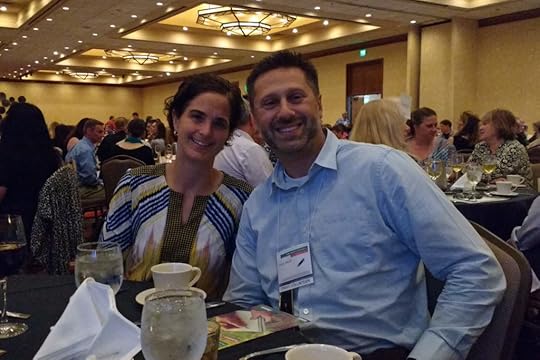
The prime seating filled in while Kristin and I spent twenty minutes chatting with one of the agents I pitched to. I didn’t mind. At all.
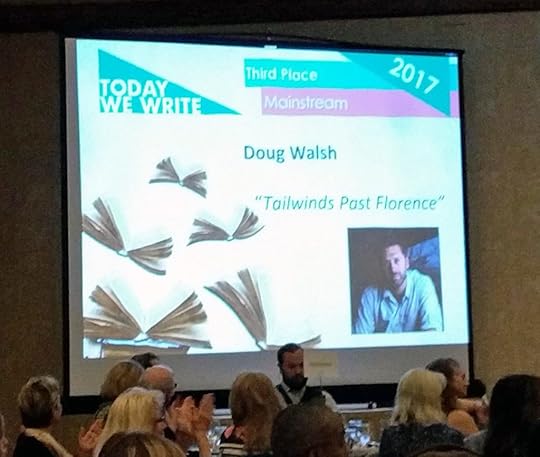
The PNWA Literary Contest, as I explained in an earlier post, had a dozen categories, each with eight finalists. The Mainstream category was first and I didn’t have long to wait to see if I was a winner.
Mine was the first name called: Third place in Mainstream.
Yes, that’s right, the novel born on the slopes of the Pyrenees has won its first award!
At this point I should probably define what the Mainstream category is. It’s a catch-all for books that don’t fit into a tidy genre (i.e. Romance, Mystery, Fantasy, etc.). It’s for books that, ultimately, blend conventions of different genres and aim for a higher quality of prose (which isn’t to say genre books aren’t well-written). Some would call it Literary. I consider it the upmarket commercial fiction that I enjoy reading. Perhaps a better explanation is to say that character development is as much, if not more important than plot.
But what a treat it was to be the very first name called. I was able to spend the entire dinner free from the stress of wondering if I was a winner, content to sit back and clap for the other names called.
After dinner, the award winners were invited along with the agents and editors to a cocktail reception in the courtyard. There I mingled over a drink and got to better know the agents I pitched to, along with others. Several more invited me to submit. Here’s my card, send me fifty pages. I’ll never tire of those words. And then the party moved upstairs, to a penthouse suite at the hotel. And two more agents who I talked with asked for those same fifty pages. One, I should mention, wasn’t even attending the pitch sessions. But when you’ve inked million-dollar contracts for your clients, you probably don’t have to.
A Reading From the WIP of Doug
Contest winners were invited to read from their entry the following morning, as one of the final sessions on the conference calendar. I was reluctant to do this, but attended anyway. I couldn’t be happier that I did.
While the room only had forty or fifty people in it, most of them finalists and prize winners, it was a real treat to stand up before a room and read the opening of my novel. But perhaps not why you think.
Each and every author who read impressed me, from Jodi Freeman, the winner of the Mainstream category to Bruce Funkhouser, the runner-up in Mystery/Thriller and so many others. I was in awe of my fellow winners and finalists. It’s easy, perhaps human nature, to doubt the caliber of company we keep when we find quick success. I know I certainly wondered exactly how good the others were if I could find myself on the stage on my very first attempt.
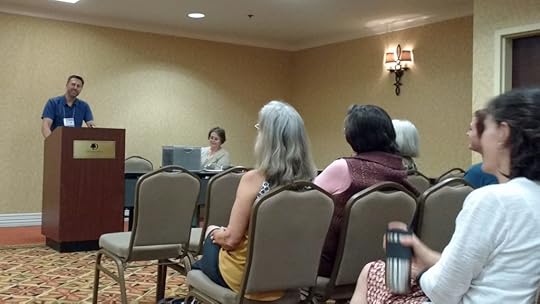
I wonder that no more. Though it was certainly a treat to have a line from my reading recited back to me after the panel ended, the real treat was simply knowing that this contest was no joke. That the people who entered — and won — were very talented, their entries polished, their writing voices clear and strong.
It was a successful conference for me, by any standard. But the one element that had me feeling as if this writing thing might truly, honestly be within my grasp, was that the contest readers and agent who judged the category saw my writing worthy of being included with the others.
If we are truly judged by the company we keep, I’m doing pretty well for myself. Because what the other winners read was nothing short of excellent. I can only hope they felt the same about mine.
The post A Great PNWA Conference Was Had appeared first on Doug Walsh.
June 11, 2017
A Contest Announcement
I interrupt my blogging hiatus to bring word that Tailwinds Past Florence has been selected as a finalist in the Pacific Northwest Writers Association’s annual Literary Contest. But wait, there’s more! This is but only a fragment of the exciting (and slightly disappointing) news I want to share with you today. So read on for a proper update about how work on my novel — and this headfirst dive into reinventing my writing career — is progressing.
PNWA Contest – Mainstream Finalist
My phone, as it so often does in the Faraday cage I call home, went straight to voicemail without ringing. This despite me sitting beside it, willing it to ring, despite carrying it with me on my morning run up Mt. Si (one of David Lynch’s Twin Peaks) and despite even taking it into the shower with me two hours earlier. I knew the contest organizers would be notifying the finalists by phone over the weekend. It was a 425 area code, local. I took a deep breath and played the message. I was one of them; one of the eight finalists in the Literary/Mainstream category.
I don’t care if I win.
No, that’s not true. At all. Of course, I hope I win. It’s the prize money I don’t care about.
The finalists in each category will now be passed along to an agent or editor attending this summer’s PNWA conference in Seattle. She (or he, but probably she) will read through the entries and determine the top three who, for several seconds during dinner, will be the envy of a room full of their peers.
The real prize comes earlier. Finalists attend the conference with a name badge marking them so. This presumably comes in handy while mingling throughout the conference and, more importantly, when pitching agents and editors during your pitch session, of which I’m signed up for two. There’s also a special cocktail reception after the dinner for agents, editors, and contest finalists. Many writers are introverts and struggle in these settings. I do not.
Of course, this has also created extra work for me. I now must add an extra sentence to the beginning of my query letter. Insert winking emoji here.
Critique Feedback
I recently sent chapters four through seven out to my pre-beta readers, the next sixty pages that has achieved the coveted green status (i.e. fourth draft) in my color-coded progress scheme. Earlier last month I received my first three chapters back from a literary consultant, care of the critique I won from an auction held by Fuse Literary. These earlier chapters had already gone through multiple revisions and achieved “blue” status. Now they’ve been revised again.
Her general comments were positive. Flattering, actually. Words like “very impressed” and “eager to read more” were used. She made two general comments in the email, then referred me to the marked-up attachment in which she did her line-editing.
Having never received line-edits from a professional literary consultant before, I was taken aback. There was just so much… ink. It seemed wrong.
I skimmed the pages quickly, feeling the wind fall from my sails. I closed my laptop and did something else. And then even more other things.
Several days later I came back to her line-edits with fresh eyes, free of the defensiveness I felt creeping into me on that initial glance. I saw that many of her suggestions were quite good. I had a tendency to slip in a touch too much description in the middle of an otherwise suspenseful moment. So I trimmed the fat. And then I trimmed some more. I also realized some of her suggestions were based on incomplete data. She’d only seen the first fifty pages. Info that may have seemed extraneous to her was really foreshadowing. But how could she know? Nobody could.
The best thing of all, however, was a comment she made about the second sentence. I had been on the fence, debating with myself whether or not to cut it. She striked it and left a footnote saying, effectively, that the opening sentence was so strong, she didn’t know why I’d want to soften it with the brief follow-up. My thoughts exactly.
Listen to those gut instincts people.
A Real Writer Now
I received my first rejection letter while I was on vacation with friends in Florida. It was in response to the fifty pages that were requested based on a Twitter pitch I had done in April. While she “loved the concept” she didn’t fall in love with the execution. And that can be for any number of reasons beyond the quality of my writing (it could also be precisely due to the quality of my writing). For example, she largely represents romance novels. The overwhelming majority of romance novels have female protagonists. Tailwinds does not. Nor is it a romance novel.
That’s fine. This entire process is so highly subjective. Finding the right agent with the right needs at the right time is harder than finding a semicolon in a Dr. Seuss book.
And that’s what has me feeling happy about the contest. Though I believed in the quality of my entry, there’s no guarantee that two people will independently judge it worthy. And all contest entries were read and scored by two people, anonymously.
A New Cover Sets Sail
I attended the monthly PNWA seminar the other night, presented by the fantastic Gerri Russell. Gerri will be giving several presentations at the conference this summer and, for one of them, she needed volunteers. Volunteers who were interested in getting a new, free, redesigned book cover.
I knocked over four tables and an old man in a walker in my effort to reach the sign-up sheet first.
The cover for One Lousy Pirate was a strict DIY effort. The chance to get a free professionally-designed cover was too good to pass up. So I filled out Gerri’s design questionnaire about what I’m looking for and her designer is going to get back to me with a couple of mock-ups. We’ll fine-tune from there. My one rule: no pirate symbolism.
The only downside to all of this is that Gerri’s presentation on the importance of cover design takes place during my pitch session. Fortunately they sell recordings of the presentations at the conference.
The post A Contest Announcement appeared first on Doug Walsh.
June 1, 2017
Post-Travel Heartache Disorder
Remember when social media first became a thing? We logged onto Facebook or Classmates and added our best friends and immediate family and then what? We looked up our old flames. It’s okay, most of us did it. Curiosity gets the better of all of us sometimes. I looked up a few. I was happy to see one married with kids, living not far from her parents; satisfied and unsurprised to see another as single and vapid as I expected; and was concerned when neither Google nor Facebook could report on a third. I hope she’s okay.
It’s important not to loiter. I didn’t pine for the old days or wonder what could have been. And I wasn’t jealous. Nor did I have the urge to go High Fidelity and seek them out, wondering what it all meant.
Then again, I’ve been in love with my wife for over half my existence without a single regret.
I’m also head-over-heels infatuated with the little corner of the world in which I live. And not just my town, but the region we proudly call Cascadia. My soul soars each day I look to the mountains ringing my town, I thrill at the bounty of recreational options that lie minutes from my front door—and the collection of cultural, creative, and culinary outlets that exist a few miles downhill to the west, in Seattle.
Yet western Washington isn’t my only geographical love.
Of Maps and GPS Tracks
I was loading a new cycling course onto my GPS recently and saw that the device’s memory was nearly full. I opened the course folder, wondering how that could be, and saw dozens of files with names like Kalamata_Mystras, Istanbul_Ephesus, and MalayPort_Singapore. The files dated from 2015, a list of start and finish locations outlining the last several thousand miles we cycled on our two year journey.
My mind traveled halfway around the world, envisioning the roads leading in and out of each town, the meals we ate, the people we talked to. It felt like a lifetime ago, something we did only in the fog of a dream seldom remembered.
I opened Google Maps and panned to the Mediterranean, zooming in on whatever was centered. The country didn’t matter to my homesick heart.
Kefalonia came into view, that sizable Greek isle off the west coast of the Peloponnese. And there was the road we took south from the ferry, beginning a mountainous circumnavigation of the island in the scorching July heat. I dragged the little orange man onto the map, depositing him atop a hill on the southern side of the island. By luck and the peculiarities of my at-times superhuman memory, I landed a few mouse clicks from a dusty bus stop we sheltered in during a midday snack break, a short walk from a convenience store where I bought several liters of water.
A flick of the mouse brought me east, to Turkey, near the city of Konya, the country’s most conservative. I paused for a moment, thinking back to the day we arrived in Konya, trying to envision the route to our hotel. I recalled the high-speed descent, my rear tire running low on air, the approaching thunderstorm, and eventually the pelting rain that had us seeking shelter at a service station.
My eyes watered at the memories.
The Little Reminders
When I really feel like depressing myself, I wonder what it would be like as a widower. I know, I know. Why would I do that to myself? Sometimes I can’t help it; the downward spiral sucks me in.
I don’t linger on the big things, the aspects of suddenly being without that would challenge my desire to go on. I know those feelings would eventually fade. Or be so ingrained in my existence I wouldn’t think of them every waking moment. They’d be normalized. Instead, I dwell on the little things, the reminders of the inside jokes we share, the peculiarities of our relationship, and the eccentricities that make her her. Those would be the hardest to suffer reminders of.
We spent a weekend at the coast last month, a chance to get away with our puppy and let her run and frolic on one of the widest, flattest, beaches in North America. We arrived late Friday night, after a four-hour drive through torrential rain and driving wind. Next to the soap and shampoo in our room was a small toiletry kit containing a bevy of items, including a small packet. It was a makeup remover towelette. Just like the ones we collected from hotels around the world, an insignificant item I never noticed in my prior years on this planet, but became something I hoarded on the road. They were perfect for cleaning greasy hands after working on the bikes.
Neither oyster shooters nor pints of local beer could brighten my mood. I hit a funk. The makeup remover reminded me of what no longer was, and how our plans for after had melted away. How our return home bore no trace of the post-trip life we envisioned.
I wondered aloud if I would be happier today having never even had those experiences. I posited that knowing precisely what we no longer could do was worse than never having done it in the first place—that ignorance, pardon the cliche, was truly bliss.
It All Leaves a Mark
Though I never spend any time thinking of the past girlfriends I looked up on Facebook several years ago, there are, of course, the occasional reminders. A particular song on the radio, for example, or a line from a movie. I smile at the memory, enjoying the moment, and carry on. No part of me wishes things were different. Yet, I also know those people and the experiences we shared helped shape who I am.
Everyone we encounter, everywhere we go, and all we see leaves its mark; a million tiny asteroids bombarding us, our imperfect slate, at all times, from all directions, indenting our being with impressions of themselves.
Sometimes the impact is painful. Other times, it’s the separation that leaves us reeling.
I’m often referencing places I’ve been on Google Maps for work on my novel. I zoom in tighter and tighter on the alleys and storefronts, panning the crowded roads of Google Street View, and I get jealous. In my imagination, the people strolling the piazzas in Florence are always there, forever traveling, immortalized by the car with the crazy camera on its roof.
These people, licking their gelato and sipping their Chianti, are where we were. Where we’re no longer. Where I wish I was.
It hurts, the constant reminders of what no longer is. Yet I stalk the cities and roads we traveled, leering from the far side of the Internet, checking on the places we’d been, jealous of those now there. As if Street View was real-time, I curse the people I see, like a scorned lover watching intertwined shadows outside an ex’s bedroom window.
And I’m left with a choice. We all are. Every one of us who has ever had and lost or loved and been hurt, we all must decide whether to risk it again.
Do we add to the memories and invite new impressions on ourselves? This, I realize, is to risk future heartache. For even the most benign objects in our life — a hotel toiletry, for example — can stir up memories that remind us of what no longer is. The more we invite into our lives, the more places we go, the more we open ourselves to future pain.
Is it worth it?
Absolutely. The future pain lets you know the past was worth living.
The post Post-Travel Heartache Disorder appeared first on Doug Walsh.
May 23, 2017
Hooked on the Nintendo Switch
Nintendo’s back.
I didn’t believe it at first. Years of hard-learned experience encased me like a Koopa shell, protecting me from their empty promises. So much dust piled atop unsupported consoles and one-trick gimmicks obscured my memories of the golden years. The Nintendo Switch is different, I was told. You just need to play it. It’s not like before.
It wasn’t that accepting the Switch hype forced a struggle against my better instincts. I wasn’t a scorned gamer wary of falling victim to the hype machine, afraid of another disappointment. It was worse than that. I had given them up for dead. Nintendo, a company that exerted gravitational forces on my childhood—my early career even—was a non-entity to me. An ex-lover across a crowded room whose silhouette stirred no emotion.
And now I’m mainlining the Kool-Aid.
On-Site, Nintendo Switch in Hand
Last month I reached out to my contacts at Prima Games to remind them that I was still interested in projects of the short-term, fire-drill variety. Assignments where I could swoop in, work myself silly for a week or two, and return to writing my novel. I instantly received an offer to work on a project that would effectively be the polar opposite of what I desired. Flattering, of course, but I couldn’t turn it down fast enough. My sanity and my marriage demanded it.
Then, a week later, the ideal situation presented itself: Spend a week on-site at Nintendo, assisting another strategy guide author.
My last visit to Nintendo’s Redmond offices was for Metroid Prime, back in 2003. That building is now an employee soccer field. It wasn’t all that has changed.
From a D-pad shaped sofa in a sparkling new building, I stared across the lobby at the Switch demo, hoping the device wouldn’t make my hands cramp the way the Wii U did and desiring nothing more than confirmation that the game in question could be played without motion controls.
It took some time, but we were finally set up. I was playing the Switch, a fantastic device whose flexibility, in case you don’t know, is remarkable. Play it on the couch, in bed, or even in a bar. See for yourself.
While impressive, the play anywhere nature of the device isn’t what hooked me. Nor was it the console’s surprisingly impressive graphics or the Pro Controller, a controller that, somehow, improved upon the near-perfect design of the Xbox 360 controller. No, what won me over is something less physical, but so much more important. It was being reminded of Nintendo’s philosophy toward game design.
What Gaming Should Be
I wrote last year about my attempt to truly give the game Skyrim a try. After fifteen hours I gave up, convinced it was little more than a mind-numbing exercise in checklist completion. There was tons to do, perhaps even a lifetime of quests and skills to master, but none of it was fun, no aspect compelling. The only reason to do anything was because I am a human susceptible to the tiny drips of dopamine released by the treadmill gaming experiences of this flavor.
A friend who shares this complaint, not only about Skyrim but the current state of gaming as a whole (fun fact: many game developers now hire psychologists trained in understanding addiction to better hook players) swore to me that the Switch was different. He explained that Nintendo had chosen to eschew Achievements, leaderboards, and other means of psychological manipulation that has bloated games and turned them more into work. He insisted I give it a try, confident I wouldn’t be disappointed.
“I’ll probably get one,” I conceded. “But Breath of the Wild is still an open-world game and it has crafting. I’m not interested,” I said, referring to the newest Legend of Zelda game, recalling the stories of people having logged over a hundred hours in the game.
“It’s not only the best Zelda, it might be the best game ever made.” High praise indeed from someone I trust.
I bought a Switch from the company store (perk of being a contractor) my second day on-site and, despite having spent ten hours playing the Switch all day for work, I stayed up until midnight that night playing Mario Kart 8 Deluxe. Despite not knowing the courses and struggling to finish in the middle of the pack in my online races, I couldn’t put it down.
Having installed-and-uninstalled over a dozen PC games in the prior few weeks, not one lasting more than thirty minutes on my hard drive. I wondered if I was through with gaming forever. Gaming, my lifetime hobby, had become pointless.
And then came Mario Kart.
I was gaming online with people from all around the world — flags decorate your profile picture in the Worldwide server — and communication was limited to a dozen or so canned emotes, the harshest of which equates to a boast that you’ll win next time. Most are saccharine. Avatars called Miis wave and dance before races and players say “Thanks for playing” before logging out. Coming from a decade of hearing every vulgar, racist, misogynistic comment a human can hurl while playing Gears of War, it was rather strange at first. The childishness of it was off-putting, the in-race silence was odd and unsettling. And then I came to love it.
Yes, in my home, I might be cursing every time a fellow racer hurled a shell at me or hit me with a lightning bolt, but at least the other players don’t have to hear me. Nor I hear them. It was more fun than playing against the A.I., but without the toxicity that plagues so many online experiences. It was the best of both worlds.
And while there are various challenges in the game like Time Trial ghosts to beat and triple star championships to win, the only carrot is your own self-satisfaction. Completing these feats affords you no digital bragging rights, no bells and whistles. These tasks exist to help you get better at the game.
Legendary Zelda
I wrapped up my project and flew to Florida that night on a red-eye. We were spending ten days at my mother-in-law’s beach house, the first five days of which were spent with friends of ours. My Switch-to(u)ting friend was in attendance and he came bearing gifts. “I can’t live in a world where Doug Walsh refuses to play Breath of the Wild,” he said, handing me a copy of the game.
I thanked him, knowing what what would happen. I’d play it for an hour or two, shrug, and put it away unfinished and forgotten.
Or so I thought.
Ten days later, after wireless Mario Kart battles between our two devices (four players, two on each Switch in tablet mode) and random Snipperclips tomfoolery, I boarded the plane with a fully-charged console. I began playing Zelda as soon as we hit cruising altitude and didn’t pause it once until the battery light flashed two and a half hours later. It’s unlike any Zelda game I’ve ever played and it’s utterly brilliant.
It’s a fresh breeze in the doldrums that is the current state of gaming.
Yes, it’s open-world, but it’s open-world done right. I’m exploring with a sense of curiosity, not the dread of obligation. The game reveals itself gradually, rewarding your thoroughness, but not overwhelming you with mindless tasks and busy work. There is crafting (cooking) but it doesn’t get in the way of the experience. The combat is fluid, the action visceral, and the story exists to guide the player, not stroke the ego of the developer.
At less than ten hours in, I know I’ve barely scratched the surface. Yet I continue to marvel at the game. My generous friend was right, it’s the perfect game for me.
About Those Golden Years…
This is going to sound ridiculously cheesy, but there’s something to playing the Switch that just makes me smile. Unlike the NES Classic which I also recently bought, the Switch is the true time machine to those halcyon days of my gaming youth. Back when I played games because they were fun, not because I was out to amass a higher Gamerscore.
Yes, there are drawbacks to the Switch. The lack of cloud saves is disturbing, the prices for games can be high (Thumper is $20 on Switch, but only $14 on Steam), and the device ships with a plastic screen instead of glass. But these are minor annoyances.
As someone working (again) in the industry, I’m also privy to certain information about upcoming games. And what excites me most about the Switch — and what tells me this won’t be like the Gamecube’s latter years or the Wii or Wii U — is that Nintendo has an incredibly ambitious plan for supporting the Switch. Even if third-party support doesn’t coalesce around the Switch, there appears to be more than enough first-party games on the way to justify the purchase.
For the first time in well over a decade, the problem won’t be finding enough games to play on a Nintendo console. The problem will be finding the time to play them all.
The post Hooked on the Nintendo Switch appeared first on Doug Walsh.
April 25, 2017
First Draft Complete
I always thought it would happen with a cigarette and a glass of champagne. I’d type THE END then lean back from my rustic, well-worn desk, ala James Caan, and soak in the satisfaction and relief of having poured everything I had into telling a story that needed to be told.
The truth is, it was nothing like Misery. For starters, I don’t smoke and I’m no fan of champagne. But even beyond those trivial discrepancies, it was not at all how I expected it. There was no Kathy Bates, just misery.
The misery of knowing that there’s still so much to do. Yes, I have a 320-page manuscript, a complete story that works. Or so I believe it does. But there’s much work to be done: the latter 200 pages are still cool in the center and this is a very labor-intensive cooking process.
I didn’t write THE END because there is so much to do. But I did print a title page. I did allow myself that one conceit.
The first draft is done. Yay!
The first draft is done. Sigh.
Workflow in Process
According to one of the many spreadsheets that I built to track my progress, I’m currently 39% complete with Tailwinds Past Florence. This assumes all stages are equal in weight and difficulty, which they’re not. The hardest part is done. The step I labored over and resisted and procrastinated against. That part is done. The blank page has been slain.
My intent when I began writing in 2016 was to not revise a single sentence until the first draft was complete. I didn’t want to chance falling into the trap of endlessly polishing a single scene before I had any idea if the story even worked. This plan went out the window once I got accepted into my wonderfully helpful critique group. My workflow split along parallel paths, two lanes if you will. One was slow, riddled with speed-bumps and tolls. The other was fast, and fun to drive. The left lane, the cruising lane, was revision. The other: my first draft.
So I altered my workflow again. With roughly twenty-five scenes left to write, I revised my approach to my first draft. I realized that what I was writing was really more like Draft 1.5. It was better than a lot of first drafts probably should be, but it was slow going. I wasn’t TK-ing anything (leaving details “to come”). I was writing emotion, dialogue, setting, description, and feeling all in that first draft. And doing so took time.
So I adapted my process. And managed to write three and sometimes four new scenes each week, all the while continuing to advance another scene each week from first draft to third, with the help of my critique group’s feedback.
And now the first draft is done. These latter scenes are more like Draft 0.9 compared to those that precede it. They’re raw. I wouldn’t let my dog read them. It’s mostly blocked out dialogue and action with little emotion or internal feeling and thought. There’s no metaphor or simile, no clever turns of phrase. But the story’s there.
And best of all, I know what I need to go back and add.
A Touch of Twitter Success
I try to spend no more than twenty minutes on Twitter each week. And when you look at it as briefly and sporadically as I do, it’s easy to miss the benefits of the platform. Fortunately, a couple weeks ago I happened to log in just as the Fuse Literary Agency posted about their critique auction benefiting the ACLU. Their dozen or so agents were each auctioning off one and two chapter critiques in exchange for a winning donation to the ACLU. I had been meaning to send a donation along anyway — they can use all the help they get these days — and this was the perfect opportunity to give more than I might have otherwise and gain a professional critique in the process. I didn’t expect to win one of the critiques, but damn if I wasn’t thrilled to do so.
So I sent off my first 44 pages two weeks ago and hope to get the critique back within the next week or two. Those chapters have been heavily revised and even been shared with beta readers, but this will be the first professional set of eyes to see them. I’m as excited for the feedback as I am nervous to hear what she has to say.
That same day on Twitter I also saw mention of a Pitchfest being hosted by The Knight Agency. Describing a 94,000-word novel in 140 characters is a skill all its own and, if I’m being honest, participating in the Pitchfest was certainly me falling victim to Resistance, but I convinced myself it would be a good experience (I can talk myself into just about anything). So, the next day, I Tweeted my pitch. And then an hour later, I revised and Tweeted a different pitch. Then again. And, finally, I did it one last time.
Edward’s bid for a new job threatens Kara’s dream of cycling around the world, pushing her into the arms of a centuries-old rival #TKA20 #MA
— Douglas Walsh (@doug_walsh75) April 5, 2017
And the head of the agency, Deidre Knight, requested my submission. Yay!
So one day of yielding to Resistance became two as I spent that evening and the following day writing and revising a query letter. Something I still need to do as I fear it still reads a tiny bit too much like my synopsis.
I probably won’t hear back (if at all) for at least another month or two, but there’s no hurry. I’ve got a lot of work to do.
61% to be exact.
The post First Draft Complete appeared first on Doug Walsh.