Doug Walsh's Blog, page 6
December 31, 2018
My Most Memorable Reads of 2018
I’d like to try something different this year. Rather than aim to identify — and then define — the best books I read this year, I’d like to instead take a few moments to discuss the ones that really wormed their way into my memory. The ones that left a mark. The books I can recall without having to look at my Goodreads profile.
They’re not necessarily the best-written, nor were they even necessarily 2018 books. Yet, of the thirty-two books I read in 2018, these are the ones I’d be most likely to recommend to anyone, regardless their reading interests. To see how I wrapped up my annual reads in the past check here and here or even here.
Presented in alphabetical order:
Hawaii by James Michener
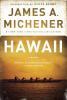 This was my first time reading a book by Michener, but it won’t be the last. Hawaii
 is an epic piece of historical fiction that reveals the history of the island chain, from the first globules of magma that bubbled out of the sea floor to the arrival of the Tahitians; and from the zealotry of the missionaries who arrived in the nineteenth century to the bombing of Pearl Harbor (the book ends shortly before statehood). Michener did an incredible job of linking centuries of events through a handful of composite characters that revealed the sentiments and prejudices of each population over the years, from those of the native Hawaiians to the New England missionaries to the Chinese immigrants to the Japanese-Americans who fought to prove their loyalty overseas during World War II.
Never Let Me Go by Kazuo Ishiguro
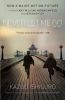 This is a haunting, disturbing yet accessible story by last year’s Nobel Prize recipient in Literature. Never Let Me Go
 follows a group of children as they grow up in an English boarding school, an institution with a very dark mystery. To say anything of why these children are there — and why they’re completely sequestered from the outside world — would be to spoil the book. But it’s impossible to look away as they age, move beyond the campus walls, and discover the truth of their existence. Unbeknownst to me until the other day, the book had been adapted into a movie starring Carey Mulligan and Keira Knightley. Though the movie did omit one of my favorite — and most touching — scenes from the book, it does a fairly good job of telling the story.
Pacific: The Ocean of the Future by Simon Winchester
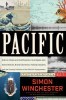 From my favorite non-fiction author comes this seemingly unrelated collection of entertaining and informative essays that combine to explain the scope and import of the largest singular entity on Earth, the Pacific Ocean. The tagline for Pacific: The Ocean of the Future
 truly says it all: Silicon chips and surfboards, coral reefs and atom bombs, brutal dictators, fading empires, and the coming collision of the world’s superpowers. What I really loved about this book is its focus on an eclectic collection of topics that don’t get the headlines (or head-space) that the obvious topics do. And while this may sound a bit dry, Winchester always does an excellent job of writing in a way that entertains as it educates. I’ve read a large number of his books and only once had I ever struggled to stay interested.
Seveneves by Neal Stephenson
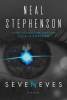 I’d say that this is the science fiction book to read for those who don’t like science fiction, but that’d be wrong. Though I don’t normally (ever) read science fiction and still found this fascinating, large portions of this 880-page door stopper are literally devoted to theoretical rocket science, engineering, and astrophysics. This may be a bit much for casual readers. That being said, Seveneves
  is a gripping story of humanity trying to hastily prolong its existence in space after the sudden break-up of the moon. In short, the Earth’s surface is only a few years from being incinerated by millions of meteorites as the moon’s fragments are pulled into the Earth’s orbit. The nations of the world — and some rather selfish politicians — aim to keep the species alive in space by sending representatives up to a massive hive colony. Stephenson splits the book, effectively leaping a millennium into the future for the final third of the book in effort to complete the story.
Tampa by Alissa Nutting
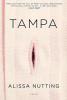 One of these books ain’t like the others. Yes, that cover is suggesting exactly what you think it is. Tampa
  is a novel inspired by the titillating, headline-grabbing (and unlawful) accounts of female teachers who court sexual relations with their male junior high students. Yes, this is provocative material. And yes, the book gets quite erotic at times. But regardless the subject matter, Tampa is ultimately a very well-written, tragic tale of a woman devastatingly afraid of getting older. The main character, Celeste, is a sociopath. No doubt. But the author provides such a unique look into Celeste’s why and how that you can’t help but feel sorry for her while also, in a way that may be hard to admit, being impressed by her tactics.
Next on My Nightstand
I finished reading After the Banquet by Yukio Mishima this weekend and the first book I’ll be reading in 2019 is Less
  by Andrew Sean Greer. I was leaving the library the other day and the cover caught my attention from the Choice Reads shelf. One look at the cover blurb left me no choice but to bring it home. As I set about scheduling my own upcoming book tour, I can only hope this doesn’t hit as close to home as I fear.
You are a failed novelist about to turn fifty. A wedding invitation arrives in the mail: your boyfriend of the past nine years is engaged to someone else. You can’t say yes–it would be too awkward. And you can’t say no–it would look like defeat. On your desk are invitations to half-baked literary events around the world. What could possibly go wrong? Thus begins an around-the-world-in-eighty-days fantasia…”
Have a great New Year everyone! As always, thank you for reading! See you in 2019.
The post My Most Memorable Reads of 2018 appeared first on Doug Walsh.


December 24, 2018
My Weekend at Portland’s BikeCraft
Without spoiling anything for those who hadn’t yet binge-watched the whole season, there’s an episode in season two of The Marvelous Mrs. Maisel , where Midge and Susie embark on their first comedy tour. Things go well, until they don’t, and Midge ends up performing before a crowd smaller than her shoe size.
Over on the series Inside Jokes , a documentary following a handful of comics hoping to land a spot at the world-famous Just For Laughs comedy festival in Montreal, they encounter the same thing. Comics take the stage inside empty clubs, paying their dues five nights a week, performing multiple sets across the city, barely earning enough to cover their cab fees. It was the same for Steve Martin
 when he was starting out. Kevin Hart
 as well.
I had plenty of time to think about the lumps these comics took as I was standing behind my table last weekend, passing the time between sales.
On the Stage Without a Spotlight
I knew right away the day wouldn’t go well. The assistant coordinating the setup for this bicycle-themed craft fair in Portland, Oregon had relegated a handful of us to the small stage, behind the popcorn vendor. The other vendors were spread out across the basement of this church-turned-community center, in prime browsing territory.
“But nobody’s going to go up there,” I said, trying to maintain a friendly demeanor. I pointed to a handful of round tables in the corner and asked if we could set up there instead, but was told the tables were for socializing. Who goes to a craft fair to socialize?
Nobody.
Resigned to the stage, I spread out my tablecloth and propped an over-sized foam replica of Tailwinds Past Florence on a small easel, stacked up some books, fanned out the bookmarks, and filled a bowl with Hershey Kisses. The doors opened to the public at noon and I activated a slideshow of photos from our bike tour, hoping to catch people’s eye with a touch of the exotic.
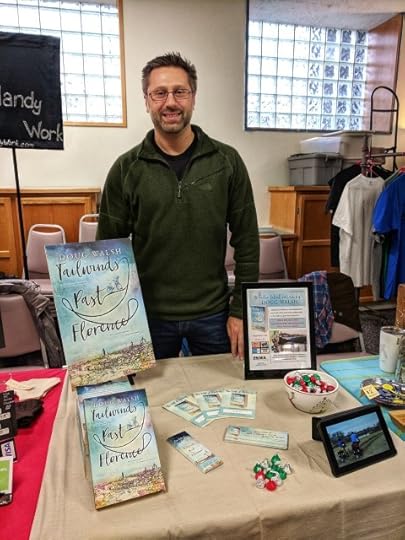
Ready to sell some books on day 2 at BikeCraft Expo, PDX.
I sold my first copy forty-five minutes into the show and breathed a sigh of relief. Later that day, someone bought a copy for every member of their book club and inquired if I’d be willing to attend their April meeting for a Q&A with the author. Portland is a three hour drive, each way.
My mind drifted to an image of Mrs. Maisel performing to an audience of four, and I handed over my business card with an invitation to email me when the time nears. I’ll consider it.
I didn’t know what to expect from the fair. With a focus on handmade, bicycle-themed crafts (think up-cycled, artisanal, crocheted seat covers) , I knew a book wouldn’t be the ideal item to hawk. Books are personal. And our tastes are often specific. We seldom buy a book without a recommendation. We’re even less likely to gift a book we hadn’t read. I sometimes walk into a bookstore, browse past thousands of covers and leave empty-handed. My three-feet of table space had but a single option, and one few had yet to hear about. It was a tough row to hoe.
The book club sale saved the day from being a disaster. And the event organizer decided late in the afternoon to reposition us for the next day. It was obvious to everyone at the show that we were getting a fraction of the traffic the other vendors were getting.
A Detour to Powell’s Books
After breakfast on Sunday morning I drove across one of the eighty-five hundred bridges in Portland to pay a visit to the incredible Powell’s Books. Occupying an entire city block in downtown Portland, Powell’s Books is a three-story vault of wonder. As when I spent the entirety of my contest winnings at the PNWA conference book sale, I couldn’t help myself in Powell’s.

I’m making a point to read more literary thrillers in 2019 as I continue work on my second novel and, as such, picked up Something in the Water and Before the Fall
 (coincidentally, I was at one point considering naming my second “Before the Fall”… emphasis on was). I also grabbed Holidays on Ice
 , Swamplandia!
 , and in an interest to learn more about my alma mater’s namesake, Lafayette in the Somewhat United States
 .
.
Thumbing through the books before heading back to BikeCraft on Sunday, I couldn’t help notice the irony of seeing Sarah Vowell (author of the 2015 Lafayette book) thank David Sedaris and Ira Glass in her acknowledgments. Then, upon flipping open 1997’s Holidays on Ice, I noticed that Sedaris dedicated his book to Ira Glass.
Talk about small worlds.
For those who aren’t familiar, Ira Glass is the long-time host of This American Life on National Public Radio and a frequent voice on many of NPR’s top shows, like All Things Considered.
Location, Location, Location
The second day at BikeCraft went much better. The five of us on the stage had been moved to the main floor, not only gaining ourselves better exposure to the shoppers, but helping to draw people further into the room toward the other vendors around us.
Interest was consistent and sales steady, which is all I could have hoped for. Rarely do authors observe someone as they go through the purchasing decision. That’s how it should be. For as great as it was to have a shopper do a double-take upon seeing the cover, dash across the room and buy a copy, it was equally painful to chat someone up about the book only to watch them walk away with a bookmark, citing the stack of books they already have unread.
But I get it. I’ve been on the other side of the table at book fairs, wanting to be polite and supportive, but knowing I really didn’t need to buy another book. I get it.
Still, it was such a joy to see people react so positively to my description of the book. I didn’t sell a ton of copies — I won’t be needing to place a second order for my launch party on January 24th — but it was worth the trip. Every book out there in the wild is one that could potentially be loaned to a friend, recommended, or wind up on the shelf in a used bookstore, waiting for the right reader to come along.
And while the steady book sales were nice, the best thing that may have come out of my attendance was an invitation to appear on the The Sprocket podcast in February, a cycling-related podcast popular in bike-crazed Portland. I hope you tune in.
Have a great week. Merry Christmas, Happy New Year, and happy reading. See you in 2019.
Upcoming Events
January 24, 2019 – Launch Party & Presentation: Compass Outdoor Adventures, North Bend, WA
February 11, 2019 – Presentation & Book Signing: Third Place Books, Lake Forest Park, WA
February 21, 2019 – The Sprocket Podcast, Portland, OR
The post My Weekend at Portland’s BikeCraft appeared first on Doug Walsh.
December 3, 2018
Remembering How to Weekend
The sun had taken aim on the trees in the distance but appeared in no hurry to dive behind them. I rolled over and hugged myself for warmth as the nylon picnic cloth did little to insulate me from the chilly autumn ground. I checked the time. I’d been asleep for an hour.
My wife, perhaps sensing my movement, stirred in her chair. Our dog looked between us and yawned as a trio of scarlet maple leaves fluttered to the ground.
“Do you need to get back?” Kristin asked, folding a book closed atop her lap.
For years, unease would have gripped me in that moment, squeezing my chest like a water balloon, sending a bubble of dread upward into my throat. I would have choked on the obstruction as my mind flooded with thoughts of the yet-unfinished chapter, the screenshots I needed to catalog, the maps I’d yet to place callouts upon. The book, which would later become my final video game strategy guide, was due to the licensor for approvals in three days. Through no fault of my own, the project had gotten behind schedule. Way behind.
But on this day, a glorious Saturday in October, my mind was elsewhere.
The Seven-Day Workweek
Save for the ten months I spent temping as a technical writer after grad school, I’ve been self-employed my entire adult life. Ever since “quitting my day job” back in the summer of 2000, I’ve been working from home as a writer.
At first, I called it freelancing because it sounded exotic. Sexy, even. Then, after graduating to a series of annual 10-book contracts (yes, you read that correctly), the term independent contractor seemed appropriate. Independent because I had no benefits, contractor because once it was up, I was unemployed. Later, after returning from two years of travel, I found myself scavenging for enough strategy guide projects a year to bridge the gap while I focused on Tailwinds Past Florence (it was fun while it lasted). In today’s parlance, I’d become part of the gig economy.
Apps and a little creativity make it possible for the ambitious (and the automated-out-of-a-job desperate) to hustle round the clock, working as independent contractors in a bevy of disparate fields. From Lyft to Fiverr to Etsy, the opportunities are numerous. My twenty-something former self would think this fantastic. The forty-something me shudders uncomfortably.
There are two persistent, yet contradictory assumptions people have about us work-from-home types. The first is that we spend our days sleeping in, playing Fortnite, and watching daytime television while pretending to be working. In pajamas. Always in pajamas.
The second common perception, and one that is eerily accurate in my case, concerns one’s ability to never not be working. This has been a problem that plagued me, well, essentially for my entire career.
There were no days off. There were simply days without a project. I used to joke that I either worked 100 hours a week or none at all. And it really wasn’t much of an exaggeration.
The time of day? The day of week? Immaterial. All that mattered was the deadline. Did I have one, or not? I wouldn’t say no to vacations or excursions but knowing what awaited me would often prohibit my enjoyment.
This is a fine way to approach one’s career for a while, but it’s not sustainable. Not over decades. Do it for too long and you come to believe you need to apologize – or suffer stress-induced angina – for spending a Saturday at the park.
Weekends are Important
“Not yet.” I said, then suggested we visit another nearby park for a walk around a lake. We later stopped for coffee and some light window shopping in the town of Enumclaw. That night, we added two more pins to our map of Washington State Parks, checking off a pair of facilities less than an hour away.
I had never thought about the concept of weekends, the necessity of them. To me, weekends were simply the days Kristin was home from work. They didn’t hold any mystique or represent a time to recharge. I worked whenever I needed to (a lot) and played whenever I could (not as much).
I had decided, perhaps subconsciously on a sunny Saturday this autumn, that this was no way to live. At the park that day, I woke from my nap with a clean mind, as free as I’d ever felt. As weird as it feels to admit this publicly, I felt like I was experiencing my first true Saturday. It was as if I had discovered how the rest of the world lives, or at least those of generations past.
For a Saturday in October, I felt like a kid again.
It’s rather ironic that it took until the waning days of my final strategy guide project to experience that. Or maybe I knew down deep inside that it didn’t matter anymore?
Work Needn’t Be a Four-Letter Word
Casual book lovers and snarky non-readers sometimes joke about the volume of Stephen King’s production, often assuming he employs an army of ghost writers like James Patterson. He doesn’t. Rather, he’s famous for saying that he makes a point of writing each and every day. Even if only for an hour. Christmas, birthdays, weekends, it doesn’t matter. He aims for two-thousand words a day, sixty-thousand a month, effectively producing the equivalent of a draft of an epic 680-page novel every three months.
That old saw about never having to work a day in your life if you love what you do may be cloyingly trite, but there’s an ounce of truth to it.
A quick glance at the spreadsheet I use to track my hours and daily wordcount shows that I logged at least an hour of “work” for 47 consecutive days in October and November, averaging 5.1 hours per day.
I wouldn’t believe it if I didn’t know the numbers to be accurate.
There were plenty of days spent working on the Darksiders 3 guide in which I definitely didn’t love my job. Quite the opposite, actually, given how buggy the game was and how little support we received from the game publisher. And I’ve experienced plenty of difficult, frustrating times while writing fiction. But I look over my worklog since finishing that guidebook – the days that I’ve been free to focus entirely on my fiction career – and I feel as if I haven’t worked a single moment. I have to say that I truly love what I’m doing.
I’m a long way from averaging two-thousand words per day, but nobody becomes King overnight.
Especially if they plan to take Saturdays off.
The post Remembering How to Weekend appeared first on Doug Walsh.
November 19, 2018
The End of an Era
We had a good run. It was inevitable. We’ve been circling the drain for years.
We lucky few who managed to build a career around the niche world of officially-licensed video game strategy guides knew it couldn’t last forever. Our days were numbered. Yet, there was still no preparing for the gut-punch inflicted on November 8th, when I learned via email that my publisher was closing.
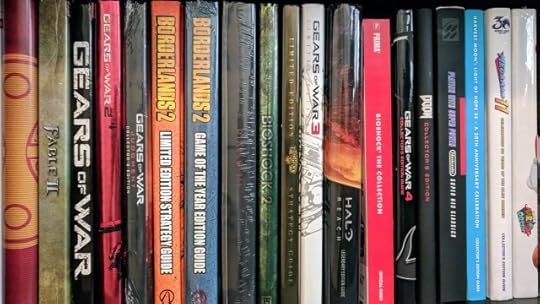
A small sample of the hundred-plus strategy guides I’d written over the years.
I posted the following to Facebook, then laid down.
Eighteen years ago, I had the chance to help co-author the strategy guide for the PlayStation game Tenchu 2. Over a hundred books later — and nearly my entire professional life — it comes to an end. We had a great run and though I can’t say we didn’t know this day was coming eventually, it still hurts. A lot. I didn’t just lose my day job, but the bulk of an industry has fallen to the passage of time. So many people worked so hard to stave off this inevitability, with countless attempts to keep the product viable in a culture dominated by the one-two punch of instant and free offered by YouTube, not to mention an evolution of game design geared toward simplistic gratification. Like film cameras and fax machines, our time had come, likely expedited by the administration’s tariffs on printed products from China.
My final strategy guide went to print two weeks ago, without me bothering to include any acknowledgments. So let me take this time to thank everyone I worked with over the years: co-authors, editors, designers, managers, and production staff. It was a hell of a ride. And best of luck to each and every one of you who tied yourselves to the mast and refused to do anything but go down with the ship.
There were so many thoughts to process. From the immediate loss of reliable income (though only a third of what it used to be), to concern for the nine-to-fivers who found themselves summarily unemployed, to a general sadness concerning the death of an industry, an entire product-class that, as both a reader and writer, has been a part of my life since I was twelve-years-old.
What Now?
My wife says not to worry. My sister points to the January release of Tailwinds Past Florence and the early praise (more about that another time) and insists this is the universe telling me, “you got this.”
Secretly, I wonder if this is a good time to learn how to make a latte. After all, there are three Starbucks within walking distance of my suburban home.
But I joke. I hope.
Two days before learning that Prima Games (formerly BradyGames, my long-time publisher) was closing, I received word that I had won an audition to ghost-write a book I’m not yet at liberty to discuss. It’s with a different imprint within the Penguin Random House family. There are some final details to sort out, and the subject’s team has to sign-off on me as the author, but the project should be a nice bridge to my life-after — and help make up for the strategy guide I was expecting to start in December.
Days Gone, indeed.
Of course, I’m not lacking for things to do. There’s the Hawaii-based novel I started earlier this year and another project I recently begun that you’ll be hearing more about this winter. I’m also spending a few hours each day making the most of the three-month run-up to the launch of my novel, digging deep into the world of book marketing, testing ads, scheduling giveaways, and booking speaking engagements and signings.
No Safety Net
When we returned home from our bike tour three years ago, the plan was for me to take a stab at writing fiction. Kristin and I created a four-year schedule that was every bit as aggressive as it was arbitrary. I’d focus my efforts on the novel that would become Tailwinds Past Florence while taking on two or three strategy guides a year. And that’s what I did.
The novel took longer to write, in part because the strategy guide projects took more of a toll on me than I expected. And also because knowing that those projects would be there gave me a sense of comfort. I lacked urgency. There was no need to burn the midnight oil, to bleed for my craft to borrow one of the many self-congratulatory phrases writers are fond of using.
That safety net is gone. It’s time to get hungry.
Shit just got real.
Update: In the interest of kicking a man when he’s down, I learned within minutes after posting this that I will NOT be authoring the ghost-written book I referred to above. The “celebrity” subject of the book decided that, though he loved my audition and thought it very creative, he wants to use an author he’s already worked with. Would have been nice to know before I auditioned.
The post The End of an Era appeared first on Doug Walsh.
November 13, 2018
Goodreads Giveaway #1
Enter to win one of 50 digital Advance Reader Copies of Tailwinds Past Florence. Because it’s on Goodreads, an Amazon site, this giveaway is technically only for Kindle readers. If you’re active on Goodreads, do me a favor and follow my author page while you’re there entering the contest. This is the first of three Goodreads Giveaways I’ll be running between now and the book’s release in January, so check back often.
.goodreadsGiveawayWidget { color: #555; font-family: georgia, serif; font-weight: normal; text-align: left; font-size: 14px;
font-style: normal; background: white; }
.goodreadsGiveawayWidget p { margin: 0 0 .5em !important; padding: 0; }
.goodreadsGiveawayWidgetEnterLink {
display: inline-block;
color: #181818;
background-color: #F6F6EE;
border: 1px solid #9D8A78;
border-radius: 3px;
font-family: "Helvetica Neue", Helvetica, Arial, sans-serif;
font-weight: bold;
text-decoration: none;
outline: none;
font-size: 13px;
padding: 8px 12px;
}
.goodreadsGiveawayWidgetEnterLink:hover {
color: #181818;
background-color: #F7F2ED;
border: 1px solid #AFAFAF;
text-decoration: none;
}
Goodreads Book Giveaway
Tailwinds Past Florence
by Doug Walsh
Giveaway ends November 26, 2018.
See the giveaway details
at Goodreads.
The post Goodreads Giveaway #1 appeared first on Doug Walsh.
November 4, 2018
Mega Man 11 Anniversary Edition – CE Guidebook Giveaway
This past August, I got called upon to help write the anniversary content for one of gaming’s most important characters. Not only does the book contain an exceptional strategy section for Mega Man 11, but the book also contains over 100 pages of art, factoids, and summaries of every Mega Man game released in the last 30 Years! Whether you’re a fan of classic Mega Man or just have a fondness for the 2D side-scrolling games of yore, this book is certainly worth owning. Enter to win one of three copies. They make excellent gifts!
I’ll be running more giveaways for books just like this, including the upcoming Darksiders 3 Strategy Guide, as well as for my novel, Tailwinds Past Florence and other items. Join the mailing list to never miss out.
The post Mega Man 11 Anniversary Edition – CE Guidebook Giveaway appeared first on Doug Walsh.
July 31, 2018
PitchWars 2018 – #BoostMyBio
Thanks for stopping by to #BoostMyBio. My name, in case you clicked the link without hovering the URL (that’s how the hackers getcha!) is Doug Walsh, and I write Mainstream fiction. Also known as the books containing a little of this and a little of that.
Think of them as brunch: really hard to describe, but quite filling.
If you stumbled upon this post, hoping it’s about baseball or saw the hashtag and figured I’m just being desperate, I’m sorry to disappoint (at least on the baseball thing).
Getting to Know Me
That’s why you’re here, right? Okay, good. Let’s keep it relevant.
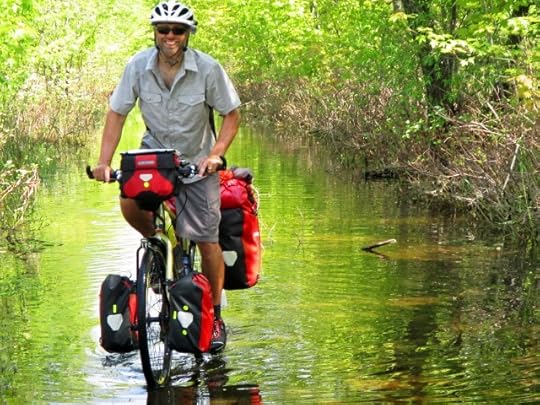
Me, somewhere in Quebec, moments after a fish swam through my wheel.
The first time I read a book for pleasure, as opposed to a school requirement, was my freshman year of high school, in Carteret, New Jersey. Go Ramblers! I had three days of in-school suspension and my mother insisted I buy a paperback to keep myself busy. So I used my paper route money to buy a copy of Stephen King’s The Dead Zone and have been hooked on reading ever since.
I suspect this is why the bulk of my stories have a thriller/suspense component. And also why, in college, I began writing a story featuring a demonic toothbrush that revealed serial killers in the mirror whenever it was being used to brush one’s teeth. Don’t ask.
I went to college in Pennsylvania, met a girl the first day of orientation, kissed her that night, married her four years later, and promptly moved to North Carolina for graduate school. Then, in 2002, we moved to Washington State. Our twenty-first wedding anniversary is coming up soon. [turns aside, “Hey Google, remind me to book a reservation for El Gaucho for our anniversary.”]
I’m drawn to stories involving twenty- and thirty-something married couples and the difficulties of syncing their wants and dreams. I hear this is a thing.
Back in 2000, after breaking my collar bone in a cycling accident, my father sent me a gift card to buy a new PlayStation game, knowing I’d be laid-up for a while. On the counter was an ad from a local guy looking for people to write video game strategy guides. My childhood dream was writing for Nintendo Power magazine, but my then-boring-ass-job was doing technical writing/illustration for a forklift manufacturer. Zip, zam, zoop… I quit my day job and built an eighteen-year career writing official videogame strategy guides for BradyGames (now, Prima Games of PRH).
Not a gamer? Then think of them as travel guides to fictitious places. I wrote eight to ten books a year for every franchise from Bioshock to Zelda, from Gears of War to Mario. My Diablo III guide spent days in Amazon’s Top 25. Not category. All books.
In 2014, my wife (yep, same one) and I left Seattle by bicycle and spent the ensuing 22 months traveling the world. In fact, we made it from Seattle to Singapore, the long way around, by bicycle and ship. No airplanes involved. For nearly two years, we cycled together, ate together, and lived out of a tent or cheap hotel room. For my 39th birthday, while in Paris, she asked what I wanted. I told her, “to not see you until dinner.” It was glorious.
I set out on that trip fully expecting to write a travel memoir about our journey. Instead, during a lengthy climb in the Pyrenees mountains, an idea popped into my head. Just like that. What if? I stopped atop the mountain pass and furiously scribbled my notes. Later that year, during a 19-day trip across the Indian Ocean by freighter, I wrote a 50,000 word outline that would become Tailwinds Past Florence.
Tailwinds Past Florence
Tailwinds Past Florence is, oh hell, ROLL THE QUERY LETTER!
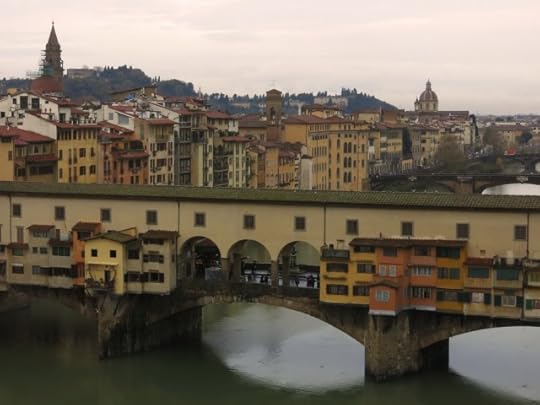
The famed Ponte Vecchio bridge, where the ish gets real in Tailwinds Past Florence.
After getting blacklisted from the venture capital industry, twenty-nine-year-old Edward Vaughan will do anything to avoid telling his wife what happened. Even if it means agreeing to her dream of bicycling around the world. Kara, tired of being married to a workaholic, was readying for a divorce. Now, she’s packing bags of a different kind. Together, they pedal away from Seattle, headed east on the open road across America, Canada, and beyond.
It’s a decision that reverberates across centuries, shattering a continuum that bound their souls throughout time, and traps Edward in a battle with a past life over an eternal love.
When a chance encounter earns him an opportunity to win a high-paying job, the temptation proves too strong for a man raised to believe his worth lay in his ability to provide. Blind to the troubles plaguing his marriage, particularly Kara’s desire for no-frills companionship, Edward shortcuts the adventure, amassing a string of lies with each mile pedaled. His ruse doesn’t just fast-forward them to Italy, but risks delivering Kara into the arms of a nineteenth-century art dealer whom fate has placed in their path.
TAILWINDS PAST FLORENCE is a contemporary love story with a magical twist, complete at 96,000 words. It combines the wonder of The Night Circus with the adventure of My Last Continent and was a prizewinner in the Mainstream category of the 2017 PNWA Literary Contest.
Why PitchWars?
Yeah, I get it. The Goodreads feed on the left shows that my most recently-read book was about self-publishing. I’ll be honest, I’m not ruling it out. We can’t afford to.
But it’s not what I want. What I want is a partner, an agent that I can build a career with. I’ve already begun work on my second novel — a more traditional (romantic) thriller set in Hawaii — and have several other ideas on deck. I’m in this for the long haul.
My hope is that with the right Pitch Wars mentor, I can staunch the flow of rejection letters, get the right eyes on the right submission, and move into the next phase. I believe in the book. Is it perfect? Is my query letter and synopsis perfect? Probably not. But I’ve taken them as far as I believe I can without the help of someone who’s gone before me.
I couldn’t get to this stage without my critique group and a small army of beta readers. I’m close. Just ninety-feet from home plate. And I’m hoping the right Pitch Wars mentor can drive me in.
I lied. There was baseball.
The post PitchWars 2018 – #BoostMyBio appeared first on Doug Walsh.
July 25, 2018
Wonderland Trail 1 – Doug 0
I drank olive brine. That is how I’ll remember my attempt at the Wonderland Trail.
Forays into the wild so often end with a gluttonous noshing of any and everything not nailed down. From pizza to pancakes to milkshakes and beer, there’s nothing quite like overindulging at a greasy spoon after long miles in the mountains. No matter the activity, whether it be backpacking, mountain biking, racing an ultramarathon, or bicycling across continents, I often remember my endeavors by the food I ate afterward. Hell, eating is why I do these things. It’d be a lie to suggest otherwise.
I arrived home Tuesday night, a day ahead of schedule, sunburned, chafed, lips cracked, and muscles sore and promptly took spoon to a tall jar of Kalamata olives. And when there were no olives left, I laid the spoon down and drank deeply. Flecks of olive and so much purple-tinted salt juice brought me back to life in a way no double-bacon cheeseburger could have.
The look of disgust on my wife’s face suggested this was not normal behavior.
Best Laid Plans
“In all my years spent handing out these permits, I’ve never seen one like this.” The ranger shook his balding head and made a clicking noise as he entered my emergency contact info into his computer. “Oh, we get a lot of people running the trail. Sometimes we catch their friends sneaking into the backcountry sites to crew for them, but you’re the first I know of to carry all their own food and gear.”
I offered a timid smile, trying not to choke on the too-large piece of adventure I was biting off.
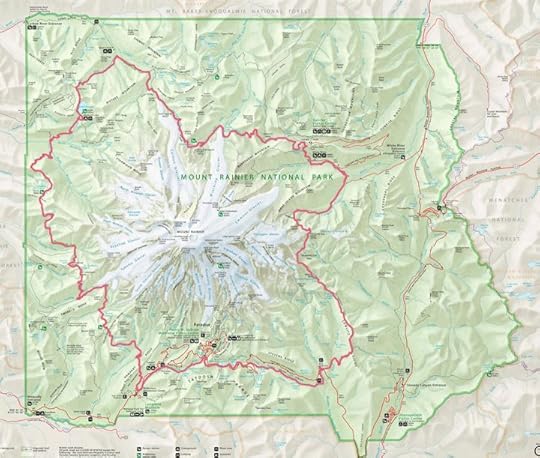
The Wonderland Trail at Mt. Rainier National Park. I began at Mowich Lake in the northwest corner and was headed counter-clockwise.
The ranger handed me my permit and looked me over, as if sizing up my chances. He made a point of letting me know where the rangers would likely be out on the trail. Told me they’d help me adjust my itinerary if I needed to shorten up my days.
There was a time when bravado and overconfidence would have led me to shrug off the comment or use it to fuel my excitement for what I was about to attempt. Not now. The Wonderland Trail, a 93-mile mountainous ribbon of singletrack encircling Mt. Rainier, climbs and descends over 23,000 feet of elevation. And though the fastest known time for a fully-supported run around the trail is a blistering 18 hours, fifty-two minutes, most people hike the trail in 7 to 10 days.
What the ranger hadn’t mentioned — which needed no explanation — is that once you start, there’s very few options for bailing out. Oh, you could access a road at either of the two visitor centers the trail passes (Longmire and Sunrise), but finding a ride back to your entry point won’t be easy. Especially if you’re starting at Mowich Lake, like I was.
Sixteen miles up a washboard gravel road, Mowich Lake is a 2.5 hour drive from Longmire to the south or Sunrise to the east. Hell, as far far as drive time is concerned, my house is actually closer than either of the visitor centers within the park. And I don’t even live in the same county.
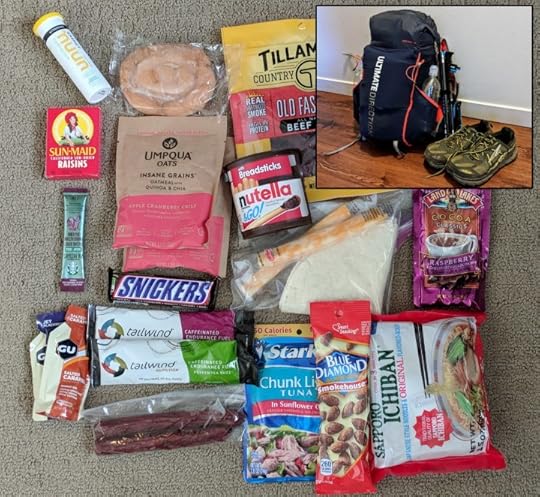
My first day’s worth of food. 3900 calories. Backpack weighed 12.2 lbs w/gear, but gained an additional 12 lbs of food & water.
My permitted plan (not exactly what I requested, but so it goes with a permit-by-lottery) was to “fastpack” the route as follows (numbers based on Guthook stats). Day 1: Mowich Lake to Cougar Rock Campground (35 miles, 9000′), Day 2: Cougar Rock to Sunrise Walk-In (33 miles, 10,500′), Day 3: Sunrise Walk-In to Mowich Lake via Spray Park alternate (22 miles, 6000′).
I exited the ranger station at Carbon River with my permit and made the long drive around to Mowich Lake, already thinking ahead to Day 2 options. As far as I was concerned, there was no reason to subject myself to an additional two-thousand foot climb at the end of the day, when I could likely camp at the front-country White River Campground and leave the climb to Sunrise for the following morning.
Had it not been for my Exped inflatable pillow blowing a seam that even five pieces of Tenacious Tape couldn’t repair, I’d like to think I would have slept soundly on that thought.
A Wonderland of Visual Delight
I rose with the sun and was on the trail before 7 o’clock. In hindsight, I should have left earlier.
My goal was to run the descents and flats and to maintain a twenty-minute per mile average overall, taking into account time spent filtering water, eating, and taking photos. This way, I figured, I’d be able to limit my day to 11 hours or so. The plan was working well, as I had knocked out 15 miles by noon. I sat perched above the raging North Puyallup River (pew-al-up), squeezing the glacial water through my Sawyer Mini filter into three 20oz bottles for my third time that day. A lunch of tortillas with salami and cheese, washed down with Ginger Lemonade Nuun made for a restorative break along the thundering river.
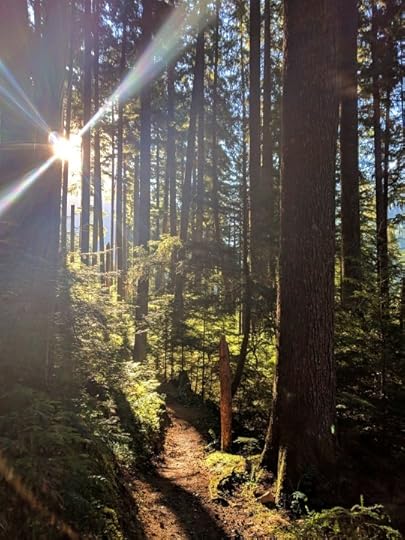
Morning light descending from Mowich Lake.
Though I had passed a number of clockwise-bound hikers earlier in the day, it had been hours since seeing someone. I was alone in nature’s splendor, had witnessed the low morning light glint through the trees, watched innumerable snakes slither out of my path, and crossed streams and meadows. Mt. Rainier, the park’s namesake volcano, stood tall beneath the bluebird sky, its permanent (so we hope) glacial cap, reflecting the sun’s glare, flaring in my camera lens. Log bridges, picturesque waterfalls, flower-gilded meadows and more await the visitor in this backcountry paradise.
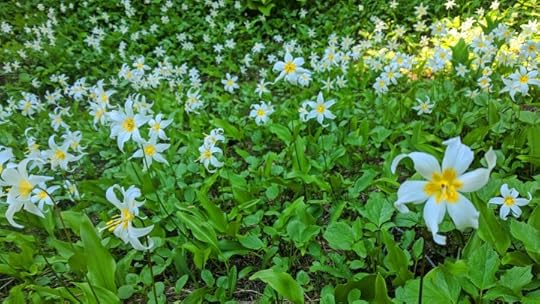
Wildflowers were a constant companion.
A hiker sunbathing by Klapatche Park told of a bear that lumbered across the nearby hillside just forty minutes prior to my arrival. I photographed the myriad tadpoles swimming in the pond, then scooped up another two liters of water to filter. Tadpoles or not, I would have drank anything after the grunt of a climb up from the river. Sadly, that was the last of the wildlife I’d see.
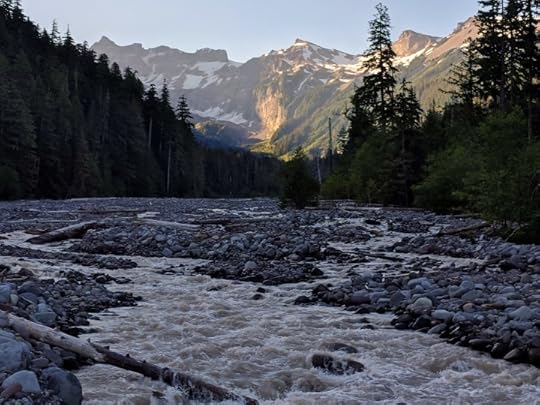
The wide gravel bars of the Mowich River.
The Sun is Not Your Friend
It was midday and the heat had begun to take its toll. Yet, I was in great spirits, thrilled to be out there, finally doing the Wonderland Trail. Twenty years since first reading about it in Backpacker magazine, sixteen years spent living within sight of the volcano. My pace slowed as I left Klapatche Park, but only briefly, as around the bend, less than a mile away, lie one of the most photogenic spots along the western side of the Wonderland Trail: St Andrews Lake.
I should have gone for a swim. I should have done more than take a photo and dunk my hat in the water, but I kept moving. The climb to Klapatche Park had put me my off my pace and I still had at least 16 miles to go.
I ran the descent to the South Puyallup River, feeling pretty good, listening to podcasts, brainstorming my next novel, but I couldn’t slake my thirst. I had drank my water bottles dry four times already — over 240 ounces — but was growing weary of the time spent filtering water. Worse, I realized I had no appetite. I got plenty of calories from Tailwinds, a light calorie drink mix, but solid food held no appeal. Fortunately, I had several Gu along for the run, for just such an occasion.
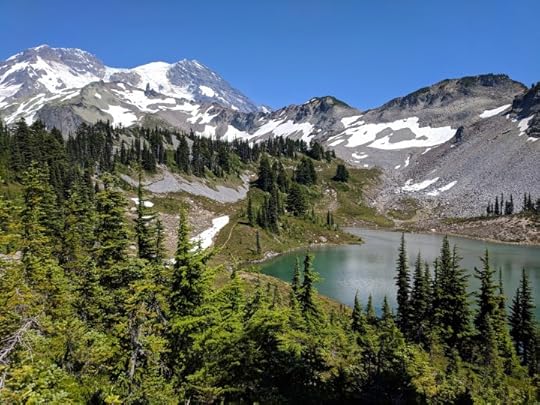
The beautiful St Andrews Lake and Mt. Rainier.
I was a mile into the climb up to Emerald Ridge when I began to feel lightheaded. My heartrate was up, my energy down, and I found myself stopping to lean on my hiking poles every ten steps. The heat grew heavy on my head and back. I vomited off the trail.
Thinking it just a one-off, I pushed on. Walk. Rest. Walk. Sit down. Another half-mile up the hillside trail, in direct sun and over 90-degree heat. I’d been going for over nine hours straight and was nowhere near done. For even after Emerald Ridge, I still had one more major climb to tackle. I had to consider my options.
A fourth day seemed inevitable. I’d find a way to notify my wife, someone with access to a land line could help. Yes, that’s it. A fourth day. No problem. I knew the itinerary was going to be hard. Just be flexible. Be smart, I told myself.
The trail had a small washout, a bit of erosion barely worth mentioning. Yet in my sunbaked state, I hesitated going around it. My legs wobbled and I felt I might fall. I didn’t trust myself. But I made it around the washout. And around another one shortly further up the trail. And then I vomited again.
There was a time in my life when I would have ignored these signs and kept going, trusting my youthfulness and superior fitness to bring me through. For better or worse, I’m fully aware I no longer possess either of those attributes. Nor the desire to test my certainty.
I checked the map. The next wilderness campsite was over six miles ahead, atop the final climb of the day. And then what? Even if I could make it, which no longer seemed certain, what would it get me other than further from my car? No, a fourth day wasn’t going to be enough. I had to get out of the sun. I had to get to water, of which I was reasonably sure there was none atop Emerald Ridge.
I shivered despite the heat and knew I had to turn back. Immediately. The South Puyallup wilderness campsite was 1.5 miles below me. I turned around, abandoning a completion of the Wonderland Trail in favor of safety, of avoiding heat stroke.
An Unplanned Out-and-Back Hike
Near the bottom of the climb, I passed three hikers who had just left the campsite to get water. They said the campsite was full, but there was room near one of their tents for another. Upon seeing how depleted I was, one of them offered to fill my hydration reservoir for me. She brought me a fresh two liters of water twenty minutes later. And not an hour after that, I was back on the trail getting myself another fresh two liters, having already drank what she brought.
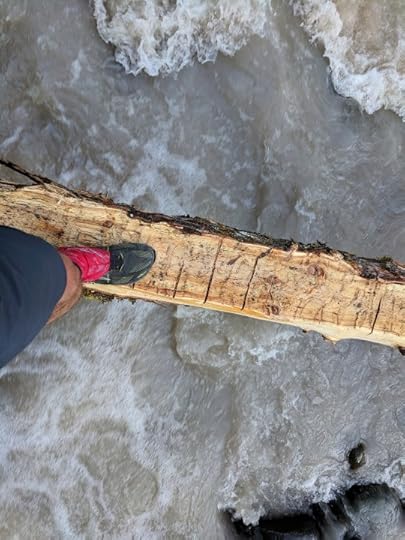
Not every bridge over the Mowich River had a handhold.
My heart rate finally returned to normal after I got washed and had a dinner of instant ramen. I drank over 12 liters of water that day and went to bed thirsty.
Come morning, I slept in, figuring that I’d hike twelve miles back to Golden Lakes, camp the night there, and wrap up the final ten miles on Wednesday. But the second day brought with it a gentle breeze and slightly cooler temperatures and though the final 2000-foot climb to Mowich Lake certainly took its toll, I made it back to my car in just over nine hours, without running a step.
I promptly sat down in the frigid waters of Mowich Lake, relieved and satisfied with my unplanned 45-mile out-and-back hike. Not disappointed. Every outing teaches us about ourselves. Every time we challenge ourselves, we learn a little more about who we are as a person. As I sat in the lake, embracing the cold on my legs, scratching at the mosquito bites that pimpled my arms, I realized something about myself I hadn’t before known.
I really hate summer. And the sun can go to hell.
*This opinion subject to change come November.
The post Wonderland Trail 1 – Doug 0 appeared first on Doug Walsh.
May 15, 2018
10 Travel Tips for Better Fiction
For me, travel is every bit as important to my writing process as outlining and revision. For novels set in real-world locations, I consider it indispensable. While much can be gleamed from Wikipedia and Google Maps, not to mention travel guides, there’s no substitute for spending time in a given setting. Especially if you aim to go beyond the obvious, unearth the subtleties, and bring the setting to life on the page. This article contains a number of travel trips gleamed from my own recent research trip.
The quality of description and sense of place has been a constant source of praise for my first novel, Tailwinds Past Florence. No doubt due to the abundance of time I spent in each of the locations featured in the book. As I begun work on my second novel, a story I conceived over ten years ago, I knew the setting was going to be every bit as important as the antagonist and plot. To do it well, to write a story I’d want to read, I’d have to return to where I first dreamed up the idea. That meant a trip to Hawaii…
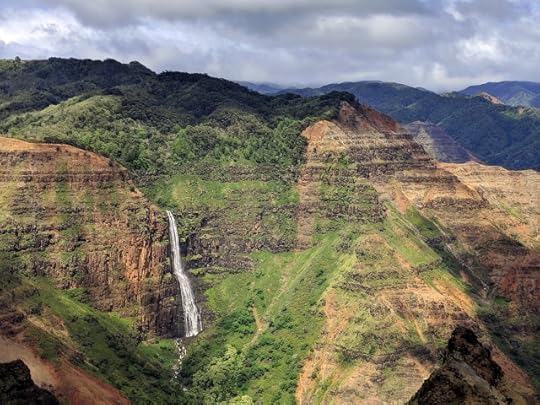
Waimea Canyon, Kauai
Travel Tips for A Working Holiday
Whether your story takes place around the corner or across the sea, it pays to visit it in person. While I admit that it isn’t entirely necessary, I’m a firm believer in the value it brings. Ultimately, it can’t hurt. But the only way it’s guaranteed to help is if you strive to make full use of your time, break free of the tourist rut, and go beyond your comfort zone. Here are a handful of tips to show you how.
1) Start Smart
I talk to writers all the time who say they don’t have time to read. Lucky for them, travel often has a wonderful amount of downtime to take advantage of. This could mean working out your itinerary, reading travel guides, practicing some key phrases in the local language, or even simply reading. I decided to use my flights to and from Hawaii to read Neal Stephenson’s scifi epic, Seveneves. Well outside my preferred genres, I was pleasantly surprised to see how well Stephenson handled female characters working in traditionally male-dominated fields, without being patronizing. He did a wonderful job handling the nuances of their situation without ever being obvious and you can be sure I highlighted numerous passages in which he masterfully revealed a character’s internal thoughts through body language and ever-so-subtle dialogue cues.
I also finished reading Norwegian Wood by Haruki Murakami during the flight. With only 80 pages left in the paperback, I was tempted to leave it home, but I’m so glad I didn’t. Norwegian Wood helped me see the kind of scene that was missing from the end of my own work in progress. I’m so glad I brought it along, as solving this problem on my WIP helped me clear my mind for the task at hand. It’s important to be focused on solely on the project that the trip is related to, don’t bring any mental baggage!
2) Shop Local… Bookstores
Sure, you can probably get it cheaper on Amazon. But it can be hard to know what you’re looking for unless you’re in an actual store, browsing real books on a physical shelf. During the eight days I spent in the islands, I made a point of entering every bookstore I happened upon — and even seeking out a couple on Google Maps. I spoke with the employees about relevant topics (never telling them why I was there) and always made a point of asking for any recommendations on books set in location X. Lucky for me, nobody could name a novel set in my chosen location. And they were all surprised by this, now that you mention it.
I ended up buying two reference books that I might not even use.Then again, you never know when one of your characters may need a clever anecdote or piece of knowledge.
3) Take a Hike
Find a park near your setting and take a walk. Let your mind wander as you soak up the smells and sounds of the area. Listen to the conversations you hear as you try to piece the events of your story together in your mind or while you sound out the working title of your story. Pay attention to how people are dressed, the animals you see, and how people greet each other. If at all.
During a short 3-mile hike to a lighthouse, I not only worked out a few plot connections that were troubling me, but came up with two new scene ideas based on what I saw. I also got a few ideas for a potential title. Sure, the scenes might get cut, and the title will likely change, but all new ideas are welcome at this stage of the process.
4) Don’t be an Introvert
Writers love to brag on Twitter about their reclusive ways. Coffee mugs celebrate the lonely, introverted lifestyle of the author. This is something I’ll never understand and would strongly recommend against. No matter how uncomfortable it may be for you, go out and talk to people. Sit down next to someone at the bar and strike up a conversation.
Not only can you end up getting some unexpected source material for your book — one of the most shocking conversations in Tailwinds Past Florence was reproduced, practically verbatim, from a chance encounter I had — but you might even open some unexpected doors. I got to talking to a couple seated beside me at a restaurant bar and, not ten minutes later, had an invitation to attend their house-warming party the next night. Better still, the woman’s brother-in-law just so happens to be the president of a well-known literary agency in New York. She repeatedly offered to introduce me. Seriously.
5) Go Solo
Which brings me to my next tip. It’s important to do this kind of trip on your own. Had my wife have been with me, there would have only been one vacant seat left at the bar, the couple wouldn’t have sat down, and I wouldn’t have been invited to the party. Or been introduced to the agent brother-in-law (not that I really expect much to come from it, bus still).
Yes, traveling solo can be lonely at times, but you need to get over it. People are far more likely to approach solo travelers than those traveling in a group or as a couple. There is a certain sympathy people feel for those left alone and solo travelers are often the recipients of generosity and invitations that groups never experience. Also, remember, your job is to be observant. It’s hard to do that while entertaining a companion.
6) Stay Where Your Characters Live
Chances are, your characters aren’t holed up in the Marriott. Fortunately, thanks to Couch Surfing, AirBNB, and CraigsList, among other sites, there’s no shortage of opportunities for you to “go local.” Seek out the neighborhood you think your character might have lived in or been from, and look for shared-space accommodations. Though having an entire house to yourself is nice, it’s even better to take a room in someone else’s home or condo so you can see how locals really live. If you’re lucky, you might even get to share a meal or two, get a tour, or hear the local gossip.
When a natural disaster forced me to change my plans last-minute, I turned to AirBNB and found a studio apartment inside a 6-unit house. The listing advertised that it was mainly twenty- and thirty-somethings who lived there. Primarily artist-athlete types. “Very 420 friendly,” the ad said. It was a little gross, a lot noisy, and not very comfortable. But it was also exactly the type of place some of my characters would have lived in.
7) Hire a Guide
Many cities have free walking tours, which can be helpful for getting the lay of the land when you first arrive. Beyond that, you should consider hiring a private guide for a few hours or a full day. Tell them what you’re interested in — but avoid admitting that you’re researching a novel, as locals may get a bit protective and paint you a picture divorced from reality.
When possible, try to broach topics of interest to your plot or setting. Steer the conversation to any historical warts that are relevant to your book and see how the guide responds. In a private conversation, without danger of being streamed on Facebook Live, the guide may let down their guard and reveal a glimpse of what everyday citizens think. Of course, it’s still only one person’s opinion, which could be an outlier. Don’t take what you hear as gospel. Instead, use the comments you hear as a springboard from which to launch a new direction of your research.
8) Visit the Grocery Stores
You can learn a lot about a place — and its people — by browsing the grocery stores in an area. Check the prices, browse the produce, and pay close attention to the prepared foods in the deli case to get a feel for what busy, everyday people are eating. Not only will this help you understand your characters better, but you may even enhance your own trip and gain an appreciation for some new foods. You’ll also learn to separate stereotype from reality.
For example, my wife and I spent two months in Italy, cycling from Livorno, in Tuscany, all the way to the heel of the boot, in the Salento region. Only once did I ever encounter lasagna on a menu, despite eating out at least once a day, and it just so happened to be in a tourist restaurant (often the only restaurants open before 8pm in Italy). Similarly, I know pizza is often bought by the centimeter (inch?) and cut by scissors from a massive sheet in small alimentari throughout Abruzzo.
9) Get up Early
You’re here to work. Unless you happen to be imbibing with a bunch of locals (not other tourists!), head to bed early. Get up even earlier, and get to work. Take notes, read, make a list of scene ideas in the morning before you head out for breakfast.
I’ve found the first two hours of the day, particularly when I’m in a hotel or guesthouse, to be well-suited for taking care of those tasks that I can’t ever seem to find time for when I’m home. Like sorting my Dropbox folder or browser bookmarks, transcribing notes from a notebook, or building a custom template in Scrivener. Better still, allow yourself the freedom to hammer out a few scene ideas in a stream-of-consciousness style. Type as fast as you can, don’t second-guess anything, and just keep going.
10) Road Trip
Rent a car and hit the road. Listen to Public Radio as you go (provided you can understand the language) and bring a map and camera. Take photos of any signage or zoomed in on the map whenever you stop so you can remember where the photos were taken (if not geo-tagging your photos with your phone) and seek out the mundane details as well as the scenery. Historical sites and others of note often have signs explaining the significance of something. Photograph the signs as a quick form of note-taking.
Dive into the towns and neighborhood where you want to set your story and walk the streets as your characters would. Even if you only have a vague idea of the plot, try to see through the eyes of your character, pay attention to the smells and sounds, and look for the obstacles that may stand in their way. Pay extra attention to the pedestrian traffic and the rhythms of the day.
Travel Takes Practice
Vacations are easy. Travel takes effort. And to travel as a form of on-site research is even trickier. Fortunately, the more you do it, the easier it becomes. But it’s important to note that you’re not a Hollywood location scout. You’re not simply looking for a place to stage a scene or shoot some B-roll to play during the opening credits.
The more you understand about your novel and the characters you intend to populate it with, the more productive your trip will be. You don’t need to know everything about your story before you go — and it’s okay to travel simply for inspiration — but I do recommend arming yourself with a specific set of questions you want answered. Consider your trip an interview with the land, the answers provided in the form of sights and scents and silent observations. These details may only net a few sentences in your novel, but if done well, it can help elevate your descriptions beyond the obvious, and signal to the reader exactly how important the setting is, and that the story is the work of an author who cared to make the details authentic.
The post 10 Travel Tips for Better Fiction appeared first on Doug Walsh.
April 26, 2018
When ‘In Media Res’ Overshoots the Mark
I wrote the opening chapter of my novel two years ago. I wrote a completely new beginning over the last ten days. The original wasn’t bad — it’s now being modified to become Chapter 2 — but in effort to start in media res, I started too in the midst of things.
Tailwinds Past Florence is, at its core, a relationship story with a magical twist set against the backdrop of an around-the-world bicycle tour.
Where should it begin?
Back where Kara and Edward first met? When the tour gets proposed? During the event that triggers the decision to actually take the trip? Maybe while packing? Or perhaps five hundred miles down the road, outside the town of Whitefish, Montana?
If that last option seems too oddly specific to be mere suggestion, it is. It’s what I went with. And it wasn’t until I compiled 793 in-line comments from my beta readers and two full-page rejection letters from helpful agents* that I realized I needed to back that train up. To be clear, not a single comment prescribed the fix I chose. Nor did more than one or two even suggest that I opened the story too far down the tracks. But while distilling the feedback I received, and infusing it with my own sneaking suspicions, the fix became clear.
Don’t Throw Out all the Rules
Writers, particularly first-time novelists like myself, can’t escape the litany of rules and bromides that get repeated from all corners. Show don’t tell. Don’t use semicolons. No adverbs! Only three exclamation points!!! Dialogue should be like a tennis match. Conflict, conflict, conflict.
Much of it is terrific advice and worth remembering. Some… shrug.
One rule, nay commandment, is that a story should start with a hook and make the reader ask questions. There should be an inciting incident within the first few pages.
The original opening to TPF had a hook, but no barb. The inciting incident — the true inciting incident — happened 40 days earlier. It was revealed through dialogue in Chapter 4.
I knew exactly what I was doing when I structured the story this way. I seldom read genre fiction — TPF is either ‘upmarket mainstream’ or ‘downmarket literary,’ take your pick — and I’m not averse to slow openings (I’m currently reading Norwegian Wood by Haruki Marukami, need I say more). Nor do I mind a story that smolders rather than erupts in a bonfire, so long as the writing is good. So I tried it this way, hoping enough hints, flashbacks, and simmering internal tension would keep things interesting.
It was worth a shot.
Set the Right Expectations
There were other things wrong with TPF.
I began to suspect one problem upon receiving my tenth rejection letter, a “Dear Author” form response. It was confirmed by a beta reader. Of the 352 pages that comprised the novel, the opening scenes were the most focused on bicycle touring. I even used the word derailleur. While certainly catnip for the sizable population of bicycle tourists (among the fastest growing forms of recreation in the world), I shudder to think how many agents I alienated, giving them the false impression that the book was a thinly-masqueraded travelogue.
Facepalm.
More problems existed. There was no concrete evidence of the magical elements until Chapter 3. There were no scenes from Kara’s point-of-view until Chapter 5 — most agents only request three chapters when querying. A touch of conflict I wrote into the opening chapters for the sake of the 2017 PNWA Literary Contest (it worked, I placed third in Mainstream) wasn’t discussed throughout the rest of the book. What was supposed to be a magical geographical/proximity issue confused beta readers and left them wondering about “the toe thing” throughout the entirety of the novel. Oops.
Do the Work
Fortunately, I know my story well enough (including the lives of my characters before the novel even begins) to know what the solution was. That doesn’t mean it was easy to write.
In the parlance of my critique group, I vomit-drafted an entirely new opening scene last Monday. Yes, I thought, this will work. Tuesday came and I spent three hours crafting the first two sentences. Wednesday arrived and I spent three hours struggling to link those two opening sentences with freshly written third and fourth paragraphs. I took the dog for a walk, ate lunch, played some Nintendo, then went back at it. An hour later, I was physically ill from my inability to bridge that gap.
A change of scenery, a pending critique session, and a twenty-ounce Americano, black, helped me produce something worth sharing later that night. It was a good start. Better ideas came during a ten-mile run on Sunday. More days were spent writing. Then, last night, I read again: a completely new Chapter 1.
The inciting incident is on the page. Kara got four-hundred words from her POV. We see them as a couple before the trip. And the magical element comes rushing in at the end of the chapter, a big fat barb on the end of a shark-sized gaff. Not gonna lie, I think it’s some of the best writing I’ve done.
As it should be. It’s the first thing anyone will read, after all.
*I must admit that it was foolish of me to have begun querying agents when I did — before getting feedback from beta-readers — but I’m indebted to the two agents who took the time to offer equal parts praise and constructive criticism. Their comments helped me see the way out of the bind I had written myself into. Though my book wasn’t right for them, I truly enjoyed corresponding with Eric Myers and Chad Luibl and appreciate the time they took in providing feedback.
The post When ‘In Media Res’ Overshoots the Mark appeared first on Doug Walsh.