Doug Walsh's Blog, page 14
February 8, 2016
Lots of New Readers! Welcome!
Sure hope they enjoy it! And, if you're one of the new readers, please do consider rating it when you're done. Good, bad, or otherwise. I appreciate the feedback.


February 5, 2016
5 Link Fridays
Now that we’re officially into February I’m trying to clean out my folder of any remaining “best of 2015” type articles. Your welcome. This week’s list has a couple of book recommendation lists, one featuring books set in the American west, another featuring the best of women’s writing over the last 5 years. Those of you thinking of attending a writer’s conference or book festival will be happy to see a list of (most of) the world’s conferences all in one place. My wife and I are going to be doing some snowshoeing this weekend and, of course, watching the Super Bowl. Hope you all enjoy a great couple of days. See you back here on Tuesday with a post about an option for an unorthodox writer’s retreat.
Bookish Links
10 Best Books Set in the American West – …according to Callan Wink. I hadn’t read any of these ten, but a couple of them have been on my to-read list for a long while, particularly Desert Solitaire. I’m actually surprised I was allowed to graduate with a geology degree (and attend field camp in the southwest) without this having been made mandatory reading.
All the Covers of Perfect Days from Around the World – It was always common in video games for companies to release different box art for the Japanese version of the game and the Western release. This Instagram slideshow shows just how much book covers can vary between countries. Raphael Montes’ Perfect Days cover art was altered to specifically appeal to readers in a bevy of different nations, often giving a completely different vibe. Marketing at work.
Holy Braille: Scientists Developing Kindle-Style Tablet for the Blind – The University of Michigan is developing a pneumatic Braille device that would use air or liquid to inflate a series of tactile bubbles that would be able to convert a page of text into Braille. No word on if this will ever go into production, but they believe it will be far cheaper than the current 1-line only digital options which cost in excess of $5,000 USD.
21 Books from the Last 5 Years that Every Woman Should Read – Another list of book recommendations, this one geared towards the fairer sex. I hadn’t read any of these either, other than to page through Bossypants in the airport on several occasions. Mental Note: Read Bossypants. The writer of the article at Huffington Post claims these suggestions represent some of the finest writing by women authors and that this selection contains “some of the most-discussed, thought-provoking and life-changing books” by women in the past 5 years. High praise!
Writer’s Conferences, Festivals, and Book Fairs in 2016 – I’m pretty disappointed that the three-day writer’s festival on Whidbey Island has become a series of monthly day-long workshops and that Washington is otherwise lacking in writer’s conferences (aside from a SFF con in March). Nevertheless, this list has dozens and dozens of conferences and festivals scheduled for all around the world, including one or two virtual conferences you can attend from home.
Bonus Link!
The Top Cameras and Brands on Flickr – This interesting article takes a dive into the camera data of all of the photos uploaded to Flickr in 2015 to see what are the most common cameras being used. Hint: it’s a phone. But more than that, the article looks at camera brands, models, and the pairs of cameras that people often use. Included are trends of camera brands on Flickr over the last five years. You don’t have to be an avid photographer to guess what that graph looks like as it relates to Canon, Nikon, Samsung, and Apple: Apple is eating Canon’s bento box.
Post Image by Fan D, used under Creative Commons
The post 5 Link Fridays appeared first on Doug Walsh.
February 2, 2016
A Year in First Sentences, Non-Fiction Edition
I can’t promise my Fiction/Non-Fiction split will always be as equal as it was in 2014 (13 fiction to 11 non-fiction, with On the Road being shifted to the former) but I do like to try. I find well-told narrative non-fiction (you’re unlikely to find me embracing the term “creative non-fiction”) to be every bit as enjoyable as the most far-fetched fictional stories owing to the old adage that truth is, sometimes, stranger than fiction. Here you’ll find a number of travel memoirs, some excellent, some decidedly less-so, and also several tales of endurance and high adventure.
The purpose of this exercise isn’t to serve as a quiz about one’s book knowledge or to try and decipher a secret meaning behind these sentences. My entire goal in doing this is to help educate myself in the art of crafting a tremendous opening. I’m taking a closer look at the first sentences from books that wound their way into my hands, to better understand what made them tick. To see which, if any, of the who, what, where, when, why and how questions the author targeted in order to hook the reader’s interest right from the start, before they know how the story turns out.
This post is a continuation from last week’s post, which covered the fiction books I read in 2014.
14) Ada Blackjack: A True Story of Survival in the Arctic by Jennifer Niven (2003)
In September 1923, a diminutive twenty five-year-old Eskimo woman named Ada Blackjack emerged as the heroic survivor of an ambitious polar expedition.
Now I’m betting that if you haven’t heard of Ada Blackjack before, you probably just added this to your reading list. And that’s the power of a strong opening sentence! Even one as straightforward as this. Non-fiction books, of which I read a fair number, tend to eschew catchy dialogue or flowery descriptions in favor of a plays-it-straight thesis statement that lets you know right away what the book is about. Just look at that sentence. Lots of information there, but it still manages to pack three purposeful adjectives into it to really make you feel like you’re about to learn something remarkable. Diminutive Eskimo woman, heroic survivor, ambitious polar expedition. Take my money!
15) Walking the Gobi: A 1,600 Mile Trek Across the Desert of Hope and Despair by Helen Thayer (2007)
I first learned of Mongolia at age thirteen during a lecture by our teacher, Miss Carpenter, at Pukekohe High School in New Zealand, the country where I was born.
This book, a first-person account of a monumental feat of endurance and suffering, starts out with, in my estimation, a heavy reliance on the title and the author’s world class resume. Instead of spelling out what the book is about, the author begins a lengthy introduction by letting us know just how long she’s been interested in Mongolia. Several paragraphs in, you get to the real hook: Her desire to explore Mongolia has been simmering for fifty years. While I can certainly understand her not wanting to put her age front-and-center and rather tease it out in this manner, it could have added some oomph to a rather dry opening line. After all, knowing that this first-of-its-kind expedition was not only completed, but by a woman over 60 years old (alongside her even older husband), makes it all the more interesting — and inspiring.
16) Marco Polo Didn’t Go There: Stories and Revelations from One Decade as a Postmodern Travel Writer by Rolf Potts (2008)
The title of this book is not my own creation: It is a direct quote from an inmate I met at Bangkok’s women’s prison in January of 1999.
I absolutely love this opening sentence. Who among us, travel writers particularly, doesn’t wish to have an anecdote as juicy as that to drop into an otherwise self-effacing confession? Potts is a wonderful teller of travel stories and this book is a superb teacher of the form, as Potts follows each story with a behind-the-scenes tell-all about how the story came to be, what parts were fabricated (after all, even travel writers have to put the art of story telling front and center to keep reader’s attention) and the mechanics of the journey. Potts is best known for his inspirational travel how-to Vagabonding, a book I read some fourteen years ago and is partly responsible for the bicycle trip my wife and I recently completed.
17) The Voyageur by Grace Lee Nute (1931)
The term voyageur, a French word meaning “traveler,” was applied originally in Canadian history to all explorers, fur-traders, and travelers.
With an opening line as fact-forward as that, it should be no surprise that we’re dealing with a book that was reprinted by a historical society. This is an encyclopedic study of a particular class/profession of people in every aspect from how they dressed, what songs they sang, to how many vices they packed into their adventurous days. Though you wouldn’t know it from the opening sentence, one wasting no time in providing the early definition of the term voyageur, the author does wax romantic about these hearty canoe paddlers who made the North American fur trade possible. As for the book’s opening chapter (which does follow a helpful preface), one has to read to the second sentence to understand how the meaning of the term shifted, and how we interpret the word today. As an aside, one of the minor characters in my work-in-progress is a voyageur… or at least thinks he is.
18) The Lighthouse Stevensons by Bella Bathurst (1999)
‘Whenever I smell salt water, I know that I am not far from one of the works of my ancestors,’ wrote Robert Louis Stevenson in 1880.
This is a fantastic opening because it begins with a quote from the very person the book is decidedly not about. The author quotes Robert Louis Stevenson, famed author of Treasure Island and The Strange Case of Dr Jekyll & Mr Hyde, writing about his ancestors and makes you immediately wonder why the ocean would remind him of them. The dichotomy of having a famous author wax nostalgic about his seemingly unremarkable ancestors strikes us as odd. And for that we want to know more. The Stevenson family, going back four generations from Robert Louis, was enormously responsible for the myriad lighthouses built around the coast of Scotland, many of them affixed to slabs of rock miles offshore that lay hidden beneath the water during high tide. A fascinating book about engineering in the 19th century, Scotland, and a most impressive family.
19) Tales of the Alhambra (Revised) by Washington Irving (1851)
In the spring of 1829, the author of this work, whom curiosity had brought into Spain, made a rambling expedition from Seville to Granada in company with a friend, a member of the Russian Embassy at Madrid.
The opening here, like a lot of good travel memoirs, opts to lay out the details of the trip, or at least its premise, directly, albeit with a casual flair. What makes this opening great, in my opinion, was Irving’s decision to incorporate a piece of information about his traveling companion that evokes a sense of intrigue. A member of the Russian Embassy? Again, we want answers: Who? Why? How? It was only in the revised edition, which I happened to have been reading, that Irving mentions that his traveling companion was the then-present Prince serving as Russian minister at the court of Persia.
20) The Next Port by Heyward Coleman (2007)
The subject was one of my favorites.
A simple sentence that tells us very little when ripped apart from the ones that follow, but even here, on its own, it makes us wonder: What subject is that, dear author? Coleman continues with a conversation my wife and I have had innumerable times: He’s outlining the route he and his family will take on their upcoming trip around the world. It’s a strong opening, filled with excitement and foreshadowing — and I know firsthand from seeing the reactions to those listening to my own tale, that it’s one that commands attention. This self-published travel memoir came recommended to me by a friend who had read One Lousy Pirate and thought I would enjoy it. She was right.
21) Attempted Hippie by David Noonan (2014)
I worked mornings at the cemetery and nights at the gas station, and if I could have found a third shitty job, I would have taken it in my futile quest to stay busy and not think about the fact that my girlfriend was living on a commune in Vermont (or was it New Hampshire?) with a bunch of hippies while I was living at home with my disappointed parents and my little brother and sisters.
The longest first sentence of any book I read in 2014 (and likely in other years too), this sentence is also one of my favorites. Sure, there’s a lot of expository information being dumped onto the reader right from the start, but, more importantly, we’re getting a really good taste of the writer’s voice. We can tell right away that this is going to be a loose, casual, conversational telling of a period in the author’s life that was anything but calm and predictable. We know there might be some talk of drugs, some profanity, and maybe some sex, and that it’s going to be a really fast read. Sadly, not much really ever ends up happening in this Kindle Single travel memoir.
22) Where Men Win Glory: The Odyssey of Pat Tillman (Revised) by Jon Krakauer (2010)
If David Uthlaut was still angry when the convoy finally rolled out of Magarah, Afghanistan, the young lieutenant kept his emotions hidden from the forty-four Army Rangers under his command.
Krakauer begins the book with a detailed “Dramatis Personae” that lists each and every vehicle, its occupants, and their rank and seating position in a convoy of Army Rangers moving through Khost Province in Afghanistan. Only after several pages listing the vehicle locations of all forty-four men, and a brief preface outlining the disgraceful evidence that came to light after his initial publication, does he then begin with the prologue, from which I include the opening line above. This is a journalistic investigation with a storyteller’s command of language and form. That opening sentence, and those that follow, read like the narrative from a refined novel. Unfortunately, we know going in that the story is true, and we know how it’s going to end. And that only makes us as angry as Mr. Uthlaut may have been in this opening line.
23) Under the Tuscan Sun by Frances Mayes (1996)
“What are you growing here?” the upholsterer lugs an armchair up the walkway to the house but his quick eyes are on the land.
The author doesn’t begin this book so much en medias res, but is actually hinting much further down the line, towards the end of the story. After all, when in a construction process are you worrying about furniture? After the house is built. We know from the blurb (or the movie trailers for those with a good memory) that this is a book about a woman who uses her life savings to buy a dilapidated villa in Tuscany and turn it into her dream home. And this sentence tells us two things. Not only did she pull it off, but the land the house sits on is her true prize. This book is one part Italian travel memoir and one part Tuscan cookbook, And should be read by anyone with an interest in either topic.
24) Excursions by Henry David Thoreau (1863)
Books of natural history make the most cheerful winter reading.
For a book that I found, at-times, very difficult to stay awake for, I really like this opening. It’s the type of charming thought-provoking comment that puts the reader at ease and invites them to keep reading, despite only revealing what any Thoreau fan would already know: this book is about nature. For the uninitiated, Thoreau is an acquired taste. This book may be his most accessible that I’ve read (and finished) aside from Walden. But let that opening sentence, as inviting as it is, serve as a warning. If you do not have a palate for plodding, detail-rich descriptions of such topics as crab apple fruit, slow strolls across the countryside, and the various species of New England maple trees, then you may want to look elsewhere for your winter reading this year.
That covers the books I read in 2014. I’ll have similar posts for the books I read in 2015 up in the coming weeks (or months). As always, please leave any thoughts, suggestions, or questions related to this topic in the comments below. Thanks for reading.
Post Image by Dun_Deagh, used under Creative Commons.
The post A Year in First Sentences, Non-Fiction Edition appeared first on Doug Walsh.
January 29, 2016
5 Links Fridays
This week I’ve got some practical and fun links about the average book length of popular novels; Van Gogh and plagiarism; words you should avoid in your writing; and a wonderful collection of critiques of e-book covers, among other things. I had a really productive week, finishing a lengthy chapter I was struggling with and getting one step closer to being done with the developmental interviews I’ve been conducting with my major characters. Hope yours was equally productive and enjoyable!
Bookish Links
Average Book Length: How Many Words are in a Novel – Curious how long to make your book? Some would say as long as it needs to be without a single word more, which is probably pretty sage advice, though not exactly the type of concrete information we neophytes are looking for. This article has a listing of some classic novels, their word count, and the percentage of books that exceed them in length. The average length, which I found shocking, is just 64,530 words.
Lessons from Seattle’s Failed Bid to Rebrand its Library – Going a little local with this one, though it was an article that got national attention. SPL was on the path to spend 2 million dollars to effectively pluralize their name. Facepalm. The money wasn’t coming directly from public coffers (it was coming from a library foundation), but it was still a pretty big misstep for the library. That aside, the Seattle Public Library is one of the city’s most remarkable landmarks and is one of the first places I like to take out-of-town guests who come to visit. Just look at it!
What Vincent Van Gogh Taught Me About Plagiarism – I was watching a documentary on Van Gogh recently and something the narrator (pretending to be Van Gogh) mentioned was that he learned how to become a better painter by essentially copying the works of artists he admired. I encountered this article by Gae-Lynn Woods just a few days later, purely by coincidence. You may remember a link I shared earlier this month by K.M. Weiland that mentioned copying passages in longhand from books you admire. Same principle. Writers and artists can use copying as a way to build muscle memory. This article neatly addresses any concerns you might have about plagiarism.
43 Words You Should Cut From Your Writing Right Now – I’m only partially through my first draft and I can already see the amount of words I’ll have to delete piling up, even as I type them. That’s okay, because thanks to lists like this one from Diana Urban (and the helpful Hemingway App), I know I’ll have the tools to help me edit. The thing I’m focusing on right now is to not worry about the inclusion of words on this list (or any adverbs at all for that matter), and to just focus on getting that first draft done. Second draft will be time to refine the structure. Third and subsequent drafts are when I plan to focus on the wordsmithing. Got any words you’d like to add to this list? Mention them in the comments below.
E-Book Cover Design Awards, December 2015 – That cover you see for my e-book One Lousy Pirate was a DIY job. It’s not great. It wouldn’t win any awards, but I’m happy with it. Joel Friedlander,an expert in self-publishing, went through and critiqued over a hundred author-submitted covers last month. Click along to see the good, the bad, and well, I don’t think any of them were terribly ugly. There are some real standouts in this crowd, showing that it pays to hire a professional design team. I particularly like the cover for Naming the Bits Between.
Bonus Link!
A Day at B’s Barbecue – A couple of my graduate school friends linked to this wonderful article about one of my absolute favorite places to eat, not just in North Carolina, but anywhere. B’s Barbecue, located in Greenville, where we lived for five years, is unlike any other BBQ place I’ve been in and I’m glad to see they’re still open, even if for just a few more years. Unfortunately, the place has gotten so popular that the last time I stopped in to eat (while vacationing with my sister), we showed up too late and all the best food had already been sold out. It wasn’t like that in the 90s. I might be headed back to NC later this year to write the strategy guide for Gears of War 4… I’ll have to swing by Greenville good and early one morning and get myself one last plate of that eastern NC vinegar-based BBQ before I miss my chance.
Post Image by Jason McKnight, used under Creative Commons
The post 5 Links Fridays appeared first on Doug Walsh.
January 26, 2016
A Year in First Sentences
The old saying about there only being one chance to make a good first impression may not be true for novelists. I may stand to be proven wrong in the future, but I believe we have two. The first, obviously, is the cover. Like it or not, the cover art (along with the blurb) is the first — and perhaps only — thing the reader will see. The second, should we be so lucky to attract a cracking of the spine, is the opening sentence. Years ago, when first beginning to test the waters of story telling, I purchased a number of how-to books, some of them gimmicky, some of them helpful. Hooked by Les Edgerton dealt exclusively with the sculpting of openings. If it helped me with anything, it was understanding the importance of that opening line. The first sentence can be used in myriad ways to convey information to the reader, whether through dialogue, monologue, setting, background, or action. Better still, a good first sentence makes the reader ask questions about the who, what, where, when, why, and how of your story. Either way, the one thing it must absolutely do is grab the reader’s attention and command them to keep reading.
Sounds legit.
So I’ve decided, as part of my ongoing quest to further educate myself — and to meet all local and international blog requirements stipulating a minimum of one post of the year-in-review variety per annum — that I would analyze the opening line from each of the books I read during the prior year, reference and how-to books aside. This post, originally written last fall, covers the works of fiction that I read in 2014. Next week’s post takes a look at the dozen or so non-fiction books I read that year. I read about 50% more books in 2015 and will be tackling the first sentences from that stack in later posts, probably in March.
As always, please let me know in the comments your thoughts on these or any other first sentences. Similarly, be sure to let me know, based on this very public exposure of my reading predilections, if you have any questions or book recommendations. Eagle-eyed readers who also followed my bicycle journey over at Two Far Gone will no doubt be able to reconstruct the chronology in which I read these books. Or you might just cheat and look at my Goodreads profile. But no peaking at my 2015 and 2016 shelves; the corresponding blog posts will be coming soon enough!
Fiction, 2014
I spent the majority of 2014 bicycling from Seattle across North America to Maine and southward from Scotland to Morocco, before spending Italy in Tuscany and Rome. My fiction reading during this time tended towards the classics of my then-current locale and two pieces of brilliant war fiction. I only realized later, when assembling this post, that only one of the authors featured below is still alive. My 2015 list includes far more contemporary works, rest assured.
1) A Study in Scarlet by Arthur Conan Doyle (1887)
In the year 1878 I took my degree of Doctor of Medicine of the University of London, and proceeded to Netley to go through the course prescribed for surgeons in the army.
The above sentence, the first of Chapter 1, follows this parenthetical introducing Part 1:
(Being a reprint from the reminiscences of JOHN H. WATSON, M.D., late of the Army Medical Department.)
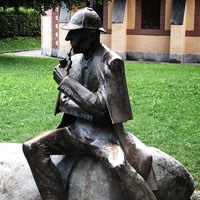
One of the big joys for me in 2014 was reading through the entirety of the Sherlock Holmes Collection, all thousand-plus pages of novels and short stories. This opening line, and its companion line preceding Chapter 1, from A Study in Scarlet, does a wonderful job of not only conveying information about the narrator — John Watson is a 19th century doctor from London who served as an army surgeon… and is now dead — but also masterfully sets the tone of the stories to come. I am of the unoriginal belief that Watson and Holmes are two of the finest, most fully-realized characters ever created for the page and this opening sentence, taken from the first Sherlock Holmes story (and my favorite, though I am a sucker for origin stories), certainly hooked me from the start.
2) The Sign of the Four by Arthur Conan Doyle (1890)
Sherlock Holmes took his bottle from the corner of the mantelpiece and his hypodermic syringe from its neat morocco case.
What? Why? I don’t like the sounds of this! The mind immediately starts shouting questions, demanding answers from our narrator, Watson. Is Holmes sick? Is Holmes turning to drugs? What’s a morocco case? Okay, that’s probably my own 21st century ignorance asking that last one. Nevertheless, in just one sentence, after a three-year hiatus between novels mind you, Doyle jolted his audience from their slumber and had them squirming along the edge of their seats.
3) The Hound of the Baskervilles by Arthur Conan Doyle (1901)
Mr. Sherlock Holmes, who was usually very late in the mornings, save upon those not infrequent occasions where he was up all night, was seated at the breakfast table.
Faithful readers had two novels and more than twenty short stories worth of Holmes’ detective work to digest by the time The Hound of the Baskervilles was released. Doyle began his longest and ultimately most famous Holmes adventure with this rather simple setup: Holmes joining Watson for breakfast. Long-time readers, and perhaps new ones too, can tell immediately from Watson’s language that Holmes either has a very early appointment or was up all night with a restless mind. Either way, the case Watson is about to write about was sure to be of a most distinct nature, as only the most spectacular cases were of interest to Holmes at this stage in his career.
4) The Valley of Fear by Arthur Conan Doyle (1914)
“I am inclined to think — ” said I.
“I should do so,” Sherlock Holmes remarked impatiently.
You can feel the condescension oozing off the page with this brief exchange that opens the final Sherlock Holmes novel. The relationship between Watson and Holmes was a decades-long subplot that, to me, was often as interesting as the sleuthing. This exchange, totaling less than ten words of dialogue, encapsulates their friendship perfectly. It’s an exchange that not only alerts the new reader that this Sherlock Holmes character has a massive superiority complex, but it also tells long-time readers that, despite the intervening years, Holmes still hasn’t changed… and he’s in a really pissy mood.
5) Pride and Prejudice by Jane Austen (1813)
It is a truth universally acknowledged, that a single man in possession of a good fortune must be in want of a wife.
What’s to be said? This is one of the finest, most memorable, attention-grabbing opening lines in literary history. It’s timeless commentary that makes us chuckle and even today makes us think of the social implications of this so-called universal truth. Must wealthy men want a wife? I don’t know, do they? One thing for sure, we know that this is going to be a love story with a touch of humor, most likely at the expense of high society. We can surmise that there is going to be a female protagonist, who is available, and a male counterpart who may or not be wealthy and looking.
6) For Whom the Bell Tolls by Ernest Hemingway (1939)
He lay flat on the brown, pine-needled floor of the forest, his chin on his folded arms, and high overhead the wind blew in the tops of the pine trees.
We know from the blurb and perhaps also from the title and what we know about Hemingway’s life, that we’re about to read a novel of war fiction, the Spanish Civil War to be exact. So we don’t need to be told that that the he is a soldier, not a daydreaming schoolboy somewhere safe. The sentence is pure description, stated in the simple economical style that Hemingway’s prose was known for, and it immediately makes us feel unease as we wonder if the man is in danger. War fiction, perhaps more than any other genre, has a way of invoking tension in even the most benign setups.
7) Her Privates We by Frederick Manning (1916)
The darkness was increasing rapidly, as the whole sky had clouded, and threatened thunder. There was still some desultory shelling.
I included the second sentence as a favor to the late author who, albeit poetically, essentially began his story with the rightfully-mocked cliche “It was a dark and stormy night.” This, in retrospect, seems incongruously amateur given the Shakespearean quotes that preface each part and chapter’s narrative. But that is just criticism in a vacuum. When paired with the sentence that follows, the opening creates such a tangible sense of foreboding that the reader can’t help but feel the tension of the battlefield and brace themselves for the tales of human suffering that are bound to follow. And besides, are stories not allowed to begin on a stormy night? Of course they are. The key is to phrase it in a way that obscures the cliche. Just like Manning did here.
8) The Sheltering Sky by Paul Bowles (1949)
He awoke, opened his eyes.
I considered including the second sentence as well, but it takes the entirety of the four flowery sentences that follow — though none as superficially redundant as the first — to complete an initial image for the reader. That being one of an existential crisis slowly unfolding. Similarly, it takes the bulk of those same five sentences to relay any concrete information or demand any questions other than a slight wonder about who opened their eyes. I enjoyed this book enough and it made a fine traveling companion as we cycled our way across Morocco to the edge of the Sahara Desert (the book was set in neighboring Algeria), but there is no question that this first sentence, especially in the context of this exercise, is by the far the weakest of the lot.
9) Big Medicine: A Western Quartet by Louis L’Amour (1948)
Old Billy Dunbar was down flat on his face in a dry wash swearing into his beard.
Louis L’Amour books are like a favorite sweater, a grilled cheese sandwich, or a mug of hot cocoa on a winter’s day. They are the comfort food to my imagination. Normally, the cynical me would laugh at a cheesy character name like Old Billy Dunbar, but it’s a western so it slides. Genre matters so much in terms of what we can get away with as writers, and what we, as readers, let slide without jest. Names aside, L’Amour does a great job of letting us know right away that Old Billy Dunbar is not having the best of days. Is he hurt? Is he in hiding? Did his mule just throw him? Keep reading to find out, I sure did! Note: Big Medicine is the title novella in this collection of four.
10) Raising John by Jennifer Lesher (2013)
John didn’t remember his mommy, but his Grammy had a lot of pictures of her.
This is a great example of the opening line reinforcing the title in a way that defies expectation. We automatically assume a child is raised by his mother and here the author throws us a curveball in the very first sentence. Nope, this poor kid is being raised by Grammy. So we immediately begin to ask questions about his mother. Is she dead? Did she abandon him? And what about the father? He’s not even mentioned. Why? Jennifer — I’ll call her Jennifer since that’s what I call her when we go mountain biking together — executed a really effective first sentence in her debut novel. I hope to be so skilled.
11) The House of the Seven Gables by Nathaniel Hawthorne (1851)
Half-way down a by-street of one of our New England towns, stands a rusty wooden house, with seven acutely-peaked gables, facing towards various points of the compass, and a huge, clustered chimney in the midst.
I’m willing to bet there aren’t too many editors out there today who would allow a first sentence consisting entirely of static description. Yet it works. And not just because of the unusual and mildly ominous description, but because the mansion is the star of the book. It’s right there in the title. The book starts in medias res, but Hawthorne chose to set the scene before getting to the body, as opposed to the rules of today which stipulate action, action, action. As an aside, this was one of my favorite books from that year’s reading. For anyone who remembers struggling through A Scarlet Letter in high school and swearing off Hawthorne for life, do yourself a favor and pick this one up. It’s romantic, it’s macabre, and it stands up exceedingly well to the test of time. Speaking of time…
12) The Time Machine by H.G. Wells (1895)
The Time Traveler (for so it will be convenient to speak of him) was expounding a recondite matter to us.
Kindly back away from the thesaurus, sir. Recondite, for those who don’t know, means something of a subject or knowledge that is little known or obscure. To use it in a sentence: H.G. Wells begins his fanciful novel The Time Machine with a recondite vocabulary selection. In addition to the word choice, Wells makes two other bold strokes in this opening sentence: naming his protagonist “The Time Traveler” and including a parenthetical to essentially explain the use of that name. I love it. Perhaps it’s the late 19th century time frame he was writing in, or his common heritage, but I sense a strong connection with Doyle’s character John Watson in the tone of this narration. And that’s never a bad thing.
13) On the Road by Jack Kerouac (1957)
I first met Dean not long after my wife and I split up.
Who’s Dean? Why’d you and you and your wife split up? How long ago was it, anyway? We immediately keep reading. After all, the author is obviously willing to take us in his confidence. On the Road is one of the great American travel memoirs/novels (I debated including this in my list of non-fiction books) and though we may wonder what, in addition to the names of the characters (Dean was actually Jack’s friend Neal Cassady), was also changed to protect the guilty, we take the author by his word and discard any concerns for truthfulness and settle in for a frenetic tale. Fans of Kerouac should stop by the Beat Generation Museum if ever in San Francisco. It’s a neat little museum and bookstore curated by fans of the era and even has the car used in the movie adaptation of On the Road, dust from Route 66 and all.
Bonus Anecdote: Shawn Coyne (of Story Grid fame) recently shared the following anecdote about the power of first sentences. This is the first sentence to The Key to Rebecca by Ken Follet: “The last camel collapsed at noon.” Great line, right? I think so. And so did best-selling crime writer Elizabeth Peters who later titled one of her novels “The Last Camel Died at Noon.” Talk about paying a professional compliment!
Post Image by David Jones, used under Creative Commons.
The post A Year in First Sentences appeared first on Doug Walsh.
January 22, 2016
5 Links Fridays
This week’s collection of links not only gives you reader/writers plenty of things to pore through over the weekend, but a few dozen movie suggestions too. This should come in handy for those of you in the northeast as you ready for Snowzilla 2016! I hope you all were able to secure your supplies; may your French toast turn out tasty.
Bookish Links
The Art of Turning a Unique Phrase – Have you ever read a phrase for the first time that was just so darn clever that you actually stopped mid-sentence, fixated on that one collection of words? You read it over and over, trying to commit it to memory, like a child pianist first learning her scales. Using too many similes in your writing can seem forced and distracting, but a well-turned phrase can really showcase the writer’s skill. Joanna Penn has nine excellent tips for helping you pull it off, with some wonderful examples to accompany each.
The Most Anticipated Books of Last Spring – Yep, you read that correctly. If you’re like me, you read as many 19th century books as you do those from this century. So lists like these never really go out of date. Here’s your chance to look back over the most anticipated books from this time last year and see which one you read, forgot about, or are now interested in. Books have no expiration date; these dozens of recommendations should still be safe to read in 2016.
The Martian and Six Other Movies That Began as Self-Published Books – Have you seen The Martian yet? If not, do it. Right now. Consider it your homework this weekend. I only just watched it last week and it quickly became one of my all-time favorite movies. The Martian is one of the biggest self-published success stories to date (along with the upcoming adaptation for Wool) but you might be surprised at some of the other entries on this list.
The 15 Most Read Stories in The New Yorker in 2015 – The New Yorker has some excellent writers and though complete issues will sometimes come out with nary an article that captures much interest, other times a story is published that takes the country by storm. Like this past year’s “The Really Big One” about the super-quake predicted to one day strike the PNW. Readers spent 3.6 BILLION seconds reading that story online. FYI: Amazon has The New Yorker (print+digital) for 97% off right now. Check it out.
A Neuroscientist Explains the Allure of Adult Coloring Books – Following up on last week’s post about the adult coloring book craze, here’s an article about the psychology behind the popularity. The biggest takeaway, which I found very comforting to see written on a science blog –it’s something I strive to remind myself (and sometimes others) — is that “Not everything we do must be in pursuit of productivity.” Preach it!
Bonus Link!
35 Harrowing Man vs Nature Movies, Ranked – You don’t know who Edward Vaughan is… yet, but his favorite recent movies are The Grey and 127 Hours, both of which are on this list. Most people would expect an investment banker like him to rank Wall Street or Margin Call among his favorites, but he doesn’t like to be reminded of the seedier side of his profession, least of all by Hollywood. At just 29 years old and with a habit of working over 80 hours a week, Edward hasn’t had much opportunity to see too many of the movies on this list. I think he’d really enjoy Deliverance and All is Lost.
Post Image by George Amaro, used under Creative Commons
The post 5 Links Fridays appeared first on Doug Walsh.
January 19, 2016
A Surprise Visit to the Singapore Writer’s Festival
There were plenty of times during our cycling trip in which we rolled up to the right place, but at the wrong time. Museums would be closed, monuments under renovation, and festivals often began the next week or had just ended the day before we arrived in town. If there was a market for photos of world-famous landmarks ensconced in scaffolding, I’d be a rich man. Fortunately, we did occasionally find ourselves in the right place at the right time. We were in Edinburgh during its gargantuan Fringe Festival (the largest arts festival in the world); Naples for Italy’s biggest New Year’s celebration; and a small mountain village in Crete for a traditional Greek wedding. But of all the moments in which our path aligned with a major event, the one I got to take the most advantage of came in Singapore.
We disembarked from a nineteen-day crossing of the Indian Ocean in Tanjung Pelepas, Malaysia and pedaled 52 miles south to Singapore. The plan was to spend three days getting our bicycles and touring gear boxed up and shipped home then another four nights in the heart of the city, soaking in the humid sights and sounds in full-on tourist mode. One of my best travel tips for visiting major cities is to check that city’s page on TimeOut.com and, for once, I took my own advice. There, listed alongside art galleries, concerts, and a stage production of A Clockwork Orange (tempting, but too pricey), was the Singapore Writer’s Festival (SWF).
SWF was in its second and final week when I learned about it, but fortunately most of the events were scheduled for the coming weekend, making it worth my while to pick up the full ten-day pass for $20 SGD (about $14 USD). Unlike weekdays which each only had two or three events scheduled, Saturdays and Sundays were filled with multiple options for every time slot from 10 a.m. through late night.
I had never attended a writer’s festival before — my writing career had previously drawn me to the annual live-action pinball machine known as the Electronics Entertainment Expo, aka E3, instead — and thrilled at the chance to schedule two days of panels, discussions, and lectures. Such great luck to have this opportunity on the heels of spending all that time at sea outlining my novel: immersion, at last! And I would arrive prepared.
Spending nearly three weeks aboard a cargo ship affords one ample time to talk, plan, and dream. My wife and I discussed nearly every aspect of our return to domestic life, particularly about my shift from writing video game strategy guides to authoring novels. The key to success, I had decided, was going to be notebooks. Lots and lots of notebooks. Notebooks in my pockets, on the nightstand, in the bathroom, my office, in our car — they’d be everywhere. The problem, as I learned once back on land, was that notebooks of the “Field Notes” variety I had coveted were quite pricey. I wanted at least twenty of them, but finding any of quality available for less than $3 or $4 each was a challenge. And I had become a bit more frugal in our two years of vagabonding. Fortunately, I stumbled upon a stationary store in Singapore with hundreds of notebooks, nearly exactly what I had wanted, in a multitude of colors for just one Singapore dollar each, about seventy-five cents in US currency. I bought thirty-eight of them. Why thirty eight? Forty just seemed extravagant.
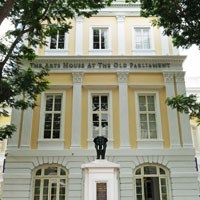
So, on the morning of November 7th, I arrived at the building now known as The Arts House at the Old Parliament and took a leather-backed seat in the main chamber. There I put a stolen Hilton-branded pen to a sweat-dampened notebook and wrote the title of the first panel in large block letters atop the first page. I underlined it, then underlined it again for good measure, and settled into a lengthy wait.
I was over thirty minutes early.
You’re forgiven for thinking a writer’s festival in Singapore would be impenetrable to an English speaker, but that is not the case. Singapore’s history as a British colony (the city-state was celebrating its 50th anniversary of independence throughout 2015) has left it with quite the English-speaking legacy. Though Malay is the nation’s official language, English is the main language used in schools and in professional settings. The SWF program guide showed that the majority of panels and lectures were given in English, with just a smattering offered in Mandarin Chinese. Though most of the presenters came from Southeast Asia, many had come from as far away as South Africa, France, and the United States. Which brings me back to the first panel I attended.
Wit and Wisdom: Capturing the Humor and Humanity in Narrative Non-Fiction
Strategy guides aside, I don’t intend to write much non-fiction in the immediate future. Even so, I was happy to see Susan Orlean on the schedule. Not only because I was beginning to miss being around Americans, but because I had always wanted to read her book The Orchid Thief, had enjoyed the movie Adaptation which was based on the book, and wouldn’t pass up a chance to hear from a tenured writer at The New Yorker.
I’ve always enjoyed reading narrative non-fiction. I consider books like Timothy Egan’s The Worst Hard Time and Simon Winchester’s Krakatoa and The Professor and the Madman among my favorite books. And yet, in today’s age of instant-answers, the need for narrative non-fiction seems questioned. “Sure, anybody could look it up. But most won’t,” Orlean said, relaying advice from her editor. “That’s what we have to remember. People could Google the history of orchid poaching in South Florida, but they’re not going to.” Speaking for myself, I agree. We won’t. Not because of laziness, but because we often don’t even realize we’re interested in a topic until we see the book blurb. Case in point: I’m an unfinished thesis away from holding a master’s degree in Geology (a story for another time), but was never interested enough in the world’s first geologic map to look it up. Then I read the blurb for Winchester’s The Map that Changed the World and knew immediately that I had to read it. And it was fascinating. And yes, I try to read everything Winchester writes.
The topic of Orlean’s talk was about the use of humor in non-fiction. And her number one tip was “to give the reader the unexpected.” She illustrated this by reading a passage from The Orchid Thief (which I’ve since read) about traipsing chest-deep through a swamp with a ranger and two work-release prisoners. She ends a serious, lengthy description of her miserable surroundings with the sentence. “I hate hiking with convicts carrying machetes.” Laughter ensued. The point, she said, is to embrace your own humanity and be the guide in telling an eloquent story, but allow the unexpected observation to get the laughs.
Wanderlust and the Promise of the Other
My SWF experience continued to a panel featuring poet Marc Nair, graphic novelist Christian Cailleaux, and novelist Nicholas Hogg. The goal of the panel, according to the program guide, was to answer the question “Why do writers travel?” but I unfortunately never really got (or expected) an answer to such an amorphous question. Why does anyone write or travel? Why do we do any of the things we do? Because we feel a calling to do so. The writers shared some excerpts from their books and talked a bit about their personal experiences abroad. Nair’s poetry made me question the lack of poetry in my reading (and later kick myself for not buying his books at SWF) and Hogg’s resume made me wish I was headed back to Japan soon. Most of the hour; however, was spent trying to decipher Cailleaux’s funny anecdotes as the native Frenchman struggled with English.
Saturday night was spent with Orlean and fifty others at a screening of Adaptation. As I mentioned earlier, I remembered enjoying the movie, but couldn’t tell you much about it. Now I can honestly say that it’s a movie worth watching twice, particularly as there’s a lot of subtle fun to be had at Hollywood’s expense. It’s also quite meta. The hour-long discussion that followed was informative and revealed a lot about the process of having a book adapted into a movie. It was oddly reassuring to hear a successful author like Orlean confirm that we authors have no control over things once we sign that contract. Of course, we should all be so lucky to have such problems.
I’ve never before read a book after watching the movie, and certainly never after also meeting the author of that book. Despite getting to briefly chat with Susan Orlean, shake her hand, listen to her talk for two hours, and have her signature gracing the title page of my copy of The Orchid Thief, it was still Meryl Streep’s face I pictured while reading the book. I guess that’s the overwhelming power of movies. Images in general, perhaps. I remember as a teen reading Stephen King’s The Gunslinger and The Drawing of the Three in paperback. Then, when the third book in the Dark Tower series finally released and included a handful of glossy full-color illustrations, I was shocked and angered. “That’s not how Roland and Eddie are supposed to look!”
Sell-Out Versus Artistic Independence
The first panel I attended on Sunday morning featured graphic novelists Troy Chinn and Christian Cailleaux. I was a little concerned about attending a second panel featuring graphic novelists, particularly one featuring entertaining but hard to understand Cailleaux, but the other options at the 10 a.m. time slot held little interest to me. Fortunately, Cailleaux brought an interpreter with him this time and, together with his fellow panelist, Troy Chinn, provided an informative and entertaining hour-long discussion. Much to my surprise, my notebook entry for this panel holds the most lines of my chicken-scratch. Which just goes to show that it’s a good idea to branch out and even attend discussions featuring people who work in different mediums or genres.
My biggest takeaway from listening to them speak, particularly from Chinn, was in direct response to a question I had posed. Chinn found himself having to self-publish his earliest works because Singapore, despite being one of the world’s most modern and thriving cities, had no publishers of graphic novels when he first started out. He told us about driving around town, delivering copies of his books to local shops, wondering if they’d earn enough to cover the gas money. He now works with a local independent publisher and reaches a bigger audience. I asked him if he was tempted, much like I was with One Lousy Pirate, to return to his earlier works and improve them. He said that the temptation was there, but he wouldn’t ever do it for a number of reasons. For starters, he already had enough ideas for a lifetime of work and going back and redoing earlier works was too time-consuming. He also expressed the concern for continuity. His books are an auto-biographical series about his adventures abroad and it would be jarring to new readers, for example, to see his earliest works match the artistic style of, say, his eighth or ninth books but for his mid-series books to still show the signs of someone learning their craft. Cailleaux chimed in and said that one of the benefits to having an agent and publisher is that they will not tolerate you spending time trying to perfect everything you’ve already released; they want to see you creating new content, not polishing the old!
That’s two votes against and none in favor: One Lousy Pirate will not get a rewrite.
The Burden of Experience
The final panel I attended was titled “Real to Print: The Burden of Experience” with Thaddeus Rutkowski, Alison Jean Lester, and Siow Lee Chin. Chin, a world-famous violinist, stole the show from the start with a haunting performance of Jeanie With the Light Brown Hair, the song she played for her dying father who had taught her how to play the violin. She’s since played at Carnegie Hall and Osaka Symphony Hall and everywhere between. Chin read from her recent memoir and Rutkowski and Lester read from their most recent novels. While Chin used her personal experience of overcoming cancer and a major car accident to continue her rise amongst the world’s great virtuosos, her fellow panelists used their childhoods and relationships to add authenticity and a unique perspective to their fiction.
The title of the panel was apt as the word “burden” came up frequently. I shamefully forget who used the term first, and it may have been an attendee in the form of a question, but the literary phrase “objective correlative” was mentioned as a tool to remember. “We should,” Lester said, “write to give the reader the feeling you want them to have and don’t just focus on your need to tell.” The lady knows what she speaks. Lester confessed to recently — as in just that week — having started over on a novel she had been working on for five years. For five years her agent and editor had been telling her that her book was far too personal and that she needed to make it better for the reader. “The pain of a recent divorce was finding its way into too many pages,” she confessed. The burden of experience, in other words.
I ultimately didn’t end up chatting with too many people at SWF, as there just never seemed to be much mingling. I did purchase the following two books: The Orchid Thief by Susan Orlean and Evil and the Mask by Fuminori Nakamura. And, personalized autograph from Orlean aside, I immediately regretted buying the books in physical form. What can I say, I love the Kindle’s highlight feature and built-in dictionary.
I look forward to attending at least one or two conferences a year going forward, likely with advance notice and time to plan out my days better. Looking through the program guide for SWF, I see that there were some all-day workshops that would have been worthwhile to attend, and I’m sure if I had come prepared with samples, business cards, a prepared pitch or anything, I might have been able to get more out of it. Or at least made some connections. Nevertheless, it was a pleasant surprise and a great, air-conditioned way to spend a couple of days in Singapore.
Got any thoughts or tips on attending writer’s festivals or conferences? Thoughts on The Orchid Thief or any of the other books I mentioned? If so, let me hear it in the comments below. Thanks for reading.
The post A Surprise Visit to the Singapore Writer’s Festival appeared first on Doug Walsh.
January 15, 2016
5 Links Fridays
Another Friday, another trip into my folder of links. Some of them are older, others newer. Readers and writers alike should find something useful here. Enjoy!
Bookish Links
James Patterson Explains Why His Books Sell Like Crazy – I was in Costco two days ago, before getting waylaid with my second bad head cold since returning home to American germs, and there was a cardboard display shelving dozens of paperback novels, dirt cheap, and most of them were Patterson’s. If you’ve ever walked through an airport bookstore, then you’ve no doubt seen his name, even if, like me, you’ve never read him. He had 13 books coming out the year this article was written (2012). Read how he unabashedly churns out book after book, each with his name on the cover, despite doing very little writing of his own. We hate him cause we ain’t him. Or something like that.
Ten of the World’s Most Beautiful Bookshops – This article on the BBC has gotten spread around a couple times over the past two years, and it made the rounds again this week. I can’t help gazing at the beauty of these stores any chance I get. I was particularly excited to see that arguably the most beautiful of the lot — the Livraria Lello — is in a city we’ll be visiting later this year. If you don’t follow our travel blog, we put a basket of 100+ travel dreams together and my wife drew us a trip to Portugal and The Azores.
The Coloring Craze: Adult Coloring Books, 2015 – We’ve seen them everywhere (I saw them all over Asia and Europe as well). Many of us have even started coloring a page or two of our own. But did you know that the two most popular books, Secret Garden and Enchanted Forest, combined for approximately 800,000 copies sold in 2015? Those are huge numbers. I remember a story from a couple of years ago about a woman in Idaho who started making her own adult coloring books and pitched them to Costco. This, I believe, was back in 2012 or 2013. Anyway, I remember seeing them in the local Costco before our trip and thinking they were just the coolest thing ever. Talk about being ahead of the curve.
How to Become a Better Reader in 10 Steps – I still fail miserably at Tip #1: Quit Reading (I’m extremely resistant to leaving a book unfinished, even if I’m not enjoying it) and I haven’t joined a book club or read any British quarterlies, but this is a great list of useful tips, especially for those who ever find themselves ever not knowing what to read.
How to Study Plot and Character in Your Favorite Stories – I will always fail at one of the reading tips mentioned in the previous link — Skim — because I read not to escape, but to study the craft. At least most of the time. Anyone who browses my Goodreads shelves will find some cheap thrills tucked amongst the classics and bestsellers. That said, I mentioned K.M. Weiland’s books in my previous post and this blog post of hers has some great actionable tips for getting the most out of your reading. I’ve employed some of these techniques in analyzing other books this past year and will be modifying my approach to include some of her tips here. If you’re a student of storycraft, then you really ought to be following her blog.
Bonus Link!
Death By Coconut: A Story of Food Obsession Gone Too Far – What happens when a German nudist decides to move to Papua New Guinea in 1902 and start a cult obsessed with eating coconut? Enjoy the bewildering story of August Engelhardt, care of NPR. It was certainly one of the wildest things I read in December.
Post Image by Mike van Dalen, used under Creative Commons
The post 5 Links Fridays appeared first on Doug Walsh.
January 11, 2016
Writing Birdcages Into Mansions
What do you tell people you’re doing when you’ve got an idea for a novel kicking around in your head, but don’t know the first thing about writing one? How do you make them understand, for us non-pantsers, that the time you spend working isn’t necessarily being spent writing? How do you characterize the studying/learning/training that must be done before you even begin?
I was faced with this conundrum on a daily basis when Kristin and I took two months off our bicycle tour last winter to spend time with her ailing father. Her mother, full of polite curiosity, would ask each and every day how much work I got done. She knew I was spending most of the day in a spare bedroom that we had neatly converted into a temporary office. She knew I was in the preliminary stages of writing a novel. That, once our trip was over, our savings and newfound frugality was going to afford me the opportunity to finally make a stab at a career as a novelist. She also knew that I had spent the last thirteen years writing in excess of a hundred videogame strategy guides for then-Penguin imprint BradyGames. She knew that I’ve had books, albeit licensed merch books, crack the top 25 on Amazon. She knew my annual earnings from writing said books occasionally topped six-figures. To her and everyone who knew me, I already was a successful writer. I felt like an impostor.
“Make some progress?”
“I’m nowhere near being able to tell you how many scenes or words I wrote today, if that’s what you’re asking.” I was getting tired of this game and my attempts to deflect the question without being rude were failing.
I sat silently for a few moments, staring blankly at James Clavell’s Shogun on my Kindle, angry for how my words came out. I sighed, unintentionally, and then my lips started moving, speaking an explanation that I had never before considered.
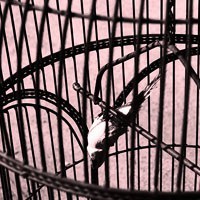
“I feel like a carpenter who can assemble the most beautiful birdhouses, but has been suddenly tasked with building a mansion. I want to start working on the blueprints,” I said, thinking about the outline I couldn’t wait to write “but before I can do that I need to learn building codes and how to do the plumbing and the electrical and the ventilation.” I sighed again.
She laughed and gave my shoulder a squeeze as she got up to check on dinner. The next night, during my turn in the kitchen, we chatted about my learning how to write a novel, about my fear of dialogue, and my goal of having a fleshed out outline complete before we finish our travels. She was happy to hear how my schooling was going and, in the days that followed, instead of asking how much progress I made, would ask if I “learned some good stuff.”
I had.
Back to School
The first step I took in this continuing education was to organize my Internet bookmarks. Now, this probably sounds exactly like the type of busy work one does to trick themselves into thinking they’re being productive. Not this time. As I inspected the untold number of useful, redundant, dead, and uninteresting links that had collected over the past two years I came upon an article about The Story Grid on Joanna Penn’s blog.

Shawn Coyne’s Story Grid of Silence of the Lambs.
Shawn Coyne’s The Story Grid instantly became my classroom and for two weeks I pored over his dozens of blog posts, absorbing everything he was willing to share from his twenty-five years as a literary editor. From genre to story arcs to the units of story and point of view, Coyne discusses it all using excellent examples and demonstrations to drive home his point. His goal? To make writers better editors. And the way he intends to do this is by revealing, via one or two posts a week, the building blocks of his life’s work, the then-unpublished book The Story Grid. His is an analytical approach to the craft of storytelling and his Story Grid technique looks as if it was screen-capped from a graphing calculator. It’s scary. But the best part? His Story Grid example is a case-study of Thomas Harris’ best-selling thriller, Silence of the Lambs. How lucky I was to stumble upon an analytical approach to explaining the art of storytelling that just so happens to use one of my all-time favorite books as its example! The teenage me, still in high school when Silence of the Lambs was released, read the story multiple times and was able to recite much of the movie by memory.
As if stumbling upon a dissection of my favorite novel wasn’t serendipitous enough, I had also begun watching House of Cards on Netflix around the same time that I began reading Coyne’s blog. What a stroke of luck this happened to be! Within a week I felt as if I was taking a master’s class in the art of storytelling. By day I was the student in the classroom, taking notes about the units of story, the changing values of a scene, and the conventions and requirements of certain genres, alt-tabbing over to a foolscap document for my own WIP and incorporating what I was learning. By night, the television was my lab, the cast and crew of House of Cards the live example in front of me that turned theory into practice.
The casual observer in me knew House of Cards was terrific; it was full of suspense and a Machiavellian hunger for power that was both attractive and terrifying, no small thanks to the brilliant performance of Kevin Spacey. But this student of storytelling quickly began to see something different. I saw the changing values of the characters as the scenes turned and built into sequences that carried the plot forward from episode to episode.
Within two weeks I was watching television and film in a whole new light. Though I always considered myself a rather critical reader, my scrutinous eyes were shut when watching a movie. The Story Grid opened them.
Of course, one doesn’t learn how to build a house — or write a novel — from reading a single website. I’ve also been diligently working through K.M. Weiland’s Structuring Your Novel and her Outlining Your Novel book and workbook, as well as Robert McKee’s quintessential Story. More about those and my efforts to Story Grid Art of Fielding in the future.
This is an interesting period in my career progression and I can’t help but feel encouraged that Silence of the Lambs is again leaving its mark. Just as Nintendo Power magazine made me want to be a writer in the videogame industry back in the 1980s, when I was just twelve years old — Check! — it was Silence of the Lambs (along with some Stephen King novels and Catcher in the Rye) that made me first want to be a novelist back in the early 1990s. My obsession with games and writing about them led, eventually, to a thirteen year career doing just that. Perhaps my love of reading spawned in part by Silence of the Lambs will similarly lead to another lengthy stint doing what I not only love, but what I always wanted to do?
These next few years, and this blog, are going to chronicle the journey to find out.
Have any writing how-to books or websites that you found invaluable? Ever make a stab at following through on your what-you-want-to-be-when-you-grow-up dreams? If so, let me hear it in the comments below.
Post Image by Antonella Beccaria, used under Creative Commons.
The post Writing Birdcages Into Mansions appeared first on Doug Walsh.
January 8, 2016
5 Links Fridays
Every Friday I plan to dig deep into my folder of curated links and share five writing-related articles that I found to be worth bookmarking, along with one bonus link just for fun. Enjoy!
Bookish Links
Ten Scenes for the Mentor Character In Your Novel – Every hero’s journey involves a mentor character. And here, the Better Novel Project provides ten examples of how a mentor can aid the hero without encroaching on his independence. Christine Frazier uses the lovable half-giant Hagrid from Harry Potter to illustrate her points.
First Bookstore Dedicated to Self-Published Authors Opens in Florida – This bookstore in Fort Myers, FL is dedicated to self-published authors and has a really neat pricing structure depending on the level of service desired. It has the potential to be a nice hit with locals and tourists wanting to bring home something to remind them of their winter getaway.I plan to stop by the next time we’re visiting in-laws.
The 20 Most Extreme Cases of ‘The Book Was Better Than the Movie” – I’m a 538 junkie, usually for stats-based political and sports insights, but I’m really glad to see them able to expand their analysis into other realms. As for the topic, I believe the movie adaptation of Stephen King’s Needful Things deserves an honorary spot someplace fiery and hot. It’s the only movie I ever walked out of.
Five Reasons Internal Dialogue is Essential in Fiction – Given that my WIP begins with a couple cycling across North America, you better believe I’ve been studying how to incorporate some internal dialogue into my story. After all, there are few better places to let your mind wander than atop the seat of a bicycle. Marcy Kennedy includes some tips for using internal dialogue along with her reasons.
The Ten Best Haruki Murakami Books – I’ve never read any of Murakami’s books (yet) but as a fan of Japanese culture — it’s my favorite place to travel to — and as someone making a specific point to read more international fiction, I was happy to see this article pop up on Publisher’s Weekly. And the fact that the first book on this list was originally titled “An Adventure Involving Sheep” just makes it all the better.
Bonus Link!
Top Five Most Expensive Mattress Brands – I stumbled upon this while trying to scrounge up some reviews for the mattress we were buying when we were setting up house. I used to think a thousand dollars was a lot for a mattress, but now I realize how wrong I was. Then again, I’ve never slept on a bed of horse hair.
Post Image by Vitor Pina, used under Creative Commons.
The post 5 Links Fridays appeared first on Doug Walsh.