Doug Walsh's Blog, page 12
April 22, 2016
Friday Links #15
My mission, which I have chosen to accept, is to carry the wonderful feeling of a truly productive yesterday into the hours that stretch out ahead of me today.
I woke yesterday morning with little recollection of the despair I felt on Wednesday. The questions and doubts that had me feeling rudderless on a sea of uselessness were gone. I sat down with my coffee to read, as I do every morning at 7 a.m. and promptly stood up. Why was I doing this? Every morning I would read for an hour, have some breakfast, check email and then finally settle in to write. By then it was nearly 9 a.m. and I had been up for almost three hours with nothing to show for it, other than an enjoyable hour spent reading with my coffee.
I’m not one of those people who need their coffee to function. I don’t like waking up, but once I do, I’m humming along at 95% capacity within seconds. By the time I’m out of the shower, I’m operating at full-speed. Reading is an important part of the writer’s job description. To be a writer, you must be an avid reader. I am. I’ve been for a long time. But it’s not the best use of my most productive hours. I put my Kindle down, grabbed my coffee, and went upstairs to my writing office.
Two hours later I was printing a fresh 2700 words, the two scenes that comprise one of the major plot points in my novel. It was barely 9 a.m. and I had a solid day’s writing already behind me.
Achievement Unlocked: Rockstar Status!
I enjoyed writing those scenes. And I must admit they came out quite good, far better than most of what I’ve written so far in this first draft. Finally, I felt the emotion of my protagonist’s inner struggle. I agonized along with his wife as she recoiled from the effect of his choices. The knot in his stomach was in mine. The hurt she felt, I felt. It’s so hard to see someone make a choice that they think is the right thing, but to know it’s going to hurt the very people they think they’re helping most. I see now that this is the blessing and the curse of the novelist. I get to create these characters, set them on their course and understand the depths of their reasoning and how their actions impact others. I see the train wreck coming before anyone else, yet I can’t intervene. I have to accelerate, I can’t clear the tracks. The readers want to see the crash. They want the carnage. Fortunately, readers want to see the rescue crews pull out a few survivors as well. That’s going to be fun.
With such a great start to the day behind me, I took my mountain bike in for a tune-up, read in the adjacent cafe, then hit the trails. Strava tells me I laid down some really fast times. I was feeling it. Back home, I began work on another videogame strategy guide project. I have the pleasure of updating the books I wrote for one of my favorite franchises. Speaking of which, it’s time to get working…
Bookish Links
The Nit-Picking Glory of The New Yorker’s Comma Queen – An interesting TED Talk from Mary Norris, a copy editor for The New Yorker magazine. You’d be hard-pressed to find a team of editors in the country with more scrutinous eyes cast their way. A great ten-minute talk.
5 More Ways to Trim Your Book’s Word Count – Another helpful article by K.M. Weiland. This set of tips for tightening up your word count gets into the micro level and includes some Scrivener tips for people who use the writing software (I do!). One of the things I’m most looking forward to is taking the hatchet to my first draft which, at my current pace, is going to exceed 500 pages. Too long for a first effort!
Your Guide to Reading the World – I’m pretty sure I linked to Ann Morgan’s TED Talk in which she discussed spending a year reading a book from every country on planet Earth. Well, this is the interactive series of maps which shows you just what she read from every country, along with some discussion of her favorites and biggest surprises.
A Beginner’s Guide to Stephen King Books – If you never read much Stephen King, this is the article for you. With 54 novels out (and counting) there’s a lot there to go through. I’m a fairly well-read King fan though I have to admit I haven’t read much from him in the past 15 years. The one book not on this list that I would definitely recommend is Misery. If you thought the movie was good (it was!) then definitely read the book. But start with The Shining. One of the best horror books ever and much deeper than the movie.
The 10 Most Anticipated Book Adaptations of 2016 – The Jungle Book is getting rave reviews but the animation seemed really off to me when I saw the trailers. On the other hand, Spielberg’s adaptation of The BFG, one of my wife’s favorite childhood stories, will surely be must-see viewing in my household. Can’t say I’ve heard of many of the others on this list.
Bonus Link!
Who Is Craig from Craigslist? – The story behind the founder of the world’s favorite online classified section. Also, if you’re curious about just how useful Craigslist can be in bringing people together for good, I highly recommend watching the movie Craigslist Joe, a documentary about a guy who spent 31 days traveling the country and relying completely on the kindness of Craigslisters.
Post Image by Mark Freeth, used under Creative Commons.
The post Friday Links #15 appeared first on Doug Walsh.


April 20, 2016
Obligatory Word Count Notes
Fifteen years ago, when I was living in North Carolina and spending upwards of twenty hours a week training for triathlon, I belonged to a Listserv called Tri-DRS. Listserves, for those who don’t remember, were the mailing list precursors to today’s Google Groups and online forums. It was customary for members of the “Triathletes of the Dead Runner’s Society” (don’t ask) to share a brief description of their daily training as part of their signature when sending an email. We had all manner of abbreviations for different tri-specific workouts, but the most common was the simple OTN, Obligatory Training Note. Throughout the day my Inbox would pile up with emails from the hundreds of members around the country as people asked gear questions, share race reports, and provided all manner of advice and inspiration. And at the bottom of most of those emails was a simple not-so obligatory training note that let us all know how far that person swam, biked, or ran that day.
These days athletes have apps like Garmin Connect, Fitbit, and Strava to share their workouts. Strava combines aspects of social media with the capacity to share GPS routes and training diaries, take part in monthly mileage challenges and, for better or worse, see where you rank on various route segments against all the other users. You can give Kudos to your friends and comment on one another’s efforts and even filter the rankings by age and weight. It has its detractors, and it certainly isn’t without its negative implications, but I do enjoy using it. Here’s an entry from one of my recent mountain bike rides that shows a lot of the app’s features, including my ranking on segments, discussion from friends, and more.
What I enjoy most about Strava and those old training notes on Tri-DRS was that it not only allowed me to see what my peers were up to, but it helped me stay motivated. By seeing the types of rides others were doing, I was able to tell whether my efforts were on par or if I was slacking off. Was I riding enough? Was I taking too many recovery days? Am I as committed as I ought to be?
Like the solitary writer at the desk, the life of the lonely distance runner also provides ample opportunity for self-doubt to creep in.
Sharing Word Counts
When I began this year’s writing efforts one of the first things I did was to create a spreadsheet that I now use to track my daily productivity. I track my daily hours (actual work, not just time at the desk — big difference!) and my word count for each day, split into four different topics: Fiction, Blogging, Strategy Guides, and Other. I picked an arbitrary number out of the air — 250,000 words — and built a series of sheets, one for each month, that measured my daily performance against the pace I would need to match to hit my goal. A summary page lets me scan my progress over the year and see how I’m doing. That goal of a quarter-million words was far too low (only 685 per day, 7 days a week), as it turns out.
Or is it? After all, it’s not like I’m privy to the daily output of other writers.
I attended my first monthly PNWA meeting earlier this month. It was a panel discussion about trends in publishing and during the Q&A portion of the two-hour meeting, the panel was asked about their daily writing output. It varied, naturally. One of the authors worked full-time and had children so she did the bulk of her writing on the weekends. Two others, including Boyd Morrison, one of Clive Cussler’s co-authors, discussed their desire to get 1500 good, solid words done each day, but it depended on what they were working on. But, all in all, the goal was to write a full scene.
Tim Grahl, the first-time novelist sharing his process with long-time editor Shawn Coyne on the StoryGrid podcasts recently discussed his output. There were days when he admitted to feeling lousy for only getting 700 words on paper. Yet he recently spent a day on a plane and managed to push through all that resistance and generate more than 6,000 words. Coyne assured him all of this was normal, and that the quality of those 6,000 words he put down wasn’t even all that important on the first draft.
That was refreshing to hear.
I mention what these others have recently shared because, as a first-time novelist with the luxury of being able to devote myself to this full-time, I too worry about my productivity. Looking over my tracking sheets, I see that on the days that I work on my fiction, I tend to average roughly 1600 words. And I might go so far as to say that some of them are even usable. Some days I write much, much more. Other days, I end up spending the bulk of my time doing research and outlining or working on the blog or other tasks.
A Strava for Writers?
Though I’m already 57% of the way through my annual goal of 250,000 words (a number I’m sure to double for 2017), I know it would be much higher if there was a place where I could see what others in my cohort were generating. I know the NaNoWriMo community must have apps and websites that they use to help motivate one another through their November; I wonder if something like that exists year-round. Does it?
This isn’t to say that I want or feel the need to be competing with others for top word count. Not at all. Rather, some sense of camaraderie and motivation and maybe even a touch of accountability. So much of what I’m doing right now — what most writers are doing — is alone. Not just the writing, but the managing of the writing.
Am I working hard enough? Am I getting enough down on paper each day? I think I am. I’m generally satisfied with my efforts, but I know there’s room for improvement. There always is.
Maybe interacting with a bunch of other amateurs isn’t the best solution. After all, there’s always the chance they know as little about this as I do or have equally poor habits. A good chance, probably. But just like all of us way back when training for our first Ironmans and marathons, patterns emerged and everyone’s hard work gradually helped lift the efforts of the collective. Little by little, those with private coaches and years of experience chimed in and offered wisdom to the group and as our race times improved and our training took better form, that bunch of amateurs morphed into a bunch of veteran racers.
If only there was a Strava for writers. Not necessarily a writer’s group, but something akin to it. A productivity-focused writer’s group with limited social media aspects that allowed for comments and encouragement, but not time-sucking discussions and critiques.
So some questions for you fellow writers:
How many words do you typically average each day you spend writing?
Do you know of any websites or apps or online communities where you share your daily/weekly productivity?
If you belong to any online writer’s groups, which ones?
Let me hear it in the comments below. Thanks!
Post Image by Bridget Coila, used under Creative Commons.

Lastly, I’m running a contest next month, but you’ll need to be a blog subscriber to have a chance at winning. Please sign up today!
The post Obligatory Word Count Notes appeared first on Doug Walsh.
April 15, 2016
Friday Links #14
A friend of mine owns a thriving physical therapy clinic here in the Seattle area and was kind enough to invite me to speak later this year. He runs a lecture series for his patients and friends and thought they would enjoy hearing about our cycling trip and that it would be a great opportunity for me to plug my upcoming book. He’ll print flyers, post to social media, and even spread the word to his ten-thousand person mailing list. I excitedly agreed on a date in October. Then he wrote back, asking a question that froze me in my seat.
“Do you think the book will be complete and available for signing by then?”
When I finally remembered to breathe and relaxed the iron-clad grip I had on my mouse, I realized it was a fair question. After all, the publishing world had changed significantly over the past ten years and it’s common for authors, particularly self-published ones, to crank out at least several books per year. In fact much of the advice to indie authors trying to make a living out of their writing goes as follows: Publish as often as you can. It’s the advice given by and to those who place earning an income as a writer above all else. And it works beautifully for some. But it’s not the path I’m wishing to take. At least not at this time.
Somewhere between Somalia and Sri Lanka, afloat in the middle of the Indian Ocean, I put a four-year writing schedule together. A flexible roadmap with some suggested deadlines to help me not only keep on track, but to help me see the big picture and to not feel the pressures to rush this story out in hopes of chasing a few bucks. That I have the occasional strategy guide to write and a wife with a solid income allows me this flexibility without having to endure the rigors of the starving artist. I’m not blind to that good fortune.
So I looked back to that schedule I assembled and discovered that I was already out in front on some tasks. I didn’t intend to even build this website until July. I didn’t plan to clean up the formatting and adjust the keywords and description of One Lousy Pirate until August. I accomplished both the website and the book update in January. But where does that leave me for October? I told my friend that, if all goes well, I hope to have the manuscript in the hands of beta readers by the end of the year. My original schedule, based only in the reality that exists in the mind of this conservative novice, didn’t even have me querying agents until the summer of 2017.
Yes, I hope to go the traditional route. Not entirely because I’m seeking validation (though I’d be lying if I said it never entered my thoughts) but because I’m following a different piece of advice: Write what you enjoy. I don’t read genre fiction. I don’t read serial books released by authors who churn them out four times a year. I don’t have anything against those who do, it’s just not what I typically read. And I want to write not only a story I want to tell, but on a level that approaches the quality of art I respect most. I understand the chance of me writing a story that gets remembered decades from now or taught in classrooms is probably less than winning Powerball. But people still buy lottery tickets, right? They still dream. I’m not dreaming, I’m simply trying. And that’s going to take time.
So no, the book will not be available this October. If all goes extraordinarily well, it might be under contract next October. But only if it’s what I hope it can become.
Bookish Links
Dear Self-Published Author: Do NOT Write Four Books a Year – I couldn’t not include this link given what I just wrote above. Lorraine Devon Wilke does a great job of not hurling stones from a glass house while still providing a voice for those who need reminding that it’s okay to slow down, take their time, and hone their craft.
The Greatest Heroines of All Time – This article by Samantha Ellis via BBC was just sent to me this morning by my wife and it provides a great discussion of classic, enduring heroines from Jane Eyre to Katniss Everdeen. It’s an interesting, thoughtful look at what inspires certain female characters to stand the test of time.
Writing the Perfect Scene – I used to think books were all about chapters. That authors focused their writing one chapter at a time. And then I started studying story structure and understand that, for novelists, the scene is the most important story unit. A chapter might contain one scene. It might have several. I’m a big fan of the StoryGrid teachings by Shawn Coyne, but this article by Randy Ingermanson is a great one-stop deep-dive into all of the things a scene must accomplish, and how to go about writing a good one.
How I Use Scrivener to Organize Research and Marketing for My Books – I love Scrivener. I use it for all of my writing except when I’m writing strategy guides and have to use my publisher’s Word template. Whether you’re writing a novel, a blog, or just want to keep track of some larger project, Scrivener can help you do it. This article by Susan Kaye Quinn includes several other uses that I hadn’t before considered.
22 of the Best Single Sentences on Writing – Nearly two dozen thoughtful pieces of advice on the subject of writing from the masters of the craft. From Orwell to Chekhov, King, and Nabokov, nearly all aspects of the creative process are covered. Enjoy!
Bonus Link!
Board Games That are Super Fun to Play Solo – I love board games. Alas, the best games often require at least three people to play. Many need more than four. And unfortunately, I’ve always straddled the no-man’s land between geek and jock. The majority of my friends I know through sports, whether it be surfing or mountain biking or running. But when I’m not playing outside, my interests skew towards videogames and board games. My wife and I recently picked up the game Machi Koro which is quite fun, but I find it a bit too simple and repetitive. She’s reluctant to get anything much more complex. What I need are solo games and here’s a list of them! Yay!
Post Image by Ian Sane, used under Creative Commons
The post Friday Links #14 appeared first on Doug Walsh.
April 13, 2016
Advancing From Third to First
You’d be forgiven if, upon seeing the title of this post and recalling the time of year and location in which I write, you felt it was going to be baseball related. It’s not. No, the ineptitude of which I write about today does not concern the Seattle Mariners, but rather my challenges with point of view. The season is plenty young; there’s time enough to discuss the former at a later date.
I have one hundred ten pages of manuscript saved on two separate computers, backed-up to Dropbox, and printed and stored in a three-ring binder in case the Y2K bug proves exceptionally tardy or ransomware goes slumming. The page count should be much higher.
Third-Person Challenges
Every day that I sit down to write I do so in a manner completely foreign to me: I write in the third person. Some days it goes well and I’ll write a scene slightly less clumsy and awkward than the others. These scenes are still raw and unpolished and not fit to be shared or critiqued. They haven’t been given a second look — full speed ahead, editing can wait! — but they’re not completely embarrassing either.
Here’s an example of one such unedited passage from my work in progress, currently titled Tailwinds Past Florence.
Edward tugged the fleece headband down further over his eyebrows, brushed aside the snow piling up on the map case, and carefully dealt with the rime encasing the mirror on his helmet, lest it fall off again. “So this is why everyone keeps telling us we’re two months early.” His voice was no match for the sound of the snow crunching beneath the tires. And judging by the glimmer of orange reflecting in the droplets on the mirror, she wasn’t close enough to hear him anyway.
The chain skipped along the cogs as Edward relaxed his cadence and shifted into a lower gear. He tried the next one down with similar results and quickly twisted the shifter back two clicks to where it was. Hearing no cars approaching, he looked down over his right hip and tentatively tried a higher gear. The derailleur pushed the chain through a small ridge of snow, but found no purchase. The sprockets were barely visible amidst the snow, their teeth no more useful than that of a six-month old infant. Not about to chance having to make any roadside repairs in a snowstorm, he shifted back to the lone clean gear, the one he’d been using since the snow had begun falling. “At least the road is flat.”
“What’d you say?” It was Kara’s naturally loud voice. “Did you say something?”
That just happened. I just shared both the working title and the first draft of two paragraphs of a scene I hadn’t looked at since writing it back in January. That was not part of the plan when I sat down to write this post. But that’s how things go when I’m writing in the first person. I’m more confident, I feel freer to shift directions, adjust to new ideas and difficulties, and write my way out of trouble. With honesty.
When I first began outlining this story last year, I hadn’t given much thought to point of view other than whether I wanted the entire story from the protagonist’s viewpoint or if I also wanted scenes written from the love interest’s and/or the antagonist’s point of view as well. Yes. And yes. But it never occurred to me to challenge my preconceived idea that the book had to be written in the third person.
That is what I am doing now. For every scene — paragraph really — that I write and feel comfortable doing so, I spend hours toiling away on others that read more like the minutes to a board meeting. I (and others, I’ve recently learned) have described the first draft as a skeleton. It’s the bones and joints of the story and I’m writing it to make sure that it can animate; that the story can stand and walk on its own. The details — the flesh and blood and hair and eye color — will come later. And while I know nothing we consume as readers ever resembles a first draft, I still want it to be less than the awkward, stiff storytelling that it currently is.
Caught in a Rundown
I couldn’t figure out why working on this book had become so difficult for me. “I’ve been writing professionally since 2000,” I thought to myself. “Why is it so hard now?” I finally realized it was because I had never written in the third person before. Not once.
I began blogging and authoring strategy guides in 2000. Blogging, except for the spectacularly ridiculous, is an exercise performed in the first person. It’s all about me. Well, I, technically. This I knew. But what I apparently never accounted for was the effect spending thirteen years writing strategy guides in the second person had on me. I never really thought about the technical aspects of doing it. I just wrote. Fast.
Anybody who has ever read anything about writing or had taken any creative writing classes will no doubt be familiar with the refrain that second-person point of view — where instead of I (first-person) and he/she (third-person), writers use you — is very rare and should be avoided in most situations. I cannot think of a single novel that was written in the second person. And for one very good reason: the reader is not the protagonist. But when it comes to video game strategy guides, the reader is the player who is the protagonist. While I tried to avoid using the word you whenever possible, these books (and I suspect most instructional guides) are in fact written in the second person.
Is it any wonder why I’m struggling with third-person point of view? Not to me, there’s not. It’s as if I’ve spent sixteen years developing a muscle that I’m now refusing to use. I can either begin to stretch it and build strength and muscle memory (which I may have to), or I can switch back to the muscles I’ve already developed.
First Person Experiment
When I look through the excerpts and highlights I’ve collected over the past few years from my reading, I see a number of excellent examples of first-person writing. I would have thought the split would have been more in favor of third-person, but in looking at my notes it seems that roughly half of the books I’ve read in the past few years were written in the first person. Some of the best-selling books of recent memory were not only first-person, but multiple first-person POV. Like Gone Girl, for example.
No doubt some of the books whose characters I felt closest to were written in this first person viewpoint. From Sherlock Holmes (Watson is the narrator) to many of my favorite Kurt Vonnegut novels to The Time Traveler’s Wife by Audrey Niffenegger which I recently read and highly recommend (and is also another multiple first-person POV book).
I thought about continuing to write my manuscript in the third person, but realize there’s no reason to do that, especially if it feels unnatural for me to do so. This isn’t to say that first-person is definitely the way forward for my story, but I’m going to write the next dozen chapters or so in first-person and see how it goes. I’m still going to do multiple POV and am still leaving the option open to switch to third-person intra-cranial for my antagonist’s POV chapters.
This is the time for experimentation and that’s what I’m going to do. Nothing is final. Not the character names, not the story, not the point-of-view, and not the title.
Who knows, the Mariners might even make the playoffs. Anything can happen when the season is young.
Post Image by Eric Kilby, used under Creative Commons.
The post Advancing From Third to First appeared first on Doug Walsh.
April 8, 2016
Friday Links #13
It’s 80 degrees and sunny outside and I’ve got a date with my mountain bike at Tiger Mountain in an hour. And a friend’s birthday celebration later this afternoon in Seattle. And a reservation for the 7:30 a.m. ferry to Orcas Island for the weekend, where I’ll be leading a mountain bike ride at one of my favorite places in the Pacific Northwest. I’ll pack tonight. Have I mentioned how happy I am to be home?
Normally I would use this space to write a few hundred words about something going on in my life or the progress I’m making on my novel. And I can do that. I can tell you I wrote three scenes (two chapters) in the past two days, adding over 6,000 words to my draft. I can tell you I spent an afternoon researching the history of Malta, the home nation of my antagonist. I can also share my embarrassment for having finally gotten around to reading the outstanding To Kill a Mockingbird by Harper Lee. But I really don’t want to do any of that. I can’t.
I needn’t even close my eyes and all I see is the cockpit of my mountain bike rocketing down trail, bouncing over rocks, and jumping off roots. I try to think of work this morning and all I think of are the myriad trails I want to ride today. The more I think about it, the longer the route becomes. And the more words I write in this space, the less time I’ll have to ride. Don’t make me resent you, dougwalsh.com!
So please forgive me, but — cough cough — I think I feel a cold coming on. Spring fever has me in its grasp. Accuweather says I should feel fine in a few days. Unfortunately.
Bookish Links
How to Make a Movie Trailer for Your Book – Timothy Ferris is a man who knows what he’s talking about. The author of the famed book (and essential reading in my opinion) The 4-Hour Workweek lays out he made the very professional trailer for his latest entry in the 4-Hour series. It wasn’t cheap, but the results speak for themselves.
List of Best-Selling Authors – Exact sales figures are almost impossible to get as so few retailers make those stats available except to the author/publisher. Nevertheless, this Wikipedia page has an estimated min/max sales ranking of the world’s top-selling authors. What I found so interesting about this was that Japanese was the most dominant non-English language represented on the list. For a small island-nation with a language not spoken beyond its borders, that’s pretty marvelous stuff.
DIY: Goodreads Ads for Indie Authors – Got some self-published works out there that you want to advertise on Goodreads? This article by Daniel Lefferts discusses how to use Goodreads to grow your platform and put its self-service advertising system to work on your behalf.
How to Use Hyphens, En Dashes, and Em Dashes – I was looking over an article my wife was writing for a newsletter at work and I noticed it was a bit comma heavy. I pointed to a couple of areas that might read better with Em dashes. The conversation that followed was another reminder how trick punctuation can be, and how little we actually remember from our school days. This article helps explain how and when to use -, –, and —. That second one, the En dash, is hiding in the Symbols menu.
15 Places to Find Your Next Beta Reader – Another helpful article from K.M. Weiland. A big part of the reason I joined PNWA was to try and find a critique buddy and I’ll be sure to be implementing many of Weiland’s suggestions as I try to find my beta readers. It’s always nice to have friends and family tell you how wonderful your writing is, but it’s not very helpful. I’ll be checking out some of the groups linked in this post for sure. And I’ve also been reading up on how to be a more helpful, effective beta reader. I’ll link to some resources for that in a future post.
Bonus Link!
‘90s Female Pop Singers You May Have Forgotten About – In developing the backstory for my character, Kara Vaughan, the wife of the protagonist, I spent some time looking back on a lot of 90s pop-culture — Kara was born in 1988 — to get a feel for the influences she may have been exposed to as a tween in the late 90s (I was already married and in graduate school and have harbored a lifelong disdain for pop music). One of the links I stumbled upon was this one with a series of videos for some pretty popular songs and artists that, as the title suggests, many of us had forgotten about. Enjoy.
Post Image by Jonathan Miske, used under Creative Commons
The post Friday Links #13 appeared first on Doug Walsh.
April 5, 2016
2015 First Non-Fiction Sentences
Largely all of my non-fiction reading in 2015 followed along with the path of our travels, sometimes indirectly as with The Orchid Thief (I met Susan Orlean at the Singapore Writer’s Festival and decided to buy her book during a signing). Others I read out of curiosity or because a listing on BookBub caught my eye. You’ll see two very different styles here in non-fiction opening sentences: many of these books are written in an engaging narrative non-fiction style while others are give priority to the info-dump. Both are effective, but which makes for more engaging reading? You decide.
22) Gomorrah: A Personal Journey into the Violent International Empire of Naples’ Organized Crime System by Roberto Saviano (2006)
The container swayed as the crane hoisted it onto the ship.
Saviano begins this epic first-hand account at the shipping terminal in a style that could be mistaken for fiction. But wait! Isn’t this supposed to be a book about organized crime? It is and, as you’re about to see, the syndicates in and around Naples, Italy made their millions in counterfeit merchandise. The first sentence is rather dull, but it focuses your attention on a single image: that of a swaying container. What’s in it? Where did it come from? Where was it headed? We keep reading to find out.
23) The Tipping Point: How Little Things can Make a Big Difference by Malcolm Gladwell (2000)
For Hush Puppies — the classic American brushed suede shoes with the lightweight crepe sole — the Tipping Point came somewhere between late 1994 and early 1995.
If I am ever in need of a reminder that I am not a trend setter, this sentence will do well to remind me. Despite attending college a mere 90 miles from the Brooklyn kids who were simultaneously making Hush Puppies desirable (presumably without irony), I had no idea until reading this book in 2015 that Hush Puppies ever enjoyed anything approaching a renaissance. To me, they were the shoes you couldn’t wait to grow out of when you were twelve years old. Nevertheless, we have all heard of Hush Puppies and Gladwell begins his book about how a handful of trend-setters in New York almost single-handedly created a craze that may have saved this shoe company from extinction. The Tipping Point goes on to discuss far heavier topics later in the book, but this sentence and the chapter that follows hooks us with something light and relatable.
24) Monsoon: The Indian Ocean and the Future of American Power by Robert D. Kaplan (2010)
Al Bahr al Hindi is what Arabs called the ocean in their old navigational treatises.
Unlike the previous two entries, Monsoon begins with the kind of dry statement of fact that can turn off a lot of readers. It’s almost as if this sentence were a gateway designed to filter out those with only a fleeting interest in the subject matter. Kaplan’s knowledge of each and every country along the Indian Ocean’s shoreline runs exceedingly deep and his understanding of American diplomatic, commercial, and militaristic interests and policies knows no bounds. Monsoon is a think-tank kind of book designed for decision makers and, apparently, people like my wife and I who thought it would be worth reading as we crossed the ocean aboard a cargo ship. It was. And we learned a lot, but that first sentence certainly left me no illusions about what we were signing up for.
25) The Orchid Thief: A True Story of Beauty and Obsession by Susan Orlean (1998)
John Laroche is a tall guy, skinny as a stick, pale-eyed, slouch-shouldered, and sharply handsome, in spite of the fact that he is missing all of his front teeth.
I attended a seminar with Susan Orlean at the Singapore Writer’s Festival where she talked about adding humor to your narrative non-fiction. Her primary tip: let the humanity shine through. She does this wonderfully in the first sentence of The Orchid Thief. Even if we’re not aware that John Laroche is the title character — hell, even if we have no interest in orchids — we’re certainly going to keep reading on account of the descriptive, funny, and easy—going narrative. The entire book is filled with as much charm and simply, subtle humor as this sentence. Those looking to write narrative non-fiction should study it at once.
26) Kansai Cool: A Journey into the Cultural Heartland of Japan by Christal Whelan (2014)
Japan is exceedingly mountainous, and long from north to south, and for most of its history has been defined more by region than by nation.
Back to the info dump style of opening a book. I have two problems with this opener. First, I think most people looking to read a cultural study of Japan are going to know that the company is elongated north-to-south and primarily mountainous (the country is practically all mountains). Secondly, this sentence just feels really at-odds with the title. Kansai is a region on the main island of Honshu, and it is certainly worth explaining right away that the country’s history is more regional than national. Otherwise, why would Kansai be significant? No problem there. But when you’re going to call your book Kansai Cool, I think you should probably avoid beginning with a very un-cool info dump. This is not to suggest the book isn’t well-written or informative or worth reading. But in a vacuum, for the purposes of this experiment, I think this is one of the weaker sentences in this sample.
27) Christ Stopped at Eboli by Carlo Levi (1945)
Many years have gone by, years of war and of what men call History.
The author is telling us, subtly, that he is writing of past events. Distant past events. Much time has passed since the events he’s going to relate to us and it’s up to us to trust that his memory hasn’t failed him. Similarly, we must hope that the benefit of perspective aids in his understanding of those events. Carlo Levi was a well-known political dissident who was exiled to a remote southern region of Italy in 1935 so he has the benefit of most of his audience already being familiar with who he was and what he underwent. Christ Stopped at Eboli is a dramatic telling of Levi’s year in exile amidst unimaginable poverty and deplorable living conditions. The book, written in the narrative tone of this opening sentence, shone a spotlight on a hideous part of life in Italy and essentially shamed the government into action.
28) The Book of Tea by Okakura Kakuzo (1906)
Tea began as a medicine and grew into a beverage.
At first glance, this appears like an ordinary info-dump style of opening, but I’d argue that there’s more to it than that. That the drink “grew into a beverage” suggests a complex and (hopefully) interesting history that we might not be aware of. Kakuzo is promising us a journey with this opening sentence, and one he delivers. The Book of Tea chronicles the history of tea from Chinese medicine to beverage to the orchestrated beauty of a Japanese tea ceremony.
29) Obscene Thoughts: A Pornographer’s Perspective on Sex, Love, and Dating by Dave Pounder (2013)
After working for several years in the adult film industry as “Dave Pounder,” I decided to move from performing to producing and directing.
This sentence, taken from the book’s introduction, helps us to understand the author’s career. This is an important piece of information to get across when reading a psychology book – which this is (though little more than barstool psychology). It’s his bona fides. And since those who work in the adult film industry are notoriously tight-lipped when it comes to talking about their profession, we’re immediately curious by this admission. Knowing we’ve taken the bait, he hooks us with the following sentences revealing some of the observations that he made after his career shift. It’s an opener that works well.
That sums up my reading from 2015. I’m averaging a book a week in 2016 so these posts may just get even longer next year. Thanks for reading and please be sure to leave a comment or suggestion below.

The post 2015 First Non-Fiction Sentences appeared first on Doug Walsh.
April 1, 2016
Friday Links #12
Today’s blog post is brought to you by the words “peace” and “quiet”.
After a week of struggling to hear myself think over the drone of a hyperactive cooling fan inside my desktop computer, I have finally managed to silence the beast. The computer, a six-year old (at least) Alienware Aurora that I paid double the price of my first car for, was given its second OS upgrade when I returned from our trip. Built for XP, running Windows 10. I don’t recommend trying this at home. After sampling a host of remedies suggested by other people running into this problem (and generally freaking out that my now malfunctioning thermal controls program is reporting 0% fan speeds and a failed cooling pump) I found a BIOS upgrade that, at first, seemed to fix the problem… until the video signal cut out.
I waited and waited but the video signal never came back. “Have you tried unplugging it and plugging it back in again?” asks the company IT guy, otherwise known as myself. Good thinking, self! The video came back, the computer is silent, but the Thermal Controls are still struggling with gremlins. And Alienware/Dell tell me my model of computer has “not been tested for Windows 10.”
You better believe every file of significance on this computer has been copied to Dropbox. And backed up externally.
My wife was considering a work-from-home, consulting career at one point last year. I had to talk her out of it. It wasn’t that I didn’t want her home all day with me (though I do enjoy my daily heaping of me-time), but I had to explain to her that I had a hard enough time being my own IT department, I couldn’t provide tech support for her as well — especially if she was dealing with remote logins and VPNs, which I know nothing about. I cannot begin to guess how many hours I have spent over the past fifteen years diagnosing and fixing computer and video-capture problems. It’s the first thing I mention whenever someone asks me what I think about being self-employed and working from home. If you don’t know how to fix your own computer problems, stick to the office.
And be nice to your IT staff — they might be the only thing keeping you from going insane.
Bookish Links
Who Versus That – Mignon Fogarty posted this”quick and dirty tip” nearly a decade ago, but sadly it seems that the world at large has missed it. Improper usage of who and that is something that drives me crazy. It’s definitely my grammar pet-peeve and I see that used when referring to people all the time and it drives me nuts. Sadly, it seems as if it’s becoming accepted practice. If you struggle with knowing when to use who and when to use that, click the link.
The 5 Stages of Revision: A Writer’s Guide to Grief – This is a fun article about coping with the task of revising your early drafts by Victoria Griffin. I cannot wait to get to the revision stage because the stench emanating from my first draft is making it hard to focus. I kid, sort of. Not really.
Writers, Are You Willing to Play the Waiting Game? – I had forgotten I had this link squirreled away, but it goes perfectly with my post from earlier this week as it’s about the need to slow down, be patient, and understand that becoming a skilled writer takes time. C.S. Lakin not only stresses the importance of taking a long view at your writing career, but makes specific recommendations for how you should spend you 10,000 hours. How wonderfully timely!
Weapons of Mass Instruction – Colossal is one of my favorite websites and this is a perfect example why. Not only does Colossal feature amazing art/design creations from around the world, but it shows offbeat works like this 1979 Ford Falcon an Argentinian man converted into a tank, armored with 900 books that he gives away free to people he meets in the city. Great photos and video at the link.
5 Tips for Getting Accepted by BookBub – Running a sale or free book giveaway and want BookBub to list your book? That’s no small feat given the competition to be exposed to BookBub’s massive mailing list, but it’s worth the effort. Author Lindsay Buroker has had phenomenal success being listed on BookBub and has some helpful tips on how to get them to include your work. There’s also an interview with a BookBub employee at the bottom.
Bonus Link!
The Danger Map of the World: Fear Vs Awareness – I linked to this on our travel FB page a few months ago and it’s worth sharing here as well. The traveling couple who writes for Uncornered Market puts things into perspective when it comes to traveling to so-called dangerous places and explains how you can learn to ignore the fear-mongering and travel safely while being aware of where you really shouldn’t go. A must-read for anyone feeling unsure about their travel plans.
Post Image by Yiannis Theologos Michellis, used under Creative Commons

The post Friday Links #12 appeared first on Doug Walsh.
March 29, 2016
The Vanishing Point: 10,000 Hours Ahead
There’s an Xbox One sitting in the corner of the room. At least that’s what I assume is inside the box that has laid on the floor for the past dozen days, the Amazon logo smiling at me whenever I walk past. I can’t be sure; I haven’t opened it yet. That I’d one day buy a new gaming console and not stop everything to set it up immediately would have been unfathomable to me several years ago. Today? It’s a liability, a tool needed for my part-time profession that poses a risk to my grand plan.
Back in November I reached out to the publisher I wrote video game strategy guides for to let them know I would be returning home from our travels and would be looking for work in March. “I’ll be focusing on fiction,” I said, “but want to pick up two or three projects a year to have some money coming in.” March came and, sure enough, they had work for me. I spent the last two weeks working furiously on a guidebook with a very short deadline (hence the lack of blog posts last week). It felt good to be back doing the work I enjoy — and to be generating content that will be seen and read by the end of spring. And no sooner had I started that guide, had I also been encouraged to get an Xbox One so I could be part of the Gears of War 4 beta coming up in April. I had written the strategy guides for the entire Gears of War series — it’s one of my all-time favorite franchises — and I’m certainly hoping to be part of the team doing the guide for the next installment. So I bought the console and I look forward to the beta and I will enjoy playing it.
But despite my love of gaming, I know I must limit my time spent doing so.
Identify the Distractions
Steven Pressfield, author of best-selling Gates of Fire and Legend of Bagger Vance writes in his books Turning Pro and Do the Work that the only way to truly master one’s craft is to eviscerate all distractions. Anything — and anyone — that poses a threat to our self-improvement must be cut from our lives. Hobbies, social media, Internet rabbit holes, mindless television, negative friends and family, and, perhaps most of all, non-essential news that only serves to make us dumber and keep us distracted. All of this and more must be jettisoned in the pursuit of our craft. It will hurt, for sure, but it must be done if we are to ever attain our goals, he says. Greatness requires sacrificing our distractions, no matter how pleasurable they may be.
There are few greater distractions than a video game console.
I’ve always been a man with a lot of interests. From mountain biking to gaming to travel and photography and several others. And I still am. There are so many things I’d love to learn how to do and activities I enjoy that I strive to do better. If only there were more hours in the day, more years in a lifetime! But we can’t do everything. We must be honest with ourselves. We must choose. Many of us choose to march along through life talking about how nice it’d be to learn a foreign language or to play an instrument or write a novel, all the while squandering the hours and days we’re afforded satisfying our baser desires with mind-numbing distractions.
There’s nothing wrong with that, so long as we admit that’s what we want.
I also think it’s perfectly fine to pursue any one of those grand goals in a casual fashion. I made three different attempts at learning guitar during my lifetime. All of them half-hearted. I acknowledge that. I didn’t want it badly enough to commit myself to the task. Not the way Pressfield recommends. And that’s fine. I’ve tried learning Japanese in the past as well, but never with any conviction. My failures were a surprise to nobody, including myself.
But what if the goal isn’t to just say you learned a new skill or did something you always dreamed of? What if the goal is mastery? Fluency? Expertise?
10,000 Hours in Practice
Malcolm Gladwell wrote in his book Outliers that it takes 10,000 hours of dedicated practice to achieve mastery. It’s a belief many psychologists and elite performers subscribe to, Pressfield among them. Not just any practice either, but structured study that is thoughtfully designed to produce an elite level of skill. My first encounter with the 10,000 hours concept came five years ago when learning about The Dan Plan. Dan McLaughlin, a thirty-year old guy who had never played a round of golf, quit his job, hired a coach to help him develop the plan, and set about mastering the game of golf. He put in 30 hours of structured practice per week with the hopes of becoming a professional golfer after his 10,000 hours were complete. It was five months before he left the driving range and putting green. His blog updates tailed off last year due to injury, but he had shot 2 under par before his back halted his effort and at one point achieved a 2.6 handicap. Not bad for a nonathletic guy who never played the game four years prior.
Interviews with successful businesspeople, athletes, and artists always uncover a few similarities about how they live their lives — things they do and things they avoid. They wake up early, they exercise daily, and they read something of substance for at least one hour every day. Other similarities include what they don’t do. They avoid reality television and they never post on message boards or spend time on social media. To a person they point out that they aim to learn something new — something meaningful — every day.
If the average employee with two weeks vacation works roughly 2,000 hours a year, assuming any overtime is offset by time wasted at the water cooler, browsing the Internet (gotta check those investments!), and just general goofing off, it would take 5 years of 40-hour work weeks to log 10,000 hours. And that’s assuming an impossible 100% efficiency.
Is it any wonder we have so few experts when there are so many distractions in our lives?
Stephen King is famous for saying he writes every single day. Even on his birthday. Even on Christmas. Some may read that and see it as a monomaniacal addiction of Ahab proportions; others see it as a man devoted to his craft, an example of what it takes. A pro’s pro.
For those like me who don’t just want to write a novel to say they did it, but are trying to reinvent-slash-dedicate themselves to the pursuit of mastery in a new craft, King’s work ethic is inspiring. And the simple math of the 10,000 hours combined with Pressfield’s tough love is the jolt of reality we need. How can we ever accumulate 10,000 hours of devoted practice if we don’t silence the distractions that surround us?
Chasing the Vanishing Point
There’s an optical phenomena known as the vanishing point. You’ve seen it, even if you didn’t know what it was. It’s that point in the distance where the parallel lines of a highway seem to converge into a single point on the horizon. In the foreground you see two parallel lines, quite far apart from one another, on your periphery. Experience tells you they’re not going to get any closer, but there in the distance they come together as one. And then? Poof! The lines, the road, the traffic has all vanished.
Standing just beyond the starting line, a scant few hundred hours into my self-guided apprenticeship, mastery seems as far away and physically unattainable as the vanishing point on the highway. It’s out there, in the distance, and though it never gets any closer I know I must pursue it in order to reach my destination.
And the lane? The lane is wide, with too much room all around for things I don’t need. Things none of us need. Extraneous hobbies and guilty pleasures and the chorus of the peanut gallery that wants to hold us back and distract us and make us as angry and unproductive as they. All of this wants to come along for the ride. But it can’t. These distractions are stowaways that serve only to encumber, to slow us down. The quicker we reject them, the faster we can complete our journey. After all, the lane is narrower out there in the distance. There’s less room. Out on the ever-moving horizon, where our goal awaits, there is room only for us and our chosen craft.
This isn’t to say I believe we must cut all other interests (or loved ones) from our lives in order to pursue the craft. Hell no! But we must be hyper defensive of our time to reach our goals. 10,000 hours is an awful lot of time. We can’t piss it away on nonsense! We must ask ourselves if each and every activity we devote even a minute of time to is time well-spent. Note that I don’t believe everything has to be geared directly towards study. For example, I try to go mountain biking or trail running at least five days a week. The exercise isn’t only healthy, but it rejuvenates me. I feel fresher — and more productive — after a hard ride than if I had continue tapping away on my laptop. Similarly, I find an occasional gaming session or time spent cooking to be meditative. And when it comes to our nightly hour of television, my wife and I watch long-form series and you better believe I’m studying the art of storytelling as we watch. We’re currently making our way through Aaron Sorkin’s outstanding show The Newsroom.
But the Internet? Email? Social media? Cable news? Reality TV? If it’s not directly related to the pursuit of craft, it’s got to go. Or at least be dialed way back, a fleeting indulgence reserved for after the day’s work has been done. After all, nobody ever achieved greatness by spending their day reading rabble-rousing Internet articles or by engaging in Twitter fights or by obsessing over their fantasy football team.
Professionals don’t seek distractions and they don’t tolerate them in their inbox.
So we must pursue the dream and chase that narrowing path with determination and endurance. Let the converging lines squeeze the polluting distractions from our lives. For it’s the only way to reach that magical point in the distance. And though the road will still be there, and the lines still parallel, we will discover that something has in fact vanished.
Our amateurism.
Post Image by Mikel Ortega, used under Creative Commons.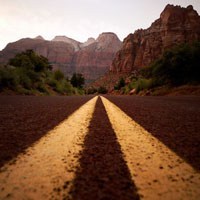
The post The Vanishing Point: 10,000 Hours Ahead appeared first on Doug Walsh.
March 18, 2016
5 Links Fridays #11
I’m going to break from the recent trend of ever-lengthening introductions to my weekly 5 Links Fridays posts and make this the shortest one yet. But for a good reason! I began work this week on a videogame strategy guide, my first one since early 2014 when I finished up the Diablo III: Reaper of Souls book (gotta love these names). I can’t tell you what I’m working on — yet — but due to a serious time crunch and circumstances beyond our control, I should be done within a week or two at the absolute most.
There but for the power of coffee go I.
I do have one interesting anecdote to share though. I recently re-read one of my all-time favorite novels, Water for Elephants, and there in the back of the book was an interview with Sara Gruen detailing her transition from technical writer to novelist. She explained that it was only through her spouse’s urging that she finally devote herself to her fiction. But, even then, she was occasionally sidelined by the temptation to pick up freelance projects to help pay the bills (this I can relate to: this strategy guide covers my new mountain bike and our trip to Portugal later this year). Nevertheless, the spouse had gotten a promotion, she was between jobs, and he basically told her to take 1 to 2 years and focus on writing that novel she’d been dreaming of writing. At least then she’d have her answer and wouldn’t have to wonder “what if” the rest of her life. I’m paraphrasing, but the reason I do is because that was exactly the conversation I had with my wife as we decided to return from our trip. It worked out wonderfully for Sara Gruen; I’ll consider it a resounding success if anything I write reaches a fraction of her audience. On to the links…
Bookish Links
– How does an author come up with a title for their book? This article by actress-turned-writer Katherine Wilson discusses the process of how she came up with the title for her book/memoir about moving to Naples, Italy. She even discusses the unsolicited suggestions she received from well-meaning family and how it was finally her editor who encapsulated the book in a simple straightforward title. For those curious, the working title of my novel is Tailwinds Past Florence. It had a different title for several months until a lengthy brainstorming session aboard the cargo ship landed me on that one. I briefly considered Tailwinds Past Firenze but a quick glance at Google Trends revealed that NOBODY uses the Italian word for Florence. At least not on the English-speaking side of the Internet.
When a Literary Agent Says Yes – Indie versus traditional routes aside, this is a really informative article about what to look for in a literary agent and how to know which one is right for you, supposing you are offered representation. This even includes fifteen questions and topics to discuss with the agent as you interview them. The big takeaway: they work for you, make sure they have your best interests in mind.
Writing the Book Was the Easy Part – My friend Jennifer Lesher wrote this several months after her first novel, Raising John, was released. In this post she shares the lessons she learned about how she successfully (and sometimes less so) handled the marketing of her book. In today’s world, all authors need to know how to do this, whether you self-publish or land a book deal. Some good tips here.
The Seven Soul Types – What Do they Look Like? –This article, complete with illustrations, helps to understand what various archetypes look like in terms of facial features. From the Priest to the Scholar to the King to the Artisan, this article suggests that, over time (yes, there are exceptions) the qualities of a certain soul type wind up having specific facial characteristics. Or maybe they don’t and it’s just the eye of the beholder projecting our own interpretations onto certain face types. I don’t know. But I do know that, when it comes to helping with describing (and understanding) the appearance of your characters, this is a helpful article.
8 Reasons to Catalog Your Books – Has your book collection gotten out of hand? Do you struggle to find a particular book when looking to loan it to a friend? This article by Emma Nichols discusses why you should — and how you can — create a catalog for your book collection. Sadly, my collection resides almost entirely on my Kindle.
Bonus Link!
The Highest Unpaved Cycling Roads in the Alps – I’m starting to prep for an off-road crossing of Washington State in early June and though it will certainly be an adventure, the terrain will be a far cry from what you’ll see in this article. Beautiful photos, elevation profiles, and route descriptions for 15 of the highest unpaved roads in the Alps is certainly enough to get my wanderlust juices flowing. Enjoy the weekend folks.
Post Image by Alexandre Duret-Lutz, used under Creative Commons
The post 5 Links Fridays #11 appeared first on Doug Walsh.
March 15, 2016
2015 in First Sentences
Now that we’re halfway through the month of March, it’s time to finally dig into the books I read in 2015 and complete the next installment in my Opening Sentences series. My Goodreads records indicate I read 33 books last year and, once again, I’ll be splitting them up between Fiction and Non-Fiction and leaving aside any how-to books or others that dispense with a narrative. Unlike in 2014, I read a lot more contemporary works last year (Homer and Shakespeare aside) and my split between fiction and nonfiction wasn’t nearly as even. As I came to realize I’d be moving into fiction, I began reading more of it.
So, if you missed my earlier posts in this series, here’s the gist: I take a look at the first sentence from each book I read in a given year and critique it’s effectiveness as it pertains to hooking the reader’s attention and making them ask questions. A good opening line should spur the reader’s mind to curiously demand answers to the questions of who, what, why, when, where, and how. At least I think so, anyway.
Fiction
As with 2014, I spent nearly all of 2015 living out of cycling panniers and, at times, a wheelie-duffel. I continued to read books set in the areas where we were traveling — this list contains some wonderful books set in Japan, Greece, Turkey, and Bali — but also, thanks to constant urging from a certain sister of mine, I finally began reading the Harry Potter series as well. Unlike in 2014, the majority of the authors I read in 2015 are still with us.
1) Shogun by James Clavell (1975)
The gale tore at him and he felt its bite deep within and he knew that if they did not make landfall in three days they would all be dead.
An excellent example of thrusting the reader into the thick of the action. Without specific mention of a ship at sea, we know from words like “gale” and “landfall” that our character — the unnamed him — is in a dire predicament on a tossing ocean. That they have just days to live raises the stakes to their highest level right off the bat. Shogun was one of my favorite books of 2015, an excellent piece of historical fiction that I’ll be discussing in greater detail in the coming weeks.
2) The Sound of Waves by Yukio Mishima (1954)
Uta-Jima — Song Island — has only about fourteen hundred inhabitants and a coastline of something under three hundred miles.
The Sound of Waves is one of the simplest, most beautiful love stories I’ve ever read, yet this opening is dry as dirt. If I didn’t tell you it was a love story, you might mistake this opener for the first lines of an incomplete Wikipedia entry. Though the island does play a large role in the story, this is a pretty poor way to begin a novel in my opinion.
3) Gates of Fire by Steven Pressfield (1998)
In 480 B.C. the forces of the Persian Empire under King Xerxes, numbering according to Herodotus two million men, bridged the Hellespont and marched in their myriads to invade and enslave Greece.
The above line is from the historical note that precedes the first part of the narrative (an opening sentence that serves only to list several dozen titles and nicknames of Xerxes). This statement of historical fact is not only integral to the story, but the style in which it was written — one that is very formal, from a position of authority — sets the tone for the book to follow. Gates of Fire is a terrific historical fiction novel about the 300 Spartans that held off the million Persians, as told by a fictitious lone surviving Spartan to Xerxes himself. Reading this book as we cycled across the Peloponnese en route to Sparta and Athens really helped bring the landscape to life.
4) The Art of Fielding by Chad Harbach (2011)
Schwartz didn’t notice the kid during the game.
This simple opener hints to something unusual about the kid, perhaps a greatness that went undetected earlier. Perhaps something far worse? We don’t know, but we’re curious. This line also suggests that Schwartz is the protagonist (or at least the narrator) but he’s not. The story is really a multi-plot novel involving the intertwined stories of five different POV characters (and a sixth character who arguably plays the largest role in the story despite not getting the POV treatment). Usually the first named character is going to be the protagonist, but it’s a rule that needn’t be followed strictly. Especially in literary fiction.
5) Harry Potter and the Sorcerer’s Stone by J.K. Rowling (1997)
Mr. and Mrs. Dursley of number of four, Privet Drive, were proud to say that they were perfectly normal, thank you very much.
Obviously the Dursleys are not the protagonists of the story (the book’s title tells us as much), proving again that the first named characters need not always be significant. What this opening sentence does so well is that it sets the tone of the narration — you can just hear the condescension in their voices, “we are perfectly normal, thank you very much.” It also suggests that there are those who are not normal in this story’s world and that, more importantly, the Dursleys are at odds with those who aren’t like them.
6) Harry Potter and the Chamber of Secrets by J.K. Rowling (1998)
Not for the first time, an argument had broken out over breakfast at number four, Privet Drive.
One of the things I loved about the Harry Potter books, and that I suspect was wholly intentional to make them even more accessible to younger readers, was that the beginning of each of the first few books takes place around the time of Harry’s birthday, during summer break, in the home of the Dursley’s. Readers picking up the second book will immediately feel pity for poor Harry having to once again deal with his cruel muggle relatives.
7) Harry Potter and the Prisoner of Azkaban by J.K. Rowling (1999)
Harry Potter was a highly unusual boy in many ways.
Yes, we know. We’re two books into a series that has many characters and events that can be considered highly unusual. Sure, we readers are always interested in discovering additional facets of Harry’s uniqueness, but this is a pretty bland opener that doesn’t tell us anything we don’t already know, nor does it help to set the place.
8) Harry Potter and the Goblet of Fire by J.K. Rowling (2000)
The villagers of Little Hangleton still called it “the Riddle House,” even though it had been many years since the Riddle family had lived there.
It’s still the summer before another school year begins at Hogwarts, but we’re not beginning it in the unusual way. Instead, Rowling introduces a new town — Little Hangleton — and a family we’ve never before heard of. This, as a growing Potter fan, was as startling as it was refreshing. Though I particularly enjoyed the customary way in which each of the prior three books had begun, that setup couldn’t continue forever. This was a great change of pace that immediately got my attention. I hope to read books five through seven later in 2016.
9) Birds Without Wings by Louis de Bernieres (2004)
The people who remained in this place have often asked themselves why it was that Ibrahim went mad.
Well now you have me curious too. Why did Ibrahim go mad? Who is Ibrahim? Where is this place you speak of and why did most of the residents leave; if I’m correct in assuming something drove many of them away. Or were they killed? By hinting at the madness of Ibrahim, the author reveals a snippet of the future. We carry this knowledge with us throughout the book and it helps us to better understand the events that follow and see how they may affect the characters of the story. It’s a very subtle foreshadowing that can be quickly forgotten if we’re not careful.
10) The Winter Sea by Susanna Kearsley (2008)
It wasn’t chance. There wasn’t any part of it that happened just by chance.
Something significant had just happened and, by the narrator’s tone, we’re led to believe that whatever it was cannot be easily explained or chalked up to mere coincidence. We aren’t told much in these opening lines, but we’re intrigued. Sort of. For as much as I enjoyed this book, a piece of historical fiction set in early 18th century Scotland, this particular opening line, when looked at in isolation, is one of the weaker of the lot.
11) Tender Mercies by Kitty Thomas (2011)
“Darcy.” She turned at the sound of Asher’s voice and smirked, wiggling her ass at him.
We’re introduced to two characters right off the bat and, in case there was any question about language, tone and content, the author answers it right there in the beginning of the book. We know there’s a sexual playfulness in the relationship between Darcy and Asher. We have no indication of the cruel and at-timed disturbing story that’s about to unfold. Nevertheless, we’re curious.
12) The Wind is Not a River by Brian Payton (2013)
When John Easley opens his eyes to the midday sky his life does not pass before him.
A lot of writers say it’s unnecessary (and some say it’s bad form) to use the character’s full name at the first mention, but I want to think that it can help with tone. This book takes place in the 1940s, during a time when introductions were more formal. You can just picture it: “John Easley, nice to meet you,” as he reaches out to shake your hand. Of course, John isn’t shaking hands in this opening line. His life does not pass before him, but perhaps it should have. If we read between the lines we can surmise John just had a near-death experience and, contrary to the cliche, his life did not pass before his eyes.
13) The Iliad by Homer (800 B.C.E.)
In the war of Troy, the Greeks having sacked some of the neighboring towns, and taken from thence two beautiful captives, Chryseis and Briseis, allotted the first to Agamemnon, and the last to Achilles.
This is taken from the “Argument” that precedes Book I in the epic poem. The version I read included this “Argument” before each major section of the roughly 700-page poem to help explain the events that follow. So, while the above wasn’t actually in the poem, it’s still the opening line of the book concerning the battle of Troy and Achilles’ reluctance to take part in it. This first sentence, stated in the manner of exposition, is of vital importance to the story that follows as Agamemnon decides to eventually take Achilles’ bride for his own. This opener teller us that Agamemnon and Achilles fought on the same side (the former is a king) and that they were prone to split the spoils, including women. As far as an opening goes, it doesn’t leave us with too many questions, but we are curious about the fate of the women.
The true first sentence of The Iliad is as follows:
Of Peleus’ son, Achilles, sing, O Muse,
The vengeance, deep and deadly; whence to Greece
Unnumbered ills arose; which many a soul
Of mighty warriors to the viewless shades
Untimely sent; they on the battle plain
Unburied lay, a prey to rav’ning dogs,
And carrion birds; but so had Jove decreed,
From that sad day when first in wordy war,
The mighty Agamemnon, King of men,
Confronted stood by Peleus’ godlike son.
14) Mother Night by Kurt Vonnegut (1961)
This is the only story of mine whose moral I know.
This sentence not only makes us wonder what the moral is that he’s referring to, but makes us question the validity of the unnamed stories this narrator may have told elsewhere. Beginning a book with a confession like this is one of my favorite techniques. I believe it puts the reader on the side of the narrator, as it makes them not only seem more human, but as if there’s a secret bond between them. When someone confides in us, particularly something that may be deemed embarrassing, we tend to feel closer to them and trust their words more. We know we’re not perfect and are drawn to those who admit their own shortcomings.
15) Twelfth Night by William Shakespeare (1601)
If music be the food of love, play on,
Give me excess of it; that, surfeiting,
The appetite may sicken and so die.
This comedic play begins in the apartment of the Duke’s Palace. The Duke is present, along with Curio, several Lords and musicians. The melancholy Duke is wallowing in his own pity concerning the unrequited love he feels for a woman who wants nothing to do with him. He wants to stuff himself fill with music in hopes that his yearning may finally draw to an end. This opening line is one of the most famous of the play and even it can only truly be understood (to me, at least) with the benefit of re-reading and hindsight.
16) The Aftermath by Rhidian Brook (2013)
The beast is here. I’ve seen him. Berti’s seen him. Dietmar’s seen him.
I’ve included four sentences here and we still have very little idea what is going on, where the story is taking place, or what this “beast” is. We know there’s a character called Berti and another called Dietmar, the latter of which is clearly of German descent. But that’s it. We’re curious as to what the beast is — that word, beast, surely refers to nothing pleasant. And if the narrator saw it and Berti and Dietmar saw it as well, it’s only fair that we should see it too! For some reason this opening paragraph ends with closed quotation marks, yet there are no opening quotes anywhere in the paragraph. Probably just a result of sloppy e-book conversion.
17) Inside Charlotte by Jo B. Hayve (2015)
Cornstalks. Charlotte was watching cornstalks.
We have a character name and a semblance of setting, but little else. I don’t much care for the one-word opening sentence so I included the second just to have something more useful. But even then, we’re left with little information and little curiosity. Charlotte is watching cornstalks. So what? We’re certainly not thrust into the thick of things (though we soon will be). And yes that is a psuedonym serving for the author who didn’t want to lay claim to this provocative and at-times (most of the time!?) raunchy piece of erotic fiction.
18) Love and Death in Bali by Vicki Baum (1937)
It must, I think, have been in 1916, a time when Europe was too much preoccupied to remember the existence of a little island called Bali, that I came by chance into the possession of some very beautiful photographs.
Here we have a story being told through recollection about a time and place few in the Western world know about, let a lone experienced. We’re curious about the photographs the narrator mentions and of this exotic-sounding place called Bali. We know from the title that there is going to be love and there will be death and, if we know our history, we know that Bali (in fact much of Indonesia) was under Dutch control in the early part of the 20th century. We want to hear this man’s (or woman’s?) story.
19) Evil and the Mask by Fuminori Nakamura (2013)
While that big case was moving towards an unexpected solution, the fact that several unnatural deaths surrounded it was barely mentioned.
The above sentence was extracted from a “Detective’s Diary” that serves as a prologue of sorts to the story. It tells us that we have a detective who will be serving as a narrator (at least some of the time) and that there is a surprise twist in a major case he’s been working on. The “unexpected solution” interests us, but it’s what comes after the comma that really gets our attention. Few things pique a reader’s curiosity more than a detective-narrator admitting to unnatural deaths either going unmentioned or, worse, being covered up.
Just because it was executed so wonderfully, I want to include the first sentence of the first chapter here as well:
“Now I’m going to tell you some important facts about your life.”
20) Texas Blood Feud by Dusty Richards (2009)
The acrid smoke from the blazing live oak fire swirled around his batwing chaps when Chet picked up the branding iron.
Holy adjectives! This is a prime example of overwriting the description. It’s a common flaw — something all writers do at one point or another (I know I have) — but to have this much of it in an opening sentence is really jarring. We don’t need to know precisely what species of tree is being burned in the fire. Isn’t nearly all smoke acrid? We know what chaps are, but few of us have probably heard of batwing chaps or know the difference. The most important part of this sentence — Chet picking up a branding iron — is almost lost in the description. I really enjoyed the story being told in this book, but the writing was of a lower quality than I’m used to reading and made it hard to finish.
21) Magic Bridge by Thomasina Burke (2011)
Once we told them, our friends always asked something like, “How did you ever come up with this hare-brained pact to scatter your ashes?”
This book is written in a documentary-style, as if the main characters are all sitting in separate rooms taking turns telling their version of what went on. It’s a very beautiful love story that moves from boy-meets-girl to girl-outlives-boy to girl-scatters-boys-ashes-around-the-world. The opening sentence succeeds in making us wonder what the ashes-spreading pact was. Unfortunately, the characters were infused with so much egotism and condescension that it really made it hard to get through the story. Cliched phrases like “hare-brained” are commonly used throughout the book to bolster the narrator’s opinion of herself. Oh, we’re soooo wild and and crazy. Ugh. I cannot remember reading a book with a more unlikeable set of characters.
Post Image by Nathan, used under Creative Commons.
The post 2015 in First Sentences appeared first on Doug Walsh.