Ronda Parsons's Blog, page 2
May 28, 2015
Daily Press Book Round-Up
“Creating Joy & Meaning for the Dementia Patient: A Caregiver’s Guide in Connection and Hope” by Ronda Parsons. Nonfiction/Self-help. Part memoir, part self-help book offering techniques to bring joy and meaning to the lives of those stricken with dementia. Parsons, of Williamsburg, is a sales professional who cared for her mother-in-law for 10 years.
Posted May 4, 2015



Amazon #1 Bestseller
Enter to win 1 of 2 autographed copies of Creating Joy & Meaning for the Dementia Patient in a Goodreads Giveaway!
Click to Enter!


April 16, 2015
The Turning Point
Caregiving is not for sissies. No experience in your life can prepare you for the daily challenges you face when caring for a dementia patient. It is physically draining, heartbreakingly sad, and stretches your patience to limits you never thought you possessed. It rearranges the tiny molecules that hold a family together. It reassigns the roles that we have played for a lifetime; mother becomes daughter, daughter becomes mother. It is like watching someone slip into a dream while they are still awake.
I know this to be true because I spent ten years caring for my mother-in-law, Nan, as she spiraled down through the stages of this devastating illness. I know what it means to care for a dementia patient day-in and day-out for many years. I know that it is a demanding reality that can bring the most loving caregiver to their emotional breaking point. For dementia doesn’t just affect the sufferer, but reaches its tentacles into the lives that orbit around the patient, often leaving them exhausted and defeated.
Initially when I began caring for Nan I was in a defensive mode, solving problems as they were thrown at me. I’d lie awake at night attempting to fix unfixable problems, searching for answers when none existed. I made lists, attacked daily problems with vigor, all the while feeling taxed and frustrated. And the sad truth was that despite my efforts, Nan continued to spiral further and further into oblivion. Neither of us was making progress. My initial plan wasn’t working.
Through observation I had come to realize that Nan no longer lived in a world made up of days or even hours, but instead she lived inside spontaneous flashes of reality. In other words, she was living her life from moment to moment. As quickly as recognition arrived, it was gone again. I knew instinctively that although her understanding was temporary, these moments were not unimportant.
So I set about creating activities that would bridge the gap between the outside world and her awareness by focusing on instincts universal to us all – the beauty of nature, our six senses, the power of music, the love of family, and the balm of laughter. We sat outdoors, touched flowers and fed birds. We leafed through a clearly labeled family album I made for her. We sang hymns and listened to her favorite music. Occasionally we even danced together. (Yes, I found that a wheelchair can easily roll to jitterbug music.) We ate her favorite foods, painted her fingernails and scented her room. We prayed and talked about the many blessings in our lives. I constantly reminded her that she was a good and wonderful person who had led a splendid life. And as the disease progressed, we watched cartoons and took turns holding her dolly. Each day I tried to create little surprises that would ignite even the briefest moment of spontaneous happiness.
Soon I discovered that no happiness was too small or its effect too insignificant to affect positive change. For when she was content and at peace, the old Nan from long ago would suddenly appear out of nowhere in the guise of a familiar comment or facial expression. These moments became the encouragement that I needed to work harder to build a bridge of connection between us. Those moments reminded me of the woman I missed so terribly and proved to me that she was still in there, lost in dementia’s thick fog. I made it my mission to harness these moments and utilize their power in order to bring joy and meaning into her life.
Granted I wasn’t always successful. But slowly my small achievements began to build and it wasn’t long before our connection grew. I found that as my attitude relaxed and calmed, so did Nan’s. I learned that as a caregiver, I possessed the power to alter the tempo and undercurrent of our relationship. I could choose to inject hope and understanding into this heartbreaking situation. And since then, somehow amid all the confusion, we have been able to share surprising moments of unexpected joy and love.
Little did I know at the time, but experts in the field of dementia were in agreement with my approach to Nan’s care. The plan that I developed naturally through intuition is in fact in alignment with methods that are being implemented in both the United States and Europe. This knowledge gives me hope — hope that families will begin to celebrate what a dementia patient can bring to their lives, rather than see them as an inconvenience to be relegated to the sidelines. It gives me hope that others are also embracing the concept that under certain circumstances, it is best to focus on the quality of our days, rather than the quantity. And mostly, it validates that my approach increases the likelihood that I am bringing joy and meaning into Nan’s life.


February 20, 2015
My book can be pre-ordered on Amazon.
Creating Joy and Meaning for the Dementia Patient, A Caregiver’s Guide to Connection and Hope can be pre-ordered through the following link.


Release date for my book is May 16, 2015
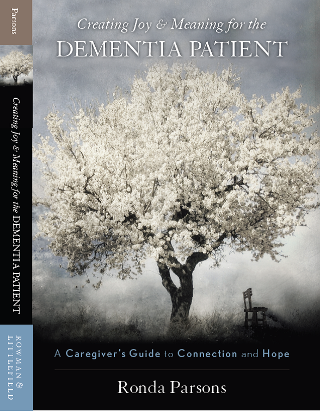
Hello Everyone,
I’ve been busy putting all the finishing touches on my book called Creating Joy and Meaning for the Dementia Patient, A Caregiver’s Guide to Connection and Hope. It tells of my personal journey as caregiver to my mother-in-law, Nan.
It is a fresh and inspirational approach to caring for the dementia patient. By understanding that the life of the dementia sufferer is lived in small increments of time, the caregiver is able to create moments of joy and contentment within the confines of this debilitating disease.
My guide explains how to connect the patient to the world around them so that they can experience the fundamental pleasures of life like nature, beauty, spirit, humor and joy. I recount my personal journey in the hope that I will leave the reader uplifted and brimming with hope. Based on 10 years of caregiving experience, I provide advice to caregivers concerning every aspect of the patient’s life.
My greatest wish is to rekindle hope for those who are striving to remain connected to their loved one for as long as possible. I share techniques designed to honor the individual that still resides deep inside each dementia patient so that they may continue to experience the simple joys of everyday life.
Published by Rowman and Littlefield Publishers.


October 3, 2014
Facing the Truth
When the early stages of dementia begin to present themselves it is a particularly devastating time for the patient and their family. Because symptoms can be so subtle and seem to appear and then vanish, family members often undervalue the severity of the problem. After all they look the same don’t they? There is no visible sign of their disease. And to make matters more confusing there are times when they are perfectly rational and able to function beautifully. This feeds into a family’s collective wishful thinking that none of this is really happening. They tell themselves, ‘We are overreacting. It is just a bad day. Soon things will be back to normal. Maybe this is just a rough patch. They are getting older after all.’ Driven by fear they create a kind of grand illusion that in the final analysis only wastes time, creates conflicts and delays constructive goal setting. Fear in this situation not only blocks us from reality but can place our loved one in jeopardy.
Helplessly watching someone you love slowly change and slip away is unfathomably sad and frightening. Each new symptom is like a punch in the stomach. The slowness of it only adds to your agony and increases your fear of what the future holds. I know this first hand, because I spent nearly ten years looking after my mother-in-law Nan, as she plummeted down through the chasm of this disease.
Fear is an odd and deceptive emotion, a chameleon of sorts. One minute it can appear as anger; the next as frustration. It has a negative impact on our behavior and feelings. When fighting dementia, fear often outruns our patience and taints our common sense, leaving us to march in futile circles around the same mountain again and again. Fear stifles our compassion and constructs insurmountable walls against the truth. Fear clouds our vision leaving us to search in the dark for answers that were in front of us all along.
In order to be effective in any sorrowful situation, we must face things as they really are, accept what we know to be true and keep moving forward one step at a time. Don’t feel defeated if you have spent too long consumed with worry for your loved one. It is never too late to work through your fears and quiet the negative voices that play in your mind.By sharing my experiences I hope to show you how to move forward in this process. I want to encourage you to offer yourself the same patience and compassion that you shower on your loved one. For it was only when I stopped being afraid of Nan’s future and how it was going to impact me, that I was able to accept her prognosis and open my eyes to the many blessing still present in her life.


September 19, 2014
Come join me on a journey filled with joy and hope.

Sing the Song of the Moment
Sing the song of the moment in careless carols, in the transient light of the day;
Sing of the fleeting smiles that vanish and never look back;
Sing of the flowers that bloom and fade without regret.
Let your laughter flush in meaningless mirth like twinkles of light on the ripples;
Let your life lightly dance on the verge of Time like a dew on the tip of a leaf.
Strike in the chords of your harp the fitful murmurs of moments.
- Rabindranath Tagore
I would like for you to consider a fresh and inspirational approach to caring for the dementia patient. By understanding that the world of a dementia sufferer is lived in small increments of time, caregivers are able to create moments of joy and contentment within this debilitating disease. This blog is a guide that will explain how to connect your loved one to the world around them so that they can experience the fundamental pleasures of life, like music, humor, nature, beauty, spirit and joy.
Having been a caregiver to a dementia patient for the past ten years, I know that you and I have walked the same path and faced the same obstacles. My greatest wish is that my experiences will help you find joy along your journey so that you can embrace the miraculous possibilities of hope.