Rebecca Stonehill's Blog, page 66
July 24, 2015
Why ‘Good Ideas’ is a MUST HAVE on every parents bookshelf

I don’t very often read how-to parenting books. They can leave me feeling frustrated when I try to put into practice their advice but it ends up backfiring, leaving me with bad-tempered children and wondering where I went wrong. But Michael Rosen’s book, ‘Good Ideas – How to be your child’s (and your own) best teacher‘ is definitely an exception to this. It is inspiring, practical, down-to-earth and served up with a healthy dollop of Rosen’s customary good-humour, embracing trial and error as an integral part of the out-of-the-classroom learning experience. Eschewing box-ticking and learning taking place solely in formal settings, not only are the ideas that Rosen throws up fun and fascinating for kids, but it re-awakens curiosity in adults, drawing us back to that innate inquisitiveness that slowly left us as we grew out of our childhood skins.
Former Children’s Laureate, broadcaster, writer, poet and so much more, Michael Rosen peppers his book with references to his own childhood and how his experiences growing up formed the canvas and backdrop of his own education. We often think of learning taking place primarily at school or university, but Rosen argues that we live in a world in which ideas, knowledge and learning can be drawn from a whole multitude of settings if we are only open to it. In his own words,
‘When people ask me about my education, I think of course about my schools and universities but part of me always wants to say, ‘And the back yard, window-sills and the alleyway where I lived.’
So how, exactly, can we and our children gain the kind of long-lasting, meaningful knowledge we all crave? Rosen divides his book into clear sections, taking us through all the different places where good ideas can come from: The Home, Outdoors, The Street, Travelling and Holidays and Days Out, Outings and Visits. Let’s take The Home for example, not only does he dive into what makes the kitchen or sitting room interesting places of learning, but goes a step further, devoting a whole chapter to ‘The Loo’. Because come on, let’s face it, all children have a fascinating from a young age with wee and poo! (My four year old loves to shout these words at every possibility). If the cistern breaks, don’t just call in the plumber, lift the lid off with your kids and see how it all works in there to enable the loo to flush. This is, Rosen argues, ‘home technology at its best.’ What are some amusing rude rhymes that your children know (and that you can remember from your own childhood?) How do our digestive systems actually work? How come some animals can cope with swallowing down great chunks of food (or smaller animals) and others need to meticulously chew? Who invented the toilet? How do they differ culturally around the world and taboos surrounding going to the toilet?
There are so, so many questions that can be asked if we keep alive that crucial element of curiosity. Children have this naturally, but as parents or teachers, we can encourage this by suggesting interesting questions as a springboard to deeper learning.
Rosen finishes his book with some ideas to get children writing (which has proved invaluable for my Magic Pencil workshops), suggestions of supplies to have at home, advice about books and some fun puzzles which my nine year old has gleefully dived into from time to time.
I honestly cannot recommend this book enough. It needs to be on the bookshelf of every parent up and down the land, no matter the age of their children. Please, buy it now. It might just be the best thing you have bought for your children (and yourself) this year.
I’d like to leave you with the advice Rosen gives the reader in his introduction which was given to him by his older brother and parents. Inspiring stuff.
1. Be curious. Endlessly curious. Go on asking questions. Never stop wondering why. Or how. Or when. Or where. Never stop wondering why or how one thing links to another. How something changed. How one thing turned into another. How something died out. How something else started up. Be curious, they said.
2. Anything out there, any knowledge, any culture, anything going on, can be yours, they said. You are entitled to find out about it, enjoy it, go there, do it, be it. There are no walls, nothing is too posh or un-posh, nothing is too highbrow or lowbrow. Don’t let anyone block you off from any of it. Don’t block yourself off from any of it. Just give yourself a chance with any of it. Give it a go.
The post Why ‘Good Ideas’ is a MUST HAVE on every parents bookshelf appeared first on Rebecca Stonehill.


Book Review: Good Ideas. How to be your child’s (and your own) best teacher
I don’t very often read how-to parenting books. They can leave me feeling frustrated when I try to put into practice their advice but it ends up backfiring, leaving me with bad-tempered children and wondering where I went wrong. But Michael Rosen’s book, ‘Good Ideas – How to be your child’s (and your own) best teacher‘ is definitely an exception to this. It is inspiring, practical, down-to-earth and served up with a healthy dollop of Rosen’s customary good-humour, embracing trial and error as an integral part of the out-of-the-classroom learning experience. Eschewing box-ticking and learning taking place solely in formal settings, not only are the ideas that Rosen throws up fun and fascinating for kids, but it re-awakens curiosity in adults, drawing us back to that innate inquisitiveness that slowly left us as we grew out of our childhood skins.
Former Children’s Laureate, broadcaster, writer, poet and so much more, Michael Rosen peppers his book with references to his own childhood and how his experiences growing up formed the canvas and backdrop of his own education. We often think of learning taking place primarily at school or university, but Rosen argues that we live in a world in which ideas, knowledge and learning can be drawn from a whole multitude of settings if we are only open to it. In his own words,
‘When people ask me about my education, I think of course about my schools and universities but part of me always wants to say, ‘And the back yard, window-sills and the alleyway where I lived.’
So how, exactly, can we and our children gain the kind of long-lasting, meaningful knowledge we all crave? Rosen divides his book into clear sections, taking us through all the different places where good ideas can come from: The Home, Outdoors, The Street, Travelling and Holidays and Days Out, Outings and Visits. Let’s take The Home for example, not only does he dive into what makes the kitchen or sitting room interesting places of learning, but goes a step further, devoting a whole chapter to ‘The Loo’. Because come on, let’s face it, all children have a fascinating from a young age with wee and poo! (My four year old loves to shout these words at every possibility). If the cistern breaks, don’t just call in the plumber, lift the lid off with your kids and see how it all works in there to enable the loo to flush. This is, Rosen argues, ‘home technology at its best.’ What are some amusing rude rhymes that your children know (and that you can remember from your own childhood?) How do our digestive systems actually work? How come some animals can cope with swallowing down great chunks of food (or smaller animals) and others need to meticulously chew? Who invented the toilet? How do they differ culturally around the world and taboos surrounding going to the toilet?
There are so, so many questions that can be asked if we keep alive that crucial element of curiosity. Children have this naturally, but as parents or teachers, we can encourage this by suggesting interesting questions as a springboard to deeper learning.
Rosen finishes his book with some ideas to get children writing (which has proved invaluable for my Magic Pencil workshops), suggestions of supplies to have at home, advice about books and some fun puzzles which my nine year old has gleefully dived into from time to time.
I honestly cannot recommend this book enough. It needs to be on the bookshelf of every parent up and down the land, no matter the age of their children. Please, buy it now. It might just be the best thing you have bought for your children (and yourself) this year.
I’d like to leave you with the advice Rosen gives the reader in his introduction which was given to him by his older brother and parents. Inspiring stuff.
1. Be curious. Endlessly curious. Go on asking questions. Never stop wondering why. Or how. Or when. Or where. Never stop wondering why or how one thing links to another. How something changed. How one thing turned into another. How something died out. How something else started up. Be curious, they said.
2. Anything out there, any knowledge, any culture, anything going on, can be yours, they said. You are entitled to find out about it, enjoy it, go there, do it, be it. There are no walls, nothing is too posh or un-posh, nothing is too highbrow or lowbrow. Don’t let anyone block you off from any of it. Don’t block yourself off from any of it. Just give yourself a chance with any of it. Give it a go.
The post Book Review: Good Ideas. How to be your child’s (and your own) best teacher appeared first on Rebecca Stonehill.
July 17, 2015
Where to find some fabulous poetry activities for kids

One of the best websites I have ever found for inspirational kids’ poetry workshops ideas comes from the Poetry Society. I have used countless exercises via their downloadable lesson plans, adapting them as necessary to suit my needs. Recently, I used poet Roger Stevens’ Animal Menagerie activity as a springboard for children producing their own work. Now animals, in my opinion, are nearly always a winner. Nine times out of ten, children get enthused about animals, whether they have cats slinking up their stairs at home, chickens running round their yards or a pet spider they keep in a matchbox. Ever noticed the number of kids books that are written either from the perspective of an animal or about an animal? This is testament to the enduring connection that children have with our furry, winged or finned friends. Which is why it’s definitely worth planning some creative writing around the animal kingdom.
The poetry society, of course, came up trumps with Animal Menagerie. Not only does this activity get kids working together, but it can get them focusing on alliteration and writing brilliant, fun poetry without them even realising. In brief, here’s what you do:
On the board, write In Mr Magoo’s Amazing Zoo you will find… (or substitute zoo for safari park / pet shop /farm etc and find a rhyming name)
Now, draw two columns. On the right side, ask the class to give you ideas of six animals. Don’t be tempted to change them, just write down whatever comes up. Next, it’s time to ask the class for different adjectives that can go with each animal. Here, you can stretch the children. For example, if they come up with a ‘tall giraffe’, challenge them by saying we all think of giraffes as being tall and what else comes to mind?
Before you know it, you’ll have your first group poem! For example:
In Mr Magoo’s Amazing Zoo you will find
A lazy lion
A mischievous monkey
A ferocious tiger
A cunning snake
An eight-legged octopus
and a grumpy rhinoceros.
Yes, it really is that simple to write a poem. But now it’s time to put the children into pairs and small groups and ask them to come up with their own poem. For very young kids, they can do something similar to the above, for older or more able students ask them to add some alliteration in (a languid lion, a sinister snake, a rambunctious rhino). They can set their poem in whichever place they like and, in a more able or older group, really get them to play with and stretch their poem out. Some ideas for this:
– Thinking of more than six animals
– Finding multiple adjectives for each animal
– Get each animal doing an activity (e.g. a languid lion licking her cub’s fur)
– Use rhyme
– Use metaphor and / or simile (e.g. a rhino like a runaway tank / a boulder of a bear

Animal Menagerie really is fun and light-hearted and is sure to get children scribbling away, even the most reluctant of writers. Of course they don’t need to work on the final version in pairs or in groups, this can also be a focussed independent activity. You just need to play around with it to see what best suits your group.
Enjoy!
The post Where to find some fabulous poetry activities for kids appeared first on Rebecca Stonehill.
Animal Menagerie
One of the best websites I have ever found for inspirational kids’ poetry workshops ideas comes from the Poetry Society. I have used countless exercises via their downloadable lesson plans, adapting them as necessary to suit my needs. Recently, I used poet Roger Stevens’ Animal Menagerie activity as a springboard for children producing their own work. Now animals, in my opinion, are nearly always a winner. Nine times out of ten, children get enthused about animals, whether they have cats slinking up their stairs at home, chickens running round their yards or a pet spider they keep in a matchbox. Ever noticed the number of kids books that are written either from the perspective of an animal or about an animal? This is testament to the enduring connection that children have with our furry, winged or finned friends. Which is why it’s definitely worth planning some creative writing around the animal kingdom.
The poetry society, of course, came up trumps with Animal Menagerie. Not only does this activity get kids working together, but it can get them focusing on alliteration and writing brilliant, fun poetry without them even realising. In brief, here’s what you do:
On the board, write In Mr Magoo’s Amazing Zoo you will find… (or substitute zoo for safari park / pet shop /farm etc and find a rhyming name)
Now, draw two columns. On the right side, ask the class to give you ideas of six animals. Don’t be tempted to change them, just write down whatever comes up. Next, it’s time to ask the class for different adjectives that can go with each animal. Here, you can stretch the children. For example, if they come up with a ‘tall giraffe’, challenge them by saying we all think of giraffes as being tall and what else comes to mind?
Before you know it, you’ll have your first group poem! For example:
In Mr Magoo’s Amazing Zoo you will find
A lazy lion
A mischievous monkey
A ferocious tiger
A cunning snake
An eight-legged octopus
and a grumpy rhinoceros.
Yes, it really is that simple to write a poem. But now it’s time to put the children into pairs and small groups and ask them to come up with their own poem. For very young kids, they can do something similar to the above, for older or more able students ask them to add some alliteration in (a languid lion, a sinister snake, a rambunctious rhino). They can set their poem in whichever place they like and, in a more able or older group, really get them to play with and stretch their poem out. Some ideas for this:
- Thinking of more than six animals
- Finding multiple adjectives for each animal
- Get each animal doing an activity (e.g. a languid lion licking her cub’s fur)
- Use rhyme
- Use metaphor and / or simile (e.g. a rhino like a runaway tank / a boulder of a bear
Animal Menagerie really is fun and light-hearted and is sure to get children scribbling away, even the most reluctant of writers. Of course they don’t need to work on the final version in pairs or in groups, this can also be a focussed independent activity. You just need to play around with it to see what best suits your group.
Enjoy!
The post Animal Menagerie appeared first on Rebecca Stonehill.
July 10, 2015
Which kids’ book inspired one man to cycle across the globe?
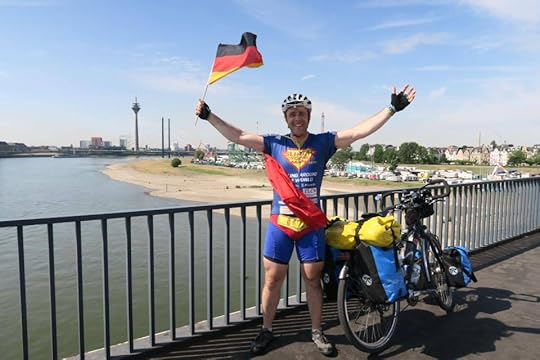
SuperCyclingMan, currently in Germany
I have a friend I went to university with, Will Hodson, who is currently at the start of a five year cycling journey that will take him across all seven continents. And not only that, but he is cycling each and every day in a Superman costume. Yes, really.
There’s a reason and a story behind all this though. A primary school teacher from South West London, one day Will read his group of Class One children a story called Max by the leading Australian picture book creator Bob Graham. This is the tale of the son of superheroes, the proud owner of a cape and mask. Yet he cannot fly and his parents just cannot understand why not. But one day, he saves a falling baby bird from crashing to the ground and realises that he can fly, he is just a different type of superhero from his parents: a small hero (though no less important), doing small deeds.
Will and his class were really inspired by this story. He says that “I loved the message that WeCanAllBeHeroes and that small acts of kindness are actually everyday heroic acts and can have a massive impact on other people.” After reading the book, his Year One class all made their own superhero costumes to celebrate whatever they were good at. There was a SuperFootballGirl and a SuperReadingBoy, and Will dressed as SuperCyclingMan. But whilst most would leave it there, Will decided to take it a step further. He went on a few long cycle rides in the school holidays in his costume and his class so enjoyed following his journey and adventures, that Will decided to do something nobody has ever attempted before: to cycle across all seven continents.
Will left last month from Tower Bridge in London, but this journey will take a whopping five years and he will cross 100,000 km’s, including Antarctica. All in his SuperCyclingMan outfit. Not only is he raising money for various charities, but Will also wants to encourage people to believe in their unique talents (his hashtag is #WeCanAllBeHeroes) and inspire adults and children from all walks of life to get on their bikes, have an adventure and live their lives to the full. And to think this all started from a children’s book. Well done Bob Graham and well done Max. And even more importantly, good for you SuperCyclingMan!
To visit Will’s website which is packed full of information about his trip (you can also track his journey across the globe, particularly fun for kids as the whole site is presented in comic form) and to support him, click here. And here is SuperCycling man himself explaining his quest:
The post Which kids’ book inspired one man to cycle across the globe? appeared first on Rebecca Stonehill.
A life-changing children’s book for SuperCyclingMan
SuperCyclingMan, currently in Germany
I have a friend I went to university with, Will Hodson, who is currently at the start of a five year cycling journey that will take him across all seven continents. And not only that, but he is cycling each and every day in a Superman costume. Yes, really.
There’s a reason and a story behind all this though. A primary school teacher from South West London, one day Will read his group of Class One children a story called Max by the leading Australian picture book creator Bob Graham. This is the tale of the son of superheroes, the proud owner of a cape and mask. Yet he cannot fly and his parents just cannot understand why not. But one day, he saves a falling baby bird from crashing to the ground and realises that he can fly, he is just a different type of superhero from his parents: a small hero (though no less important), doing small deeds.
Will and his class were really inspired by this story. He says that “I loved the message that WeCanAllBeHeroes and that small acts of kindness are actually everyday heroic acts and can have a massive impact on other people.” After reading the book, his Year One class all made their own superhero costumes to celebrate whatever they were good at. There was a SuperFootballGirl and a SuperReadingBoy, and Will dressed as SuperCyclingMan. But whilst most would leave it there, Will decided to take it a step further. He went on a few long cycle rides in the school holidays in his costume and his class so enjoyed following his journey and adventures, that Will decided to do something nobody has ever attempted before: to cycle across all seven continents.
Will left last month from Tower Bridge in London, but this journey will take a whopping five years and he will cross 100,000 km’s, including Antarctica. All in his SuperCyclingMan outfit. Not only is he raising money for various charities, but Will also wants to encourage people to believe in their unique talents (his hashtag is #WeCanAllBeHeroes) and inspire adults and children from all walks of life to get on their bikes, have an adventure and live their lives to the full. And to think this all started from a children’s book. Well done Bob Graham and well done Max. And even more importantly, good for you SuperCyclingMan!
To visit Will’s website which is packed full of information about his trip (you can also track his journey across the globe, particularly fun for kids as the whole site is presented in comic form) and to support him, click here. And here is SuperCycling man himself explaining his quest:
The post A life-changing children’s book for SuperCyclingMan appeared first on Rebecca Stonehill.
July 6, 2015
Book Review: Under the Spell of the Moon

Under the Spell of the Moon is self-described as ‘Art for children from the world’s great illustrators.’ I would amend this title to ‘Art and Poetry…..Great illustrators and poets’. For this book is a visual feast in more ways than one, highlighting beloved artists and poets such as Quentin Blake, Robert Louis Stevenson, Anthony Browne and Lisbeth Zwerger, as well as a huge number of talented international poets and illustrators I did not know before my children were given this book.

What I like most about Under the Spell of the Moon, and what makes it so unique and special, is that all the poems are displayed in their original languages alongside their English translations. My children have laughed and laughed whilst I have tried to twist my mouth around Belgium syllables and Polish consonants. I know I do a terrible job of it, but of course it matters not a bit.

It is hard to dispute the fact that, no matter how talented the translator, any work in translation loses a vital ‘something’. So simply by having those poems there on the page, in their original form, breathes a little of their lost life back into them and gives a necessary nod in the direction of how these words were first formed and conceived.

There are languages in the book that are familiar with the odd word my children or I being able to translate, or to guess at least, for example German, Dutch, Swedish or Portuguese. Yet there are others still that are utterly unrecognisable to us as they spread out across the page in their beguiling, artistic forms: Japanese, Hebrew, Arabic, Hindi, Chinese.

The illustrations are simply stunning and I had great difficulty choosing just a few for this blog, but each and every one is lovingly paired with a poem in such a way that it is hard to imagine them ever not being together.

For adults or children who love art or poetry, or both, this is a rare gem of a book. There is, like so many inspirational books, also an interesting story behind it. Jella Lepma, a Jewish journalist, was the founder of the International Board of Books for Young People (IBBY). After WW2, she was asked to return from her defeated homeland which she had fled to advise the occupation forces on the cultural and educational needs of women and children. She managed to persuade a number of bureaucrats that what was needed above all else was books, to help replenish the minds and souls of a war-battered nation.

Jella Lepman’s dream is expressed eloquently in her autobiography, A Bridge of Children’s Books, in the form of a poem:
Stop telling us of war and destruction,
The children cry out
Across the boundaries
That adults establish.
And they press gloriously on
Into the uncharted future,
Creating again what the other
So mercilessly ruined.

This wonderful book, Under the Spell of the Moon, is the visual evidence of Jella Lepman’s dream come true, one to be savoured and treasured by both child and adult alike.
The post Book Review: Under the Spell of the Moon appeared first on Rebecca Stonehill.
June 28, 2015
Shel Silverstein’s ‘Whatif’
I think that for anyone who writes, its therapeutic properties must have come to mind at some point. We’ve all been there, I’m sure, that moment when we finish writing something – whether it’s a letter, a diary entry, a chapter of a novel or a poem – when we experience what feels like a momentous release; something shifting inside us and feeling lighter. Not to overstate the point, but writing has helped me ever since I was very young: to come to terms with emotions, to understand myself better and my place in the world, to make sense of events that have troubled or perplexed me. It made far more sense to me than talking about things, because (whilst not always healthy), there was no judgement, no self-consciousness and no answering back. Just my thoughts, raw and unabridged on the page.
I started thinking about this recently whilst reading a poem entitled ‘Whatif’ by poet, illustrator and musician Shel Silverstein from one of my poetry for children collections, wondering how I could adapt it into a poetry workshop. Unless we are a zen-like superhuman, we all worry about things so we can all relate to this simple but important poem. Here it is:
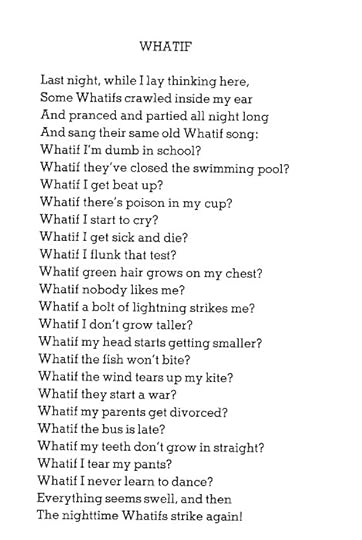
I thought it would be interesting to try out this poem with the two different groups of children I work with: my Magic Pencil after school club (middle class Kenyans & ex-pats) and the school I volunteer in (Kenyan kids from low income families) and it really was fascinating to note the different responses. As an example, a number of children from the second group asked me what ‘divorced’ meant. These were 11 and 12 year old’s and it was the first time they’d heard the word which blew me away. It’s a huge taboo to divorce in Kenya and I guess it’s something people just don’t talk about much, particularly not in front of children. There was also great hilarity amongst this same group when we reached the line ‘Whatif I tear my pants?’ Pants in Kenya (as in England) mean underwear and they were in fits of embarrassed giggles as I explained that in the US pants are trousers.
After going through the poem a few times with both groups, ironing out any vocab issues and then chatting in small groups about the kinds of things that ‘worried’ them, they then had a go at writing their own Whatif poems. Such a beautifully simple activity, but a wonderful way for children to express their fears and anxieties in a supportive, accepting way. I wondered if they may feel uncomfortable discussing their worries with others they didn’t necessarily know very well, but this wan’t the case. It certainly helped that I firstly shared some of my own ‘Whatif’ worries with the groups, making it clear that it is absolutely normal to not feel strong all the time.
If you scroll down a little on this page of children’s writing, you can see a couple of great poems written in response to ‘Whatif’ by the second group of Kenyan kids. It was interesting to note that that the second group were worried about things like being hit and parents dying and the writing club children asked questions such as ‘Whatif Al Shabaab strikes again?’ and ‘Whatif our car crashes?’, all indicative of different exposure to news and life experiences.
I do hope that some of the children from these two groups felt lighter as a result of writing their fears. Even if it resonates with just one or two children, it’s worth it in my book.
Shel Silverstein 1930-1999
Thanks Shel for the great poem.
The post Shel Silverstein’s ‘Whatif’ appeared first on Rebecca Stonehill.
June 18, 2015
You’re an artist when you say you are
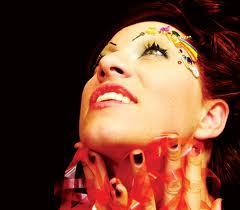
‘People working in the arts engage in street combat with The Fraud Police on a daily basis, because much of our work is new and not readily or conventionally categorized. When you’re an artist, nobody ever tells you or hits you with the magic wand of legitimacy. You have to hit your own head with your own handmade wand. And you feel stupid doing it.
There’s no ‘correct path’ to becoming a real artist. You might think that you’ll gain legitimacy by going to university, getting published, getting signed to a record label. But it’s all bullshit, and it’s all in your head. You’re an artist when you say you are. And you’re a good artist when you make somebody else experience or feel something deep or unexpected.’
Amanda Palmer
I love love LOVE these words of Amanda Palmer’s (musician, writer and unapologetic maverick) because they resonate SO deeply with me. When I look back, I realise that I spent a very long time (read: years) not feeling legitimate as a writer just because I wasn’t published. This was largely because lots of people, when they asked me what I was up to, I’d squirm and do a bit of a cough and say Well…erm…I’m writing a novel. Great! they’d exclaim, when’s it getting published? And I would just shrug and look shifty and say I didn’t know and end up feeling kind of stupid. What I’m not doing here is putting this on to other people – this was my issue and it was up to me to be brave and legitimise my writing and my passion. But more often than not, I didn’t.
The point is this: am I a better writer now just because I’m published? No, I’m certainly not. As Amanda Palmer says so succinctly, it’s all just bullshit and yep, it really was all in my head that being published would suddenly turn me, as if by magic, into a writer. No, no, no. I’ve always been a writer, I just haven’t been courageous enough to face those nay-sayers head on and tell them This is what I am.
Seriously. In hindsight? I’d say this to my younger self: Be brave. Be fearless. Believe in your art and just keep doing it regardless. And more importantly than anything else, when people ask what you’re doing, don’t be afraid to look them in the eye and say This is me. I’m a writer.
The post You’re an artist when you say you are appeared first on Rebecca Stonehill.
June 12, 2015
Book Review: The Gift

Poetry, above all, is a series of intense moments – its power is not in narrative. I’m not dealing with facts, I’m dealing with emotion.
Carol Ann Duffy
I have long been a fan of both Carol Ann Duffy (renowned poet and the first woman to hold the post of Britan’s Poet Laureate) and artist Rob Ryan, so imagine my delight when the two of them collaborated on a book called The Gift.
Combining Duffy’s lyrical prose and Ryan’s intricate papercut artwork, this is the story of a young girl who wanders off from her parents one day whilst picnicking in the woods and finds a small, magical clearing ‘…where buttercups sparkled in the sunlight’ which she at once feels at peace in.
‘A thought suddenly came to the girl – as urgent and vivid as a butterfly opening its orange wings – that she wanted to be buried in this plot of land when she died.’

The girl makes a chain from the buttercups but, no sooner has she done so, than an old woman appears out of nowhere and stands before her, asking for the buttercup necklace in exchange for her wish to be granted.
In the coming years, the girl returns often to the same clearing in the woods, which she makes her own, planting seeds and bulbs and placing special stones there. As time goes on, it becomes clear that ‘The young woman had art in her hands and she became a painter.’ We learn of her art, how she falls in love and becomes a mother and how as one season and one year rolls into the next, she takes her children to the clearing to play and to paint.

When her parents die, ‘This was a season of real darkness for the woman. She painted nothing and kept her family close, as snow whirled and shredded itself around the house,’ this dark period portrayed beautifully in the colours on the page.
But, she slowly recovered. ‘The woman’s life brought happiness in love and art and her children grew and flourished.’

The time then arrives when she takes her grandchildren to her clearing with the help of a walking stick. ‘She knew all the names of the flowers – monkshood, campion, stock, hollyhock, love-lies-bleeding, snapdragon, columbine, cornflower, wallflower, clematis, foxglove, sweet pea, flax, lupin, honesty, marigold and rose of heaven.’
But eventually, she cannot even reach the place with her walking stick and takes to her bed. As she grows weaker and weaker, she tells her family not to fear and that she wishes when the time comes to be buried in the clearing the woods. That night when she sleeps she dreams of being in her clearing and a young girl sits there making a chain with flowers. She places the chain around her neck and ‘Her head filled with a sweet, golden light and as she watched, the young girl turned and rain into the juggling shadows of the trees.’

This book is a visual and poetic delight from the first page to the last; a celebration of a life that is no way extraordinary, yet filled with the small joys and sadnesses instantly recognisable by each and every one of us. The Gift resonates with art, love and a deep appreciation of the earth, a gentle message issuing from its pages of inter-connectedness, continuity, renewal and the beauty of becoming one with special places. It is every bit as much for adults as it is for children and the small pictures I have included above or snippets of prose cannot begin to do it justice. Published by Barefoot Books, you can buy it here.
Oooh, and London people, if you are ever in the east, you must go to Columbia Road and visit Rob Ryan’s Ryantown shop. And take lots and lots of money with you, seriously.
The post Book Review: The Gift appeared first on Rebecca Stonehill.