David Williams's Blog, page 46
June 9, 2018
Satan v. Satan
 This week is always an odd one, as church school wraps up for the summer. The kids will handle the worship tomorrow, and I'll watch them get 'er done with pleasure.
But that means I don't have to write a sermon. I don't have to pursue my usual weekly pattern of scripture reading, study, and meditation.
I do anyway. It's just part of my weekly discipline, and it'd feel off if I didn't.
And so, from the reading, out popped the text that struck me, one that seemed to be just a little brighter and more attention catching than the others.
It contained a question that was posed by Jesus, when the authorities were cheesed at him for teaching and healing and generally carrying on in a way that subverted their authority.
He must be evil, they said, as the people flocked to him. He must be using the power of the Dark One to heal people and comfort the downtrodden and lift up the oppressed.
And in response, Jesus rolled his eyes.
"How can Satan cast out Satan?"
How can evil overcome evil?
It can't. Because if you take evil, and you pit evil against evil, what you get is more evil. That's how evil works. We know this, or we can conceptually grasp this.
This is something we seem to have trouble putting into practice, particularly when we encounter folks who are just plain wrong. We know they're wrong because they disagree with us, which means they're clearly not just incorrect but also somehow in cahoots with the forces of darkness.
Our response to those people is to attack them. To assail them. To find everything about them that is wrong, and to be sure to highlight it. Or perhaps to exaggerate it, just a tiny little bit, because they're monstrous, and why shouldn't we attack monsters?
And so we hurl epithets like stones, casting out curses and imprecations, and we become diabolos..."the ones who throw things"...ourselves.
And so we make accusations, trumping up charges against those we hate, because we hate them, and we become ha Satan, which just means "the Accuser," ourselves.
Now, we might resist this idea. If we're hating the haters, then our hatred is justified! We should be filled with giant burning rage! But Satan's methodology of relationship caricatures and objectifies and depersonalizes. It subverts the mystic awareness of the Other's soul that love stirs in us. Hate blinds us to places of possible reconciliation, turning our awareness away from possible new life and restored connection.
Humans have always fallen for that path, but thankfully, in this new enlightened era of democratized mass communication, when we can see and stand in encounter with everyone, everywhere, things are getting better. We...oh...wait. Never mind.
Sigh.
After all of these years, Jesus still rolls his eyes at our hubris.


June 6, 2018
A Last Lesson from JEB Stuart
 Yesterday was the last day of my younger son's high school career.
It's done. Six years, we've been part of J.E.B. Stuart High School. And with our departure comes the end of something else: the end of Stuart as a high school. After a very public debate that pressed out into the national conversation about the Confederacy and it's strange place in our history, the name is gone.
The class of 2018 will be the last class to graduate from JEB Stuart high school.
I'm fine with that. Utterly at peace with it. It was kind of weird having a school named after a guy who burned and terrorized his way through Northern Virginia, the 19th century equivalent of one of those masked street gangs on dirtbikes and ATVs, only with swords, rifles, and explosives. All for a good cause, though, right? Cough.
In an odd serendipitous moment, I encountered Stuart in my reading this last week. The book was KILLER ANGELS, a wonderful work of tightly researched historical fiction from the early 1970s. It's the Pulitzer Prize winning story of the battle of Gettysburg, told from a variety of different perspectives. That battle is the point at which the Confederacy lost the Civil War. Lee's great ambitious gambit to isolate Washington and rout the armies of the United States of America? It died on those bloody fields.
And JEB Stuart played a surprisingly large role in that battle.
Stuart's cavalry was sent ahead of Lee's armies. His specific orders were to reconnoiter through enemy territory, and to let Lee know where the armies of the North were and where they were moving. With that information, Lee could isolate smaller units and destroy them. With that information, Lee could pick his ground, choosing where and when to fight. Given those insights, Lee, who was...our contemporary #twitter revisionism aside...one of the most brilliant generals of his age? He'd have had a very real chance of inflicting enough damage to force an early peace.
But Stuart didn't do his job.
He raided. He harassed. He and his cavalry stormed about attacking Union facilities in Pennsylvania, doing pretty much what he'd always done as he trounced his way through NoVa. It was exciting and daring! Men on horseback! Outlaw cavaliers! Go raiders!
What JEB Stuart did not do was send intelligence back to Lee. Not anything.
Absent the information he needed, Lee was forced to move blindly, and got hung up at Gettysburg, where outnumbered Union forces took advantage of superior and highly defensible ground. It was not the fight Lee wanted, but his hand was forced.
JEB Stuart didn't show up until day two of the battle, after the first ferocious effort to dislodge the Union forces had barely failed. With the Union Army now being reinforced and the situation growing desperate for the Confederates, Lee was petitioned by several of his generals to court martial Stuart for dereliction of duty. Needing every last man, including Stuart's fiercely loyal cavalry, Lee demurred.
But the damage was done. The CSA forces were routed in an appalling bloodbath, their first significant defeat of the war.
And the momentum shifted in a nontrivial way.
All thanks to JEB Stuart.
So, in a very real way, it could be argued that Stuart lost the Civil War. By not doing the right thing at the right time, by choosing to focus his energies on doing what he was used to doing and/or that which felt good rather than the thing that needed to happen at that point in history?
The entire secession effort failed.
It's a good reminder, and a nice little lesson.
So thanks, James Ewell Brown Stuart. Thanks for six years of high school, and the reminder of how important it is to do the right thing at the right time.
June 5, 2018
Crazy, Dumb, and Cruel
 It was the kind of thing that could happen to anyone.
A moment of clumsiness, the error that happens every ten-thousand strides. A momentary tumble down concrete steps. And the result? A broken hand, meaning a badly fractured metacarpal.
That happened a couple of months ago to our twenty year old son, and it meant a trip to the ER, followed by imaging, followed by the recommendation for a minor surgery to repair a hand that wasn't going to heal well on its own.
It got done, because it needed to get done.
Now, of course, the bills come in. They're not small. Doctors. ERs. Hospitals. One after another. We're insured, and so the bite is manageable. He's insured, because, well, the Affordable Care Act mandated the extension of care to 26.
And he's got insured parents, and we do well enough, and it's more an annoyance to us than a punitive burden.
But I'm reminded that it is insane that it works this way. Twenty year olds don't always have insured parents. They often have parents who are struggling. They're adults, and if they were working on their own, this kind of thing would be catastrophic. I'm not talking the five figure bill for the surgery. Just the "patient's share," the five hundred here, the thousand there, times three or four? That's more than many young adults could manage. How many young adults living on their own can drop five thousand without it taking a bite?
For most, it'd mean taking on debt, piling borrowed money on top of student loans, and taking a young life and laying a deeper burden onto it.
Again, this is insane. There are ways to do this better, ways that every developed society figured out fifty years ago. But we forge on, doing it the same way over and over again, the way that just doesn't work. Madness is expecting different results, after all. Or maybe we're not insane. Maybe it's something else.
Maybe we're dumb, in the stubborn way that genuine dumbness inflicts itself on a life. We spend more, and get less, and shatter lives in the process, and then come up with reasons why that's the way it needs to be. It's unacceptably stupid.
But we're so good at rationalizing our failure. So very good. Dumb isn't anywhere near as good at rationalization.
At a certain point, it becomes simply cruel, the bitter cold malice of the blind ideologue, who resents and despises the reality that won't bend itself to their control.
Given the bankruptcies and stress and suffering that we inflict unnecessarily on millions of our fellow citizens? Perhaps it's all three.
May 29, 2018
The Poor Peoples Campaign 2.0
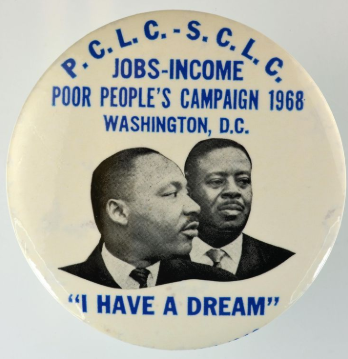 The Poor People's Campaign is a fascinating thing. Back in sixty-eight, it was to be the great final project of the civil rights movement, uniting all of those left behind by the American economy. It was to be the culmination of Rev. Dr. Martin Luther King Jr.'s work.
There's a solid overview that can be found by following this link, which includes some remarkable recordings of Dr. King's vision of the effort.
But Dr. King was murdered. And the movement failed.
Now, because it's 2018 and reboots are a thing, there's a new Poor People's Campaign. It's well meaning and the intention is what it was in 1968: to bring about justice and challenge racism and deal with poverty once and for all.
And I find myself looking at it, and as much as I sympathize with it, I...just can't see it accomplishing much. Sure, I could be wrong. That is quite possible. But I just can't see it. Why? Here are five reasons:
1) The Focus.
It's all about Justice, because every movement of the Left is about Justice. Dig deeper, though, and it becomes more diffuse, the usual smorgasbord of causes on the left spectrum. This is useful for building a coalition, admittedly. Here the People are, under the Umbrella of Justice! Only, well, when it comes to doing anything to bend the arc of history, things get a little amorphous. A little pillowy.
Take, for pointed example, the very public failure of the Occupy Movement. It had energy. It had the attention and the sympathy of a nation at a time of economic crisis. But other than working out the dynamics of how to live in an increasingly muddy tent city, it couldn't find a common focus to act. It lacked the One Great Aim to be Pursued with Force and Determination, and turned inward, towards managing its diffuse internal political dynamics. There, it devoured its own energy.
Which, given "justice" as an organizing principle, is no surprise. Justice is, after all, the equitable balance of competing interests within a culture. It's inherently self-referential, and oriented towards process and internal systems thinking.
For that reason, it's a poor ground for progress. It doesn't call a culture to transcend itself, but rather to chase endlessly after the Procrustean ideal of everything coming out even. "Let's do everything all at once" is a great way to do nothing.
2) The Semiotics.
Are people "poor?" I mean, sure they are, and the calcification of class is a real thing, but do poor people think of themselves as "poor" in 2018? Perhaps they do. But to my ear, that language seems challenging.
Saying "I am poor" is a hard thing. It always has been. It requires admitting that your agency is compromised. It requires acknowledging that socioeconomically, your personhood is diminished. And our culture offers up alternatives now, alternatives that light up our pride of self.
People are "faking it till they make it," but they're not poor. People are just that one big break away, they just know it, but they're not poor. People are having a hard time right now, but they've planted that seed with Pastor Creflo, and they just know if they try a little harder and pray a little harder, the Lord will bless them with abundance so long as they have a heart for God's abundant blessings.
The challenge, for the organizers of this reboot, is that you're pushing against deeply entrenched forms of self-understanding that make it harder and harder for the "masses" to resonate with your message. Even those who might most benefit from it.
3) The Era
This is not 1968. I realize that's hard for us to grasp, but it isn't. The political dynamics are different. Culture is different. And Christianity is different. The dear sweet oldline denominations that defined Christian identity in 1968 no longer hold the same place in popular culture...or even in Christianity.
The new movement may not have gotten that message. Take the activist/pastors who lead the movement. They are front and center in marches, and they're wearing robes and stoles and clerical collars. This...er...isn't exactly representative of mainstream 21st century faith leadership. Fine for royal weddings, sure, but oddly dissonant for a putatively progressive movement. I mean, I like the robe'n'stole look. I do it myself, in church. But it feels...I don't know. There's a peculiar vibe about it.
A little stale. A little off. A little Uncle Rico, reliving his dreams of glory.
That's always struck me as the challenge, at least in my neck of the woods. We're trying to be who we were, only...well...we're not that any more.
And here in 2018, with the reactionary, lumpen-populist right in control of all branches of government, do we really believe that demonstrations will be heard?
4) The Medium
So much of the success of the civil rights movement was predicated on getting the message out, and connecting with a broad swath of America. In an era when everyone tuned in to ABC, NBC, and CBS for their nightly fix of news, and media was deeply trusted, the civil rights movement had a narrative that soared. It was both clear and interesting.
Well-dressed, peaceful black men and women were seen nightly assaulted by profane, abusive racist thugs. It was compelling and clear and...importantly...seen by all.
But again, this is not 1968, and the media environment is different. Where once a small group of networks provided the foundation for a unifying national narrative, now media is critically fractured and diffuse.
For any contemporary mass movement, this is an immense challenge. Oh, sure, you're #tweeting and getting #retweeted by the sealed media silo of the Usual Suspects. It feels like a thing is happening. But that thing is contained by the self-selected firewalls of new media.
You can break out of it with a compelling singular purpose, as with #MeToo or the youth-led campaign against the plague of gun violence.
Unless you have a focused long-game strategy to breach the boundaries of your echo chamber, new media's illusion of democratized communication is just that: a phantasm, one that can be used to tamp down your narrative under the smothering chaos of a thousand competing narratives.
I'm not sure the movement is beyond that.
5) The Timing
No-one is more horrified at the venality, self-delusion, and incompetence of our current administration than I. No-one. Seriously. Fight me.
And I get that one wants to maintain energy, that one wants to Resist, and that there are real issues there.
But the timing is wrong. The zeitgeist isn't there to ignite a mass movement. Get off #twitter for a minute, let your eternally #twoke outrage diminish for a moment, and look around at broader conditions
Unemployment is at record lows. Good paying jobs are out there going unfilled, as an economy superheated by debt-fueled tax cuts turns it up past eleven. It's not that there aren't poor folk. It's not that there aren't issues to be addressed. But starting a "justice economics" mass movement now seems utterly futile, because the masses are flush with the fever-dream of a borrowing bubble.
There's just not going to be the necessary energy there, the rumbling volcanic pressure of discontented millions. It was that energy, fueled by a time of significant economic crisis, that lit up the Occupy movement. Occupy caught the attention...and for a moment, the sympathy...of a nation. Occupy squandered that moment, sure. But it could have been a thing. The potential was there.
That potential isn't strong now. It's like trying to build a sandcastle when the tide is rolling in. It's just going to come apart.
Three, four, five years from now? There's the strong likelihood things will be different. You can't govern this incompetently without doing damage, and that damage will be significant. Mountainous debt, catastrophic neglect of financial and environmental regulation, and the inevitable impacts of climate change?
The time will be right. It will.
May 22, 2018
The Importance of Silly Things
 When I was a tiny pup, my mom would come and say goodnight after I'd gotten into bed. We'd read together, trading off reading a Narnia book or one of the Stuart Little stories. There'd be a little prayer, and then, when that was done, we'd share sillies.
Sillies were, for a while, as formal as any liturgy. Kind of.
Doing Sillies meant you would say something absurd, or tell a joke, or make a funny face. Because those things are fun to do, and enjoying a moment together is vital for human life. It was a little ritual of intimacy, a light and shared moment of pleasure, although back when I was five or six, I probably wouldn't have articulated it that way.
It was just nice, and The Thing We Did At Bedtime.
The other day, I was writing up some explanatory text for a particularly obscure story of horror. It's a tale that reads like conventional horror, only...it's not. It's told from a compromised point of view, meaning, you can't trust your narrator to really know what's happening.
It was also an exploration of the process of semantic creep, as a term that once meant one thing can...over time and through evolving usage...come to mean something very different.
And in the thicket of studying that process, I discovered something I hadn't known.
Centuries upon centuries ago, back when English was a very different language, "silly" had a completely different meaning. It had not yet gathered about it connotations of folly or absurdity. It didn't mean preposterous.
To be "silly" meant to be blessed, to be gentle and accepting, to be holy in the simple way that the sainted and the innocent are holy. "Silly" people were trusting, giving, and without guile.
Human beings being what they are, that began to take on the connotation of being naive and easily tricked, because predators, grifters and con-men have always sought out the trusting and the gentle of spirit. Which morphed into meaning you were foolish, which became the dominant meaning. Don't be silly.
Only now, silly feels different again. Silly is...funny. Preposterous. Perhaps a little bit delightful.
Like the things we share, moments of laughter and lightness and ease, as we human creatures giggle together at the absurdity of our existence, innocently mischievous in the way that little ones can be. Which in this era defined by violence and deception, by bright blinding lights of ideologues and the cold unforgiving self-certainty of partisans, seems to be a thing set aside.
It feels, perhaps, like silliness is returning to holiness.
It's a welcome return.
May 15, 2018
A LITANY OF LAMENT FOR THE DARKEST DAY

Leader: On this day, we honor the suffering and horror of all those who have endured. On this day, we raise up those who have been oppressed and broken. On this day, we hear the voices of those who have been made to feel harmed and unsafe by motherhood.
UNISON: Motherhood, the most monstrous of things. Motherhood, the source of all suffering. Motherhood, which creates all injustice and bitterness and every form of sorrow.
Leader: Today we remember the ones responsible for hurting us in every possible way, the Moms. Hear our prayer.
Response: Hear our prayer.
Leader: For those whose moms were working, and therefore were not there enough and when they were they were too tired to be really present and didn't show up those two times to our recitals because she had "deadlines to meet," and there was "a mortgage to pay," which has meant a lifetime of therapy,
Response: Hear our prayer.
Leader: For those whose mothers stayed home cleaning and cooking, thereby failing to show us what it means to be an economically empowered and independent person, which is entirely why we can't manage to find and keep a job and also has meant a lifetime of therapy,
Response: Hear our prayer.
Leader: For those whose mothers tried to do both, and really couldn't, and were so fried and frazzled in their anxious efforts to be everything to everyone that they passed their anxiety on to us like some sort of horrible paralyzing virus, except when they were engaging in wine-based "self-care," which is also a just super healthy habit they passed along,
Response: Hear our prayer.
Leader: For those whose mothers tried to do both, and were great at it, and were there for us and positive and amazing, and they even made those little decorated notes for every single perfectly nutritious and flavorful packed lunch, and they were always funny and creative and heartfelt and nobody can ever possibly live up to that standard and they're the reason we're a total mess and never feel good about ourselves,
Response: Hear our prayer.
Leader: I mean, really, those notes were too much. Who does that?
Response: I know, right?
Leader: It's like, she's just so Martha Stewart, I mean, she goes from being perfect to being both perfect and an ex-con who chills with Snoop Dogg, and it's like, now you're even MORE perfect, and...sorry. I'm babbling.
Response: You are. It's OK. Hear our prayer.
Leader: For those whose moms had a network of adult friends both old and new, with whom they laughed and enjoyed life and we totally felt ignored and othered and excluded like we didn't matter to them at all,
Response: Hear our prayer.
Leader: For those whose moms devoted their whole lives to us, like we were the center of their universe and who can handle that kind of desperate, needy, smothering attention,
Response: Hear our prayer.
Leader: For those who had complicated relationships with their mothers stemming from that time she said that thing, and totally didn't adequately apologize, and really she should have known that weak and slightly passive aggressive "apology" was inadequate even though we didn't tell her directly how much the thing she was apologizing for hurt us,
Response: Hear our prayer.
Leader: For Loretta,
Response: For Loretta?
Leader: Remember, Loretta, from that scene in Monty Python's Life of Brian, People's Front of Judea?
Response: Oh, right, that Loretta.
Leader: For Loretta, who has the right to have babies, and shouldn't be made to feel ashamed of her right to have babies or mocked for articulating her chosen gender identity, how dare you, John Cleese, how dare you,
Response: Hear our prayer.
Leader: For those mothers who divorced, and I don't care why you did it, can't you see that messed me up and now I can't really ever trust another person ever again,
Response: Hear our prayer.
Leader: For those mothers who stayed with Dad even though things got hard, and now every time it doesn't work out I feel more and more unworthy as a person and I just know you're judging me even though you always say you're not,
Response: Hear our prayer.
Leader: For those mothers who are still alive, and it's like they expect us to be there for them all the time and I mean, we're our own person, and we're busy, and I've got too much going on right now at work to want to hear you tell me about your life for a whole half hour every week,
Response: Hear our prayer.
Leader: For those mothers who've died, because how could you leave us, you can't ever leave us, god we miss you and it hurts because when say there wasn't enough time I know that's kind of on me and now I feel guilty, and that's your fault,
Response: Hear our prayer.
Leader: And for every other way that mothers and motherhood are responsible for every terrible thing, including that specific way that your particular mother hurt you to make this the Darkest of All Days,
Response: Hear our prayer.
Leader: And let the people say,
UNISON: AMEN.
STREPITUS, all leave in silence.
May 14, 2018
THE POX, Explained
Language is strange.
It allows us to understand things, and also to misunderstand them. It creates connection, but also...by establishing categorical frameworks around complex realities...can establish a false narrative.
This post is meant to interpret a peculiar little horror short story entitled THE POX, one that is both told to a particular purpose and almost utterly indecipherable without explanation. Almost. There's no point in reading this until you've read that. So go there, read it, and come back if you'd like to know what you just read.
Seriously. Go there first. C'mon. Work with me here.
When I wrote THE POX, I was intentionally creating a false narrative. Meaning, the young girl narrating the story only has her own understanding to guide us through the telling.
The story Button tells is one of simple horror, a child menaced by a devouring threat, the inhuman and monstrous Pox that threatens her community and her person. That's Button's "lived experience," as they say these days.
Only that's not what's happening. Button is fundamentally compromised. Maybe you picked up on that. The clues are definitely there, if you attend to them. It's possible, veiled though it is, to intuit what's really happening. But she has no idea.
The story...of a future dystopic culture...was inspired by the current term of choice to articulate a binary racial dynamic.
According to today's orthodoxy of race, there are "whites." And there are "POCs."
People Of Color.
The assumption in the tale: POC has devolved from being the approved and correct term du jour to being a racist epithet. It has gone through the linguistic process of pejoration, that "euphemism treadmill" in which a term initially intended to be positive gets turned to a hateful purpose.
When my admittedly odd brain hears earnest folk describe people whose socio-cultural heritage is from the global south as "POCs," it sounds...well...exactly like "Pox." Like a disease. Like it would be easy to turn into something demonic and dehumanizing, something that evokes the racist's terror of race-contagion and impurity. Hence this tale of horror.
Button and her family aren't the heroes. They're the monsters. The story is nothing more than a starving black man and his daughter being murdered after being caught foraging for food, seen through the eyes of a little girl who is so poisoned by her community's racism that she can't even see them as human. All she sees is her own fear of the Other.
Because zombies aren't anywhere near as horrible as the reality created by the lies we tell ourselves.
Really. They're not.
It allows us to understand things, and also to misunderstand them. It creates connection, but also...by establishing categorical frameworks around complex realities...can establish a false narrative.
This post is meant to interpret a peculiar little horror short story entitled THE POX, one that is both told to a particular purpose and almost utterly indecipherable without explanation. Almost. There's no point in reading this until you've read that. So go there, read it, and come back if you'd like to know what you just read.
Seriously. Go there first. C'mon. Work with me here.
When I wrote THE POX, I was intentionally creating a false narrative. Meaning, the young girl narrating the story only has her own understanding to guide us through the telling.
The story Button tells is one of simple horror, a child menaced by a devouring threat, the inhuman and monstrous Pox that threatens her community and her person. That's Button's "lived experience," as they say these days.
Only that's not what's happening. Button is fundamentally compromised. Maybe you picked up on that. The clues are definitely there, if you attend to them. It's possible, veiled though it is, to intuit what's really happening. But she has no idea.
The story...of a future dystopic culture...was inspired by the current term of choice to articulate a binary racial dynamic.
According to today's orthodoxy of race, there are "whites." And there are "POCs."
People Of Color.
The assumption in the tale: POC has devolved from being the approved and correct term du jour to being a racist epithet. It has gone through the linguistic process of pejoration, that "euphemism treadmill" in which a term initially intended to be positive gets turned to a hateful purpose.
When my admittedly odd brain hears earnest folk describe people whose socio-cultural heritage is from the global south as "POCs," it sounds...well...exactly like "Pox." Like a disease. Like it would be easy to turn into something demonic and dehumanizing, something that evokes the racist's terror of race-contagion and impurity. Hence this tale of horror.
Button and her family aren't the heroes. They're the monsters. The story is nothing more than a starving black man and his daughter being murdered after being caught foraging for food, seen through the eyes of a little girl who is so poisoned by her community's racism that she can't even see them as human. All she sees is her own fear of the Other.
Because zombies aren't anywhere near as horrible as the reality created by the lies we tell ourselves.
Really. They're not.
May 10, 2018
When Your Leader Is Like David

"He's like King David," say Christians, when they want to defend a leader who has shown signs of significant moral failing.
It's an old habit, one that manifests on left and right alike. It occurs when the miscreant in power has engaged in wanton canoodling with someone they saw bathing on the roof or flashing a thong in the oval office.
It's understandable. Here, a leader in whom you've placed your hopes and to whom you've given your allegiance. They represent, in a way, your own power and agency, and straight-up rejecting them creates a dissonance in your soul.
So rather than taking the hit to your partisan pride that moral consistency requires, you defend their actions. They're just a flawed human being, like all of us. Aren't we all sinners? Who are we to judge? Don't go throwing that first stone!
And so on, as a cardboard cutout image of David the hot lusty yet sympathetic King gets carted into the conversation. "God loved David, and he was the greatest king of Israel! He messed around, and, well, golly, if he could do that, why shouldn't Leader X be cut some slack on that front?"
For those who are being pitched that analogy by a Christian, there tends to be some resistance. "He's not like David at all! How specious and self-serving, and an eisegetical political warping of scripture! You are a dumb-dumb for saying it and I #hashtag hate you!"
Let me suggest, however, that this is not the best response. Instead, when that comparison is made, run with it.
When David messed around, and allowed his lust and rapaciousness to rule him, what was the response of faith?
Seriously. If, from faith, you claim someone in power is "like David," what was the faithful response to David's transgression? Was it to shrug and say "don't go hatin'?"
Obviously not. In the event you don't remember how that whole story played out, here's a link to the whole narrative in the Bible. Or, alternately, you can watch the Veggie Tales version.
The faithful response to David is to take him to task for violations of fundamental moral norms. The prophet Nathan didn't equivocate, or try to rationalize, or give self-serving justifications for the actions of his king.
Nathan brought the king to truth with a pointed parable, and with a prophet's narrative sleight of hand nailed David to his sin. He was not gentle about it. He was almost unbearably harsh.
And God? God was even less gentle. The Numinous One who appears in the stories of the Tanakh is rarely sweetness and light, as fierce and terrible and unforgiving of our falsehood as reality itself.
For David's willingness to violate the fundamental ethical norms of covenant, God promised that his heritage would tear itself apart in violence, publicly and shamefully. And then, even though David wept and acknowledged his wrongdoing and showed repentance, God killed his child.
That's with repentance and a humbled, contrite, sack-cloth and ashes heart. Not punching back, or bald-faced lying, or getting a lawyer/fixer to write a menacing letter, or trying to redefine what the word "is" means.
So sure. If Dear Leader is like David, so be it.
But know that the Davidic model for flawed leadership bears with it two things. First, an expectation that the faithful will stand hard as iron against breaches of moral norms. And second, that lying, lustful, avaricious, and self-serving leadership always has catastrophic impacts on a nation.
Always.
History, Violence, and the Sacred
 It's been another challenging season in our stalwart little adult education class.
Three months we've been journeying together through the "Deuteronomic Histories," which is just a fancy pants way of saying the books of 1 and 2 Samuel and 1 and 2 Kings. All of them were likely compiled by an editor whose primary interest was the law of Torah, and particularly the ethical and theological teachings found in Deuteronomy.
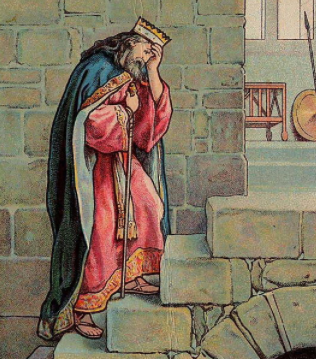
In these books, there are familiar stories of familiar faces from our Sunday School years. The prophet Samuel, called by God in the darkness. Saul, the troubled, handsome king. David, beautiful and noble and tragically flawed, slayer of Goliath. Solomon the wise, builder of the temple. Elijah the prophet, fed by ravens in the wilderness, rushing to heaven in that sweet chariot.
The tales come in a great rush, names piling upon names, as king follows king follows king over hundreds of years. Sometimes, the transitions go smoothly. More often, though, there were coups or slaughters or revolutions, as into the story of Israel and Judah are written the kind of mess that has defined all of human history.
And as we're discovering after wrapping up our reading this week, things don't end well. The northern kingdom of Israel, crushed and scattered before the might of Assyria. Judah, the weaker sister to the South, held on a little longer, but finally succumbed to the fist of Babylon.
Centuries of striving and struggle, betrayals and battles and butchery, and all of that human mess goes exactly nowhere.
"Is this feeding your souls? Are we getting anything spiritually out of this?" I asked that question last week, as we heaved through another bloodbath of a power transition. It wasn't. We weren't. There's just not much grace or goodness to be found, historically fascinating and intense as the stories may be.
So what is it, I find myself wondering, that makes this sacred text? Why is this particular narrative...a people, struggling and bleeding and failing over and over again...woven into a holy book?
In part, it's because it's honest, unflinchingly so. The historian who compiled these books clearly had his own perspective, but was willing to approach even his heroes with storytelling that pulled no punches. They're recognizable in their human failing, even across thousands of years. Their stories still have resonance.
But it's also because it gives context and ground to the story of the gospel, and to the cries for justice that came from the prophets. Here, written in a sprawling entropy of human power struggles, lies not just the culture and history of Jesus, but also the reason for the gospel.
In Saul's deepening, anxious madness, we can see it. In David's growing agony over the loss around him. In Solomon's wealth, which became both his strength and his hubris.
Human beings, struggling to find a way to be together, in which violence and power and hatred of the other are no longer in control of our lives. Without the story of history...Hebrew and Gentile alike...the necessity of the Way might feel less urgent.
So as much of a struggle as it was, it was well worth the reading.
May 1, 2018
How We'll Flunk The Mid Terms
 So I'd been wondering to myself: What would the ideal result of the mid-term elections be? I mean, sure, the American right and the American left each have their vision of what that'd look like, but there are other interested parties involved.
Specifically: If you're Vladimir Putin, what's the best case scenario?
Remember, the Russian goal here is not to support the current administration. Putin could care less about the "success" of our president. The goal is to sow chaos in the leadership of a geopolitical opponent, which his troll farms did with tremendous success during the last election.
So which of these three possible outcomes is the ideal: 1) Republicans retain control of the House and the Senate; 2) Republicans retain the Senate, and the Democrats take the house, or; 3) Democrats take control of both House and Senate?
Option one has some advantages. Continuing the catastrophic fiscal approach of the Republican party will, in the long term, significantly destabilize the United States. Any political movement that imagines it can successfully fund a functioning government with daydreams, faerie dust, and unicorn farts is headed for a reckoning. The current approach to fiscal policy has failed every single time it's every been tried, but ideologues aren't known for their ability to learn. Putin has to see this, and so there's going to be a temptation to let the American right wing continue that process.
That, and America Firsters are great at making America more isolated in the world, as their reflexive nativism alienates former friends and allies.
Option two results in rapid political destabilization. There's no question that a "blue wave" would augur ill for this administration, as the slow-burning and measured Mueller investigation would be overtaken by a fiercely partisan sequence of paralyzing investigations. Impeachment and removal would become a very real possibility, with the concomitant unrest to be expected in our political system. Even the removal of the least popular president in the modern era would be an incredibly tumultuous event.
The prospect of that undoubtedly sends shivers of pleasure up Vladmir's spine.
But I think, to be frank, that it's door number three that has the most appeal. A House controlled by Democrats and a near-split Senate would mean the complete collapse of government function. Budgeting? Hah. Laws being passed? Highly unlikely.
Oh, sure, that's not a *necessary* thing. With a competent president willing to work with other parties, a divided Congress could still get things done. That's happened historically, even in times of significant difference.
But we don't have a competent president. We have a belligerent chaos muppet, whose spiritual gift is disruption.
Definitely door number three.