David Williams's Blog, page 44
July 31, 2018
How to Kill Whitey In Five Easy Steps: Step 4
 Step 4: Whiteness is unAmerican.
It doesn't happen often, but it does happen.
Like the time I was in a florist's shop, where I'd gone to pick up the corsage we'd ordered online for one of my sons' prom dates. The young man in front of me was Salvadoran, as was much of the neighborhood where the florist was located.
After he had left bearing flowers, I took my turn at the counter. The woman at the counter, in her late fifties or early sixties, gave me a look. "I'm so tired of selling to those people," she said. "It's nice to have a real American come in here for a change."
I was taken aback. I mulled, for a moment, whether to simply leave. But prom was in two hours, and I had already paid, so I did not. Perhaps there might have been a better way to deal with it. Whichever way, that florist never again received my business, and I shared that story with friends.
Because what she said was grounded in her sense of being "white," and it was also profoundly un-American.
Here, I part ways with both the idea of America shared by the radical right and the ideological left. The denizens of the far right wing assume that "whiteness" is a fundamental part of American identity. Our constitutional republic was established by "white" culture, or so the argument runs, solely for "white" people.
The far left has the same operating assumption, presented in ideological photonegative, in that strange way that extremists of all ilks end up kinda being exactly the same.
Both far left and far right present us with an image of America as fundamentally racist, of an America either unworthy or irredeemable. This is convenient if you're an ideologue who sees nothing but race, and particularly and doubly so if you benefit from that assumption.
But there is nothing inherent in the founding purpose of the United States that should encourage our embrace of "white" identity. Was that concept there, as part of the self-understanding of the Founders? Sure. Duh.
"Whiteness" was the poison that weakened the integrity of this nation. It was the demonic delusion that subverted and warped our best purpose. Without it, there would have been no race-based chattel slavery or segregation. Without it, there would have been no Trail of Tears.
But just as a self has flaws that can be resolved without resorting to seppeku, so too can the essence of American identity rise above the primal sin of race.
Human liberty, respect for the fundamental rights of the individual, and the political dynamics of a constitutional republic? A can-do attitude, fierce hope in the future, and a willingness to strive and thrive? These things are not "white," nor does the category of "whiteness" serve them.
All that is best and most noble about American identity does not require "whiteness" to exist at all as a way of self-identifying.
I was reminded of this at the graduation of my youngest son from his high school. My boys attended one of those schools named for a Confederate notable, which always struck me as fiercely ironic. Oh, sure, back in the 1950s when the name was chosen, the school was "white." But now?
Now it's a wild joyful mix of ethnicities and cultures, drawn from every corner of the globe, seeking exactly the same thing that my ancestors sought when they came to America: The universal hope for freedom and opportunity.
After the valedictorian, there was a second speaker, a student from the Middle East. He was Arab, and when he came to America at the start of high school, he didn't speak a word of English. But he made himself learn, and made himself focus. His parents pressed into him the potential of work and diligence, and so there he was, up in front of his classmates, delivering a fiery patriotic speech about the promise of America in a language he'd made his own. He blew the doors off that speech.
It was completely American.
And not "white" at all.


July 26, 2018
A Rod for the Back of Fools
 "A whip for the horse, a bridle for the ass, and a rod for the back of fools."
It's not one of the easiest bits of scripture, because, well, it just isn't. It's from the book of Proverbs, that fascinating collection of ancient Wisdom teachings in my sacred book. Pithy aphorism follows pithy aphorism, each with the intent of steering the reader towards a wise life and away from folly.
It's pretty much all good stuff, advice that holds up after millennia. Be patient. Be measured and thoughtful. Be teachable and adaptive. Don't be brash and arrogant and greedy. Don't lie and gossip. Be humble. Don't screw around with folks you're not married to. Respect women.
Most of these teachings are easy to get behind. I try to live by them, because wisdom increases the probability of a blessed life.
But here and there, Wisdom whispers intimations of something darker. Something a little...brutal.
Because fools do not learn, and will stubbornly insist on messing things up, the ancient Wisdom traditions have a pretty basic solution for the fools in your life: You beat the crap out of them. The fool willfully refuses to hear and respond to what is true, and therefore only responds to pain and coercion. In the ancient world, this was not figurative or metaphorical. You take a rod. You hit the fool.
It wasn't "tough love." It was just tough.
For liberals and progressive Christians, it's easy to reject this teaching. It's not loving or compassionate. We reject this, as an echo of a cruder, bloodier time in human history. "That's just not the way things are," we say, "now that Jesus has taught us to love one another." "The Christian God is love," we say, "not that mean and abusive Old Testament God." We say this while our Jewish friends roll their eyes, but we pretend not to notice.
Yet I'm not sure the God of Creation is quite as filled with Twue Wuv as we blithely assume. Because Creation, which is God's first work, is not particularly forgiving to the foolish. In point of fact, it is precisely the opposite. If a creature does not adapt, if it will not learn from and respond to the environment?
It dies.
And we are creatures, both as individuals and as the peculiar social organism that human collectives have become. Why we suppose that this is no longer the case is beyond me. Perhaps it's that we're used to the shelter of modern society, and in our lingering modern-era hubris imagine ourselves masters of creation. Or we spend too much time dickering around in our virtual fantasy worlds.
But foolishness has consequences.
Yesterday, I rode my motorcycle home in a fierce deluge, as major flooding swept across the Mid-Atlantic. A wee bit foolish, perhaps, but it was entertaining, as my "adventure" bike was designed to ford streams, and I rarely get that opportunity as part of my commute. The day before, I'd emailed with my agent, who lives in North Texas. Which is on fire. She'd been in touch with someone we're talking with in LA, which is experiencing a dangerous heat wave. The guy from LA was about to vacation in Yosemite, which is also on fire.
I have social media friends in England, which is experiencing a record breaking heatwave, with the lush green richness of the British landscape turning dead and brown. I have friends who are Korean American and worried about their families back in Korea, which is sweltering under an unprecedented heatwave. I have family in Japan, where nearly 30,000 people have been hospitalized this week with heatstroke, and almost 100 have died as temperatures soar to new records.
There are those who will blithely insist that nothing is happening here. That none of this is connected. "It's just weather," they say. "Don't drink the climate change kool-aid," they say. There's no need to adapt, or to learn, or to change behavior based on changing circumstances. Just ignore the evidence of your eyes, and keep doing what you're doing.
In the face of the storm, I'd changed. Sure, I was the stubborn fool still riding his bike. But I took a different route home, on larger, better draining roads. I rode at a different, more careful pace.
Still, as the rain spattered heavy and tropical against my faceshield, my tires cutting a wake through the ponding, that scripture popped into my head.
"A rod for the back of fools."
Which is what happens, whenever we hear creation's warning and snarl back, "You're not the boss of me."
July 25, 2018
The South Will Rise Again

You learn something new every day. It's one of the joys of being truly alive.
This is especially true if you take your time with something, and really pay attention to it. You notice detail and nuance that eluded you before. You grasp a thing more deeply, because you're really attending to it.
I had just such an experience during the three month course I recently taught on the Deuteronomic Histories. Meaning, if that term doesn't just pop something right to mind, the cycle of biblical stories about ancient Judah and Israel that begins with 1 Samuel and ends with 2 Kings.
I'd read them before, perhaps a dozen times over the course of my ministry and seminary education. I cranked through 'em in two weeks for my Hebrew Bible coursework. The stories, all faintly familiar through the pastel haze of Sunday School. Saul the struggling psychotic. David and Goliath. David, the imperfect, soft-hearted poet-King. Solomon and all his shiny golden wisdom.
But in the rush of study and the granular picturebook isolation of individual tales, a larger truth hadn't quite seeped through into my awareness.
This year, I spent months moving slowly through those stories with my adult education class. As week of careful class prep followed week of careful class prep, something came into focus.
Though the history we have was told from the perspective of Jerusalem...a perspective that was buffed, polished and retold centuries later by the revisionist, hagiographic Chronicler...Judah was the runt of the litter.
From the time of Jeroboam's rebellion, through the Omride Dynasty and on to the final fall of Israel, Judah was considerably weaker than her Northern neighbor Israel. Even as presented by its own storyteller, Judah was less wealthy, had a weaker army, and was more likely to be kicked around by the other powers in the region. Again and again, tribute was wrung out of Judah, which strove and fumbled for power.
In the North, there was real power and significant dynasties and regional recognition. In the South? Dreams of what once was, of a heritage squandered.
It's a strange dynamic, writ into an ancient story.
And so odd, how history somehow manages to create the same familiar disharmonies, over and over again.
July 17, 2018
Providence, Probability, and Politics
 Being a heretic does have it's advantages.
Take, for example, this particular hypothetical.
Imagine, for a moment, that America had elected a president who lacked any moral core. It's a stretch, I know. But hear me out.
This hypothetical president would be a boor and a brute, a petty troll of a man. He would be serially unfaithful, profane, and a pathological liar, exhibiting none of the moral virtues of authentic Christian life. He'd have odd connections with foreign powers, and flagrantly defy the standards and norms used to prevent the corrupt from gaining power. As I'd envision this imaginary person, he'd exhibit none of the moral virtues of any culture or faith, with the possible exception of LaVeyan Satanism. And even there, he'd be pushing it.
Now imagine that he'd promised American Christianity...not the sweet fading oldline, but the megachurch evangelical movement that now defines the faith in the United States...complete "protection" of their political agenda. Every one of their material goals, he'd pursue. All they have to do is give him power.
He would not, in his words or deeds, actually hold or live out those values, sure. But he's offered the world, and Lord, that's a hard offer to turn down.
If you view Creation as linear and divine providence as holding only one possible outcome, supporting such a leader would not be difficult as a Christian.
You have a political goal, which you believe to be part of God's singular purpose. You trust that God is completely in charge of everything. And from that basis, you can look at this human being who bears none of the marks of Christian morality, and say...huh. God works in mysterious ways. Maybe this is how He's getting it done. The workings of providence are known only to God, after all. Sure, this guy seems immoral and brutish and venal. But, or so traditional and deterministic providence permits, we must be otherwise on track towards God's intent.
There is a logic to this. It isn't stupid. It isn't necessarily evil, although it tolerates evil.
It simply assumes that what appears to be very wrong right now can be part of a larger plan.
That isn't my theology. I used to hold to a version of it, being that I grew up in a Reformed and Calvinistic tradition.
I set that aside, years ago, as an offense both God's creative power and divine sovereignty.
Instead, I view God's work as encompassing an infinite multiverse in which everything is made manifest, and where the liberty and agency of sentient beings is integrated into God's design. From that perspective, things look a little different. In the case of our hypothetical president, this creates two key differentials.
First, if every situation contains within it the seed for every possible outcome, then Christian moral action isn't just about one's "end." It is equally...and perhaps more intensely...about living out the Kingdom right now. There are patterns of being and thought that conform me to Jesus, and I must live them out no matter what. That's my duty as a follower of Jesus.
The outcome of my actions, ever uncertain and shrouded in the irreduceable complexity of God's creative work? That's of less significance to my choosing than the Spirit and the moment. I do not know with certainty if my moral action will bear fruit. I cannot. So you choose the right, right now. You speak the truth, and do what is kind and honorable, no matter what.
You don't give power or encouragement to the cruel, or the callous, or the braggart, because that's a violation of Christian moral duty. Every moment, every single one, is precious to...or a horror to...God.
Second, multiversal ethics require a different frameset for considering the future. If the future is not set, but open, you choose from probability, particularly when orienting yourself towards tomorrow. Again, none of it is certain, and it is subordinate to duty. But with every action, you consider the most likely potential outcome. Not the dream. Not the fantasy. Not the self-serving rationalization. But the likely outcome.
If you elect an amoral fool, it is possible God's best graces for America might manifest. A blusterous bullying debt-addled sybarite could possibly through random happenstance cause a moral and economic renewal of a nation adrift. If you down a fifth of Pappy Van Winkle and then get behind the wheel of a Dodge Challenger...Hellcat, with the six-speed, natch...you might possibly make it home just fine.
The Lord God who makes and does all things knows what those unlikely realities would look like should they occur.
But from a moral framework that rests not on rigid linearity but on probability, it ain't likely. It is highly improbable.
What is considerably more likely, considering the Bayesian priors when making a probabilistic decision, is that you'll run that Hellcat off the road. Or wrap it around a tree. Or, if you're lucky, get pulled by the cops before you kill someone.
And if you elect a fool, most potential futures involve that fool making a total mess of things. Someone with a cavalier and self-serving attitude towards debt will make a debt slave of our nation. Someone whose "work" tends to involve greed and chaos-muppet flailing is more likely stumble into disaster. Someone who is fundamentally untrustworthy in both their business and personal dealings will do damage to the mutual trust that must exist for a nation to be healthy of spirit.
Or it could be worse. Far, far worse.
That's the fat wide path we have chosen, blind to both duty and the likely result.
And the Lord respects our freedom, God help us.
July 16, 2018
How To Kill Whitey in Five Easy Steps

We have a problem with race.
We do. It's a thing. Here in the United States of America, race has been problematic for...well...since there's been a United States of America, and from earlier still. It's the primal demon and failing of what could otherwise have been a perfectly delightful constitutional republic.
Efforts have been made to exorcise this demon, but they've only gone so far. Its manifestation in the form of race based chattel slavery was washed away in blood at Gettysburg and Antietam, and in William Tecumseh Sherman's terrible-swift-sword campaign of fire and destruction.
But it did not die, taking on the form of Jim Crow and segregation, which required the application of soul force, the blood and discipline of Freedom Riders and marchers and martyrs. That changed the laws, but changing laws only goes so deep.
Now it's gone in deeper still, not legal and systemic but cultural and spiritual, gibbering in the deep shadows of our collective subconscious, from where it warps our application of law and poisons our views of other human beings. What was once maintained by overtly oppressive legal structures is now maintained by something subtler and more pernicious.
And we don't know what to do about it.
Some conservatives would ignore the problem. "It doesn't exist," they say. "It's not real. Stop whining, you special snowflakes. And even if it is real, it's your fault, because black people are scary and criminal. But we're not racist. We have a black friend!" Then they watch Fox News, which every day features Scary Dark People.
Every step forward, every possible moment of healing? It's ignored or suppressed or mocked, because nothing is wrong. You can gun down a black boy on the street for the crime of defending himself from a strange man, or strangle a black man to death while he politely asks you to stop, and they'll find a reason to justify it.
"Progressives" don't ignore the problem. They imagine themselves to be helping. There are consciousness raisings, and activities to surface privilege, and much moaning and lamenting and #shametweeting. But there is no "fixing" of the heart of the problem, because "fixing" is an oppressive construct of the patriarchy. Best to just heighten anxiety, division and resentment, and then live into that tension. Own your racism. Just sit with that reality.
This is as helpful as the oncologist who wants you to "own," "sit with," and "live into the tension of" your cancer.
Racism must be destroyed. You do not sit in conversation with it. You do not ignore it. It must be nuked, poisoned, cut out, and burned away with focused light.
I do not presume to speak to how do do that for those whose identity is shaped by race in other ways than mine, but as a pastor who falls under the cursed category of "whiteness," I'm inspired by the peculiar Christian soul whose image...painted in fierce mural on the Kansas City statehouse...has graced my blog for more than a decade.
For his time, John Brown had a bizarre sense of race, so far from the cultural norm that to many it seemed insane. It has been said that he did not see race, but that isn't right. It went deeper, into his sense of self. "Whiteness" did not define his personhood, nor did the truth claims of "whiteness" guide his actions. Fredrick Douglass, who was a friend and visitor in the Brown household, marveled that the Browns just treated him like another soul, without condescension or wariness.
When John Brown, visiting the house of a friend, saw that friend beat a young slave into unconsciousness? He didn't see a "white" man beating a "black" man. He saw one person violating another person, and it was a mortal horror to him. It left him traumatized and in shock.
And in his peculiar witness, there's a truth.
Racism dies when it is dead in our souls. When race has no claim over your identity, and no longer shapes how you relate to others, racism dies in you. The war against racism will be won by changing culture, and you change culture one soul at a time.
To that end, and from my own self understanding, the idea of "whiteness" must die. I will not speak to or make claims about other "races," or other identities.
But in this war, whitey must die.
Again, not literally. Sweet Jesus, people. It's just a transparently provocative way to frame it.
What I am saying is this: that sense that "white" makes any meaningful claim over a person must be rooted out and decoupled from identity. It must become Other. If you see yourself as defined by whiteness, then attacks on whiteness can feel like attacks on your person. It can feel like a threat, to be fled from or fought.
If white is not "you," not a meaningful part of your soul? If you have named it for the demon it is?
Then challenges to cultural assumptions of place, privilege and power have more purchase.
To that end, I offer up five ways of tearing apart a person's sense of "whiteness," a clenched fistful of ways to heighten the necessary trembling dissonance that can shatter the hold of "white" identity over your soul.
The first way to kill whitey: White is BS. It's just not a real thing.
July 15, 2018
How To Kill Whitey in Five Easy Steps: Step 3
 3) Whiteness is weak.
The peculiar paradox of "whiteness" is the weakness of that identity.
Here, I'm not talking about the "white fragility" that American leftism uses as part of the counterproductive taunt/shaming protocol that it somehow imagines creates "allies."
You know that drill. "As a white person, you are responsible for all of the suffering in the world," says the leftist to the hapless honkey. "You are part of a racist system and your whole life is a fraud. You should be ashamed." "But I'm not a racist," says the honkey. "I find racism horrific, and I've never done anything to..." "Yes you have. You're part of that racist system. You benefit from it. You need to shut up and be ashamed." "You don't know my life, and the people I care about. I don't think you have the right to..." says the insulted honkey, their dander now clearly up. "Oooh, look at you, all mad now! You're mad because you're so white and fragile. Racist. Clearly."
That emotionally and relationally stunted exchange is not the weakness I'm talking about.
I'm talking about the weakness of whiteness in relation to POCkness, the bizarre weakness of white identity as understood in relation to non-whites. The lie of white supremacy always rested on the prideful assumption that the "white race" was the strongest. "Whites" were dominant, superior to all other races intellectually, technologically, and morally.
Only there was a significant caveat.
"White" identity couldn't touch another racial category without dying. If a white person mingled genetically with a non-white, the whiteness of the offspring was annihilated. They were no longer white.
You'd think it'd be the other way around. If there were any foundation to "whiteness" in our genetic reality, and it was dominant, then the pernicious fabrication of the one-drop-of-blood concept would be inverted.
"White" would spread virally, drawing more and more into itself like a consuming, insatiable fire.
But the lie of whiteness always worked the other way. When you mingle "white" identity with "colored" identity, it is destroyed. And not even in the way of a recessive gene, where it might pop up again from time to time. The best that you get in that circumstance, under the old horror of the lie of race, is someone who "passes as white." They're not actually white. They're a dodecaroon, or some similarly preposterous term.
And so integrated into this supposedly "superior" race was the terror of contagion, the fear of the corrupting influence of that which was Other and alien and poison. This was not a rational fear. Nor was it a fear based in any genetic or cultural truth.
"White" identity creates the kind of fear, rage, and resentment that rises when you are trying to justify a lie you have integrated into your sense of self.
Because, again, the very idea of "whiteness" is false and insane.
And so terribly, terribly weak.
July 12, 2018
How to Kill Whitey in Five Easy Steps: Step 2
 Step Two: White is Not Your Heritage.
I'm proud of my blood. I am. My family reaches back generations and spans multiple European cultures. In some instances, all the way back to the Mayflower.
This is not a metaphor. Meaning, I can trace, genetically and through my lineage, myself back to an indentured servant brought across the Atlantic on that very vessel. Those genealogies have been done. I know where I come from, all the streams of my blood and lineage.
I am Welsh, because Williams is as Welsh as you get. It's also my Comstock heritage. We're a sturdy, mischievous, stubborn people, strong of arm and long of torso. That line is where I get my enjoyment of green and growing things and my deepening baritone.
I am Scottish, of the Clan MacDougall, whose raven-flagged galleys plied the waterways of that craggy land. This means I'm also a little bit Danish/Norwegian, as the MacDougall...meaning "the sons of dark strangers"...were Vikings who arrived in Scotland and decided to stick around.
I am Irish, from the Daleys. That's the side that includes fallen priests and itinerant farm workers, and I credit it with my love of tale-telling and a sometimes counterproductive alcohol tolerance.
I am German, of the Huffs, tall and wiry men with craggy faces, who journeyed deep into this continent, and who...when the settlers came West...had already set up shop and shacked up with the locals.
I am a rich mix of these things and others, and I remember them. I have told these tales to my children, who have a richer heritage still.
I married a Jewish woman, whose Austrian Ashkenazi side either came to America and settled in Queens or were burned away in the Holocaust. Her Sephardic side had fled the Inquisition and settled in the sun-kissed Greek city of Thessalonika, where there are still synagogues and Jewish life.
The blood and story and heritage of my family is made of many intermingled things, the rich robust history of the proud mongrel.
"White" is not one of those things.
Oh, at some points in my family past, it was. I know this and own this. But now?
Now it confers no defining meaning. Nor should it. Whiteness does not shape my identity, because "white" would erase all of those cultures and stories, mashing each of the distinct textures of those peoples into a flavorless paste. Not the rich harmonic ever-changing ratatouille of the melting pot, but an inedible mash, like an overcooked stew that has been so oversalted that all you taste is the salt.
That was, in point of fact, the purpose of "white" identity. Its purpose was to annihilate the cultural distinctions of European peoples, and to forge them into something new and synthetic. It seeks to create a "race," and obliterate the complex evolving reality of culture through the application of that fabricated sense of self.
"White" is the heritage of a people who have forgotten their heritage, the identity of those who have lost sight of the powerful stories and languages of their ancestors.
July 10, 2018
The Old Rusty Shed
 It had sat there for years in the shadow of the trees. Over eighteen years, in point of fact, since some time before we bought into our little rambler.
It was an old metal Arrow shed, up on a low pressboard platform in our back yard. It had seen better days, most likely in the 1980s.
Now, though? One of the sliding doors scraped along its track, the runner broken. The roof, covered with fallen debris. And everywhere, rust and corrosion, a random splotching of oxidization. It was ugly. It looked terrible, and like it was halfway through falling apart. Every time I dragged out the mower, I would think, man, I need to do something about this wreck of a shed.
It's summer, and summer is the time for outdoor projects, and so I began thinking about finally getting a replacement. I mapped out what that'd entail, and did some pricing of new sheds. I'd need to tear it down, of course, which'd probably involve some unscrewing and unbolting followed by smashing with a large sledge.
Which is always cathartic, and gets my inner twelve year old boy all fired up.
I went out to measure, just to be double extra sure of the dimensions for a replacement shed. Eight by ten, just as I'd thought. But as I walked around the shed, taking measurements for its doom, I looked more closely. Yes, it was corroded. But the rust was entirely superficial. The structure wasn't compromised, even though it looked terrible. The metal roof was dinged and bent in a few places from where large storm-tossed branches had pranged it over the years, but it was still fundamentally sound. The pressboard foundation was without rot or flaw.
And I realized, you know, this shed doesn't need to be discarded. It just needs some attention. Some repair, followed by sanding, primer, and paint.
So on and off over the course of a week, I did what needed to be done. I cleaned it. I sanded down the corroded sections with that power sander I'd gotten but never used, and cleaned it again. I disassembled and reassembled the door. Then primer, and a day later, paint.
And lo and behold, the thing that was an embarrassing eyesore to be discarded? It was perfectly fine again.
Not fancy. Still with an imperfection here and there. But it isn't a wreck now. It is, in point of fact, a decent-looking shed.
We are so quick to throw things away in our culture, to toss aside something for another thing the moment it shows signs of flaw or weakness. From that basis, we are equally quick to look at those flaws we see rising in ourselves, and to start thinking that the whole endeavor is just not worth it. With all that rust and ricketyness, we're just beyond fixing.
And so we don't try.
As we roll into this summer fallow season in life's rushing busyness, it seems worth taking a few moments to visit those rusty areas of your soul.
A little sanding, a little prayer, and a little repair may be all that's needed.
July 9, 2018
Five Things Christian Men Can Learn from the Amish
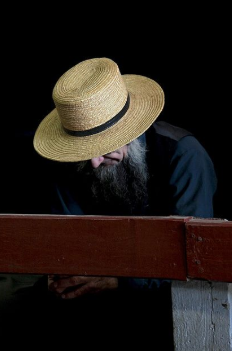 The video that was making the rounds this spring, honestly, was not all that unusual. It was for a Christian Man-Conference, for Men who Are Strong Big Manly Jesus Men, and I've seen its like before.
What that hyperkinetically edited promo promised precisely mirrors our cultural expectations for manhood. Explosions! Guitars! And drums! And jumping! Much jumping! Praise leaders jumping. Basketball players jumping. Motorcycles jumping. Monster trucks jumping.
Jumping is what Jesus men do, apparently, although just looking at all that jumping makes my knees ache. Man, it's tough getting older.
There was shouting about having power, and more explosions for Jesus! And dual-wielded submachine guns for Jesus! And Mixed Martial Arts Cage Matches for Jesus! Every single man-box, neatly checked, in a bona-fide Holy Ghost Exclamation Point Testostorama, and I just...sigh.
I mean, it looked sort of fun, to the twelve year old boy in me. I mean, honestly. It did. I have not lost touch with that part of myself.
I saw everything the world tells us about being a stereotypical man in 21st century America mirrored back as relevant to being a disciple of Jesus of Nazareth. And I wondered: perhaps there's something off here.
Does a life-commitment to the Way of Jesus mean you are loud for Jesus, aggressive for Jesus, hungry to be entertained by Jesus? Does it mean that you are, in appearance and action, conformed to the expectations of the secular culture for Manliness?
Rather obviously from those flagrantly rhetorical questions, I'm pretty sure that it doesn't.
There are other models for being an XY-chromosomed disciple, ones that look quite different from the norms of our society.
Lately, my understanding of what it means to be a man and a disciple has been more shaped by the narrator-protagonist in my postapocalyptic Amish novel, WHEN THE ENGLISH FALL. His name is Jacob, and he was my best effort at writing an authentic Amish man's voice. Creating a character as a storyteller is such a peculiar thing, because it requires you to step a little bit outside of yourself. While there are bits of me in Jacob, he is not me.
Most significantly, he's Amish, which I am not. In an effort to create him which bordered on hubris, I studied and listened to and researched the culture of the Old Order. It worked, more or less, or so folks who know the Amish better than I have told me. There are inaccuracies here and there, which I expected. But the tone works. I got the voice and the geist of Jacob.
In the act of finding that voice, I found my faith changed and deepened.
Because while I do not choose to live an Amish life, I am a committed Christian, and that feature of Jacob's identity is front and center in the novel. That meant putting my faith...and my whole soul...in relationship to a different branch of the Way. In finding Jacob's voice, I found myself relearning something of what it means to be a man and a disciple in this peculiar era. Given how much of a struggle men seem to have following the path of Jesus these days, this seems like a nontrivial thing.
This being the era of listicles, I'll offer up five ways we Englischer men who claim to follow Jesus might benefit from the Amish understanding of manhood.
1) A Christian man is calm. In all of my reading and research into Amish life, there's a fundamental stillness to their souls, a placidity that is not inert, but rather unswayed and unbowed by the endless churn of the world. The ideal among Amish men is not one who gets agitated, not one who is easily riled, not angry all the time about every last thing. He doesn't feel that it's his task in life to shout down everyone he disagrees with.
In that, there's a remarkable functional similarity between the Amish ethos and that of the ancient Stoics, those philosophers of the Greco-Roman era who saw that being unphased by anything was a significant virtue. In our hyper-emotive era, when we are expected to rage and weep and howl at the least input, this is profoundly countercultural.
The roots of an ethos of measured calmness are also fundamentally biblical, with a deep foundation in the Wisdom literature. The wise soul does not allow anger or panic or anxiety to rule a life. Wisdom does not bellow or shout down. It remains unflappable, and sticks to what it knows is true.
That's true if your day is just an average day. It's equally true if planes are falling from the sky and the world as you know it has come crashing down.
In our reactive, ranting, overstimulated, hyperagitated #tweetstorm era, that's something worth remembering.
2) A Christian man is humble. Yes, I know, we're all supposed to be constantly one-upping each other, in an endless display of higher-primate alpha-male dominance. We're told to be brash and bold and loud. We're supposed to build our brands, and self-promote, and claw our way up over the bodies of those weaker than us, all of those delightful mortal sins that popular consumer culture reinforces in us.
But that's not the path of Jesus. It just isn't. It has never been. There is no legitimate reading of the Gospel that says otherwise. If you want to be proud and feel powerful, you're welcome to go hang out with with Anton LaVey or Ayn Rand.
Six of one, half a dozen of the other.
Among the Amish, humility is a fundamental virtue, one that my protagonist Jacob lives out repeatedly in his engagement with those around him. He sees himself, first and foremost, as a servant to those around him. Though he is resourceful, competent, and able, he sees all of those strengths as existing primarily to be a strength to those around him. Not to dominate or control them, or to advance himself, but to give aid and help bear the burdens that fall on those around him.
When his community is threatened...by storms, by violence...Jacob simply does what needs be done, turning himself over to the building up of others. He does his duty, no matter what that might entail, even up to the point of exposing himself to suffering and death.
This is, again, a fundamental dynamic of the the teaching of Jesus. It's the cross in a nutshell. And it is utterly alien to the culture of self-absorbed "manhood" taught in our society.
3) A Christian man is diligent. Popular culture presents us with an image of men as eternal man-children, permanent adolescents who like nothing more than to loaf about and can't manage to do much of anything. Golly, Dad just put the diaper on the baby's head again! Men are so witless! Hah! Hah! Better get back to the mancave to yell at the sportsball while organizing our collector cards!
Christian manhood isn't like that. We're not called to be shallow, not flighty, not driven by appetite. Christian men remember what it was to be a boy, the energy and creativity of it. We are allowed to still enjoy those things. We're allowed to be childlike.
Childish? Not so much.
Oh, sure one can enjoy stuff. But we are also no longer boys, and we should know it. There comes a time when we must set aside childish ways, as the Apostle Paul reminds us.
That means attending to duty. It means pursuing labors even when they aren't what we feel like doing right at this very moment. It means not giving up, simply because we're feeling tired or disinterested. It means pursuing competence at those things we know we need to accomplish.
And Lord have mercy, do the Amish pursue and value competence. They are an intensely pragmatic and results-oriented folk, who commit themselves to crafts that require attention and focus.
It means patience, and the willingness to do what we know Christ demands of us, while letting God do God's work at God's own pace. That, in this Veruca Salt I-want-it-now age? That requires being intentionally countercultural.
It is also the essence of what it means to be a disciple.
4) A Christian man is reflective. This one is tough, because it means we've got to be willing to look hard at our own lives and admit that we can be wrong. If you err, and you realize there's a possibility that the thing you just did or the thing you just said is incorrect, you correct yourself.
This is hard. It stabs at our pride, at our sense of self and sense of strength. We would rather double down. We would rather be defiant in our correctness.
But the process of growing and developing as a disciple requires that we constantly check ourselves against our primary commitment, which is following Jesus of Nazareth. If we act in ways that don't measure up, we've got to be willing to admit we're on the wrong path.
The operative word here is repentance. Yes, repentance. If you never allow for your being wrong, you won't ever repent. We've got to be willing to let repentance...that turning away from our brokenness that is every day of the Way...actually be what we do.
The Amish are profoundly serious about that form of self-discipline, continually checking their own actions and thoughts against the standards of their Ordnung...the Order that rules their communal and personal lives. Jacob is continually checking himself against what he knows his faith requires, and even then, is sometimes surprised to discover that his assumptions about others are completely wrong.
And then he corrects himself.
When was the last time you reconsidered something about yourself? Or told someone, hey, you know, I completely messed that up?
That's not being weak. It's repenting, and without repentance, you do not have the discipline to be a citizen of the Kingdom of God.
5) A Christian man is peaceful. In this peculiar, benighted age, we seem obligated to troll one another. There's a fierce and relentless hostility, one that seethes and burns in so much of our communication with one another. Insults and conflict rage, as we take opposition and difference to mean we've got to prove ourselves dominant in every exchange.
That's not the path of Jesus. Never has been. We like to turn to those times Jesus felt and articulated anger to justify our own acting out in rage...and ignore the ethic that is clearly taught in the Gospels. Overturn the tables! Turn out the moneychangers! Booyah!
But when Jesus taught us what to do and how to act, that wasn't what he said. When the Apostle Paul taught how to approach the World, that wasn't what he said.
When interacting with peers and colleagues, we are to be peacemakers. When faced with those who oppose or oppress us, the centurions and jailers? We nonetheless act and speak with honesty, decency, and respect for their persons.
Jacob deals that way with his English friend Mike, who may be profane and live a "complicated" life. He deals that way with Asa Schrock, the bishop of his settlement who frustrates and challenges him.
But he also is firm and respectful with murderous men, even as his own life is threatened.
It's how we convince others. It's also how we show who we are.
Again, this is immensely challenging. Men are aggressive. It's one of the reasons we do well in the world. Aggression...and the focused energy it creates...is part of our nature, and it can be useful, particularly where large predators are involved.
But the easy embrace of self-serving violence is not and has never been the Christian path. Christians have engaged in violence, sure. Wherever Christianity has subsumed itself into state power, it has become warped into an instrument to justify violent action. Occasionally, there have been Christians faced with demonic, dehumanizing powers so destructive that violence seemed the only option. Faithful men such as Dietrich Bonhoeffer or John Brown took up arms against the brutal demons of their culture, and it's impossible to reject their witness out of hand.
The Amish...and Mennonites generally...present us with a different path.
They are willing to resist, if their way of life is threatened. But they will never strike out, because to do so would violate their integrity as Christians.
When faced with the choice of using violence, even in self-defense, they don't. This is not because they are weak. Nor is it because they water down their Christianity with dreamy idealism.
It's because they're better disciples of Jesus Christ than you or I.
As a lifelong Christian who prays daily, studies the bible, has three degrees under my belt, and pastors a church, I can say this. In their radical nonviolence, there is a purity of faith that I in my carefully constructed greyscale Just War rationalizations lack.
This was the path of the early church, after all. Complete nonviolence, even unto death. Protestants in particular have forgotten this, as the stories of the martyrs are set by the wayside, replaced by tales of success and prowess and material prosperity.
Despite this, it is What Jesus Did, and What He Told Us To Do.
I struggle with this, particularly when I see injustices inflicted on the weak. I struggle with this more deeply still, when I feel my loved ones are threatened.
When I wrote Jacob, there are moments in the story when he faces similar threats. His responses to violence, drawn from his faith? They are more authentically Christian...more like Jesus and the first Spirit-fired churches...than mine. He doesn't punch back. He doesn't attack. He avoids violence, no matter what, because that is what Jesus did. Period.
We don't want to hear this. From our pricked pride and our innate, kata-sarka male aggression we resist it. We come up with rationalizations. We proof text. We wave our flags. It feels good.
But if we do not allow ourselves to see the deeper strength of their nonviolent path, we are being willfully blind, and we are not allowing ourselves to learn from those whose faith is stronger.
In our shallow, violent, hyperkinetic time, it's easy for men who've claimed Jesus as their primary life commitment to wander from his path.
Calmness. Humility. Diligence. Reflection.
And a soul turned fiercely and defiantly towards peace.
These virtues are fundamental to the Christian journey. They are also, as much as I like my pride and my aggression and things blowing up, the demands Jesus makes of us.
They aren't easy. But good things rarely are.
July 6, 2018
The NPC
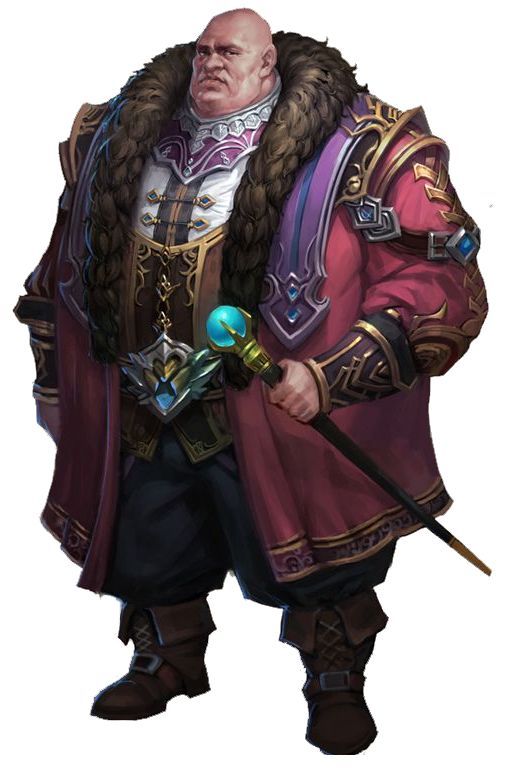 I've been working on a major NPC for a campaign that I'm in the middle of playing through with my friends, and wanted y'all's opinion on whether he seems believable or not.
A little context: the campaign is based in a large and prosperous city state. It's loosely based on a combination of Venice and the republic of Athens, and has been a center of power and trade in the world of the campaign for two centuries.
While formerly ruled by warriors and mages, it's now in the hands of a merchant-lord of questionable intent, one who seems to have some shady connections with the orcish realms to the east.
So as I've messed around with his stats and characteristics, I'm looking for a reality check. Does this guy seem believable? Here he is:
Attributes:
Strength: 10
It used to be four points higher, back when he was young. He was and is a big man, one used to throwing his weight around.
But he's old now. He's still got the grip, and the mass, which he still uses to his advantage. He remembers that strength, and doesn't totally realize it isn't what it once was. Tells endless tales of his own prowess, but is rarely called upon to prove it.
Intelligence: 8
Slightly below average. Enough that he can connect, easily, with the average person on their level. Enough that he can see where his advantage lies, without the pesky clouding complexity of subtleties or nuances. But not enough that it slows him down, or changes his propensity to make snap decisions that may or may not be grounded in reality. This, peculiarly, is a strength.
Wisdom: 4
It was never a strength, and it never needed to be. The scion of a merchant family, he's been rich since he was born. Wealth and the power wealth gives means you don't need the guidance of wisdom. You can screw up, and it doesn't matter. You can botch relationships, and choose wrongly, and it has no effect. Money does that.
Does not know when he is erring, and doesn't care if he is wrong. It has never mattered. As far as he is concerned, he is never wrong. Has no sense of his own limitations, and makes a point of surrounding himself with underlings and toadies who do not tell him. Does not care to correct this.
Dexterity: 9
A big man, not without some natural grace in his energies. Still vigorous, as men driven by appetites of the flesh tend to be, but no more than average.
Constitution: 9
Like his strength stats, not bad for his age, but also not what they used to be. His low wisdom score masks his awareness of this diminishment, and no one around him is willing to share candidly with him just how much he has faded.
Charisma: 17
This is the heart of his power. Completely and unquestioningly self-confident, so totally sure of self that his certainty radiates into and shapes the material plane around him. Brash, bold, and often quite funny in the awful way that bullies can be genuinely funny. Knows how to play with and manipulate a crowd of peasants, how to use indirection and simple, opaque language to his advantage. High wisdom and intelligence scores are necessary to make the saving throw against his influence.
Alignment: Chaotic Neutral
He has no moral core beyond his own interests and appetites. If it serves his power, he'll do it. If it gets him ahead, he'll say it. Truth and any integrity of self are meaningless. Capable of anything.
So that's the character sketch, and I'm pretty sure it holds up, although I might want to tweak the attributes a little bit.
What I'm really having trouble with is the name. The only things I can think of are just too absurd.
High Merkantor Danacious Flump?
Lord Regent Nonar K'B'rult?
Autarch Ona'Jae Vrunt?
None of those feel real. I mean, the folks I'm playing with would see right through that kind of character.
Any suggestions?