Jake Desyllas's Blog, page 26
July 13, 2015
213 How To Think For Yourself Part 3: Logic And The Courage To Follow It
Part 3 in the series on how to think for yourself is all about logic. Here is how you reach true conclusions about any question in life: start with undeniable premises and use valid logic. Logic— used in reasoned argument— is the universal, impartial method that humans have for finding the truth together peacefully. Yet very few people use logic consistently. I discuss some reasons why it is so hard to be logically consistent. The most important reason is that it takes courage to follow an argument to its logical conclusion, especially if the conclusion is not accepted by the majority of people around you. If you want to think for yourself, you need more than just valid logic— you also have to have the courage to follow it.
Show Notes:
Ad Populum FallacyIf A, Then B: How the World Discovered Logic by Michael Shenefelt & Heidi WhiteThe Right To Ignore The State by Herbert SpencerWhy I Don't Vote by George CarlinMurray RothbardHans-Hermann HoppeListen to Episode 213



July 6, 2015
212 How To Think For Yourself Part 2: Science And Rationality
Last week I suggested two key challenges to resolve if you want to think for yourself:
How do you tell truth from falsehood? How do you know what you can be certain of?
This episode is about how the scientific method can help address the first of these challenges: determining truth. I provide a summary of the philosophy of science and the rules for deciding whether a theory qualifies as scientific.
However, there is a huge problem with the philosophy of science when it comes to addressing the challenge of certainty. The scientific method—as defined by leading philosophers of science—is self-contradictory. It's not even an accurate representation of what practicing scientists do (which is why scientists tend to ignore philosophers and just get on with it). In the episode, I explain how rationality is the necessary foundation of science—more fundamental even than empiricism—and how it provides the certainty that makes the scientific method possible.
Show Notes:
Karl PopperThis Lecture by Hans-Hermann Hoppe about the philosophy of science provides a deeper discussion of many ideas covered in this episode with reference to economics.Image Source: Bruno Gilli/ESO
Listen to Episode 212


June 30, 2015
211 How To Think For Yourself Part 1: Introduction To Truth And Certainty
You can't be free unless you can think for yourself. If someone else is doing your thinking for you, then it's not your life that you are living.
When you know how to think of yourself, you cannot be controlled or manipulated. Your life is truly in your hands and is up to you what you do with it.
This episode is part one of a new series on how to think for yourself. This episode introduces the two biggest problems you have to overcome if you want to think for yourself:
How can you tell truth from falsehood? How do you know what you can be certain of?
Listen to Episode 211 (10 mins)


June 21, 2015
210 Tax Strategies And Financial Freedom Part 2 (Interview With Joshua Sheats)
This week's episode is part two of an interview with Joshua Sheats, host of the Radical Personal Finance podcast. Joshua shares his insights on tax strategies for those pursuing financial freedom. In part one of the interview (last week's episode), we covered tax strategies for employees. In this episode, we discuss tax strategies for entrepreneurs. Joshua describes his own experience developing a lifestyle business and the tax advantages that this provides.
Show Notes:
Radical Personal Finance PodcastAs always, it's up to you what you do with your money. I'm not a financial advisor and you will need to do your own research.Listen To Episode 210 (30 mins)


June 14, 2015
209 Tax Strategies And Financial Freedom Part 1 (Interview With Joshua Sheats)
Tax is the biggest expense category for most people. It is crucial for everyone interested in financial freedom to understand tax and develop a tax strategy. Yet many of the leading books on financial independence hardly mention tax. In this interview, Joshua Sheats provides a wealth of insights on this topic.
Joshua trained as a financial planner and now runs the Radical Personal Finance podcast. In part one of the interview (this episode), Joshua discusses tax strategies for employees. In part two (next week), we discuss tax strategies for entrepreneurs.
Show Notes:
Radical Personal Finance PodcastYour Money or Your Life by Vicki Robin and Joe DominguezThe Millionaire Next Door by Thomas StanleyIRA and Roth IRAMad FientistGo Curry CrackerLaurence KotlikoffAs always, it's up to you what you do with your money. I'm not a financial advisor and you will need to do your own research.Listen To Episode 209 (41 mins)


Joshua trained as a financial planner and now runs the Radical Personal Finance podcast. In part one of the interview (this episode), Joshua discusses tax strategies for employees. In part two (next week), we discuss tax strategies for entrepreneurs.
Show Notes:
Radical Personal Finance PodcastYour Money or Your Life by Vicki Robin and Joe DominguezThe Millionaire Next Door by Thomas StanleyIRA and Roth IRAMad FientistGo Curry CrackerLaurence KotlikoffAs always, it's up to you what you do with your money. I'm not a financial advisor and you will need to do your own research.Listen To Episode 209 (41 mins)
June 9, 2015
208 Creating Purpose, Structure, And Community Outside A Job
If you want to quit your job to pursue a more freedom-oriented lifestyle (such as entrepreneurship), there are many challenges to overcome. Some challenges are practical, such as replacing the job income that you no longer have. This episode is about the psychological challenges. Even an unfulfilling job has a psychological "pull" that is easy to take for granted because it provides:
A sense of purpose Structure for your life A ready-made community
Part of the fear that many people feel about quitting their jobs relates to losing the sense of purpose, structure, and community that comes from a job. To live job-free, you have to create your own sense of purpose, your own structure for life, and your own community. You can hear more about this topic in the podcast episode.
Show Notes:
E136 Your Purpose In LifeE101 How To Dream BigE185 How To Set Meaningful GoalsAll Previous Episodes On Productivity (for creating structure)E139 How To Build A Network
Listen to Episode 208 (12 mins)


June 2, 2015
207 Who Will Buy Your Business?
If you are an entrepreneur, you might want to sell your business one day (or at least have that option). There are many issues to tackle in order to make selling a real possibility. For one thing, you need to identify a potential buyer.
This podcast episode provides an overview of the two main groups of potential buyers: strategic and financial. I suggest some issues to consider when looking for each kind of buyer and I explain why I would always prefer a strategic buyer.
Show Notes:
Finish Big: How Great Entrepreneurs Exit Their Companies on Top by Bo Burlingham
Listen to Episode 207 (15 mins)

May 24, 2015
206 Luck In Business
Are successful entrepreneurs just "lucky"? This episode is about the role of luck in business. Here are some of the ideas discussed:
The main job of the entrepreneur is to minimise chance and uncertainty. "Luck" is not the basis of success, it is the enemy. People confuse the success or failure of a business idea with the success or failure of an entrepreneur's career—they are not the same thing. Successful entrepreneurs have many failures behind them. A business is not static. It is not a matter of chance whether it succeeds or fails. You can adapt and change everything about your business as you go, and thereby improve your chance of success with every step. There will always be influences that are entirely outside your control. But even those things outside your control can be managed and adapted to.
Listen To Episode 206 (17 mins)

Photo Credit: andyburnfield

May 17, 2015
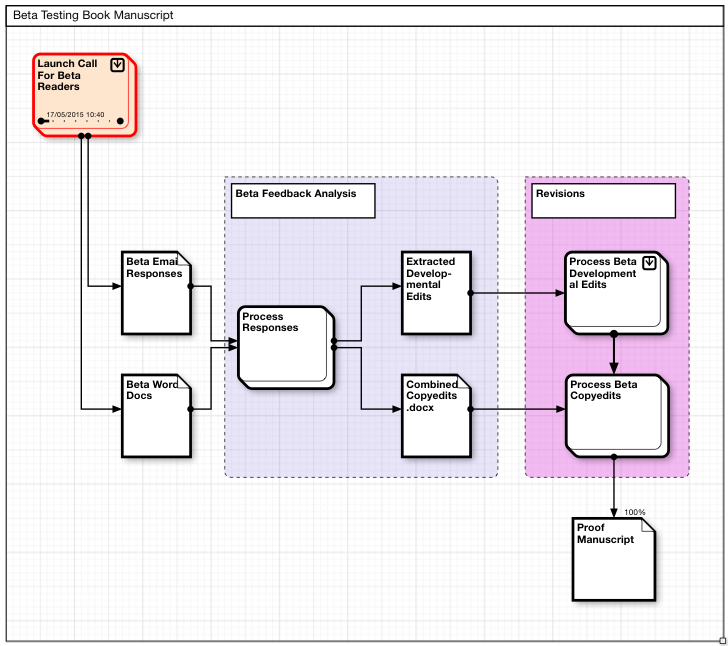
205 The Most Powerful Planning Tool I Know
This episode is about the most powerful tool that I know for planning anything. A process map is a tool for visualising a workflow. It's also called a workflow map or a network diagram—there are many different names for this tool.
It's a way of clarifying exactly what has to happen to in order for you to get all the way from where you are now, to your final goal. The map shows the dependencies between all inputs, processes, and outputs. This identifies the logic of all the work ahead of you.
You don't need to be involved in project management to benefit from creating workflow maps. Visualising your workflows can help you achieve your goals in any aspect of life. However, a workflow diagram is also the basis of many useful project management tools, like a PERT Chart or Gantt chart. If you want to get more into project management, you can use this tool to identify the critical path and critical chain.
Show Notes:
TVL Episode 120 Eight Tools That Will Free Your MindThe Magical Number Seven, Plus or Minus TwoInShort Diagramming App (Mac)Listen To Episode 205 (19 mins)

May 10, 2015
204 Making Sense Of Frugality And Minimalism
This episode is about making sense of two important concepts: frugality and minimalism. Frugality means to be economical or sparing with regard to money, but this definition prompts the question: what are the criteria for deciding if a choice is economical? Similarly, the definition of minimalism (to own the minimum amount of possessions) also prompts a question: what are the criteria for deciding what the minimum is?
Both these ideas only make sense if they are defined in relation to your goals and purpose in life. Using examples from entrepreneurship, I suggest ways to define frugality and minimalism in relation to your goals.
Show Notes:
TVL Episode 136: Your Purpose In LifeTVL Episode 116 (for discussion of the 4% rule)The Goal: A Process of Ongoing Improvement Eliyahu M. by GoldrattListen To Episode 204 (24 mins)