Alexi E. George's Blog, page 57
April 27, 2014
Landmines in Daily Life
The story of a man who stepped on a land mine was quite intriguing to read in a recent Indian edition of Readers Digest. Although I’ve previously read stories of people who have stepped on mines, this time I began thinking about those who set such traps. I wonder if they set off their own mines and loose limbs and lives. I’d imagine if they were not extremely systematic and careful, they would fall into their own traps, especially since they are setting up so many land mines in certain areas.
In common daily situations, some have a lifestyle of setting traps for others. It may be with words, procedures, or regulations within bureaucratic settings. The psalmist describes such a person with quite descriptive words: “Behold, the wicked man conceives evil and is pregnant with mischief and gives birth to lies. He makes a pit, digging it out, and falls into the hole he has made. His mischief returns upon his own head, and on his own skull his violence descends” (Psalm 7:14-16).
These are people who are so mischievous that others are not able to relate to them with any sense of normalcy. Maybe we’re not so extreme in our approach. But living in a society or working in an environment that’s heavy on the side of corruption and deceit can be quite a challenge – after some time, we can begin to think and behave in similar ways.
Whatever situation or environment we are in, we must take that initiative to know who we are and be willing to be counter-cultural in our approach. Even if everyone around us is corrupt, we must be different. Even if it is because we know that the one who digs a pit will eventually fall into it.
Share your experience of facing corruption or “pit digging “ in the comments section of this blog post by clicking here.


April 23, 2014
Understanding Anger and Honor
“Fools!” “You all are fools. You’re all idiots. Fools. Arrgh…” And the words went on as this lady became hysterical on the train that I was traveling on. Although her words seemed to be directed at everyone on the train, her anger was focused on one elderly couple who said “Shh” to her son. The little boy happened to be jumping up and down and running around the train while most passengers were resting quietly.
Eventually her words and her anger subsided while everyone remained silent. No one responded to her outrage – it was completely ignored.
The psalmist said “Be angry and do not sin: ponder in your own hearts on your beds, and be silent (Psalm 4:4). Although we may have used this verse many times, there are important factors we need to grasp. The true and basic issue that triggered the anger may be the breach of our honor. “O men, how long shall my honor be turned into shame? How long will you love vain words and seek after lies” (v.2)? The psalmist said that his honor was turned to shame.
As humans we wish to be honored and respected for who we are. When that inner desire is denied and violated, we attempt to protect ourselves. As our vulnerability becomes evident, our response turns to anger. It was in the context of honor that the psalmist said “Be angry, and do not sin” (v4).
He follows up with an appeal to recognize God and to trust Him. The unreliable nature of those around us ought to turn us to God rather than turning us to anger.
As the lady on the train went on with her words, it was clear that she probably grew up with lots of rejection. All of those unresolved issues might have caused her to become such an “explosive” person.
Maybe not just her. Maybe you too. Maybe me too. We all want to be honored and respected for who we are.
Instead of turning to anger, let’s turn to God, and put our trust in him. He understands, because many misunderstood him. The Bible says “He came to his own, and they did not understand him” (John 1:9-12).
Please leave your response in the comments section of this blog post by clicking here.
April 16, 2014
That Flattering Tongue
“Sir, you seem like a man with a look of professionalism and authority.” That was the first time I heard such great words spoken about me. And it certainly felt great. Then the man went on: “You surely deserve to be recognized and acknowledged for the person you are.”
For a moment I basked in that great euphoria. I always wondered when people would begin to realize and acknowledge how “awesome” I am. But as the conversation went on, I began to realize that those great words of praise were just carefully devised words of flattery. He was simply trying to get me to join his multi-level marketing team.
The great words of praise directed towards me seemed to take on a new image as he began explaining how I would be on the road to wealth and affluence if I just attend one of their meetings. When I was hit by the sudden shift of emotions, I realized the potential danger in flattery. The psalmist said “For there is no truth in their mouth; their inmost self is destruction; their throat is an open grave; they flatter with their tongues” (Psalm 5:9).
Nothing new. People have always recognized the inner desire for acceptance and honor. In every society, people have longed for such acceptance. This longing has been leveraged by business people, marketers, politicians, and by many who want to influence others.
So if the need for acceptance and recognition is universal, then what’s the problem with flattery? Why not use it for our own desired results? It would seem that nature has designed it so.
There is a place for praise and acknowledging one’s accomplishments. Indeed we are to recognize others and encourage the good in them. But the problem with flattery is the purpose. The above verse says “their throat is an open grave.” This implies a selfish purpose. When words of praise are spoken solely for the purpose of benefiting the one who speaks, it becomes dangerous flattery.
Now I remember with amusement my experience of being the recipient of flattery. How fragile our emotions are and how easily we can be influenced!
Leave your response in the comments section of this blog post by clicking here.
April 10, 2014
Benefits of a Connected Life With the Father
Recently my phone’s battery would get empty by 3pm. It’s a fairly new phone, and such a situation was really unwelcome. Thinking that some apps that I recently downloaded may be the culprit, I deleted most of the apps.
After all my attempts failed, I was joking with my friends that the best option is to just shut off the phone in the morning after charging it, then the battery won’t drain out too quickly. (Later, I was able to get the phone repaired under warranty, and it works just fine now.)
Of course, the phone is doing its job of constantly staying connected to the cell phone tower. When in an area where the connection is too weak, the phone repeatedly makes attempts to make that connection. Of course, this drains the battery even faster. Nevertheless, the phone continues its constant quest to stay connected to the tower.
Jesus had a similar quest to stay connected to the Father. He was completely dependent on his heavenly Father. Several times Jesus expressed his complete dependence when he said “Truly, truly, I say to you, the Son can do nothing of his own accord, but only what he sees the Father doing. For whatever the Father does, that the Son does likewise” (John 5:19).
The dependence of Jesus was so comprehensive that he felt completely incapable without the Father. He depended on the father for direction, judgement, honor, life, words, authority, and for everything necessary to live and work while on this earth.
Later, the Jews were surprised at the teachings of Jesus who did not have formal advanced education. “So Jesus answered them, ‘my teaching is not mine, but his who sent me’” (John 7:16). His dependence was not just an internal matter, but something that was clearly evident to others.
Jesus instructed his disciples to be connected to him in a similar way. Without that connection they would be able to do nothing. He said, “I am the vine; you are the branches. Whoever abides in me and I in him, he it is that bears much fruit, for apart from me you can do nothing (John 15:5). The branches are the life source for the vine. It’s connection is the only way of survival for the vine.
Jesus wants such a life giving and life sustaining relationship with his followers. For without him, we can do nothing. Jesus demonstrated such a relationship with the Father in his life and ministry. Now, he wants us to have such a relationship with him.
Leave your response in the comments section of this blog post by clicking here.
March 31, 2014
Four Steps to Fulfilling Your Role
Your role in this world is important. It’s time for you to step up to the responsibility. People all around you are waiting for someone to lead them. I like the example of Barnabas because he was a common person with a good reputation who mentored others by teaching and leading them. You can read about how Barnabas lived out these qualities at this link.
There are many who are driven by the need to be heard, to be famous, or to make a name for themselves. But you must be different. Take the example of Barnabas and be an enabler. We can take four important tips from the life of Barnabas: Be reputable, be a mentor, be a teacher, and be a leader.
Be Reputable
Build reputation through consistency and longevity. Keep on doing what you do for a long time. When you are consistent, people can count on you. They become comfortable around you. Longevity brings a similar response. It’s not a matter of being perfect, it’s a matter of showing up. Again and again, month after month, year after year, continue to perform your task with faithfulness.
Be A Mentor
In a rapidly changing society, there is a great need for mentoring. People are more independent than ever before, but they still long for role models and mentors. The frequent and drastic shifts in society create a vacuum that must be filled. Mentors are like anchors that hold the ship in turbulent weather. Many are waiting for people like you to stand up and be an anchor, a mentor they can count on.
Be a Teacher
From your childhood, you have been learning. Formal learning in the classroom coupled with your life experiences has produced within you an increasing amount of knowledge. Be generous and share what you know. People are eager to learn more than ever before. Take a bold step and begin sharing what you know.
Be a Leader
I’ve heard it said that leaders don’t need to know everything. They just need to know the next step. In a world that is vast and confusing, your leadership is important. People are waiting for someone to lead them. You have what it takes. Just being one or two steps ahead of others qualifies you to lead.
Whatever profession you are in, you can be a Barnabas. Every profession needs reputable mentors, teachers, and leaders. Begin seeing yourself differently.
Here are some practical ways you can begin to take a step. Begin with your profession, your passion, or things you enjoy doing the most.
Start a small group
Spend personal time with those who are struggling
Write short notes or articles on common struggles
Start a blog and begin sharing your knowledge and experience
In what ways do you think you can be a Barnabas?
Share your thoughts in the comments section of this blog post by clcking here.
March 25, 2014
Just You and God – Meditation
“Oh how I love your law! It is my meditation all the day” (Psalm 119:97).
Day by day, we face numerous issues that deter us from our focus. The events of the day seem to control us. Emotions vacilate from one extreme to another. Tension gradually builds as control slips out of our hands.
By hearing God’s voice and direction each day, we can reduce the chances of being controlled by circumstances. His words can be a guiding light that leads us through the day and throughout our journey of life. I wish to present to you a simple three step process of meditating on God’s Word and for hearing His voice each day.
The instructions given below are derived from the concept of Lectio Divina (Latin word for Divine Reading). The roots of this practice of meditation go back to the 3rd century. You can read further about its background at this link. Some have called it Time Alone With God to emphasize the relational aspect of our meditation.
Three R’s For Meditation
1. Read (and reflect)
Get ready. Find a suitable place.
Invite the Holy Spirit to come.
Read one chapter, section or paragraph from the Bible.
Listen for God’s still small voice as you read.
Select one verse and read it several times.
Focus on one word or phrase out of that verse.
Listen to God’s voice about that word or phrase as it applies to your life.
2. Respond (and pray)
Prayer is a conversation with God. Pause and listen to him.
From the verse you are meditating on, God will speak to you about the following matters:
S - sins to confess
P – promises to accept
A - attitudes to change
C – commands to obey
E – examples to follow
Silence and stillness of the soul are important aspects of prayer.
Alternate between silence, words, and contemplative reading as you return to the text.
3. Record (and Revisit)
In a notebook, write the date and text you read.
Write down what God spoke to you.
Record your response.
Throughout the day, revisit your conversation with God by reviewing what God spoke.
Allow God to integrate his words into your life as you face life and all its difficulties.
I hope this simple three step process (or something similar) can become a daily process for you. After you do this today, please post your response about what God spoke to you as a comment on this blog post by clicking here. Then, please help others by commenting on their response as well.
March 17, 2014
When There Is No One Else But God
We were in the mountains of Sikkim, near a town called Namchi. My wife, daughter, and I visited this area for the first time. It was after being healed of chronic back pain that I had for 17 years. With every step, I thanked God for healing and restoration. I could never imagine climbing and walking like this before. The hills and mountains around Namchi were quite steep, and every step was amazing to me. In fact, one of the villages we visited required a climb of more than 260 steps (pictured below).

The mountains were beautiful and I enjoyed every minute as all my prior expectations were blown away. Before my healing, I was never be able to move my body as I used to. One by one, each MRI revealed that my back was falling apart. I could barely stand, sit, or lie down without excruciating pain.
I finally asked the doctor, “Does this mean that my back will eventually collapse and I’ll finally be crippled? The doctor struggled with that question and stumbled for words as he explained that the damage was irreversible. Then he said that an operation may help, but the success rate was too low and the risk too high.

I felt like my body was giving up on me. It was as if there is still life left in me, but my body was giving up too early. I experienced somewhat of a feeling of betrayal. My body should have stayed with me for the rest of my life. It was a deep internal struggle that was unexplainable.

When David was betrayed by his own son Absalom, he had to flee. David realized there was no one to trust except God. Thus he responded: “But you, O Lord, are a shield about me, my glory, and the lifter of my head. I cried aloud to the Lord, and he answered me from his holy hill” (Ps 3:3-4). David had lost all hope, and in the midst of his distress, he reminds himself that God is his hope.
In my utter helplessness, God in his mercy, put me through about two years of emotional healing and finally experienced his miraculous touch in June 2012. The pain was miraculously gone and I was able to resume all my former activities. You can read about the healing at this link.
The mountains of Namchi were a testimony to God’s faithfulness and healing power. What is impossible with people is possible with God.
Please leave your response in the comments section of this blog post by clicking here.
March 12, 2014
Why Do We Try To Defend God?
When someone speaks against God or the church, we may feel offence or fear. Obviously something important and dear to our hearts is being put down.

Some are quick to respond in defence of God or the faith. These responses may end up in arguments that lead nowhere. The response may be verbal, through writing, or through social media.
There is an internal fear that causes us to respond when someone speaks against God or the church. We fear that God’s name or honor may be defamed. Our own reputation may be on the line due to the attacks.
But why the fear? Could it be a lack of trust in God and his ability to handle his own reputation and that of his church?
I acknowledge the value of apologetics and how it can positively impact young minds that are truly inquisitive and impressionable. But here, I am referring to our personal reactionary response which possibly comes from fear.
The Psalmist has an interesting take on this. He sets the stage where nations and their kings are all set against God. They speak arrogantly against God. For God, it looks like there is trouble on every side, and the odds are stacked against Him.
God’s response is given quite simply and directly. “He who sits in the heavens laughts; the Lord holds them in derision” (Psalm 2:4).
This obviously implies that God sees the taunts and words of his enemies as simply comical. He is not at all worried about his reputation or his kingdom.
I suggest we take God’s approach. When you hear someone speaking against God or his church, let’s take a step back and think twice before responding.
*What do you think? Please leave your response in the comments section of this blog post by clicking here.
March 4, 2014
Are The People Truly Committed?
By looking at any local church, we can understand that not all who attend are equally committed to Jesus and his church. These variations in commitment among the people may be quite drastic. At our church in Adoor, we have the entire spectrum of people from those who are fully committed to the least committed attendees.
Years ago, I learned a principle called Circles of Commitment that helped me to understand these variations and minister to people according to their needs. The people in any given church come with various levels of commitment to Christ and to his church. Unless we understand this, we may become disillusioned as we minister to people.
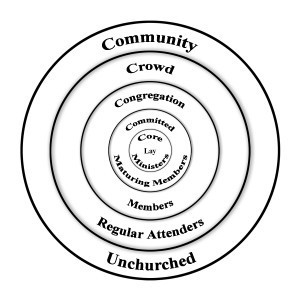
Circles of Commitment
The diagram above illustrates the five levels of commitment that people have as they attend church. Those in the core are fully committed to Jesus and his church. The ones in the outer circle may only come occasionally when there are special programs or when their friends urge them. Our goal is to move people from the outer levels of less commitment to the inner levels of greater commitment.
Community
I consider our community as that large group of people who are loosely connected with our church. Some of these connections are families, friends, co-workers, neighbours, and anyone our people relate with on a daily basis. These people are our first target group for the extension of God’s kingdom and love.
Crowd
All who attend the worship service are part of the crowd. Many may be unbelievers with no commitment to Jesus, but we encourage them to keep coming. A church that actively reaches out will have a larger crowd. These people will be the first to accept Christ in your church.
Although they are not believers, there is something that draws them to the church. The worship and sermons may not be so meaningful to them, but they certainly will be “warmed” by the fire of the Holy Spirit.
Congregation
Those who have made a firm decision to follow Christ are part of this group, the congregation. If your church has no official membership roll, then these are your members.
These people consider this their church. When there are weddings, funerals, and other important events in their lives, this is the church they call on. These people will come on Sundays, but you will not get any further involvement from them.
Committed
Those who take the next step towards maturity in Christ are part of the committed group. These people will attend small groups, other special meetings, and make an attempt to tithe regularly. Once people are in this area, they begin to take more responsibility for their personal lives.
Core
The Core of any church consists of people who are willing to take responsibility for various functions that are important to the church. These people are an integral part of the life of the church.
This is the smallest yet most crucial group for the growth and stability of the church. These are people you can really count on week after week.
*The concepts and the diagram above are from the book Purpose Driven Church by Rick Warren.
February 18, 2014
How To Have Clarity In Life
It was in Calcutta that the ethicist John Kavanaugh met Mother Teresa at her centre. He came there to spend three months and to get a clear answer regarding his future. When Mother Teresa asked him what she can do for him, he asked for prayer.

At that point, she asked him his request. Happily and longingly he said, “Pray that I have clarity.”
She was quick to reply “No. I will not do that.” Then she said “Clarity is the last thing you are clinging to and must let go of.” Kavanaugh retorted that she seemed to have so much clarity – which is exactly what he wanted in life. But quickly she said, “I have never had clarity; what I have always had is trust. So I will pray that you trust God.*
Trust forfeits control and clarity. We work hard to devise a clear path to the plans we have for our lives. But life seems to ignore our plans and takes a path of its own. It goes completely out of our control. The steering wheel seems to turn on its own will. Then we see our plans in the “rear-view mirror.”
Job was a man who looked in his “rear-view mirror” and saw his plans left behind. Looking ahead, he only saw darkness, gloom, and death. But finally God broke through the darkness from above and gave him a new perspective. God said “Where were you when I laid the foundation of the earth? Tell me if you have understanding” (Job 38:4).
He wanted Job to know that even if his life seemed to be completely out of control, God is the creator and holds everything in his hands.
So, what do you see in your “rear-view mirror”? Are your plans lying there all shattered with the broken pieces of your life?” Then when you look ahead what do you see? You don’t even want to think about it? Complete darkness? Now, its time to look up and trust God. He holds everything firmly in his hands.
One thing God asks of you is to trust him with your life: Your career, family, health, and all your dreams for the future.
Would you share what you see in your “rear-view mirror”?
Leave your response in the comments section of this blog post by clicking here.
*This story comes from Brennan Manning’s book Ruthless Trust: The Ragamuffin’s Path to God.