Michael Patrick Hicks's Blog, page 53
October 1, 2015
Guest Post: What’s In A Name? by Chris Holm
Chris Holm
I have a confession to make: I suck at naming characters.
I’m not kidding. Once, while working on a first draft, I realized my book featured three Jakes. Which, apart from sounding like an ill-conceived second sequel to CHINATOWN, probably made the story a little tough to follow. (Note to self: THE TWO JAKES was a massive flop. Even among hardcore mystery fans, that joke ain’t likely to land. Not that that’s ever stopped you before.)
Even when I manage to avoid repeating myself, the names I’m drawn to have a certain sameness to them, like those parents who name their children Braden, Caden, and Jaden. That’s fine for triplets, I guess. (An aside to parents who do this: I’m being polite because I want you to buy my book. It’s not fine. In fact, it may constitute cruel and unusual punishment.) But in a work of fiction, it pierces the illusion of a wide and varied world, and pulls back the curtain of authority we writers hide behind.
When I sat down to write THE KILLING KIND, I wanted to avoid my usual naming rut. I wanted names that sounded lived-in, authentic. So, as a music geek, I turned to an unlikely source for inspiration: the real names of punk artists who use stage names.
Straight-laced FBI agent Charlie Thompson has little in common with her namesake, whom Pixies fans know better as Black Francis. Ditto her partner, Henry Garfield, who takes his name from Black Flag front man turned spoken-word artist Hank Rollins.

 True Detective Season 3?
Though I changed the spelling a tad, my rockabilly stoolpigeon Eric Purkhiser is named after the late, great Lux Interior of The Cramps.
 This guy doesn’t look cut out for Witness Protection.
And Hendricks’ best bud Lester Meyers is named after legendary punk innovator Richard Hell (born Richard Lester Meyers) of Neon Boys, Television, the Heartbreakers, and the Voidoids.
 Former Special Forces Lester Meyers is probably way buffer.
Not all my characters are named after punk musicians, of course. Rough-hewn hitman Leon Leonwood takes his name from the “L.L.” in L.L. Bean, as a nod to my adopted home state. I likely cooked up Chicago Mafioso Monte D’Abruzzo’s name after a particularly tasty glass of Italian red. Alexander Engelmann’s surname was taken from Glennon Engleman, a St. Louis dentist who moonlighted as a hitman. (Posthumous congratulations, Glennon: you’re no longer America’s most hated dentist.) His alias—L’Engle—was borrowed, with apologies, from Madeleine L’Engle, author of A WRINKLE IN TIME. And casino pit boss Bernie Liederkrantz keeps the stage-name theme alive, although he’s certainly no punk musician—he’s a felt-based game show host better known as Guy Smiley.
 “You there! Counting cards! I’m going to have to ask you to come with me.”
But what of my lead character, Michael Hendricks? The truth is, I tried out several names before I found one that stuck. He began life as Michael Stark, after the warrior angel and Donald Westlake’s nom de plume, respectively. But that struck me as too cheesy—like Chase Stone or Slade McFacepunch. Plus, the world’s already got a Ned Stark and a Tony Stark. How’s poor Mikey going to stack up against Iron Man and the Lord of Winterfell? (No, really, fanfic authors: I wanna know.)
So how’d I land on Hendricks? I tend to think of Michael as a little prickly and unapproachable, but oddly compelling. One day, when I was editing the opening chapter of THE KILLING KIND, I read this and it clicked:
“[Hendricks] missed the dark greens and cold blues of northern New England, where even the hottest summer sun failed to warm the deepest hollows of the forest, and the water ran cold all year long.”
Cold, piney, unapproachable, and a little bit James Bond-y… yeah, I named him after gin.
One last thing: Hendricks burns through a goodly number of aliases over the course of THE KILLING KIND—each of them an easter egg, a winking reference. But those, I think, I’ll leave you to discover.
 Chris Holm is an award-winning short-story writer whose work has appeared in a number of magazines and anthologies, including Ellery Queen’s Mystery Magazine and THE BEST AMERICAN MYSTERY STORIES 2011. His critically acclaimed Collector trilogy made over forty Year’s Best lists. His latest novel, THE KILLING KIND, is about a man who makes his living hitting hitmen, only to wind up a target himself. For links to Chris on Twitter and Facebook, visit http://www.chrisholmbooks.com.








September 30, 2015
Review: Seize the Night: New Tales of Vampiric Terror
 About Seize the Night
A blockbuster anthology of original, blood-curdling vampire fiction from New York Times bestselling and award-winning authors, including Charlaine Harris, whose novels were adapted into HBO’s hit show True Blood, and Scott Smith, publishing his first work since The Ruins.
Before being transformed into romantic heroes and soft, emotional antiheroes, vampires were figures of overwhelming terror. Now, from some of the biggest names in horror and dark fiction, comes this stellar collection of short stories that make vampires frightening once again. Edited by New York Times bestselling author Christopher Golden and featuring all-new stories from such contributors as Charlaine Harris, John Ajvide Lindqvist, Scott Smith, Sherrilyn Kenyon, Michael Kortya, Kelley Armstrong, Brian Keene, David Wellington, Seanan McGuire, and Tim Lebbon, Seize the Night is old-school vampire fiction at its finest.
My Thoughts
Tin Men and Snowblind author Christopher Golden puts on his editor’s cap here to assemble twenty-one authors to help the mythic horror figure of the vampire reclaim the horror-filled night.
Seize the Night: New Tales of Vampiric Terror is a highly successful anthology, one that puts vampires back into the shadowy, hidden corners where they belong and makes them creepy, chilling, at times downright frightening, and even occasionally sympathetic. There’s nary a sparkly, star-crossed love to be found here. Instead, we’re getting back to the old-school roots of vampiric lore, going back to the heydays of Bram Stoker’s Dracula and Stephen King’s Salem’s Lot. As far as I am concerned, this is a vital return to form for these stoic, and historic, universal baddies.
Collected here are twenty brand new and diverse short stories (“Mrs. Popkin” is co-written by Dan Chaon and Lynda Barry) that range from historical period pieces reaching as far back as the Mayan empire to near-future post-apocalyptic wastelands, that takes us stateside and across the pond to the UK and Sweden, from idyllic neighborhoods to a Philippine village ravaged by a tropical storm. Equally diverse are the representations of the vampires themselves, some decimating the world as a viral plague, or appearing as the more common Gothic figures, or water-dwelling creatures of the night.
While this anthology is incredibly strong, there were a few stories that failed to satisfy me, which is pretty common, and frankly expected, in any anthology. Still, there were several authors that I expected greatness from and they definitely delivered; better still, there were a number of surprises along the way to keep me happy. I won’t cover all twenty stories here, but a few worth particular mention are:
THE NEIGHBORS by Sherrilyn Kenyon. The familiarity of the plot is properly upended with a fantastic twist in the story’s closing moments and I really adored this one.
PAPER CUTS by Gary A. Braunbeck. This one I freaking loved! 5 stars all the way! Great twist on the vampire mythos and the concept, and repercussions, of their eternal nature. This one’s a shade of Eco-horror and really well done. I loved the concept, the little plays on familiar vampire tropes, and the bookish nature it all gets wrapped up in. This one is my absolute favorite of the anthology.
WE ARE ALL MONSTERS HERE by Kelly Armstrong – great take on the vampire apocalypse, with the vampirism presented as an uncontrolled epidemic that leads to post-apocalyptic survival. There’s shades of The Walking Dead here, which I’m completely fine with since it’s rather well done. Note to self: buy a bunch of Kelly Armstrong books.
THE LAST SUPPER by Brian Keene. How does a lone vampire hold up after an epidemic wipes people off the map? Keene does a great job capturing the emotional turmoil and loneliness of vampire Carter’s walk through the wastelands, right on through to a rather sad ending. Potent stuff for a fairly short story, but easily another one of my favorites of the anthology.
SEPARATOR by Rio Youers. Youers gives us a great twist on the vampire mythos by approaching it from the perspective of Filipino culture. David is a Canadian real estate developer tearing down the forest in Palla, ready to evict an old woman from her home in the trees. This causes the locals a fair bit of anxiety, and David is forced to confront a brutal horror. A rock solid entry, with plenty of sex and gore, and the manananggal presented here might be my favorite depiction of the vampire in this collection.
Seize the Night has the singular aim of making vampires terrifying again, and it heartily succeeds in its mission. Golden and the contributors deserve a fair amount of applause for their work here, and this anthology is a wonderful reminder of what made vampires such a popular horror staple, and why they continue to endure across the ages.
[Note: I received an advanced reader’s copy of this title from the publisher via NetGalley for review.]
Buy Seize the Night: New Tales of Vampiric Terror at Amazon







September 14, 2015
Review: Brother by Ania Ahlborn
 About Brother
From the bestselling horror author of Within These Walls and The Bird Eater comes a brand-new novel of terror that follows a teenager determined to break from his family’s unconventional—and deeply disturbing—traditions.
Deep in the heart of Appalachia stands a crooked farmhouse miles from any road. The Morrows keep to themselves, and it’s served them well so far. When girls go missing off the side of the highway, the cops don’t knock on their door. Which is a good thing, seeing as to what’s buried in the Morrows’ backyard.
But nineteen-year-old Michael Morrow isn’t like the rest of his family. He doesn’t take pleasure in the screams that echo through the trees. Michael pines for normalcy, and he’s sure that someday he’ll see the world beyond West Virginia. When he meets Alice, a pretty girl working at a record shop in the small nearby town of Dahlia, he’s immediately smitten. For a moment, he nearly forgets about the monster he’s become. But his brother, Rebel, is all too eager to remind Michael of his place…
About the Author
Born in Ciechanow Poland, Ania has always been drawn to the darker, mysterious, and sometimes morbid sides of life. Her earliest childhood memory is of crawling through a hole in the chain link fence that separated her family home from the large wooded cemetery next door. She’d spend hours among the headstones, breaking up bouquets of silk flowers so that everyone had their equal share.
Beyond writing, Ania enjoys cooking, baking, movies, and traveling.
Learn more about Ania on her site, http://www.AniaAhlborn.com.
Want to connect? Follow Ania on Twitter @aniaahlborn, or find her on Facebook at http://www.facebook.com/aniaahlborn.
My Thoughts
You think your family is messed up? Brother, you ain’t seen nothing yet!
You see, deep in the Appalachia woods is farmhouse far off the beaten path. And inside this farmhouse is a twisted little family of cannibals, overseen by their brutal matriarch who has a penchant for killing young women. Brothers Reb and Michael have a relationship that borders on master/servant, or perhaps owner and pet, the dominant alpha and the cowed beta. Taken as a whole, the Morrows are a sick clan where the term ‘sibling rivalry’ barely even scratches the surface.
If you’re a fan of The X-Files like me, you be sensing shades of the episode “Home” about inbred killers, or maybe The Texas Chainsaw Massacre. There’s shades of both here, which is absolutely a good thing! And holy hell, is this ever a dark read.
I’ll admit to being a bit lulled by the early happenings of Brother, where Ahlborn spends a lot of time establishing these sickos and their relationships, building a family history with alternating chapters that plumb earlier periods of Reb and Michael’s life together, along with their sister Lauralynn, who is mysteriously absent from the present-day sections.
There is actually a lot I want to talk about here, but can’t for fear of wading too deeply into spoiler territory. I’ll just say the family dynamics here a bit…complicated, and leave it at that. The resolution is satisfyingly bloody, with a final denouement that felt like Ahlborn was sticking fish hooks into my heart and steadily jerking the line around. The finale is stupendous and horrifying and bleak, with an absolutely marvelous twist.
Ahlborn plays this one like a master locksmith, slowly moving the tumblers into place and then letting everything fall with a satisfying click, revealing all the goods.
[This review is based on an advanced copy received from the publisher via NetGalley.]
Buy Brother at Amazon







September 11, 2015
Review: Stars Wars: Aftermath by Chuck Wendig
 About Star Wars: Aftermath
Journey to Star Wars: The Force Awakens
The second Death Star has been destroyed, the Emperor killed, and Darth Vader struck down. Devastating blows against the Empire, and major victories for the Rebel Alliance. But the battle for freedom is far from over.
As the Empire reels from its critical defeats at the Battle of Endor, the Rebel Alliance—now a fledgling New Republic—presses its advantage by hunting down the enemy’s scattered forces before they can regroup and retaliate. But above the remote planet Akiva, an ominous show of the enemy’s strength is unfolding. Out on a lone reconnaissance mission, pilot Wedge Antilles watches Imperial Star Destroyers gather like birds of prey circling for a kill, but he’s taken captive before he can report back to the New Republic leaders.
Meanwhile, on the planet’s surface, former rebel fighter Norra Wexley has returned to her native world—war weary, ready to reunite with her estranged son, and eager to build a new life in some distant place. But when Norra intercepts Wedge Antilles’s urgent distress call, she realizes her time as a freedom fighter is not yet over. What she doesn’t know is just how close the enemy is—or how decisive and dangerous her new mission will be.
Determined to preserve the Empire’s power, the surviving Imperial elite are converging on Akiva for a top-secret emergency summit—to consolidate their forces and rally for a counterstrike. But they haven’t reckoned on Norra and her newfound allies—her technical-genius son, a Zabrak bounty hunter, and a reprobate Imperial defector—who are prepared to do whatever they must to end the Empire’s oppressive reign once and for all.
About the Author
Chuck Wendig is a novelist, screenwriter, and game designer. He’s the author of many novels, including Blackbirds, Atlanta Burns, Zer0es, and the YA Heartland series. He is co-writer of the short film Pandemic and the Emmy-nominated digital narrative Collapsus. He currently lives in the forests of Pennsyltucky with wife, son, and red dog.
My Thoughts
The release of Star Wars: Aftermath marks the official relaunch of the Star Wars Expanded Universe into post-Return of the Jedi territory. It is also a release that has been greeted with a rather rabid divisiveness among the Star Wars fandom community. When it released on Force Friday (Sept. 4, 2015 to the rest of the world), it was assailed almost immediately with one star reviews, with online groups devoted to the original Expanded Universe — titles now marketed under the Star Wars: Legends banner — encouraging fans to buy the Legends titles in an effort to outsell Aftermath. That doesn’t seem to have worked as, at the time of this writing, Aftermath is now sitting in fourth place on the USA Today and NY Times Bestseller lists. The more vocal and ferociously devoted fans of the previous Expanded Universe have also taken umbrage at the inclusion of gay characters, strong female leads, the lack of the film’s heroes, and apparently any and all non-one-star reviews posted at Amazon.
Given the intense backlash meeting this new entry to the brand-new Star Wars canon, the immediate question is, is Aftermath any good?
The answer is, thankfully, yes. We’re off to a pretty strong start with the relaunch, with a few enticing teases during this book’s resolution that promises to only get better.
Opening with the immortal words, “A long time ago, in a galaxy far, far away…” and giving us a brief “crawl” through recent events to establish this story, you’d be hard pressed to not hear the infamous opening notes of John Williams’ score.
As noted, this book is free of Luke Skywalker, while Han Solo, Chewbacca, and Leia pop up ever-so briefly in cameo appearances (the Han Solo cameo in particular is pretty tantalizing and opens up the door for what should be a pretty solid adventure in its own right).
Our characters here are Norra Wexley, an ace Rebel Alliance pilot, her son Temmin, an ex-Imperial Loyalty Officer Sinjir Rath Velus (whose motivations are explained wonderfully and with a gracious bit of depth and truth for a man in his position late in the book), and a bounty hunter, Jas. Temmin has some robot-building mojo and has updated one of those ridiculous, monotonous, and childishly awful battle droids from The Phantom Menace to be his personal bodyguard. More impressive, Wendig has taken this battle droid, named Mister Bones because of the animal bones it wears as a sort of stylized armor, and because it was named by a 15-year-old, and turned it into something interesting and humorous.
On the villain side, we are treated to Admiral Rae Sloane, who has captured Rebel/New Republic pilot Wedge Antilles, and has organized a meeting on the planet Akiva in an effort to reunite the fractured Empire. Among those gathered are a prominent banker and slaver, who is in the crosshairs of the bounty hunter, Jas.
What could have been a pretty good Star Wars story in its own right takes on an epic scope with a series of interludes. In these vignettes, Wendig is able to explore the ramifications of the war between the Empire and the Rebel Alliance, and the reader is able to get a deeper sense of the state of the galaxy, the threat the Empire still poses, and the process of rebuilding as the Alliance shifts gears towards becoming the democratic New Republic. I loved getting a peek into all these various corners of the galaxy and these characters responses to the conflicts affecting their lives, either directly or indirectly.
Writing in third person, present tense – a stylistic choice that Wendig has used in his previous novels – the story is given a sense of graceful urgency, propelling the reader along through the action. Some have voiced their displeasure at this approach, but I have zero problems with it and, as with previous Wendig books, I was able to sink right in and enjoy.
Star Wars: Aftermath is a good, fun start to a new series of books, and one that provides enough galactic intrigue to start building depth across the gap between this title and the release of the film, The Force Awakens, later this year. If, like me, you had no particular attachments to the previous Expanded Universe, it’s a good time to dive in without worrying about continuity outside of the films. But, if you did have a strong attachment to those prior novels, I still encourage to approach this work with an open mind and decide for yourself.
On a sliding scale to the film comparisons, I’d say it is not as terrible as The Phantom Menace, but at least as good as Attack of the Clones and a solid follow-on from Return of the Jedi. We might not be into The Empire Strikes Back territory, but the set-up promised in the final chapters of Aftermath looks like there’s a very fun story ahead of us.
Buy Star Wars: Aftermath At Amazon
[And if you’ve made it this far and thought this review was helpful, please vote at Amazon to indicate as such. I don’t ever ask for this, but given how often and how quickly positive reviews for this title are getting slammed by the so-called “fan” community, those of us who did enjoy the work would appreciate the support. Thanks in advance!]







September 9, 2015
Calling Indie Horror/Thriller Authors! #indieauthors #bookpromo #BadMoonOnTheRise

Indie authors of the horror/thriller genre should check this out. Teri’s reviewed a few of my titles in the past, and is opening up a chance for free publicity throughout October.
 Originally posted on Books & Such:
For the month of October, I’m planning a new series for Books & Such – one I hope to continue yearly. I’m calling it Bad Moon On The Rise – 31 Days of Thrills and Chills, featuring one author per day, so if you’re an indie author of horror/thriller books, send me your info! This is your chance for free publicity, to talk up your book, learn about other authors of the same genre, and hopefully sell some books. Each post will contain any information you’d like to include, such as a book synopsis, author bio, contact links, buy links and a short interview.
I still have some openings, so email me at tpolen6@gmail.com with your name and title of your book and I’ll send you an info sheet within the next week.
I’d appreciate any help in spreading the word about this – thanks in advance!







September 8, 2015
The Aftermath of Aftermath’s Aftermath
 So things have been buzzing quite a bit over Chuck Wendig’s latest, a media tie-in novel to a small franchise you might have heard of called Star Wars: Aftermath.
I wrote a piece about some of the reactions floating around out there in the wake of this book’s Force Friday release on Sept. 4, and it seems to have been drawing a lot of eyeballs. WordPress tells me it’s getting lots of traffic and that my stats are booming. In fact, yesterday and today have been the two most-visited days this little blog has seen (if not ever, than at least in quite a very, very long time). And in these last two days, my post on Star Wars has become the most viewed post of the year on this blog. Crazy stuff, that.
Apparently getting mentioned by Chuck Wendig and The Mary Sue is a good way to generate traffic to a single entry on this blog. Not that I’m complaining. I’m happy for the visit, and maybe a few will stick around for more in the days, weeks, months, and years to come.
In a much less ego-centric fashion, though, the salient point to take away is that whatever protests were aimed at Aftermath have clearly failed. If the goal, either from rabid fans of the prior Star Wars Expanded Universe or rabid puppy/GamerGate types who loathe diversity in their science fiction, was to steer people away from this latest Star Wars novel, then it has seriously failed. If the goal was to shut down any interest in the title, then that, too, has failed.
The mob rule that 1-star reviewers had enjoyed over the weekend is slowly degrading as less divisive readers and fans weigh in. Over the last 24 hours reviews have doubled, and the 1-star reviews, which at the time of my writing yesterday had accounted for more than 50% of the book’s reviews, has now dropped to 40% and the title’s overall rating has increased from two stars to 2.7.
I suspect that the book’s ratings will increase as more people chime in. Soon, balance will be restored to the Force.
While any title is bound to have 1-star reviews, the velocity and ferocity with which they came is more than a little bit suspicious. So, I think that what we’re seeing now is an increase in level-headedness, an increase in honest reviews from those less invested in the old Expanded Universe, and the curious who were brought into the fold because of all the vitriol and attention brought to Aftermath by this anti-Disney, anti-New EU campaign (if that was, in fact, the leading cause behind all those initial 1-stars).
This whole campaign kerfluffle has also given the book a lot of attention at Amazon, as the curious click through to that book and buy it, increasing the book’s sales ranking, as noted by Mr. Wendig over at his blog:
Amazon algorithms are interested not in the quality of the reviews but rather the attention that the reviews and the book get. (Meaning, a passel of negative reviews actually elevates the book’s overall sales ranking. Which in turn garners it more sales. Amazon reps have been clear with me on this point: buyers buy books with reviews, period. Not good reviews, not bad reviews. But rather: quantity of reviews impress buyers to make purchases. So, leaving a ton of bad reviews actually increases the book’s sales.
If my own writing on this 1-star campaign yesterday is anything to go by, then many more readers will soon be discovering and purchasing Aftermath just to see what all the hubbub is. And that, of course, means that the campaign against the Expanded Universe and diversity in our fiction has, again, failed and failed miserably.







September 6, 2015
Star Wars: Aftermath And The Regressive Hate Machine
Update 9/6/2015, 4:51 p.m. EST: I was unaware of this, but saw a post on my FB timeline that was posted to Chuck Wendig’s page that there is apparently a Facebook group called The Alliance to Preserve The Expanded Universe that has launched a “raid” against this book, hence all the 1-star reviews cluttering up the Amazon product page. Chuck posted a link to this article from Oct. 2014, from TheForce.net. Another posted a link to Del Ray’s official Star Wars Books page, which given a cursory glance seems to be crawling with The New Expanded Universe protesters (because that’s apparently a thing now).
Original post follows….
This is not a review. In fact, at the time of this writing, I’m only little more than a quarter into Star Wars: Aftermath. If you believe the Amazon reviews, though, quite a lot of other folks have read the book and the Petty Internet Hate Machine has been unleashed at full power against this title, with, at the moment, more than half of the reviews ranking this book at a 1-star.
Again, I haven’t finished the book yet. I stopped last night at Part Two and will be resuming my read through shortly. I’m enjoying it. A lot. I’m pretty sure that Chuck Wendig is incapable of writing a bad book, let alone a book so bad that the majority of its readers give it a 1-star review. I mean, shit, have you even read his Miriam Black trilogy? And if not, you should. Now. Go buy it. Start here.
Now, I was not a big fan of the previous iteration of the Star Wars Expanded Universe. Like a lot of others, I read and loved Timothy Zahn’s Grand Admiral Thrawn trilogy. I tried to read some of the stuff that followed, but was mostly unimpressed and found myself content to wait for the prequel trilogy, which I was disappointed with roughly 1/3 of. When Disney bought the rights to the Star Wars franchise and decided to reboot the Expanded Universe and start over from scratch, I was mostly ambivalent. I still have my battered copies of Zahn’s books and Disney has yet to confiscate them from me and burn them on my porch, a scenario that is highly unlikely to ever occur, so this maneuver to put their own unique corporate stamp on the Star Wars brand meant little to me. And like so many others, I am hotly anticipating Episode VII in December. But the books, I can mostly take ’em or leave ’em. Yet when Chuck Wendig was announced as the writer that would be tackling the post-Return of the Jedi narrative on the Journey To The Force Awakens, I was legitimately excited, particularly after having devoured his Heartland trilogy. Here was one of my favorite writer’s getting to spin his own story inside one of my favorite film franchises.
I’m reading the book currently, and I am still excited by it. I’m freaking ecstatic that this is going to be a trilogy and that are two more Wendig Star Wars books on the horizon. But these one-star reviews have thrown me for a bit of a loop. Point in fact, I seriously do not understand where most of them are coming from. Particularly in light of such positive reviews from sources like Sci-Fi Bulletin, Omnivoracious, Nerdist, and Den of Greek. And yes, I know and understand fully well that people are entitled to their opinions. That’s great. But, and you knew there would be a ‘but’ here, I’m not sure that many of them have actually read the book. In fact, I’m fairly certain that most of them are part of a (likely disorganized, band-wagon) smear campaign at worst, or are just knee-jerk nerdrage at the least.
Most of the reviews have little in the way of actual content. There’s little discussion of what, exactly, is supposed to be bad about Aftermath, yet they are also very homogeneous in their opinion of what’s wrong with the book. The big target is Wendig’s writing style, which is third person present tense, a style that he’s honed over the majority of his work. Maybe I’m just cynical, but I’m surprised that this many reviewers have pinpointed this particular style as their main reason for hating the book. Meanwhile, others seem to be shitting all over this new title for the simple reason that it is not Timothy Zahn, or because it is now a Disney property, or because it’s not actually The Force Awakens itself (and more than a few seem to already be using this book as a scapegoat for why they think that movie, due out in December, will suck). Or simply because it’s a new Star Wars, and anything new is somehow a stain on their own personal memories of the Original Trilogy.
One reviewer writes:
This book is an abysmal, absolutely unreadable failure. Does the Walt Disney Corporation have editors?
This is a pretty straight-forward scare tactic that gets repeated by a number of the one-star reviewers, attempting to frighten readers away by saying it’s impenetrable thanks to shoddy editing and typos galore. Yet similar refrains from other reviewers provide no examples to back up their complaint, and I’m not finding anything particularly egregious. One reviewer claimed to have made it through a whopping three pages before giving up. So, please, if you haven’t bought this yet, use Amazon’s Look Inside feature and see if it’s up to snuff for you. But also realize that every book has errors, typos, misspelling that even a team of editors sometimes miss. Some big, some small. That’s just the way it is. Not every single story is flawless. But this critique from the rebel band of 1-star reviewers is just flat out incorrect in its presumptive scope. I’m not finding many egregious errors at all, and am finding the book to be highly readable. Again, it’s a quibble, my opinion versus theirs. Or perhaps they think the writing style itself is the failure, which is also incorrect. But, for here, I’ll presume they mean merely poor line edits. My own personal standard is that if it’s as poorly edited as Vince Flynn’s American Assassin was, then the editors deserved to be excoriated. That book was riddled with mistakes, typos, and in at least one memorable instance, the switching of two characters mid-scene yet separated by entire continents. Frankly, Aftermath has not set off any of my editing alarm bells, and if there are any mistakes (and, honestly, odds are there are a few) then the story has been rolling along well enough that I’ve completely and utterly overlooked them.
Many seem to have a problem with Wendig’s narrative style of third person present tense (one reviewer even mistakenly calls this first person and claims it reads like a blog entry. It doesn’t.), or eagerly chalk this up as nothing more than ‘fan fiction,’ as if that’s somehow a bad thing. Again, maybe it’s a quibble, but a licensed property paying an author to write a canon story is hardly fan fiction. I know many are using it as an insult here, but if this is fan fiction, then so was the original Expanded Universe, starting with Timothy Zahn himself. We can get all philosophical about how any piece of writing could be fan fiction, but I don’t want to get too digressive here.
Then, as we go through page after page of one-star reviewers, we get closer to the original words of warning. Finally, we maybe get to the actual meat of the issue here, and perhaps why there have been so many one-star reviews that all sound alike and hit on so many of the same notes without providing any supporting evidence.
Dennis, whose only previous product review on Amazon was a 1-star review for all three platforms in which Mass Effect 3 appeared more than three years ago, writes:
It’s a propaganda piece by a SJW progressive intent on sending a message about his brand of politics.
While Georgio opines:
it seems that either him or Disney are using the Star Wars property to push a political agenda…that of diversity. This book includes 3 gay characters that feel so forced into the story. Disney is stuffing diversity down our throats and it’s taking me out of my suspension of believe because it feels forced. I myself am a minority but when I read star Wars I don’t want to be thinking about racial consciousness or sexual idenitity. I also don’t like the inclusion of so many gay charcters becuase my personal opinion is that homosexuality is not normal; sodomy is not normal and I am tired of the liberal media trying to make me accept this lifestyle.
That damn diversity. Next thing you’ll know, they’ll retcon the OT so Lando is a black guy and might even have him blow up the Death Star instead of one of the white heroes.
This issue of diversity as a political issue is one that confounds me. Writing characters that are diverse isn’t some crazy political reactionary thingamajig. Representing the world as it actually is should not be whacko political rehtoric. The world, the real world, is radically diverse, but hey, screw you evolution for being so damn political and shoving diversity down our throat, what with all those different kinds of flora and fauna and people.
And, again, this is still Star Wars, so there’s actually no sodomy to be found here. Not a single blow job, rim job, anal penetrative act, or human/non-human love fest to be had. Actually, there’s no sex at all, gay, straight, or otherwise. Maybe Georgio has been reading different fan fiction. I will admit at this point, though, that I’m more than a bit shocked that Wendig hasn’t lobbed in a few “fucks” yet, so he was either remarkably constrained or did have editors who were right on the ball.
Even Fox News contributor Allen West (I know, I know, say no more, just bear with me here) has chimed in with his blog post, Wow: New “Star Wars” character shows how FAR America has fallen.
Yes, folks, that’s right. The Star Wars universe has dared to become representative of reality and feature a cast of diverse characters! AMERICA HAS FALLEN! BAHWAHWHAHAHAHA!
But, no. Just no.
WENDIG HAS DESTORY STAR WARS AND ‘MERICA!
What a fucking feat that would be! That’s a twofer of the highest order! He should get a medal, or a carbonite statue in his honor, or maybe a cheeseburger named after him.
America is fine. America hasn’t fallen. The nation is still chugging along and filled with white people, black people, Latinos, Asians, Arabs, Canadian Hispanics running for US President, men, women, Donal Trump, LGBT, pansexual, asexual, and straight people. Dare I say, Star Wars is starting to look a little more…familiar. A little more realistic. A little more representative.
The cast of Star Wars: Aftermath is not Luke, Leia, and Han Solo. Many are upset by this. People are, in fact, downright pissed off that Wendig had the balls to write a Star Wars book that features all-new characters (a bold and daring maneuver last seen in the likes of the video-game series Star Wars: Knights of the Old Republic), in which the primary protagonist is a woman. In fact, the primary Imperial antagonist is also a woman. There’s a bounty hunter who is also a woman. And the ex-Imperial Loyalty Officer that features heavily in the narrative is…gasp!…homosexual.
DAMN YOU AND YOUR PROGRESSIVE POLITICS AND ALL-INCLUSIVE WORLD VIEW, MR. CHUCK WENDIG! HOW DARE YOU FEATURE STRONG WOMAN AND GAY MAN SHOVING INTO OUR THROAT.
Or not, really.
By the way, why are the bigoted homophobes constantly going on and on about having things shoved down their throats? Is this like a wishful thinking sort of thing? Doth thou protest too much?
The one-star campaign against Star Wars: Aftermath is starting to reek of Angry Puppy flopsweat, with a dash of tart, mealy GamerGater tears.
And there’s only one thing that’s certain in such instances – when these groups, and people like Allen West, get vocal against something, you can generally presume that thing is actually pretty darn decent and worthwhile.
So, maybe, instead of copying bullet points from other one-star reviews and jumping on the band wagon, you could, I dunno, actually read the book and bring an informed opinion to the table? Just a thought.
If that’s too difficult, here’s a a quick and very heavily-loaded and unsubtle list, written by a guy who has read a full 27% of his Kindle edition of Aftermath, to determine if Aftermath is or is not for you.
Are you willing to experience a Star Wars story that does not feature Luke, Han, and Leia?
Do you like Chuck Wendig?
Did you bother to read the book’s description in order to make an informed decision as a consumer with purchasing power and the ability to govern yourself and make decisions on your own?
Are you OK with stories that feature a cast of diverse characters from a non-homogenous background with varying life experiences, and science fiction that has some measure of commonality with the actual real world?
Are you fine with reading the first book in a new trilogy?
Do you hate, loathe, despise all things Disney? Does my mention of Disney cause you to suddenly breakout into hives and foaming at the mouth?
Do you love Star Wars yet inexplicably hate all things Star Wars?
Do you love Star Wars but dislike anything new being introduced beyond the films or what you already know from the previous and now defunct Expanded Universe?
Do you already hate Star Wars: The Force Awakens even though you haven’t seen it yet?
Are you willing to read a brand new post-Return of the Jedi novel that is not written by Timothy Zahn, does not feature Grand Admiral Thrawn, and has nothing to do with the now-defunct Expanded Universe?
Does a novel written in third person present tense bother you? Can you even identify third person present tense?
Do you believe that it is impossible for women to be capable in their duties, to be both a soldier and a mother, possess agency, and that they have no business being seen, heard, or written about?
Are you troubled by the fact that the day may be saved by characters that do not conform to hetero-normative standards?
Are you troubled by the fact that non-white, non-male characters may be able to save the galaxy?
Like Allen West, do you, too, hate “‘art’ that wants to change our traditional values”? Do you even understand the basic function of art?
Do you refer to homosexuals as “the gays” and believe that they are the sole force responsible for eroding American “family values” while at the same time supporting Bible thumpers who molest children, join Ashley Madison and routinely have extramarital affairs, get divorced multiple times, and routinely hold everyone to a system of highly flexible double standards?
Were the “good old days” an era in which equality didn’t exist and Jim Crow laws are something you miss with all your heart?
Depending on your answers to the above, you may wish to avoid Star Wars: Aftermath. Or, conversely, you might decide this one is right up your alley and give it a shot. I only suggest that if you do read this book, you approach it with an open mind and then decide if you liked it or not.







September 1, 2015
Review: The Heart Goes Last by Margaret Atwood
 About The Heart Goes Last
Margaret Atwood puts the human heart to the ultimate test in an utterly brilliant new novel that is as visionary as The Handmaid’s Tale and as richly imagined as The Blind Assassin.
Stan and Charmaine are a married couple trying to stay afloat in the midst of an economic and social collapse. Job loss has forced them to live in their car, leaving them vulnerable to roving gangs. They desperately need to turn their situation around—and fast. The Positron Project in the town of Consilience seems to be the answer to their prayers. No one is unemployed and everyone gets a comfortable, clean house to live in . . . for six months out of the year. On alternating months, residents of Consilience must leave their homes and function as inmates in the Positron prison system. Once their month of service in the prison is completed, they can return to their “civilian” homes.
At first, this doesn’t seem like too much of a sacrifice to make in order to have a roof over one’s head and food to eat. But when Charmaine becomes romantically involved with the man who lives in their house during the months when she and Stan are in the prison, a series of troubling events unfolds, putting Stan’s life in danger. With each passing day, Positron looks less like a prayer answered and more like a chilling prophecy fulfilled.
About the Author
MARGARET ATWOOD, whose work has been published in thirty-five countries, is the author of more than forty books of fiction, poetry, and critical essays. In addition to The Handmaid’s Tale, her novels include Cat’s Eye, short-listed for the 1989 Booker Prize; Alias Grace, which won the Giller Prize in Canada and the Premio Mondello in Italy; The Blind Assassin, winner of the 2000 Booker Prize; Oryx and Crake, short-listed for the 2003 Man Booker Prize; The Year of the Flood; and her most recent, MaddAddam.She is the recipient of the Los Angeles Times Innovator’s Award, and lives in Toronto with the writer Graeme Gibson.
My Thoughts
Margaret Atwood’s The Heart Goes Last is a strange beast, but not one that I can recommend.
Conceptually, the book is terrific – Atwood presents us with an economically wreaked near-future America and the married couple of Charmaine and Stan. They live in their car, after deserting the home they could no longer afford, while she works at a bar making enough money to keep their vehicle in gas. When the opportunity arrives to apply to the Positron Project, she leaps at it, and soon enough she and Stan are enrolled. Those admitted into the program alternate months between the town of Consilience and the Poistron project, living as inmates. While they’re in prison, an alternate couple lives in their home, the two flip-flopping in and out of the residence in accordance with the project’s guidelines.
There’s an edgy darkness to the story that I liked, particularly as the couple grow more deeply aware of the corporate surveillance state they find themselves living in. After Charmaine is caught having an affair with another Consilience citizen, both she and her husband are wrapped up in a spider’s web of secrets that soon boils over into conspiracy and manipulation.
However, I never really bought into the very abrupt affair between Charmaine and her alternate Max, which begins with nary a prompt. After Stan discovers a note left for Max, sticking out from under the refrigerator, signed by “Jasmine” and sealed with a kiss, he begins to unravel, intent on winning Jasmine’s love, thinking that Jasmine is Max’s wife. He goes into full-blown psycho-stalker mode, which leads me to my next problem.
Neither of the leads are the least bit sympathetic, and they are only marginally interesting in their contradictions. It’s not long before you realize just how broken and artificial their marriage is. Much like the Poistron Project itself, both have a certain superficial veneer, but each is rotten to the core. Stan is a sex obsessed creep with anger management issues and a number of rapey impulses who wants to bang anything with a pulse, including the chickens he oversees during his time in prison, and the sexbots introduced in the book’s last third, programmed to give the appearance of a pulse.
Most of the novel’s first-half feels a bit soggy from the rinse-and-repeat narrative in which Stan lusts for sex with Charmaine, Charmaine has sex with Max, Stan lusts for sex with Jasmine and plots ways to track her down before they alternate their lives between the city and prison. This first half, though, feels long and plodding and I spent most of the book wishing I could move onto some other title rather than continuing to engage in a progressively growing number of pointlessly mundane exercises that make up these chapters. It’s not until the last half of the book, or perhaps even later, when things finally pick up and take on the bent of a paranoid conspiracy thriller. Unfortunately, this devolves into sheer absurdity with a finale involving a handful of Elvis and Marilyn Monroe impersonators.
Ultimately, I feel largely ambivalent about The Heart Goes Last, falling somewhere between “didn’t like it” and “meh.” I’d recommend skipping this one.
[This review is based on an advanced copy received from the publisher via NetGalley.]
Buy The Heart Goes Last At Amazon







August 31, 2015
99c Sale – All My Titles On Sale This Week Only
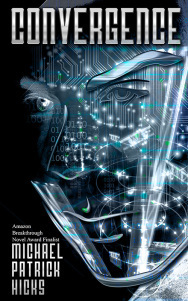
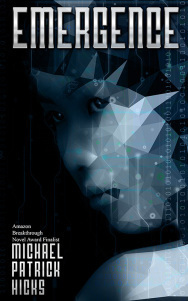
I will be running a Kindle Countdown promotion on both Convergence and Emergence this week.
Beginning today, Mon., Aug. 31, and running until Friday, Sept. 4, you can get both of my science fiction cyberpunk titles, collectively known as the DRMR series, for only 99c each. This offer is good in both the US and UK stores.
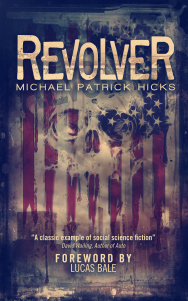
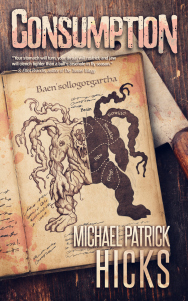
If you haven’t already, you can also pick up both of my short stories, Consumption and Revolver, as well. These are normally 99c anyway, but why not get the entire MPH library to date for a whopping grand total of $3.96 in one go-round?







August 24, 2015
Reblog: A review and discussion of ‘Revolver’ by Michael Patrick Hicks
Many thanks to Tommy Muncie for this insightful and gracious review of REVOLVER! Some choice snippets follow, but please give it a read in full over at the link below.
What makes it so brilliant is that it stirs emotions in the reader that mirror the way emotions are stirred by the media within the story itself: a strong reaction and a response are what’s desired.
…
‘Revolver’ is a brave, powerful piece of writing that says ‘let’s not dress things up or put thin veils on the idea, let’s just shout about it and make it read like it’s a gun pointed in the reader’s face.’ It’s unapologetic, visceral, and the kind of story that would probably have sent the Clean Reader app into cyber meltdown. Give it a read if you like your stories to take you to the edge of your seat.
Source: A review and discussion of ‘Revolver’ by Michael Patrick Hicks.
REVOLVER is available now for purchase on the Amazon Kindle, or free to read to members of Kindle Unlimited or the Kindle Owners Lending Library. You can check it out by clicking here.